

Night photography has never been merely about darkness. It is about what remains when light withdraws.
When the visible world softens, fragments, and isolates itself, photography enters a different psychological register.
The night does not simply reduce visibility. It transforms space into suggestion, architecture into presence, landscape into memory. The five projects gathered here approach night photography not as spectacle, but as inquiry. Each photographer uses darkness to reveal something that daylight conceals: traces of humanity, the sculptural weight of objects, the intimacy of vast spaces, or the persistence of history within process itself.
Xavier Blondeau’s Presence Obscure begins with absence. His urban environments are stripped of human figures, yet they never feel empty. Instead, they vibrate with a residual imprint, as if the city continues to breathe after its inhabitants have left. Blondeau is less interested in artificial light as dramatic device than in the subtle threshold between visibility and disappearance. Early mist, dim illumination, the ambiguous quiet of late hours become transitional spaces, almost metaphysical corridors. The built environment, supposedly opposed to human nature, reveals how deeply it carries human intention. Even when deserted, it bears an unmistakable stamp. His work suggests that presence does not depend on bodies. It persists through objects, surfaces, and spatial tension. Night becomes a medium through which this tenuous yet insistent human echo can be felt.
Peter Ydeen’s Easton Nights shifts the focus from metaphysical presence to structural clarity. What began as a technical exercise evolved into a disciplined meditation on constructed environments. Influenced by George Tice, Ydeen uses night not to dramatize but to isolate. Streetlights carve the scene into fragments. Gas stations, parking lots, parked cars, signage and poles become actors on a minimalist stage. Unlike the conventional association of night with mystery or danger, Ydeen’s photographs reveal elegance in ordinary architecture. A trash can acquires sculptural gravity. A modest vehicle takes precedence over luxury. The reduction of visual noise through darkness allows geometry to emerge. Night functions as subtraction. It removes distraction and leaves behind structure. In doing so, it exposes how deeply our fabricated environments organize perception.
Tom Lowe’s Mojave Moonlight departs from the urban fabric and enters the vastness of the desert. His approach is rooted in immersion rather than detachment. Drawing from decades of travel and cinematic work, Lowe treats the night landscape not as obstacle but as revelation. Under moonlight, the Mojave transforms. Harsh terrain softens into tonal gradients. Distance becomes intimate rather than overwhelming. Unlike urban nocturnes shaped by artificial light sources, Lowe’s images depend on natural illumination. The moon acts as both spotlight and equalizer, reshaping geography into abstraction. His belief that getting lost is essential to discovery resonates in these images. The desert at night is not a void. It is an expanded field of perception. Silence intensifies scale. Darkness enlarges awareness.
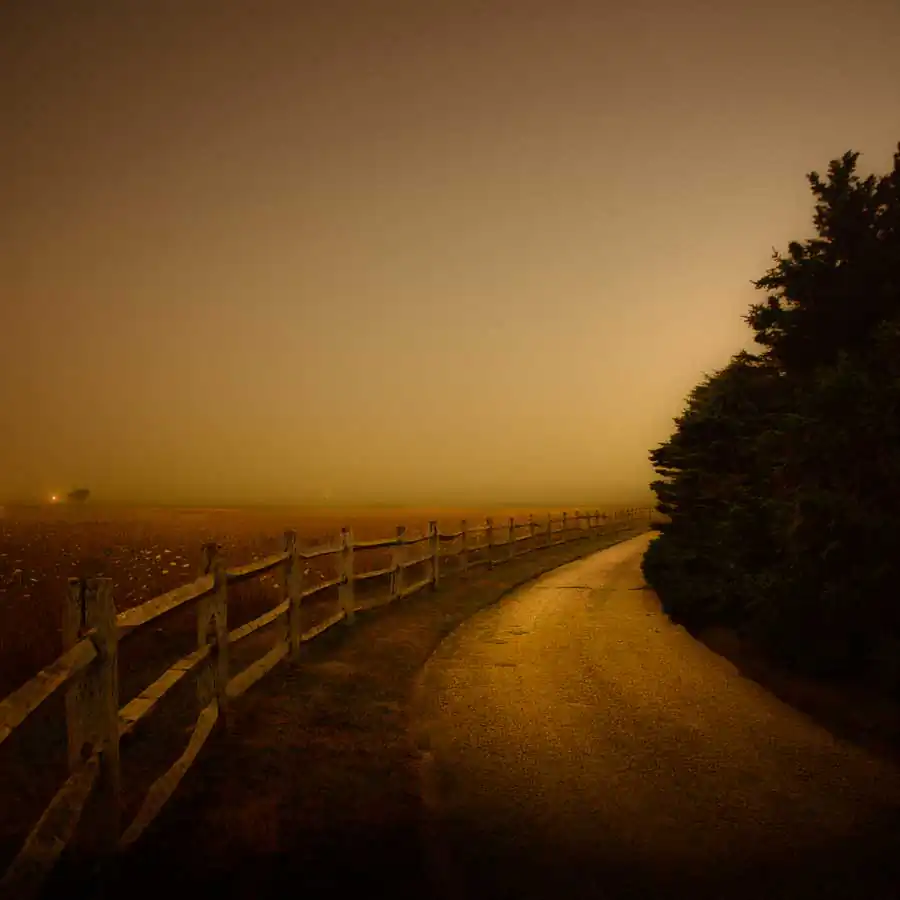
Bob Avakian approaches night through architecture and lived experience. Trained in building and construction, his relationship to structure is tactile and informed. When he returned to photography after years in management, it was architectural space that reignited his practice. In his nocturnal work, buildings assert personality. Light traces edges, clarifies volumes, emphasizes proportion. The absence of crowds removes distraction and foregrounds form. Working in an island environment such as Martha’s Vineyard, Avakian’s images avoid urban excess. They are contemplative rather than theatrical. The night clarifies what daylight disperses. For him, photography becomes an extension of structural understanding. Darkness reveals how space holds itself together.
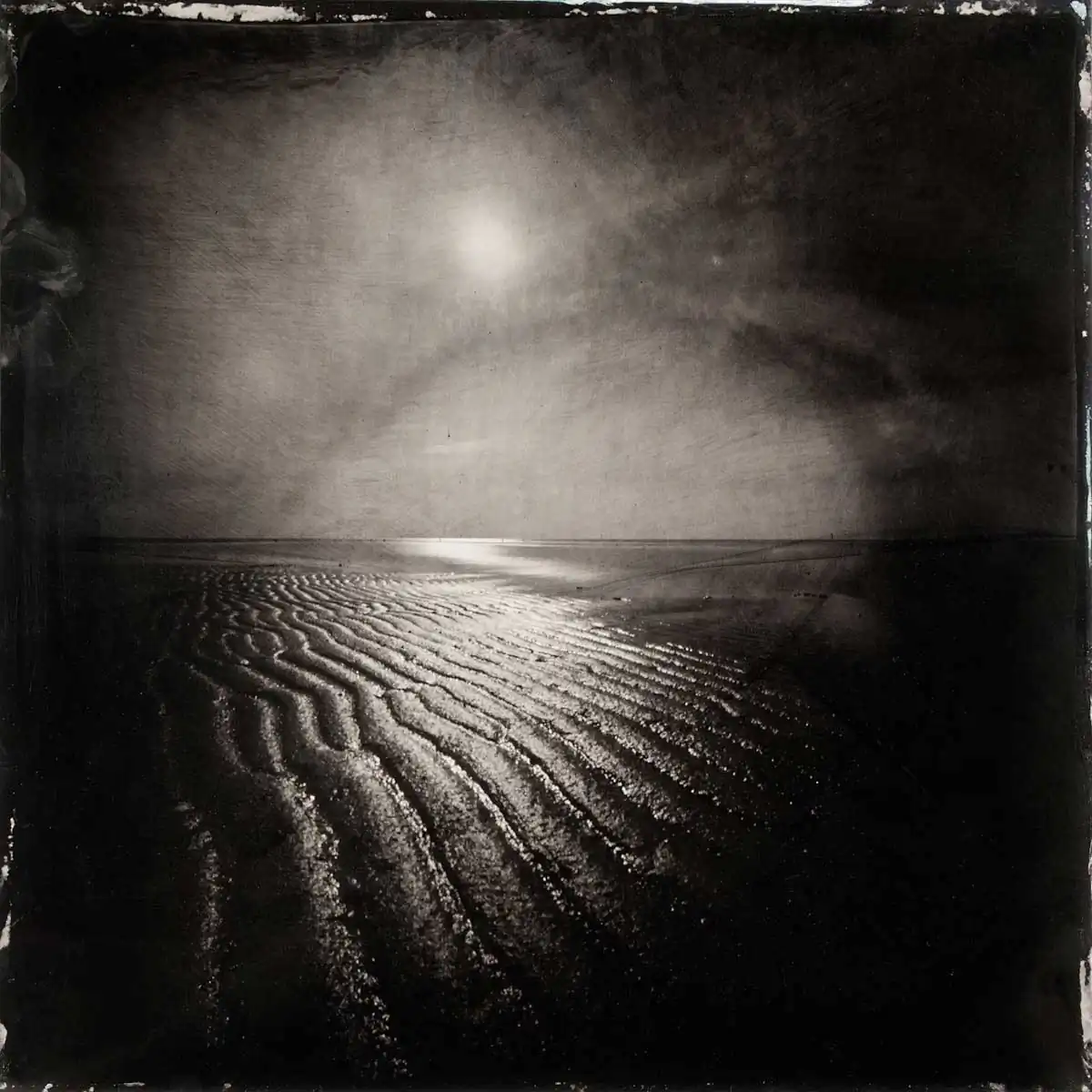
S. Gayle Stevens and Judy Sherrod, in their collaborative project Nocturnes, shift the discussion from subject to process. Using mammoth plate tintypes and historical techniques, they position night photography within a lineage that reaches back to nineteenth century survey work. Their inspiration spans Carleton Watkins to Whistler, from early landscape documentation to tonal painting and musical interpretation. Long exposures, shifting tides, unpredictable water surfaces place the artists at the mercy of natural forces. Their nocturnes are shaped as much by duration as by light. Time becomes visible. The water’s surface oscillates between presence and absence, solidity and dissolution. By embracing historical processes, they introduce material fragility into contemporary night photography. The darkness is not only visual. It is temporal.
What connects these five visions is not aesthetic similarity but a shared refusal to reduce night photography to technical bravura. None of these projects rely on high contrast spectacle or exaggerated chromatic drama. Instead, they explore what night does to perception. Blondeau finds human residue within emptiness. Ydeen isolates the geometry of built space. Lowe reveals intimacy within vast terrain. Avakian clarifies architectural identity. Stevens and Sherrod merge time, material, and landscape.
Together, they demonstrate that night photography is not defined by exposure settings or equipment. It is defined by engagement. Darkness becomes a conceptual tool rather than a condition to overcome. In these works, night does not obscure reality. It reveals the structures, memories, and presences that daylight too easily conceals.
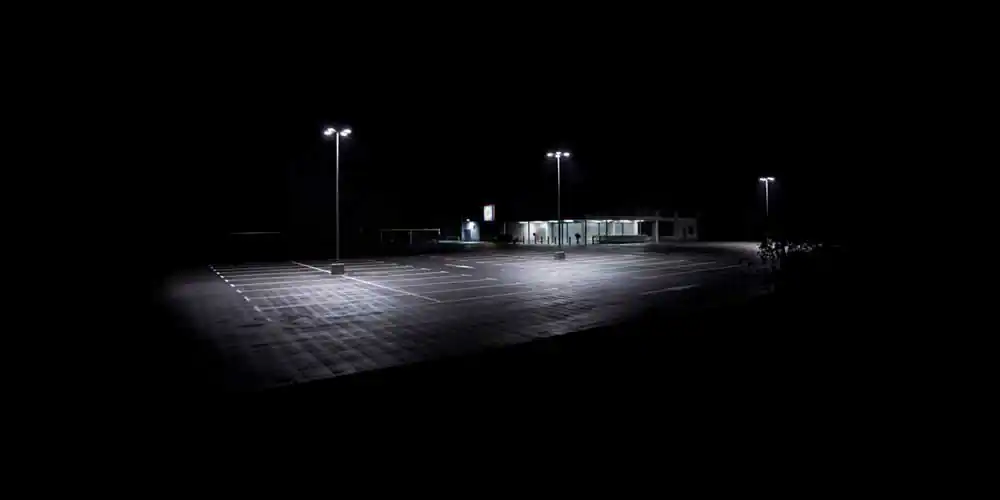
Night photography : Presence obscure by Xavier Blondeau
Presence obscure There exist places or situations in which, despite the absence of any human entity, a faint presence can still be felt beyond objects. This ‘shadowy’ presence, like the barely perceptible persistence of a recent past, gives things another dimension. As if they needed a human stamp to exist. Thus, the darkness of night or the nascent mist of the wee hours are passageways to the other world. They help us better feel this barely-there presence. Presence obscure thus focuses on urban surroundings at night. Those universes, though stripped of human presence, yet inexorably loop back to Man. As if the artificial environment he has built, which seems to contradict his human nature, still left its unwavering stamp. One might be tempted to see in these tenuous but tenacious traces, a far more intimate origin?… Read More
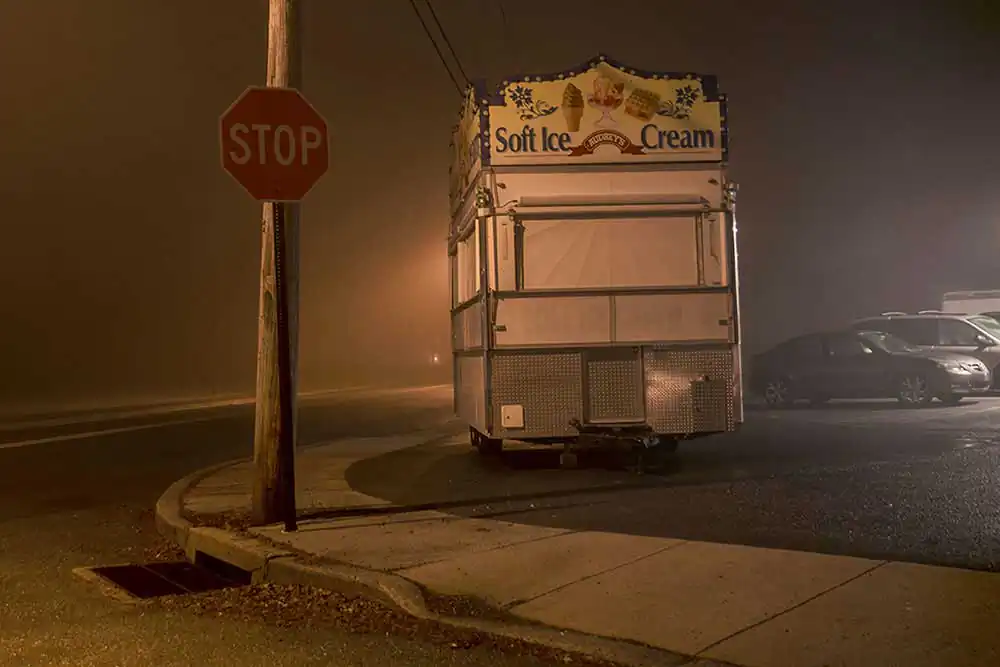
Night photography : Easton Nights by Peter Ydeen
The series “Easton Nights” began in late 2015 as an exercise in night photography, inspired mostly by the poetic shots of George Tice. The exercise soon evolved into an obsession, not just with the night or night photography, but with stages and places which we all create and where we act every day. The night spotlights, isolates and minimalizes what we see; and stripped of its makers, our fabrications awake with an animism, which hypnotizes, fascinates and engages. It does not reveal the macabre often associated with the night, but a beauty and elegance of our man made environment. Sweaty Toyotas take precedent over Cadillacs; signs and poles lean in soft repose, and a plastic rubbish can takes on sculptural importance that would make R Mutt proud. Its’ geometry, complexity, and layers built on layers, are all intended to contain, protect and organize, while the street lighting spotlights our doors which seem as portals to other worlds… Read More
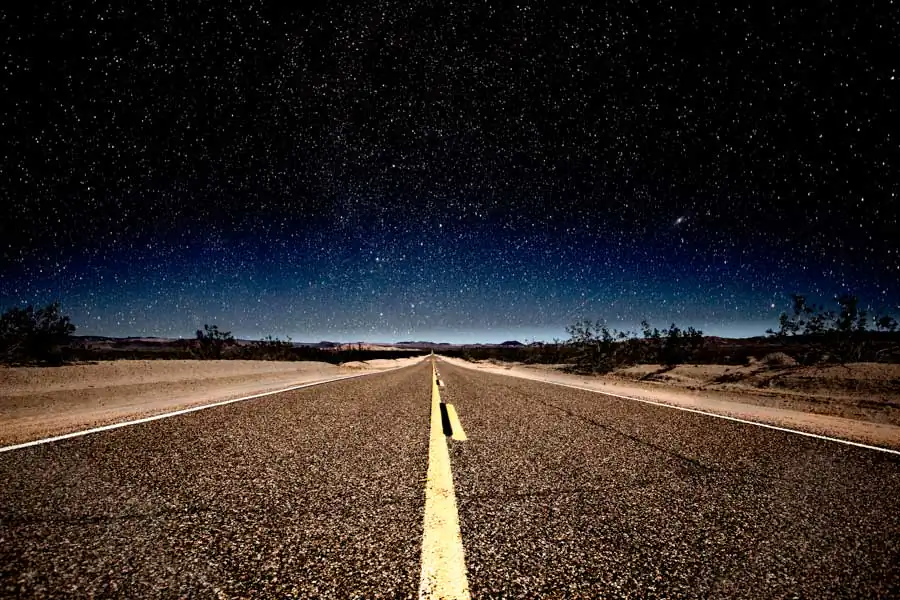
Night photography : Mojave Moonlight by Tom Lowe
I’ve been lucky to visit six continents and work in over fifteen countries during the last twenty-five years in the film industry. From the heat and humidity of India, to the barren landscapes of central China, to the serene calm of an Italian summer and the lapping waves of the Caribbean, I’ve endeavored to take the road less traveled, eat at the cafés frequented only by locals and walked the streets without a map. I continue to believe that getting lost in a city is the best way to discover it. A regular tourist I am not, if nothing else, my adventures have shown me the world outside the pages of the popular travel guides… Read More
Night photography by Bob Avakian
Bob Avakian and his wife Gail visited Martha’s Vineyard for the summer in 1973 and it has been home ever since. Trained in architecture, engineering and building, for years he has worked in the construction field as a custom homebuilder. After finding himself in management, removed from the satisfaction of hands-on involvement, he turned to photography as a means of self-expression. “In the early 70’s I took a photography class as an art elective while in college. Soon after, I moved to Martha’s Vineyard. I still had my camera but going from NYC to a quiet Island was a big change and street photography was too intimate on a small island, so the camera got put away except for taking photos of family and friends. A few years ago I took a workshop in architectural photography and it was at that moment that my passion for photography was rekindled”… Read More
Nocturnes by S. Gayle Stevens and Judy Sherrod
Our Nocturnes series began as an experiment, an adventure, a collaboration. A pinhole camera-maker and a wet-plate collodion artist collaborated to produce mammoth plate tintypes, echoing the work and process of the early survey photographers. Carleton Watkins, William Henry Jackson, and Timothy O’Sullivan, surveying the expansive landscape of the western US, found themselves at the mercy of nature. James McNeill Whistler, inspired by the visual melody he found in dark skies and seas, titled many of his paintings nocturnes. In turn, these paintings provided inspiration for the orchestral nocturnes written by Debussy, musical impressions that ebb and flow. Inspired by these artists and the waters of the gulf in Pass Christian Mississippi we too found ourselves at the mercy of the tides, our images determined by the capriciousness of the water before us…Read More