
Few photographers have managed to combine wit, elegance, and emotional depth with the effortless precision of Elliott Erwitt.
In a medium often associated with seriousness or solemnity, Erwitt demonstrated that humor could be just as powerful a tool for understanding the world as tragedy or drama. His photographs are quiet observations of everyday life, but within those seemingly simple frames lies an extraordinary sensitivity to the absurdity, tenderness, and contradictions of human existence.
Born in 1928 in Paris to Russian Jewish parents, Elliott Erwitt’s life was shaped early by displacement and cultural hybridity. His family moved to Milan during his childhood and eventually emigrated to the United States in 1939 as Europe descended into the turmoil of the Second World War. This early experience of migration and adaptation seems to echo subtly through his work. Erwitt developed the instinct of an observer, someone who studies the world carefully, noticing details others might overlook.
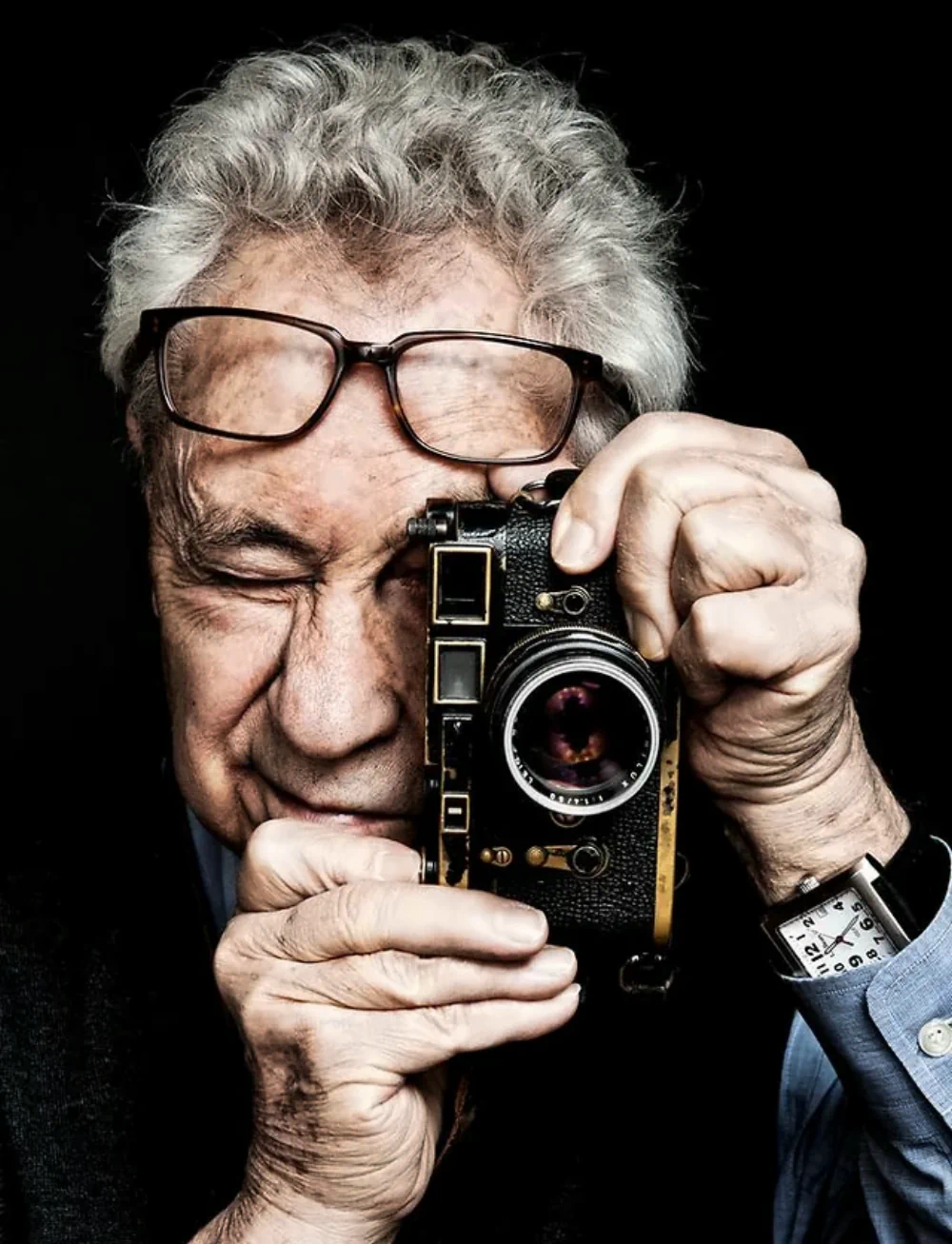
By the time he settled in Los Angeles as a teenager, Erwitt had already begun experimenting with photography. What started as curiosity soon evolved into a profound artistic language. He worked in a commercial photo lab while studying filmmaking and photography at Los Angeles City College, learning the technical foundations that would later allow him to operate with remarkable freedom behind the camera.
Yet technique alone never defined Erwitt’s vision. What distinguished him was his ability to recognize moments where reality briefly reveals its own humor. His photographs rarely feel staged or contrived. Instead, they appear as fragments of life captured precisely at the instant when the ordinary becomes poetic.
Magnum Photos and the Shaping of a Photographic Voice
A decisive turning point in Elliott Erwitt’s career arrived when he met Robert Capa, one of the founders of Magnum Photos. Capa immediately recognized Erwitt’s talent and encouraged him to join the legendary cooperative. In 1953 Erwitt became a member of Magnum, an institution that had already established itself as a central force in documentary photography.
Magnum was not simply an agency; it was a philosophy. Photographers such as Henri Cartier-Bresson, David Seymour, and George Rodger believed in authorial independence and in photography as a tool for witnessing the world. For Erwitt, joining Magnum meant entering a community that valued both artistic freedom and journalistic integrity.
During the following decades he produced assignments across the globe, photographing political events, cultural icons, and historical moments. Yet even when working within the framework of reportage, Erwitt’s distinctive voice remained unmistakable. While many documentary photographers sought dramatic images, Erwitt often gravitated toward subtle situations where irony quietly unfolded.
One of his most famous photographs, taken during the 1959 American National Exhibition in Moscow, captures a tense exchange between U.S. Vice President Richard Nixon and Soviet Premier Nikita Khrushchev. The image shows Nixon pointing his finger emphatically at Khrushchev while the Soviet leader listens with visible irritation. The photograph is now widely recognized as a visual summary of Cold War tensions. Yet what makes it memorable is not only its political significance but also the theatrical nature of the scene. Erwitt managed to frame a moment that feels both historically important and strangely human.
His work during this period also included portraits of some of the most influential figures of the twentieth century. He photographed Marilyn Monroe, Che Guevara, Fidel Castro, Jackie Kennedy, and many others. Yet even when facing powerful personalities, Erwitt avoided the conventional language of heroic portraiture. His images tend to reveal vulnerability, spontaneity, and sometimes a quiet sense of comedy.
Dogs, Children, and the Subtle Theatre of Everyday Life
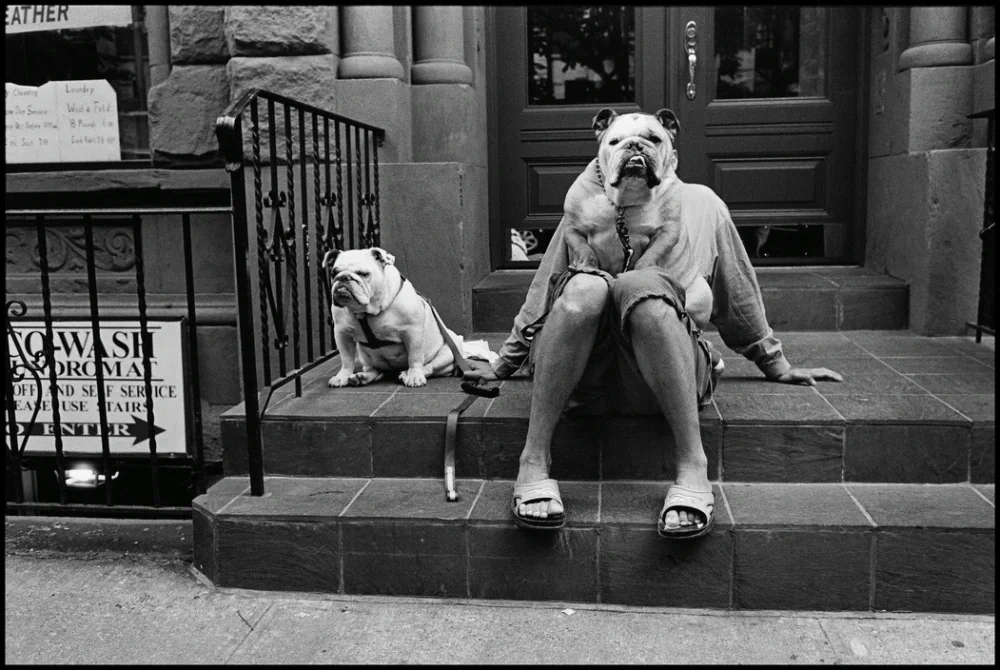
If one theme has become inseparable from Elliott Erwitt’s legacy, it is his fascination with dogs. Throughout his career he produced an extensive series of photographs that place dogs at the center of the frame, often juxtaposed with their owners or the surrounding urban environment.
At first glance these images might appear whimsical or playful, but they reveal much more than simple humor. Erwitt understood that animals could serve as mirrors of human behavior. The gestures, postures, and expressions of dogs often echo those of the people who walk beside them. By framing these relationships carefully, Erwitt transforms everyday scenes into subtle visual metaphors about companionship, hierarchy, and identity.

In one well known photograph taken in New York City, the camera looks downward toward a tiny Chihuahua standing between the towering legs of its elegantly dressed owner. The composition exaggerates the contrast between scale and perspective, producing an image that feels both humorous and strangely dignified. The dog becomes a character, almost an actor performing within a miniature stage.
Children also occupy an important place in Erwitt’s imagery. Much like dogs, children possess an unpredictable spontaneity that resists social conventions. Erwitt was drawn to moments when their behavior revealed something honest about the adult world around them. In his photographs, children often appear curious, mischievous, or contemplative, reminding viewers that innocence can sometimes expose truths that adults prefer to ignore.
What unites these subjects is the photographer’s fascination with the small dramas of everyday life. Erwitt did not need monumental events to create meaningful images. A sidewalk, a park bench, or a quiet street corner could provide the stage for scenes filled with emotional resonance.
Humor as a Philosophical Position
Humor in photography is often misunderstood as something superficial or decorative. Elliott Erwitt approached humor in a completely different way. For him, irony was not merely a stylistic device but a philosophical stance toward reality. The world, in his view, was filled with contradictions, and photography offered a way to reveal those contradictions without moralizing.
Many of his images operate through subtle visual juxtapositions. A billboard might echo the gesture of a passerby. A statue might appear to interact with a pedestrian. A dog might imitate the posture of its owner. These moments are fleeting and often invisible to those who are not paying close attention.
Erwitt once explained that photography is essentially about noticing things. The photographer must be alert, ready to respond when the world briefly aligns itself into a meaningful composition. Humor arises naturally from this attentiveness. When disparate elements suddenly connect within a single frame, the result can feel both surprising and inevitable.

Unlike photographers who rely heavily on dramatic lighting or complex staging, Erwitt favored simplicity. His compositions are usually clean and direct, allowing the viewer to grasp the situation immediately. Yet within that simplicity lies a remarkable sophistication. Each photograph contains layers of interpretation that unfold gradually over time.
This balance between accessibility and depth is one of the reasons his work has remained widely appreciated by both general audiences and serious critics. People may first encounter his images through laughter, but they often return to them because of the emotional intelligence embedded within the frame.
Cinema, Color, and the Expansion of a Visual Language
Although Elliott Erwitt is most frequently associated with black and white photography, his career also includes extensive work in color as well as in film. During the 1970s and 1980s he directed several documentaries and television programs, exploring the possibilities of storytelling beyond the still image.
These projects revealed another dimension of his creative personality. While photography captures isolated moments, cinema allows time to unfold within the frame. Erwitt approached filmmaking with the same curiosity and observational sensitivity that defined his photographic practice.
His color photographs, which gained greater recognition later in his career, demonstrate a similar sensibility. Unlike many photographers who treat color as purely aesthetic decoration, Erwitt used it sparingly and thoughtfully. The colors in his images tend to feel natural rather than exaggerated, reinforcing the sense that the viewer is witnessing an authentic moment rather than a constructed spectacle.
Even as photographic technology evolved, Erwitt remained committed to the essential principles that guided his early work. Cameras became lighter, film stocks changed, and eventually digital tools emerged, yet his approach continued to revolve around patience, observation, and the search for meaningful coincidences within ordinary life.
The Enduring Influence of Elliott Erwitt
Elliott Erwitt’s contribution to photography extends far beyond the individual images he produced. His work helped redefine the relationship between documentary photography and humor, demonstrating that seriousness and playfulness are not mutually exclusive. In an era when much of photojournalism focused on crisis and conflict, Erwitt offered a different perspective, one that celebrated the subtle absurdities of everyday existence.
This perspective has influenced generations of photographers, particularly those working in street photography and humanistic documentary traditions. Many contemporary photographers continue to explore the visual language of irony that Erwitt helped refine. Yet few have managed to achieve the same balance of elegance, empathy, and humor that characterizes his work.
His photographs also remind us that the most powerful images are often rooted in empathy. Erwitt never mocked his subjects. Even when his photographs contain elements of satire, they remain fundamentally compassionate. The people in his images are not objects of ridicule but participants in a shared human comedy.
Over the decades his work has been exhibited in major museums and galleries around the world. Numerous books have celebrated his photographs, including iconic collections dedicated entirely to his dog imagery. Yet despite this international recognition, Erwitt himself often maintained a modest attitude toward his career. He frequently described photography as a simple act of observation rather than an act of artistic genius.
That humility is perhaps part of what makes his work so enduring. His images do not attempt to overwhelm the viewer with spectacle. Instead, they invite quiet reflection and perhaps a gentle smile.
Photography as a Way of Seeing
To look at an Elliott Erwitt photograph is to encounter a moment that feels both accidental and perfectly composed. The viewer senses that the scene existed only briefly before dissolving back into the ordinary flow of life. The photographer’s achievement lies in recognizing that moment and framing it with clarity and elegance.
This ability requires more than technical skill. It demands patience, curiosity, and a deep respect for the unpredictable rhythms of everyday life. Erwitt’s camera functioned almost like a translator, converting fleeting gestures into visual narratives that can be understood across cultures and generations.
In a world increasingly saturated with images, his work serves as a reminder that photography is not simply about producing pictures. It is about paying attention. It is about recognizing that even the smallest interaction between strangers, animals, or objects can reveal something profound about the way we inhabit the world.
Elliott Erwitt did not set out to create grand statements about history or society. Instead, he focused on moments that might otherwise pass unnoticed. Yet through those moments he constructed a body of work that speaks quietly but powerfully about human experience.
His photographs suggest that life is simultaneously serious and absurd, fragile and joyful. Within that paradox lies the true poetry of his vision, a vision that continues to inspire photographers and viewers alike.