

Seascape photography occupies a central place in the history of the image, yet in contemporary practice it has acquired a conceptual density that decisively distances it from mere aesthetic exercise.
The sea no longer appears solely as sublime spectacle or as a romantic backdrop inherited from painterly tradition; it has become a critical space where perception, memory, minimalism, identity, and ecological crisis intersect. The horizon line, seemingly simple, now functions as a visual device loaded with meaning: it defines, divides, creates tension, and questions our relationship to the world.
In a context marked by climate acceleration, coastal erosion, and the irreversible transformation of ecosystems, the seascape can no longer be neutral. To photograph the sea in the twenty-first century inevitably implies taking a position in relation to its fragility. Every horizon contains a question about the future. Every beach records a territory that is never stable. Every tide rewrites the surface of the world. Photography no longer documents only a place; it documents a process.
At the same time, the minimalism that characterizes much of contemporary seascape photography is not merely a formal pursuit, but a conceptual reduction. Removing visual noise, emptying the frame, insisting on horizontality and repetition forces the viewer to confront the essence of space. The horizon, in its radical simplicity, becomes an axis that organizes both the image and thought itself. It separates sky from water, but also the tangible from the imagined, the present from what is yet to come.
Within this framework, the seascape functions as an in-between territory. The coast is a physical boundary between land and sea, yet also a symbolic boundary between stability and uncertainty. It belongs to two worlds and to neither at the same time. This liminal condition explains why so many contemporary artists return to the shoreline: not to reproduce classical iconography, but to explore the tension between permanence and change, contemplation and warning, beauty and threat.
The projects gathered in Dodho Magazine make this transformation of the genre visible. From the minimalist exploration of the horizon as visual structure to the reinterpretation of landscape as fragmented memory or climatic document, the sea emerges as a field of experimentation where photography continually redefines itself. Contemporary seascape photography no longer seeks merely to describe a specific place; it seeks to question how we inhabit the planet and how we remember what may already be beginning to disappear.
The Horizon as Visual Structure and Philosophical Divider
In Horizon, Kip Harris transforms the shoreline of Nova Scotia into a space of distilled perception. Having moved to the South Shore in 2004, he has walked that coast daily, observing a quality of light that, as he suggests, sinks into the soul and reshapes the way one sees the world. What emerges from these years of wandering is not a traditional seascape practice but a conceptual inquiry centered on the horizon itself.
Harris approaches the coast as a flâneur of light. Though inclined toward street photography, he has transferred that sensibility to the shoreline, where the horizon replaces the urban grid. The series is intentionally minimal. Wind strips away distraction. The images are reduced to essential elements: sky, water, line. In this reduction, the horizon becomes more than a compositional device; it becomes an axis that bifurcates the conceptual and the real, the found and the constructed, the perceived and the imagined.
The horizon fractures the image plane. It interrupts depth while simultaneously producing it. It destabilizes the photograph even as it organizes it. In these works, seascape photography shifts from representation to investigation. The question is no longer what the sea looks like, but what the horizon does to our understanding of space.
The Beach as Liminal Territory
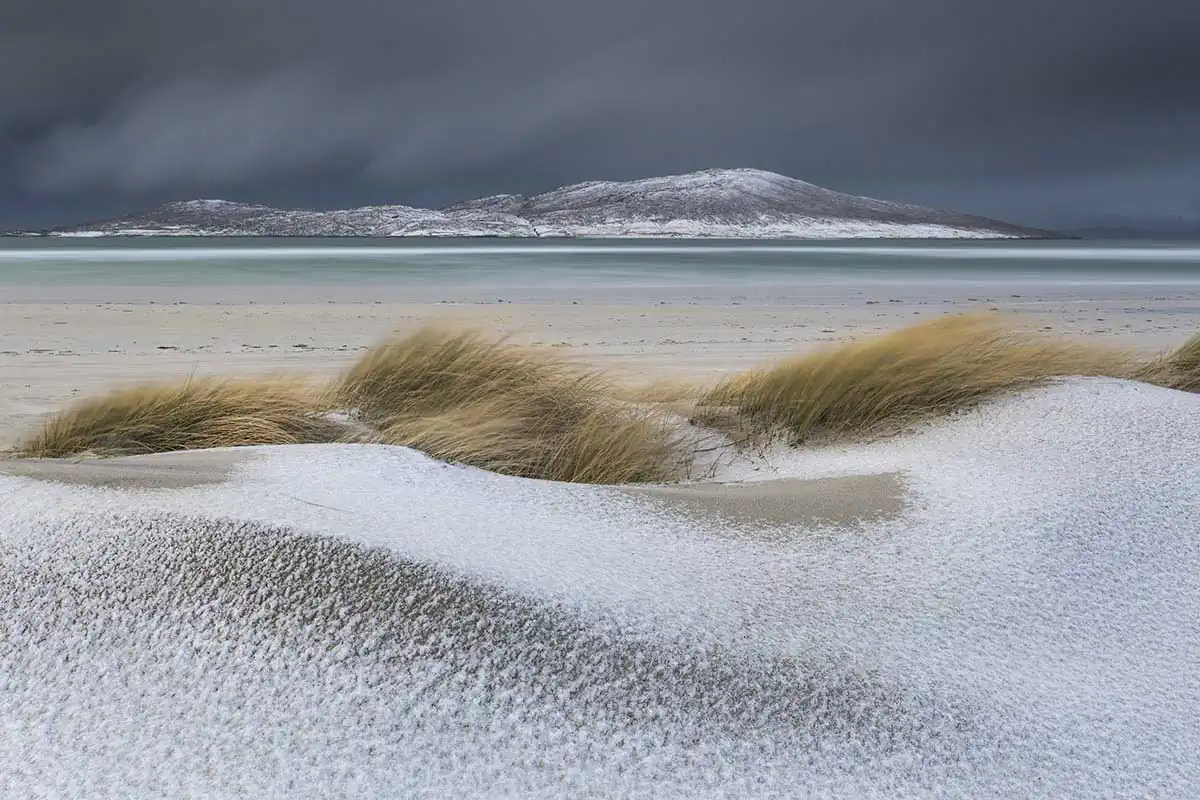
In The Beach, Duncan MacArthur turns to the island of Harris in the Scottish Hebrides, at the northwestern edge of Europe, where the Atlantic Ocean asserts itself as a dominant force. His focus is not the dramatic spectacle of the sea alone, but the beach as an indefinite zone between land and water.
The beach belongs to neither element fully. It is created by tidal movement, constantly reshaped, endlessly rewritten. Sand flattens and ripples. Water carves and erases. Patterns appear only to vanish with the next tide. This instability defines the conceptual core of MacArthur’s project. The shoreline becomes a site of perpetual negotiation, where no form is permanent and no mark is secure.
MacArthur is drawn to the minimalist appeal of expansive, clean spaces and tonal variations. Yet beneath the formal clarity lies a deeper meditation on impermanence. The sea sculpts the land and then erases its own gestures. Human presence is temporary here. There is no stable ground upon which to settle. The beach, as photographed, becomes a metaphor for parity and balance, a space equally claimed and relinquished by sea and land.
Mediterranean Minimalism and the Poetics of Long Exposure
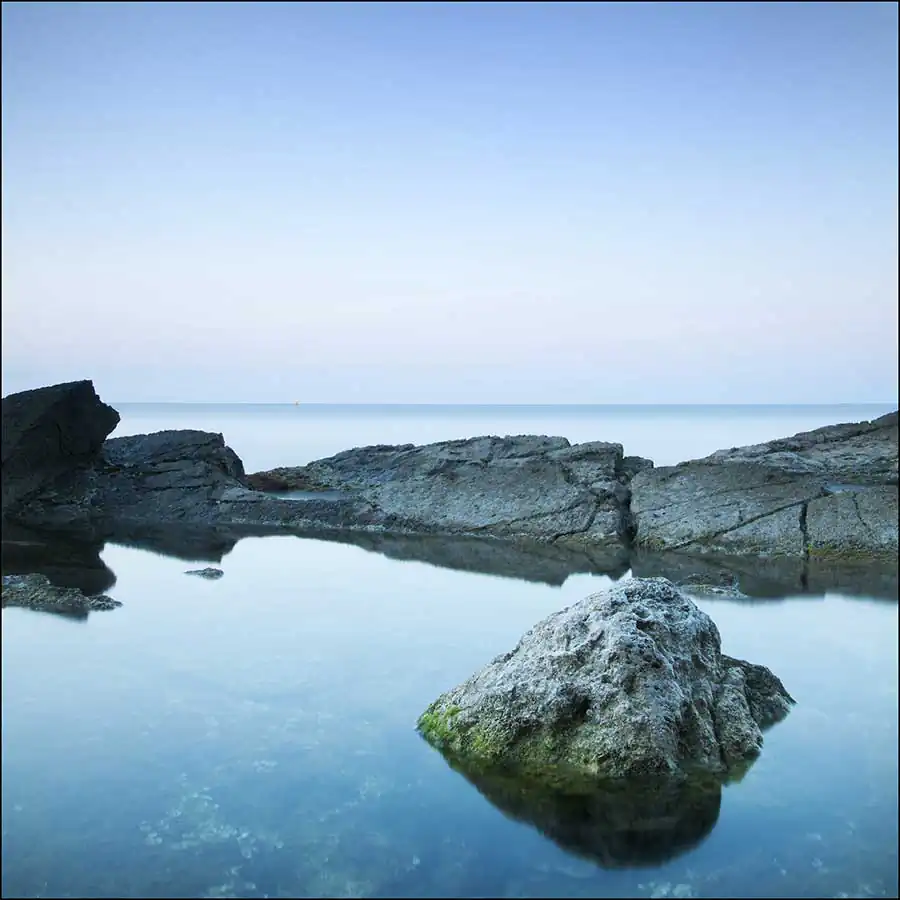
In Céleste, my Mediterranean, Michel Lecocq explores a narrow stretch of coastline between Cassis and Sainte-Maxime in southern France. Developed over several years, the series is the result of rigorous exploration and a sustained commitment to long exposure techniques.
The slow shutter transforms the Mediterranean into a surface of serenity. Movement dissolves. Waves become vapor. Horizons flatten into meditative planes. Lecocq’s minimalism is not purely aesthetic; it is an attempt to strip the landscape of distraction and reveal improbable, almost abstract environments hidden within the everyday.
The sea is approached as a feminine presence, a goddess-like entity that mirrors the sky and balances emotional states. Lecocq draws an analogy between the relationship with the sea and the relationship with a loved one: intimacy, fascination, turbulence, reconciliation. The horizon becomes a space of calm, even when the sea’s power is evident. In this context, seascape photography becomes a refuge, an interior space disguised as exterior landscape.
Solastalgia and the Climate-Conscious Seascape
The ecological urgency embedded within contemporary seascape photography finds one of its clearest articulations in Mindful Reminiscence by Debra Achen. Her project introduces the concept of solastalgia, a form of eco-anxiety generated by environmental change. It is not nostalgia for what has already disappeared, but for what is visibly in the process of vanishing.
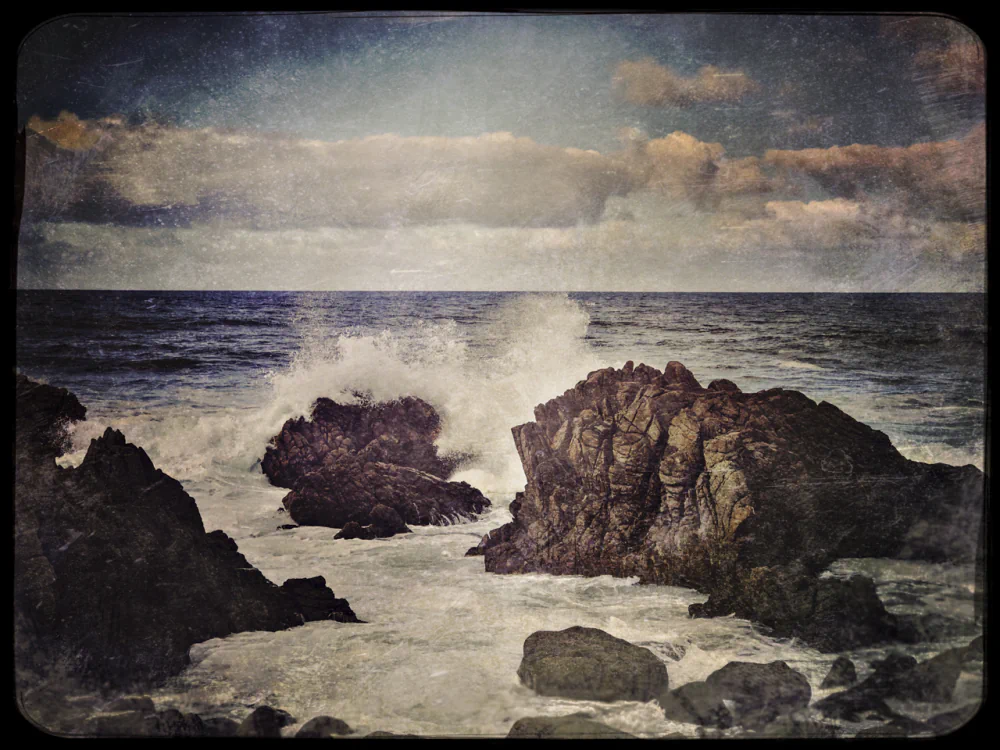
Achen photographs coastlines during king tides, moments when gravitational alignment between Earth, sun, and moon intensifies tidal extremes. These events offer glimpses of a possible future marked by sea level rise, intensified waves, and storm surges. Infrastructure, aquifers, and coastal communities stand at risk. The horizon, once symbol of openness, becomes a measure of encroachment.
Her images are treated with a vintage aesthetic inspired by early autochromes. The present appears aged, as if already archived. The here and now is rendered as memory. Through this strategy, Achen collapses temporal distance. The seascape becomes both documentation and warning, both contemplation and call to awareness.
Imagined Archipelagos and Fragmented Memory
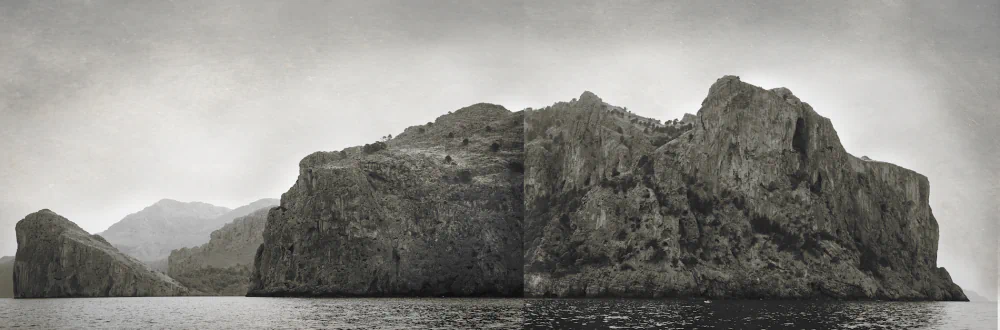
In Isles of Mind, Lisa Cassell-Arms departs from direct documentation and moves toward speculative geography. Her islands drift between recognition and invention, assembled from fragments of real landscapes captured in different places and times.
Rather than concealing the seams where images meet, she reveals them. These fault lines act as visual evidence of the construction process. Landscapes overlap, disagree, and merge. The horizon misbehaves. Orientation becomes unstable. The work echoes early stereoscope cards, where paired images would fuse into a three-dimensional illusion. Here, multiple landscapes collapse into one continuous yet unreliable space.
Cassell-Arms treats the seascape as a mental construct. The sea becomes a site where memory operates as collage, where perception is flexible, and where geography is subject to reinterpretation. The horizon no longer guarantees coherence; it invites uncertainty.
Seascape Photography as Contemporary Inquiry
Across these projects, seascape photography emerges as a field of conceptual rigor. The sea is no longer a passive backdrop but an active participant in the construction of meaning. The horizon divides and organizes. The beach negotiates and transforms. The tide erases and rewrites. Climate change destabilizes and warns. Memory fragments and recomposes.
What unites these bodies of work is not geography but methodology. Each artist uses the seascape to interrogate perception, time, and vulnerability. Minimalism becomes language. Long exposure becomes meditation. Vintage treatment becomes temporal displacement. Digital compositing becomes cognitive metaphor.
Contemporary seascape photography thus stands at the intersection of aesthetics and urgency. It compels us to reconsider what it means to look at the sea when the sea itself is changing. The horizon remains visible, but its meaning is no longer fixed. It is now a threshold between contemplation and responsibility, between beauty and awareness, between permanence and inevitable transformation.