
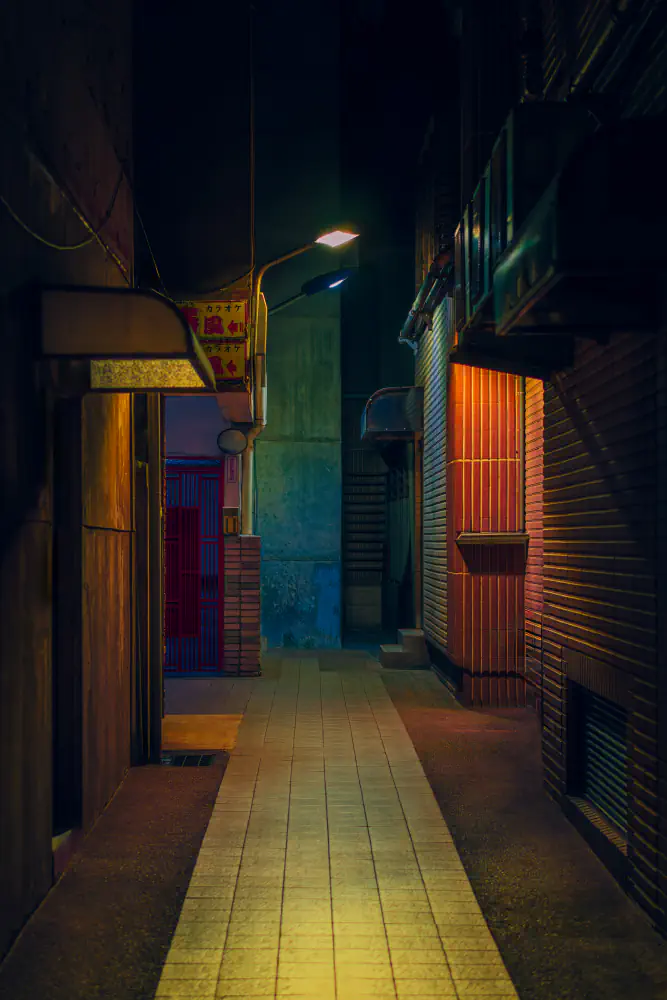
For Etienne Perrone, the city changes its nature after dark. Streets, parking lots, staircases and anonymous urban corners become something more than physical locations—they become psychological spaces where reality and imagination quietly overlap.
Working at the intersection of photography, cinema and visual art, the Marseille-based photographer transforms familiar environments into mysterious stages, using light not simply to illuminate what already exists, but to reveal what usually remains invisible.
Built over years of solitary night walks across Europe, Asia and the United States, Dreams Happen After Dark explores the fragile boundary between documentary observation and cinematic fiction. Combining existing urban light with carefully placed flashes and colored interventions, Perrone creates images that suggest another possible reality—one where silence, absence and expectation become tangible visual elements. Rather than documenting the night itself, the project invites viewers to experience the city as a place of projection, memory and possibility.
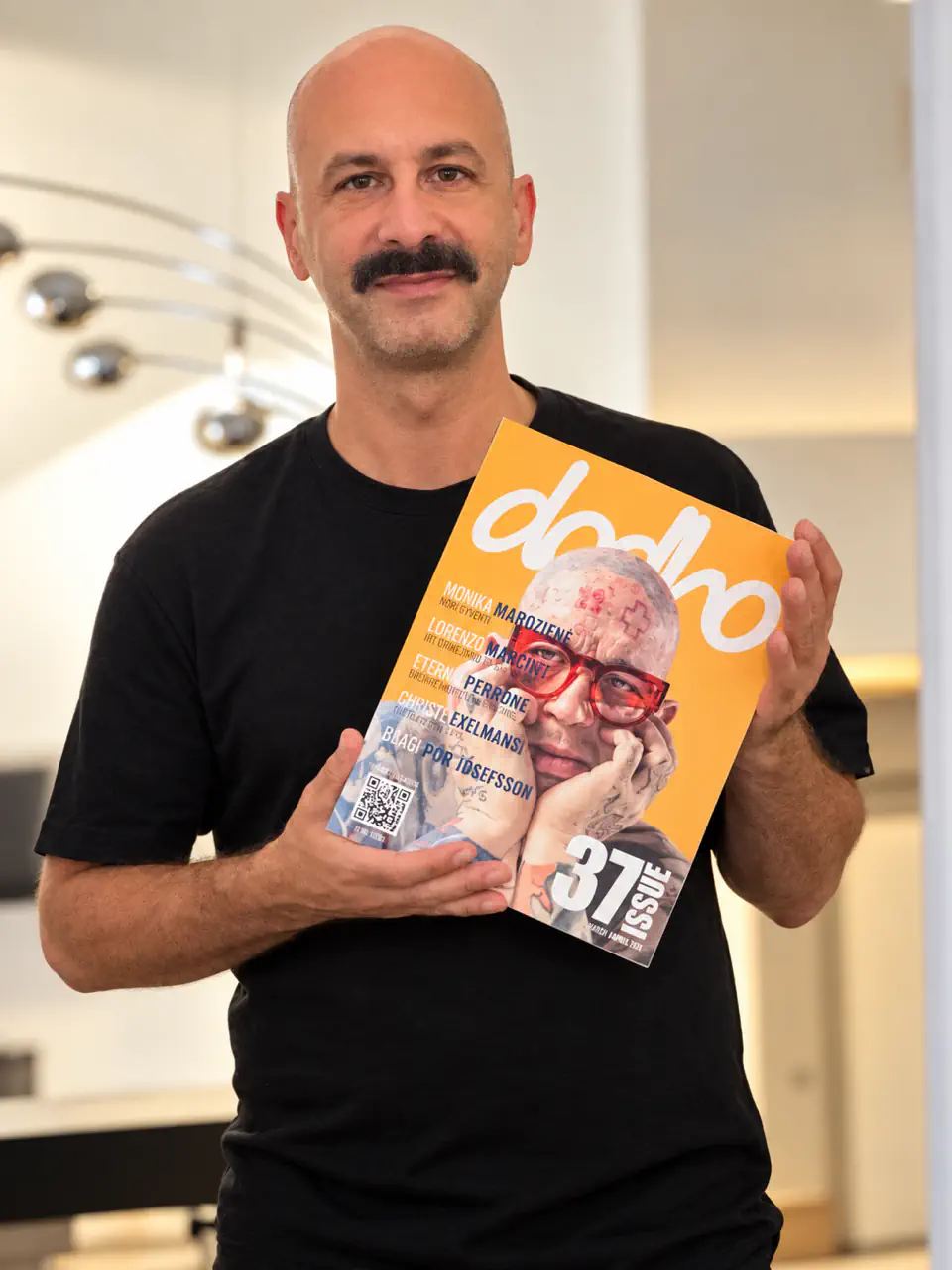
Following the publication of Dreams Happen After Dark in Issue #37 of Dodho Magazine, we spoke with Etienne Perrone about the origins of the project, the influence of cinema on his visual language, and his ongoing search for those fleeting moments when reality begins to feel like fiction. [Official Website][Issue #37]
Looking back, what first attracted you to photography, and when did you realize it would become your primary language for exploring the world?
I really started taking photography seriously in 1999, when I was at film school. We had access to a black-and-white darkroom, and I spent an enormous amount of time there. I was shooting film, often Ilford, and experimenting with different black-and-white stocks. Even back then, I was already strongly drawn to night photography, particularly using highly sensitive films at ISO 3200 or even 6400, which produced a lot of grain.
The arrival of digital photography was another important moment for me. Many photographers around me were suspicious of it or worried about it, whereas I immediately loved it. I bought a digital camera very early on—it must have had about five megapixels—and suddenly I was photographing absolutely everything. That new freedom profoundly changed my relationship with photography.
But for a long time, I didn’t really consider it a serious artistic practice. I was mainly taking photographs because I enjoyed it.
A major turning point came in 2016 during a trip to the United States, where I photographed constantly. I started posting those images on Instagram, the response was very positive, and I eventually began selling prints. From that point onward, something gradually started to become more structured in my mind. My approach became more precise and conscious, and photography began taking up more and more space in my life.
I have always needed to create, whether through cinema, music, or photography. But photography offers a very particular kind of freedom. It also combines perfectly with another major passion of mine: traveling alone, walking, exploring, and experiencing a sense of adventure. It naturally became the ideal medium for bringing all those things together.
Your work exists somewhere between documentary photography and cinematic fiction. How did this visual language develop over time?
It’s actually quite funny because, even though my photographs may outwardly have a documentary quality, I don’t really consider myself a documentary photographer at all.
I have no particular desire to show reality as it is or to document it. I leave that to documentary photographers, who do it far better than I could. My approach is almost entirely rooted in fiction; I simply use reality as my raw material.
I walk through places that really exist, but I am looking for the points where that reality seems capable of shifting. I want to raise questions: What just happened here? What might happen next? Why does this place suddenly feel as if it belongs to a story?
It’s a little like a writer sitting at a desk. Physically, they are in a real room, but mentally they are already somewhere else, inside the world they are writing. When I walk at night, I am physically in reality, but I am looking for those cracks through which I can enter a world of my own. Taking the photograph becomes almost a way of showing other people where I was mentally at that moment.
Over time, I have tried to push that distance from realism further, particularly by introducing my own lighting and colored flashes.
I love Gregory Crewdson’s work, for instance, but his approach is almost the opposite of mine. In his photographs, fiction is immediately identifiable. He constructs a set, introduces characters, and creates a situation. Your brain instantly knows that what it is looking at is fictional.
What interests me more is that ambiguous territory where everything appears real, yet something no longer behaves entirely like reality. The brain is no longer quite sure where to place the image.
It is a direction I am continuing to explore today, particularly through new experiments involving rephotography and physical interventions in the image.
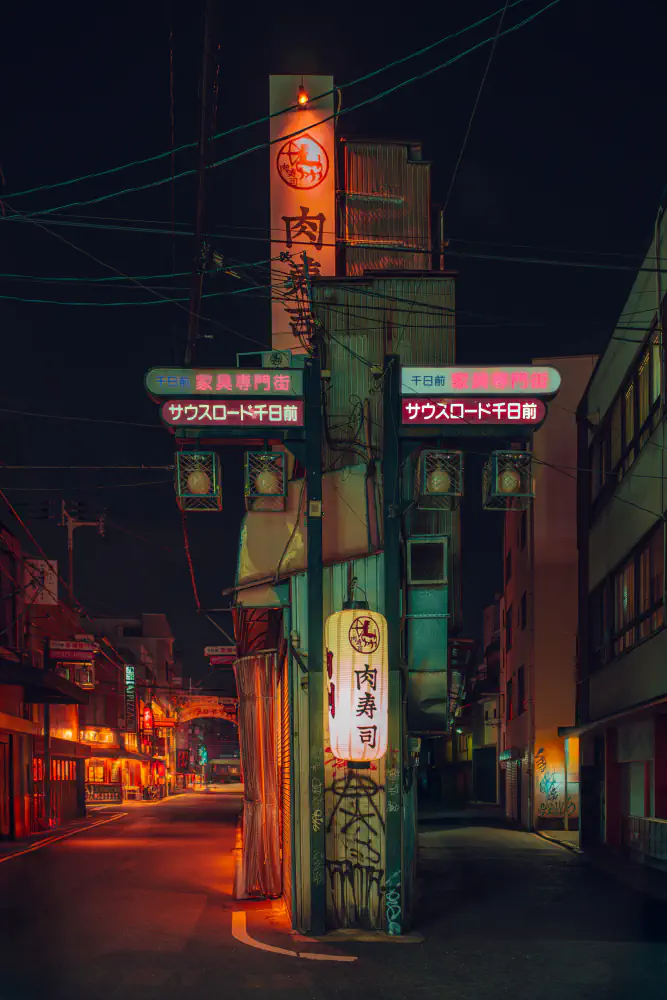
You describe Dreams Happen After Dark as a search for “elsewhere” rather than a project about the night itself. Could you tell us more about what that idea means to you?
Ever since I was a child, I have had an extremely strong attraction to fiction and to the idea of escaping elsewhere. I have always spent a great deal of time imagining things. When I’m falling asleep, when I’m bored, when I’m sitting on a train… my mind very easily starts creating worlds, situations, and stories.
I’m also a huge fan of science fiction and cinema. I have always loved the possibility of being transported into worlds that do not exist, alternative realities, or parallel lives.
Night is particularly conducive to that.
Daytime belongs largely to ordinary life: work, family, appointments, shopping, bills, and social interactions. At night, part of that machinery disappears. In the countryside, everything stops and the sounds of the forest emerge. In a city, even a very busy one, certain neighborhoods become completely empty.
Tiny sounds suddenly become perceptible: the hum of a neon light, an air-conditioning unit, a drop of water, an engine somewhere, my own footsteps, my breathing, gravel beneath my shoes.
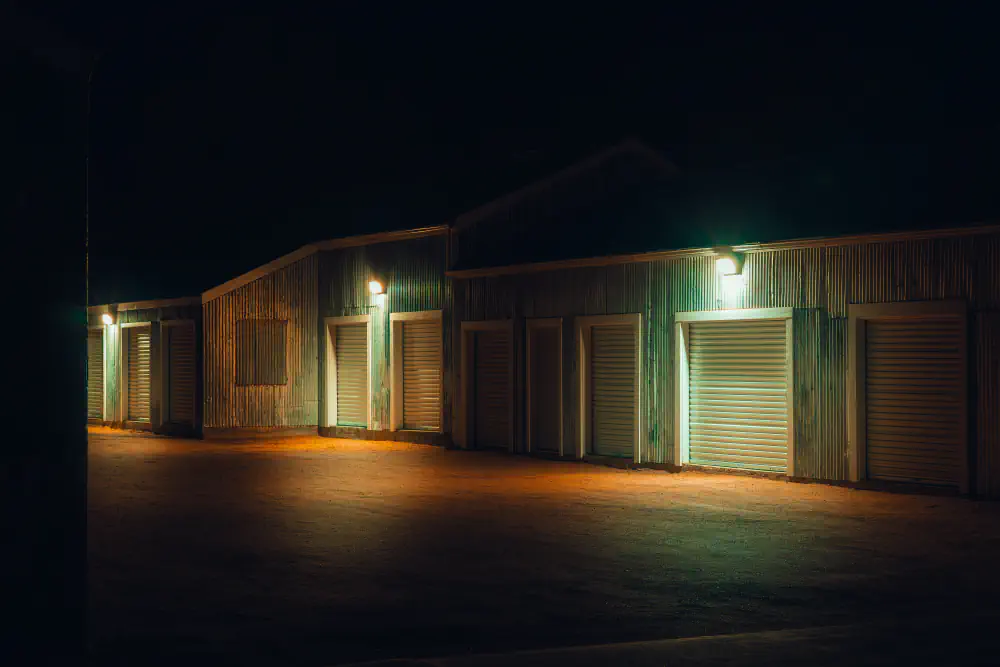
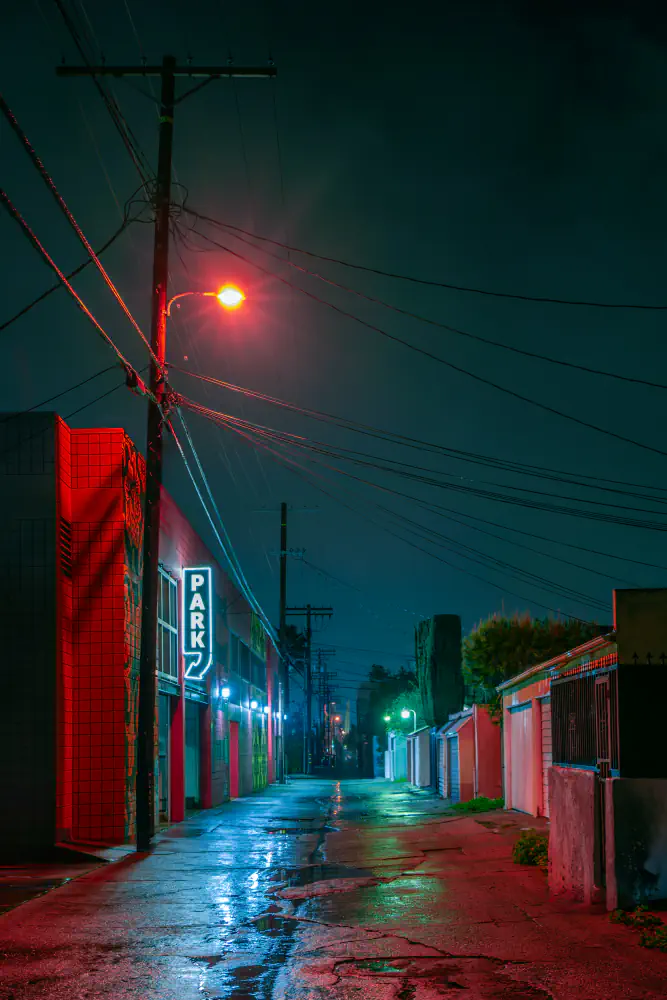
Visually, something similar happens. Small islands of light emerge from the darkness: an illuminated doorway, a streetlamp, a neon sign left on behind a closed shop. Everything around them disappears, and these few illuminated areas become points of focus.
Among them, I look for places that suddenly seem to open a door onto something else. A place that, for reasons that are sometimes difficult to explain, looks exactly like somewhere that might exist within a fictional or parallel world.
For a few moments, I almost feel as if I am brushing against another existence—the life of another Etienne Perrone who might exist somewhere inside that imaginary world.
That “elsewhere” is really what I am searching for, much more than night itself. Night is simply the territory that allows me to access it most easily.
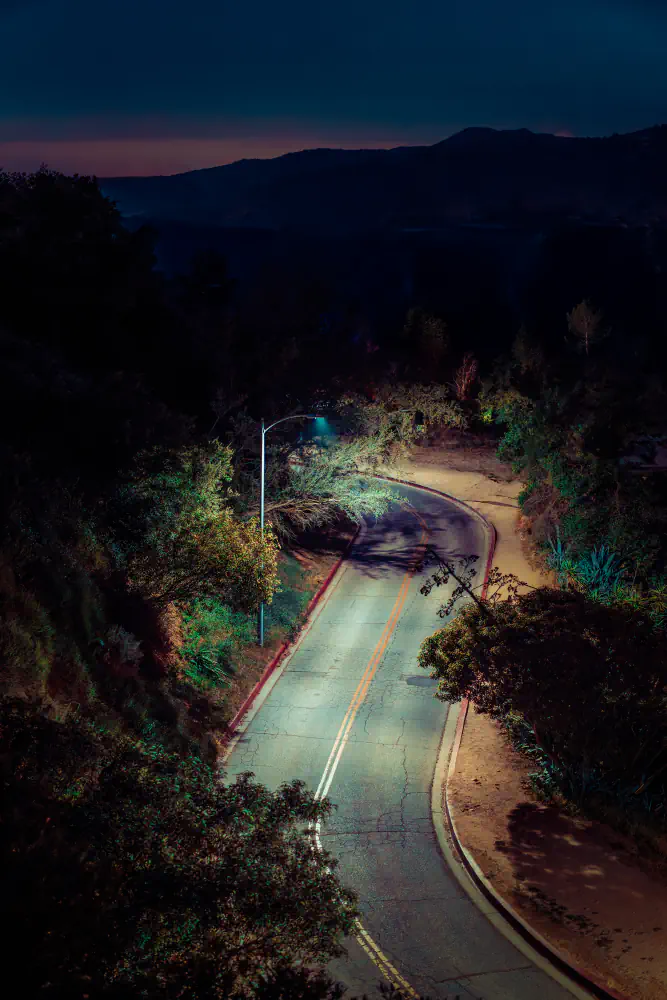
Cinema appears to have played a profound role in shaping your imagination. Which filmmakers, films, or visual experiences have influenced your work the most?
I would probably make a distinction between filmmakers who were fundamental in shaping the way I think about art in general and individual films that more directly feed the mental universe behind my photography.
Filmmakers such as Bergman or Tarkovsky have mattered enormously to me, although not necessarily because I am trying to reproduce their aesthetics.
Ultimately, I think I am often more influenced by individual works than by a director’s entire filmography.
Very different films such as Enter the Void, 2001: A Space Odyssey, Blade Runner, Paris, Texas, Stalker, Akira, Dune, In the Mood for Love, and Annihilation have all had a profound impact on me.
They obviously do not share the same aesthetic. What they do share, for me, is something else: they manage to create an extraordinarily powerful world.
That happens through the image, but also through sound, rhythm, production design, lighting, and storytelling. At some point, you stop watching the film from the outside and begin to feel absorbed into its universe.
That sensation is probably what interests me most, and what I am trying, in my own way, to rediscover through photography.
You spend countless hours walking alone through cities after dark. What have those solitary journeys taught you that daylight never could?
Night completely changes my level of attention.
When a city slows down, information that was drowned out during the daytime suddenly becomes intensely present. I become much more aware of sounds, small sources of light, movements, distances, and everything happening around me.
There is something quite paradoxical about the experience: I become both much more focused on the outside world and much more introspective.
I am extremely attentive to what I see and hear, but all those external signals also begin feeding something internal. They generate thoughts, memories, and projections.
There is also a fundamental difference in terms of lighting. Daylight imposes itself. I cannot really compete with it. At night, it is almost the opposite: darkness becomes a kind of black page.
That darkness gives me the possibility of deciding where to place a light, which color to introduce, which part of a scene to reveal, and which part to allow to disappear. For someone whose professional background is cinematography, that possibility of sculpting a fragment of reality is obviously very stimulating.
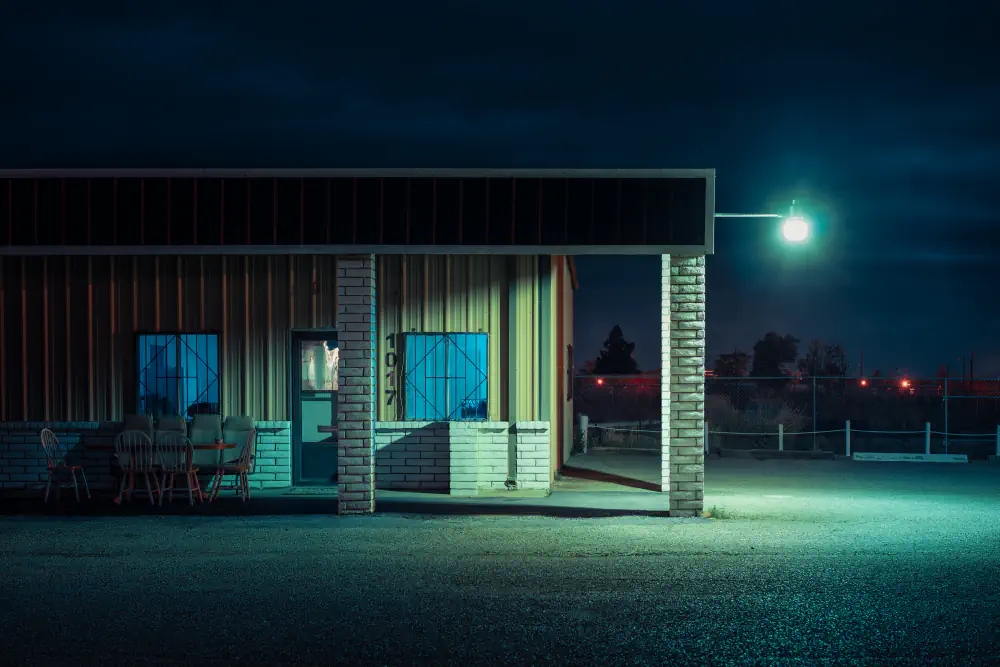
Many of your photographs depict places that most people would simply walk past without noticing. What draws you to these ordinary urban spaces?
There is something slightly paradoxical about it: taking a beautiful photograph of an already beautiful place is difficult, but perhaps not quite as difficult as it seems. The main problem is that millions of people have probably already photographed that same place.
Finding a genuinely personal visual signature then becomes much harder.
I am more attracted to a less obvious kind of beauty, sometimes even to something that not everyone would immediately consider beautiful.
Of course, if I see a pretty Tokyo alley filled with neon lights, I may photograph it simply because it looks pretty. But when I edit my work later, I often realize that the photograph remains just that: pretty. It does not necessarily contain the soul, the strangeness, or the slight tension I am looking for.
So I often work with ordinary spaces, or with very small areas within those spaces.
I also very rarely use extremely wide compositions. I tend to work with focal lengths of around 35 or 50 mm, sometimes longer. I isolate a relatively small portion of the visual field.
That turns the place into a scene rather than a landscape.
The viewer is then confronted, almost unconsciously, with a question: Why am I being shown precisely this place? Why am I supposed to look here?
It is within that tension between banality and strangeness that I often feel something begins to exist.
Light plays both a technical and symbolic role throughout the series. How do you decide when the existing light is enough and when a scene calls for your own intervention?
For several years, I never added any light at all. For probably five years or so, I simply searched for whatever was already there: beauty, mystery, or strangeness produced entirely by the location and its existing lighting.
Then I began to feel the need to move further away from realism.
There was also something slightly strange about the situation for me: I am a cinematographer, so my profession is precisely about working with and sculpting light, yet in my photographic work I was barely using that part of my experience.
So I began experimenting.
I became particularly interested in colors that occur relatively rarely in urban lighting at night: certain pinks, violets, and very strong reds.
I am not necessarily looking for subtlety, either. Sometimes a very visible burst of colored flash hitting a building, a bridge, or an unexpected area of the scene creates precisely the anomaly I am after.
Gradually, that became a larger part of my practice, and today many of my photographs involve some form of lighting intervention.
But I also still enjoy going out occasionally with a very small camera, without flashes, without a tripod, and without all my professional equipment. That lightness gives me another kind of freedom and keeps a completely spontaneous form of exploration alive.
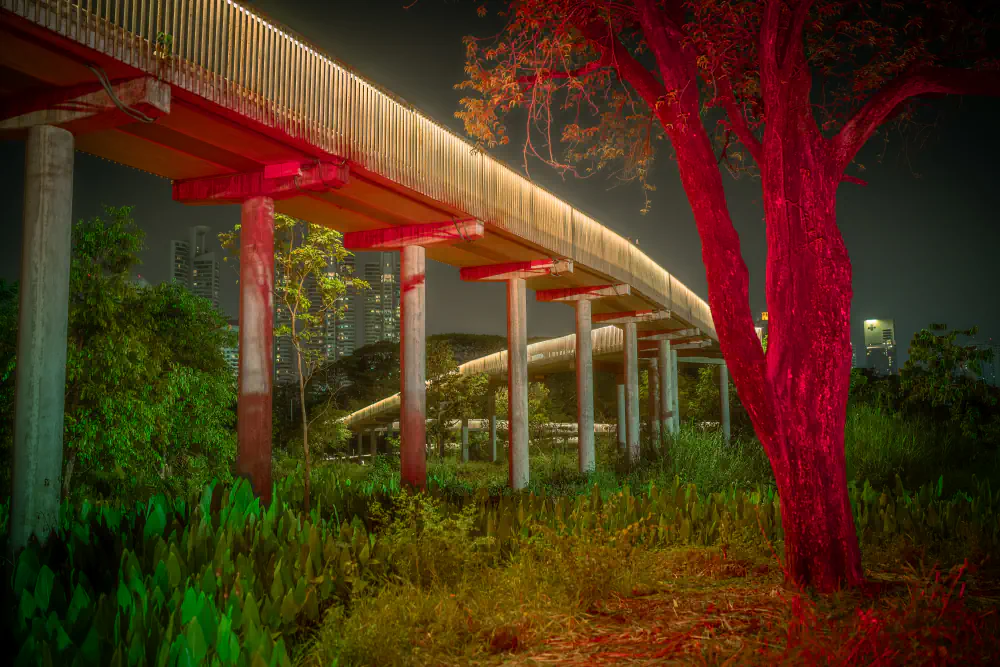
Unlike digital effects added later, your colored light is created directly on location. Why is it important for you that these transformations happen in the physical world?
It matters precisely because the photographs can look as though they have been manipulated.
When someone looks at one of the images and wonders, “Did that light really exist? Was this image altered?”, I find it interesting to know that the element creating that doubt genuinely existed at the moment the photograph was made.
I have no purist position regarding retouching. I am neither a journalist nor a documentary photographer. If a trash can or a piece of litter unnecessarily interferes with an image, I have no problem removing it.
But I do not want the central element that gives the photograph its strangeness to be invented digitally afterward.
The light has to have physically traveled through that space.
In my new series, What Happens, I push this idea even further through rephotography and the use of physical phenomena—particles, smoke, materials, and light—to transform an existing photograph. Again, the transformation takes place in front of the camera rather than being generated digitally.
I think this question has become even more interesting today, at a time when artificial intelligence and generated imagery are making it increasingly difficult to know what ever existed physically.
Creating an image that appears unreal while knowing that its central phenomenon genuinely happened in front of the camera feels almost more relevant today than it did a few years ago.
Human figures are almost entirely absent from the project, yet their presence is constantly felt. What does this absence allow the viewer to experience?
I am a film director, so I am very used to working with actors, casting people, and thinking about a face, a posture, clothing, or an action. And I love staging scenes. It is absolutely not something I reject.
But in this particular series, the absence of people became essential.
As soon as a character appears in an image, a large part of our attention immediately moves toward them. We begin trying to understand who they are, what they are doing, and what they might be feeling.
When the setting is empty, something different happens: the viewer can almost take the place of the character.
Rather than necessarily observing a scene from outside, they can feel physically present inside that space.
The setting itself then becomes the main actor.
There is also a reason directly connected to the way I work. These photographs are deeply associated with the mental state I enter when I walk alone.
If I traveled with a model and had to tell them where to stand, how to position themselves, or where to look, I would immediately leave that state. I would move from an internal exploration and a search for fragments of reality into a deliberately staged situation.
That would not be less interesting. It would simply be a different body of work.
Your photographs often leave us with the feeling that something has just happened—or is about to happen. Is creating that sense of anticipation one of your main objectives?
Yes, definitely.
I have actually realized that there is very often a door, a window, an alleyway, a path, or a street corner—almost always some form of entrance, exit, or passage—in my photographs.
They are thresholds.
They naturally create the impression that a scene might be about to begin, or that it has just ended.
As soon as an ordinary place becomes, in my mind, a fictional setting, it almost automatically contains that possibility: if it is a setting, then something can happen there.
That idea of possibility is extremely important in my work.
And it goes beyond photography. In video, cinema, and my other artistic practices, I have always been drawn to the feeling that a world contains more than what it immediately reveals.
Having photographed cities across Europe, Asia, and the United States, how have different urban environments influenced your perception of space and atmosphere?
What I have mainly discovered is that certain environments activate my imagination enormously, while others do so much less.
I have lived for long periods in Europe and spent a great deal of time in cities such as Paris, Lyon, and Marseille, yet I have actually produced relatively few photographs there for this series.
One reason is very concrete: the way many European streets are lit simply does not correspond very well to what I am looking for. Large streetlights often cast a fairly uniform wash of light over an entire street.
There are relatively few genuine points of focus.
In many of the places I have explored in Asia or the United States, I have found much more contrast between darkness and small, precisely illuminated areas. You can walk for twenty meters in near darkness and suddenly encounter a doorway, a sign, or a fragment of a building caught in light.
For me, that completely changes the perception of the night.
There is also a dimension connected to my cinematic memory. A setting in Los Angeles or in certain Asian cities immediately activates a huge number of references to American or Asian cinema.
Paris, Rome, or Lyon may evoke romanticism or film noir, but those are not necessarily the imaginary worlds I am searching for in this series.
The difference is quite striking: in Europe, I can spend a long time producing almost no images, whereas in Asia or the United States I can find myself photographing virtually every day.
Throughout the project, you acknowledge that the “other world” you are searching for may ultimately exist within yourself. Did making this work change your understanding of that search?
Yes, probably.
The series did not begin with a highly intellectualized concept. At first, I was photographing quite instinctively, both during the day and at night.
Then, gradually, I noticed that I was photographing less and less during the daytime and that night was taking over almost completely.
As I continued working on the series, I began to understand more clearly what I was actually searching for through those images.
There is a kind of frustration in me connected to the idea of adventure, to the intensity an existence can have, and to the way we experience the power of being alive.
This search for somewhere else may ultimately be an internal projection toward another existence that, in absolute terms, remains unreachable.
But traveling allows me to experience a small part of it for real.
When I am alone in a street somewhere in Asia, in a country whose language I do not speak and whose codes are unfamiliar to me, I am no longer completely inside my ordinary existence. I am no longer simply the film director living his usual life in France.
I genuinely am elsewhere, in a different situation, with a different perception of the world.
So, in the end, photography is not only a way of representing that other world. The process required to create the images already allows me, for a few hours, to live inside it.
Your images balance meticulous composition with emotional ambiguity. How do you know when a photograph has reached the right balance between control and mystery?
The funny thing is that I don’t always know when I am actually taking the photograph.
Sometimes I make an image and think, “This is going to be incredible,” then I come home, look at it on a screen, and feel completely disappointed. Sometimes it does not even make the final selection.
And the opposite happens, too. I may take a photograph without thinking too much about it, then discover while editing that it has far more power than I imagined.
I think the real judgment often happens once I am back in front of my computer.
At that point, I have left the physical experience of the location and am much closer to the position the viewer will eventually occupy: all that remains is the image.
Sometimes I realize that what impressed me was actually the power of the place itself, and that the photograph failed to convey it.
At other times, the photograph manages to extract something from a place that did not feel particularly spectacular while I was standing there.
That is part of the magic of photography that I really love: despite all the years I have spent shooting at night, something unpredictable remains.
I can recognize the potential of a place, but I never fully control the result.
What do you hope viewers experience when they spend time with Dreams Happen After Dark?
I think the series has both an advantage and a disadvantage: an individual photograph may be beautiful or intriguing on its own, but I believe the work really gains its full power when several images are seen together.
In a way, that is quite close to how we experience life.
A single moment of introspection, a frustration, a desire, or a fantasy already has meaning. But it is the accumulation of all those fragments that eventually defines a personality, a character, an identity.
I would like the series to function in the same way.
As the images accumulate, I hope they create a universe and a certain sense of melancholy. Perhaps also a desire to rediscover in reality the sensation produced by looking at them.
A desire to explore one’s own life again—one’s desires, absences, and questions—and above all to reconnect with the strange, almost mystical dimension that can exist within extremely ordinary things.
That strangeness is everywhere, even during the daytime. Night simply makes it easier for me to perceive it.
I think many people travel, walk, or seek solitude for a similar reason: sometimes we are trying to rediscover those brief moments when everyday life seems to open up and reveal something else.
I think of them as small gaps of intensity, sometimes almost moments of epiphany.
Dreams Happen After Dark is ultimately an album of those moments.
Looking ahead, do you see this project as an ongoing exploration, or are new ideas already beginning to lead you in another direction?
I absolutely do not see myself stopping this series anytime soon. On the contrary, I feel that I have not yet explored everything it contains.
I want to keep developing it photographically, particularly through colored flashes, but I also want to return to video.
I previously made a film called Gloom Bloom, which explored a very similar approach through moving images. I loved that experience, and the film went on to receive several awards. I would like to take the time to develop new video works within that same universe.
At the same time, I am now working on What Happens, a series that pushes some of these ideas further while still beginning with essentially the same initial gesture.
But beyond the individual series, I think I will probably never be able to stop walking alone at night with a camera.
It has become part of my life.
It is a way of reclaiming the things around me, looking at them differently, almost reading them differently. I am not even sure it is only an artistic practice anymore. It has become a way of living and perceiving the world that I think I would find very difficult to give up.
That is also why I have increasingly wanted to share not only the photographic techniques I have developed, but the experience itself—the extraordinary sensations, the solitude, the wandering, and the almost mystical quality these night walks can sometimes take on.