
Venice has always existed in a paradox. It is at once a symbol of beauty and a warning of fragility, a city suspended between permanence and disappearance.
Unlike other urban environments, Venice does not expand or transform in the same visible way; instead, it erodes, sinks and reflects, turning time itself into one of its most defining materials.
To photograph Venice is not simply to document a place, but to confront a condition, one in which history, nature and human presence are in constant negotiation.
The photographic works gathered here approach Venice not as a postcard image, but as a layered construct where aesthetics and vulnerability coexist. Through early morning stillness, environmental anxiety, nocturnal abstraction and historical memory, these projects reveal a city that resists simplification. Venice is not only seen, it is felt as a tension between what remains and what is inevitably disappearing.
The City as Revelation Through Light
The early morning as a strategy to reclaim authenticity
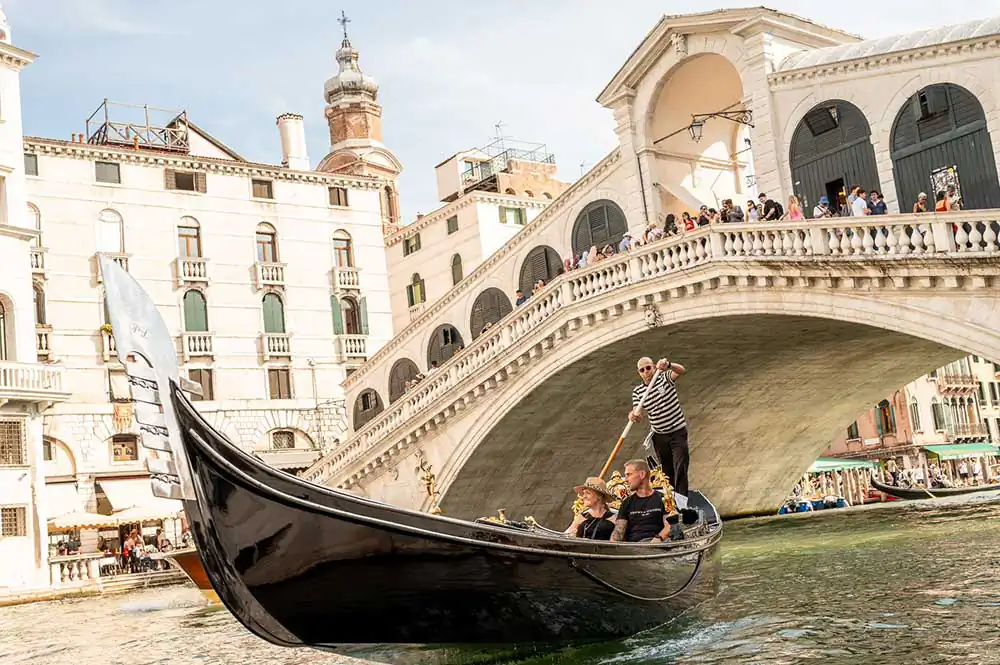
In Virtuoso Venezia by Steven Kruit, the city reveals itself through absence. By entering Venice at dawn, before the arrival of mass tourism, the photographer uncovers a version of the city that is rarely accessible. The stillness of the canals, untouched by boats, transforms the water into a mirror, doubling the architecture and intensifying the visual experience.
This approach is not merely aesthetic but conceptual. The early morning becomes a temporal threshold where Venice returns to itself, where its beauty is no longer mediated by spectacle. The presence of locals, quietly beginning their day, introduces a subtle human dimension that contrasts with the emptiness of the space. Photography here becomes an act of timing, of positioning oneself in the precise moment when the city is most vulnerable and most authentic.
The City as Environmental Warning
Venice as a living indicator of climate crisis
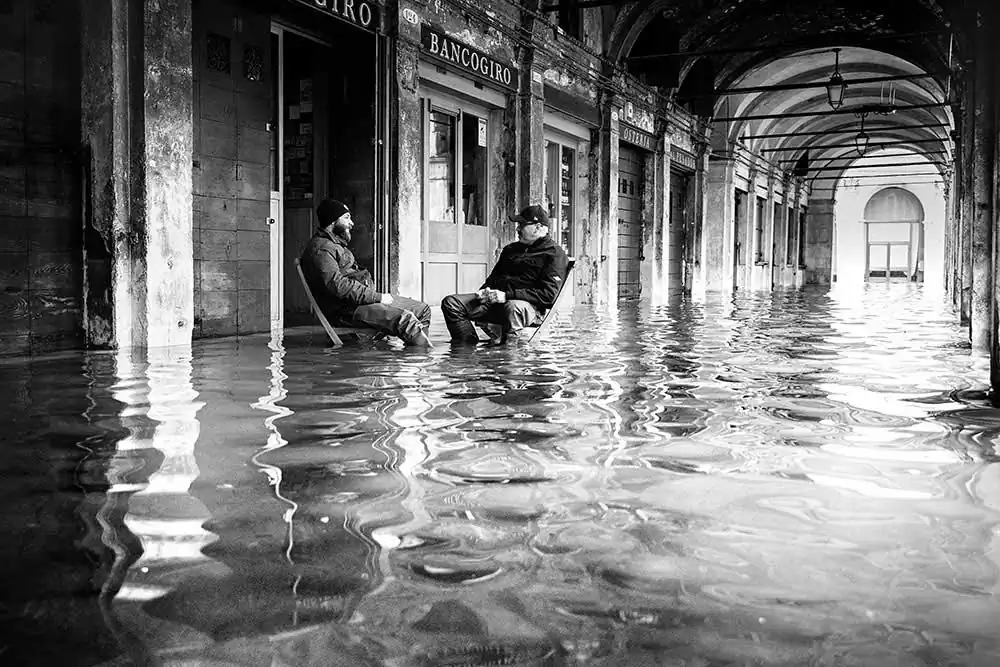
A far more critical perspective emerges in The Last Tide by Marco Campi, where Venice is no longer a symbol of beauty but a site of urgency. The rising frequency of extreme tides, driven by sea level rise, subsidence and changing climatic conditions, transforms the city into a fragile system on the brink of collapse.
This work situates Venice within a global narrative of environmental change. The data is not abstract; it is embodied in the city itself, in its flooding streets and threatened structures. Photography, in this context, becomes a form of evidence, a visual articulation of processes that are often invisible in their gradual progression. The city is no longer timeless; it is temporal in the most critical sense, defined by its vulnerability to forces beyond human control.
The City as Timeless Abstraction
Black and white as a tool to suspend time
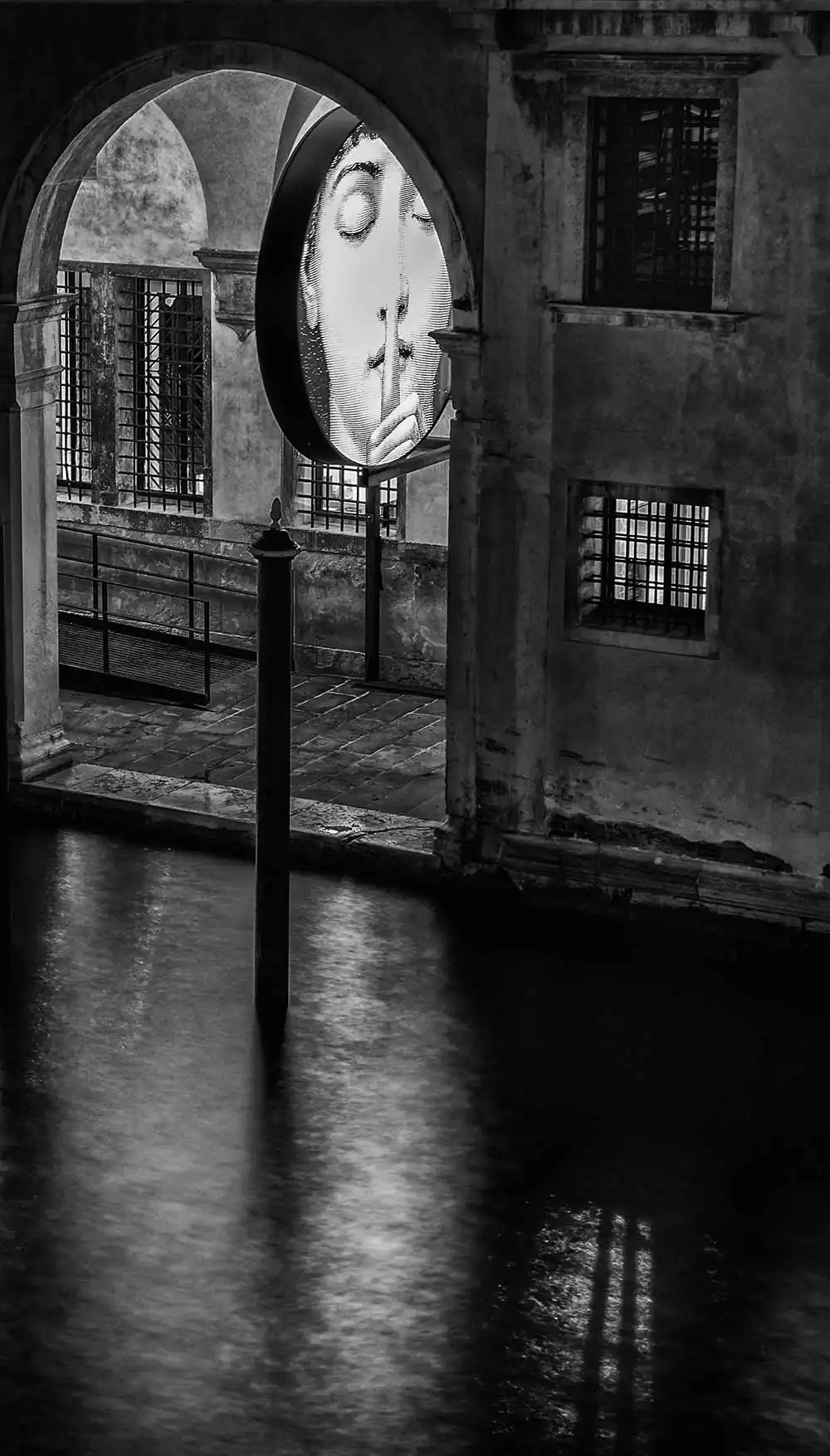
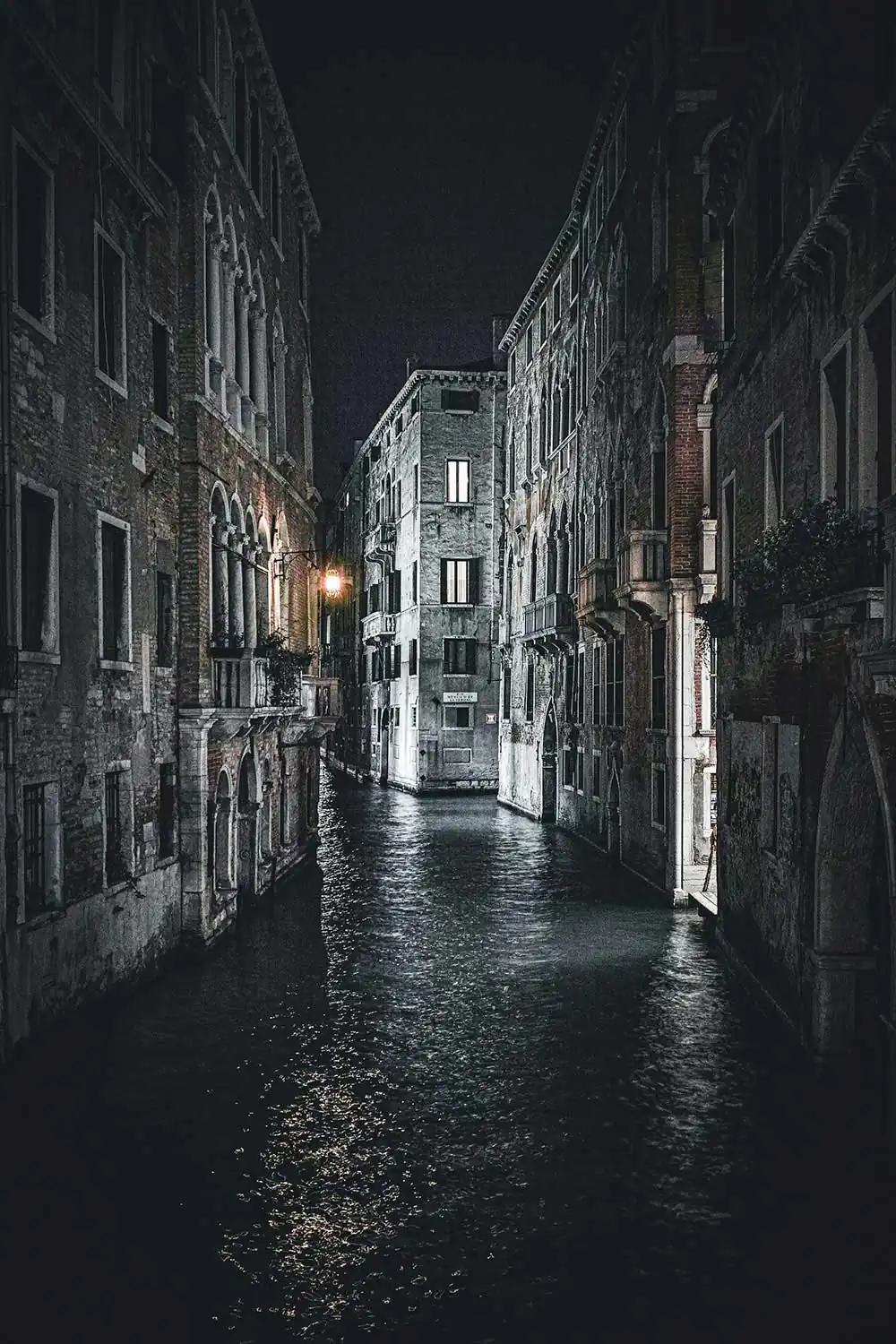
In Frozen in Time by Roland Blum, Venice is stripped of its contemporary noise and reimagined as a timeless construct. The use of black and white, combined with the absence of human figures, removes the city from the immediacy of the present, allowing it to exist in a suspended state between past and present.
This aesthetic choice is deeply rooted in the photographer’s analog discipline, where each image is the result of deliberate observation rather than spontaneous capture. Venice, in this series, becomes almost unreal, a silent and contemplative space where architecture and water merge into a single visual language. The city is not documented as it is, but as it feels when freed from the distractions of tourism and movement.
The City as Narrative and Movement
Walking as a method to uncover hidden layers
Venice by Giacomo Brunelli: A Film-Noir Vision of the Floating City introduces a more dynamic and narrative approach. For Brunelli, photography begins with walking, with the act of moving through space as a way of discovering visual possibilities. Venice is not static but experienced as a sequence of encounters, where bridges, canals and fleeting figures construct a fragmented narrative.
The film-noir aesthetic reinforces this sense of ambiguity. The city appears both familiar and distant, its forms softened and its inhabitants reduced to anonymous presences. This approach highlights the tension between permanence and change, suggesting that Venice is not only a physical space but also a psychological one, shaped by memory, movement and perception.

The City as Decadent Memory
Romanticism, history and the weight of cultural imagination
In Maximilian Chini; Venice and its canals, Venice emerges as a city saturated with history and symbolism. The narrative oscillates between personal experience and collective imagination, drawing on centuries of cultural references that have defined Venice as a space of romance, decadence and contradiction.
The city is presented as both a living environment and a mythological construct. Its canals, its fog, its seasonal transformations all contribute to a sense of ambiguity, where reality and fiction intertwine. Venice becomes a place where one can lose oneself, not only physically but conceptually, navigating a space that resists linear understanding.
Venice as a Vanishing Image
Between permanence and disappearance
Across these projects, Venice reveals itself as a city that exists in tension. It is beautiful yet fragile, timeless yet threatened, familiar yet constantly slipping away. Photography, in this context, does not preserve Venice as a static image but captures its instability, its ongoing negotiation with time, water and human presence.
What ultimately emerges is not a definitive portrait, but a series of interpretations that, together, suggest that Venice can only be understood through its contradictions. It is a city that invites contemplation not because it is fixed, but because it is perpetually in the process of disappearing.