

When I returned to Iceland in 2024, I became increasingly aware of how profoundly the experience of many well-known natural sites had changed.
What had once seemed open and almost boundless was now often organised through paths, viewing platforms, parking areas and carefully directed routes.
At the same time, growing numbers of visitors moved through these places in recurring patterns: arriving, stopping, looking, photographing and leaving again.
The initial idea for SPHERES COLLIDING emerged from this observation. At that point, it was less a clearly defined project than a sense that something was beginning to take shape. I made the first experimental sequences of photographs and later, back home, began testing different ways of combining them. I wanted to find a visual method that could preserve the individual moments while making the accumulation of human presence perceptible.
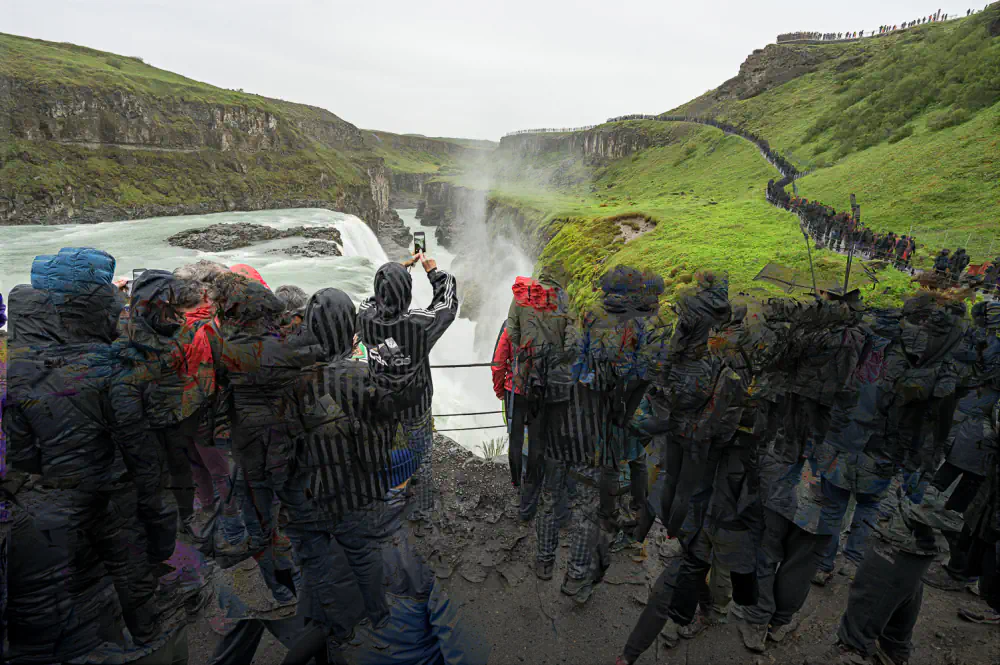
Close to the waterfall, overlapping visitors fill the foreground. Railings and the edge of the path contain their movements, while spray partly obscures the view beyond. The photograph places the viewer within the crowd, where the encounter with the falls is shared at close quarters.
These experiments became the basis for the project I developed when I returned to Iceland in 2025. The photographs for SPHERES COLLIDING were taken during this journey.
I was not interested in documenting tourism in a conventional sense. Nor did I want to portray individual visitors. Instead, I began to observe what happened when many brief human presences accumulated within landscapes shaped by processes extending far beyond human time.
For each image, I photographed the same scene repeatedly over several minutes and later combined the exposures into a single image. Depending on the location, the photographs span approximately two to eleven minutes. Bodies overlap, dissolve and merge into collective patterns.
The resulting images do not represent a single moment. They contain many moments at once.
Icelandic landscapes are formed by geological processes that operate over immense periods of time: volcanic activity, glacial movement, erosion and tectonic shifts. Against this duration, the presence of a visitor is extremely brief.
Two different temporal spheres meet in the images: the long duration of the landscape and the rhythm of repeated human visits.
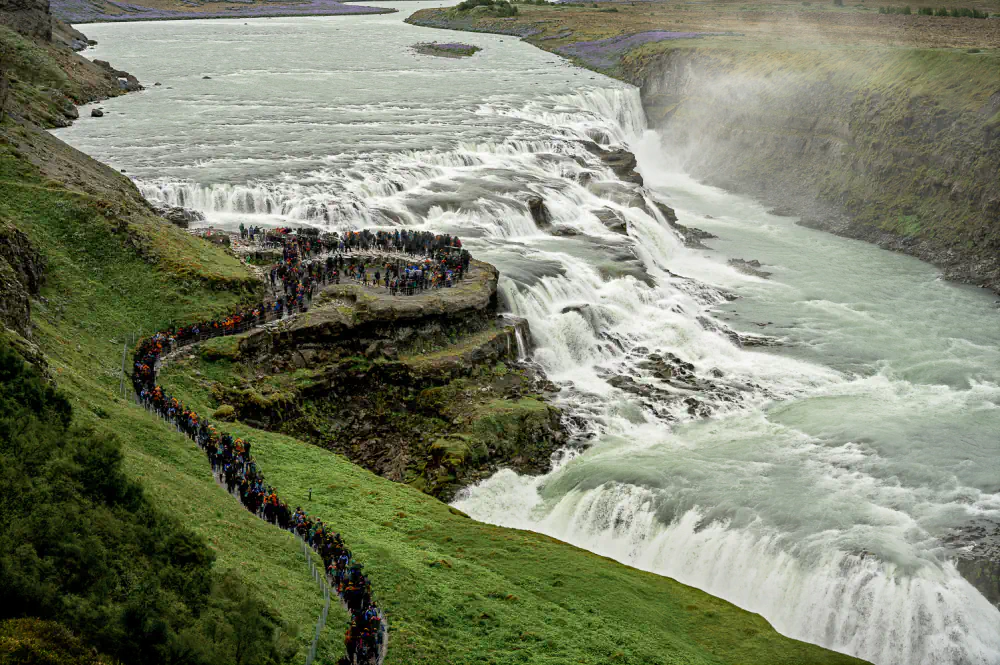
Seen from above, Gullfoss occupies much of the image, while visitors form a compact band on the lower viewing area. The elevated perspective reveals how the approach and the viewpoint organise access to the falls.
The landscape appears stable, yet it is itself constantly changing. The visitors seem fleeting, yet through photographic accumulation they form a dense, dark mass that threads its way through the landscape. Individual figures become difficult to distinguish within it.
Photography usually isolates a fraction of a second and turns it into a fixed image. In SPHERES COLLIDING, I allow many moments to occupy the same pictorial space. The photograph becomes a field in which time accumulates.
Individual gestures and identities gradually disappear. The movements described above become almost choreographic when seen together, revealing how paths and viewing areas shape the encounter with a place.
The project was created at sites across Iceland, including Silfra, Jökulsárlón, Diamond Beach, Fjaðrárgljúfur, Svínafellsjökull, Skógafoss and Gullfoss. Each place has its own physical character, yet similar patterns of human behaviour emerge repeatedly.
I do not see these photographs primarily as a criticism of tourism. I am part of the same system: I travel to these places, I look, and I photograph. The work arises from participation rather than distance.
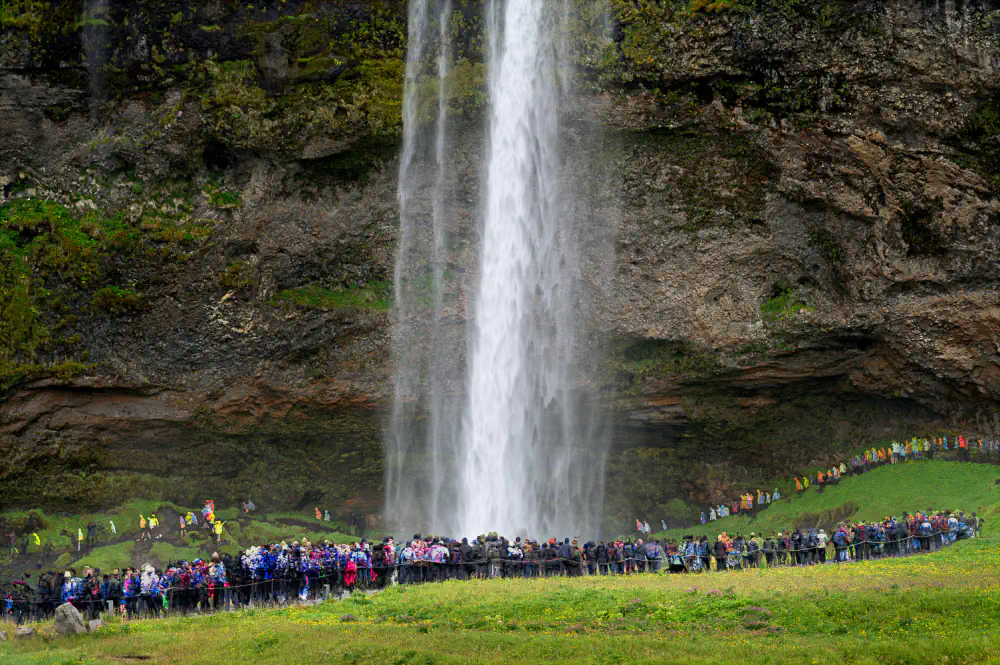
At Seljalandsfoss, visitors form a dark band along the foot of the cliff. The narrow line of human presence follows the path beneath the falling water, tracing the route through which the site is experienced.
At the same time, another concern lies beneath the project: the growing density of human presence, the finiteness of space and the pressure placed on natural environments. This concern remains an underlying tension rather than an explicit argument. Through the accumulation of brief visits, places that appear vast become visibly occupied and structured by human movement.
The images ask what happens when different scales of time, movement and attention occupy the same space.
At a certain point, the distinction between landscape and human activity becomes unstable. Geological duration and temporary presence begin to overlap.
Photography makes this collision visible.
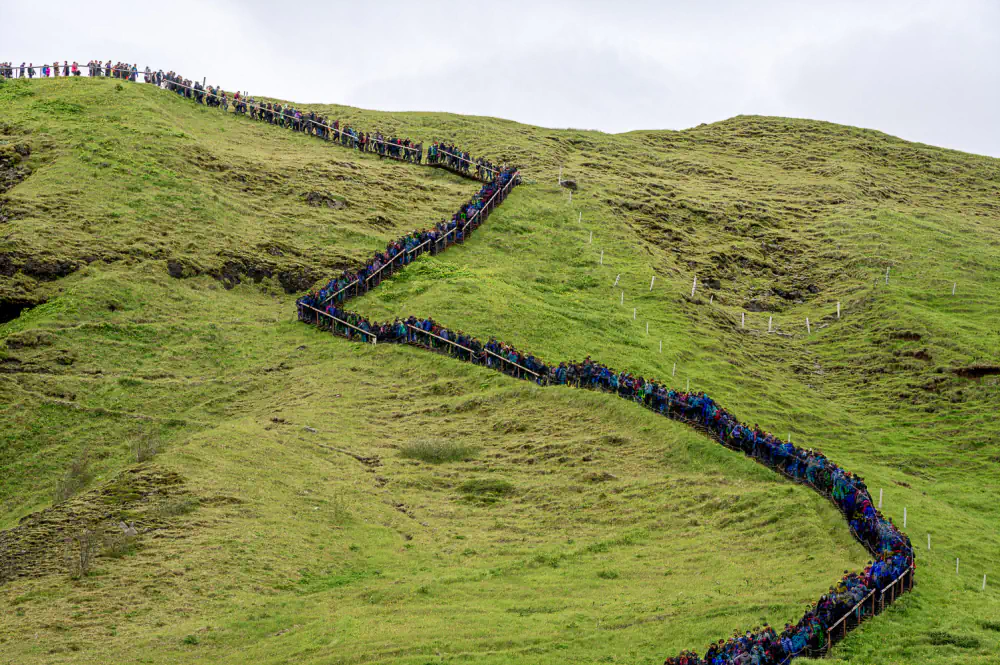
The path to the upper viewpoint at Skógafoss cuts a winding line across the green hillside. Accumulated figures darken its course, making the prescribed route visible from a distance. The landscape remains open around this concentrated line of movement.
About Eckart Bartnik
Eckart Bartnik is a German photographer based in Wiesbaden. His work moves between two complementary approaches: abstraction as a means of exploring natural processes and perception, and reflection on the relationship between people, places, and their environments.
Before focusing on photography, Bartnik worked for more than three decades as a cell and molecular biologist. His scientific background continues to influence his way of seeing, particularly his interest in structures, transformation, materiality, and the relationship between microscopic and macroscopic scales.
His photographic projects often begin with close observation and evolve into explorations of how images shape perception. Rather than using photography primarily to explain the visible world, he is interested in moments when certainty begins to dissolve and familiar subjects become open to new interpretations.
Bartnik is a member of the German Photographic Society (DGPh). His work has been exhibited and published internationally. In 2026, his series SPHERES COLLIDING was presented at THE GÄLLERY, Staatsgalerie Stuttgart, as part of the UNORDNUNG exhibition during Fotosommer Stuttgart. His work was also exhibited at Kolga Tbilisi Photo 2026. In 2025, his series FLOOD was nominated for the Prix Pictet. [Official Website]
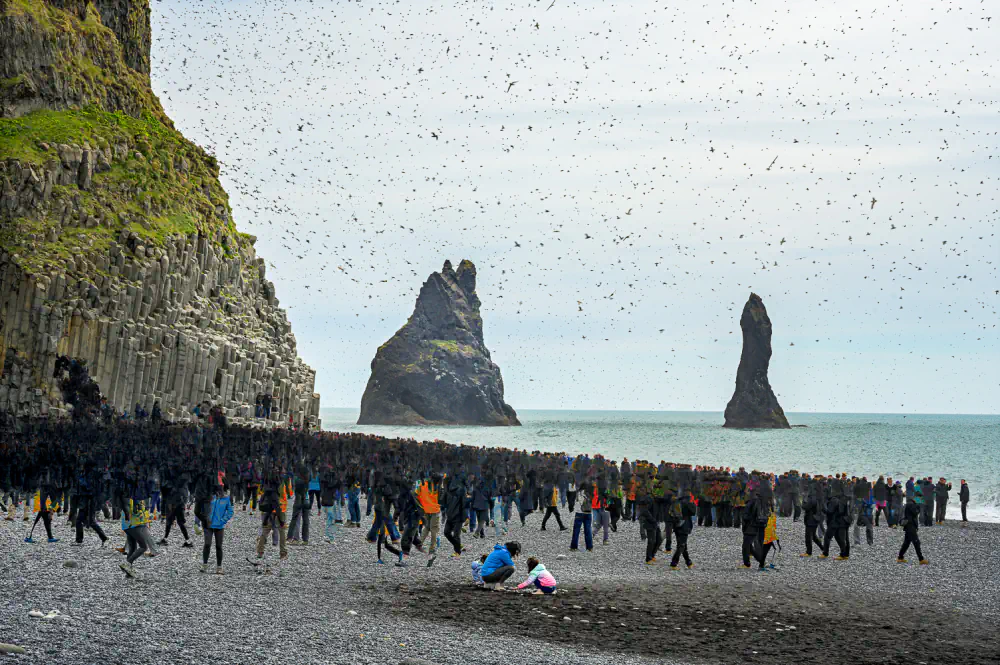
Visitors gather on the black sand at Reynisfjara, facing the Reynisdrangar sea stacks. Their overlapping silhouettes stretch across the beach beneath the open sky. The repeated act of stopping to look gives the shoreline a temporary human boundary.
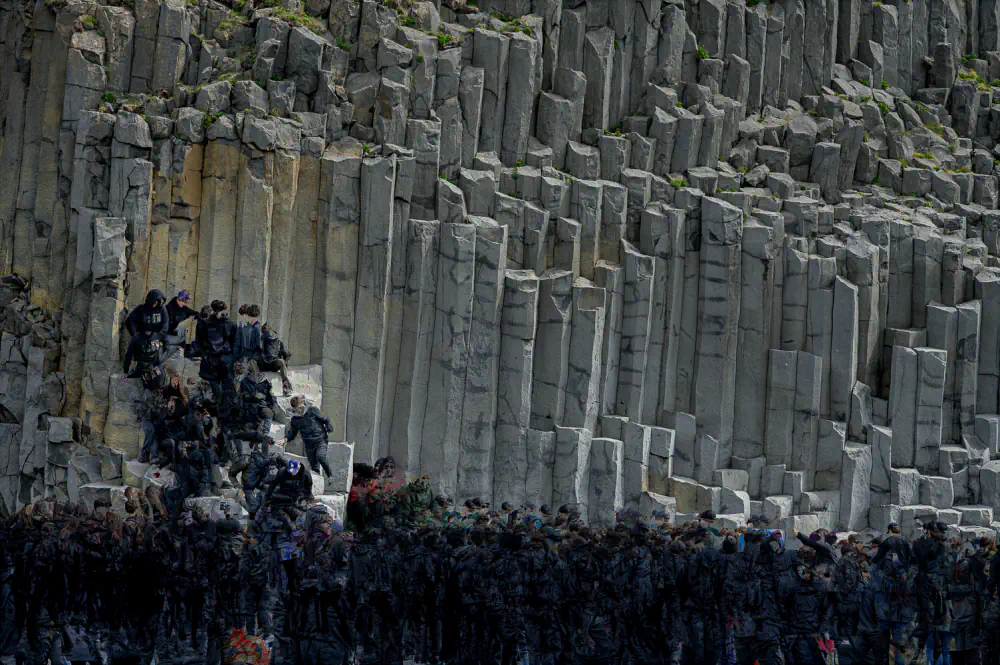
Basalt columns at Reynisfjara form a patterned backdrop to the visitors gathered below. Overlapping bodies cluster at the base of the rock face, with some figures positioned higher against the columns. The geometric structure of the stone contrasts with the shifting outline of the crowd.
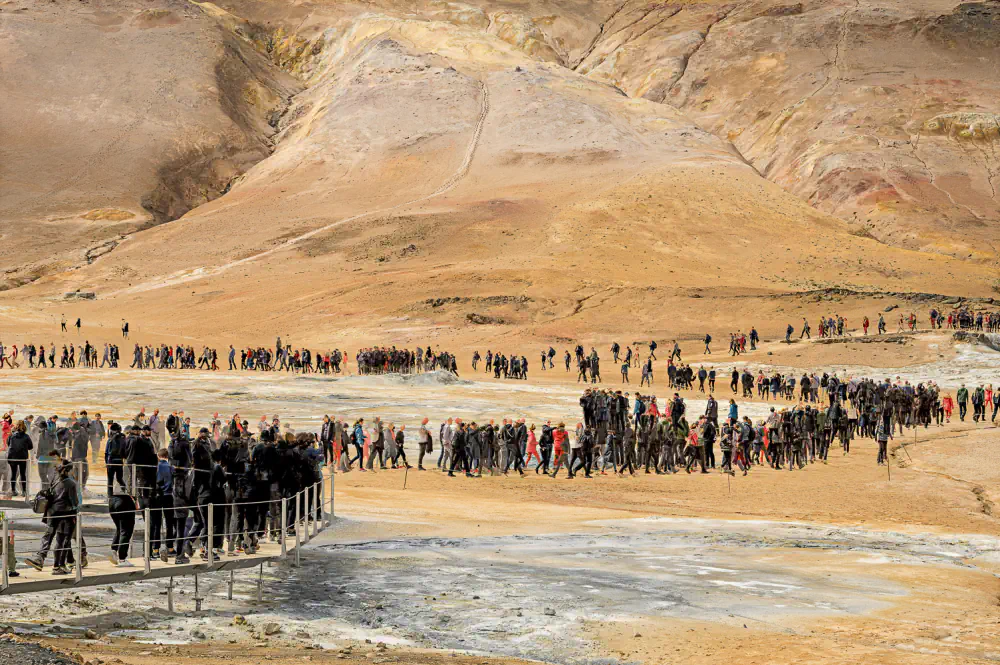
Across the geothermal ground at Hverarönd, visitors appear as scattered groups and thin lines. Seen from a distance, their distribution traces the routes through the pale terrain. Human movement provides a scale for the otherwise difficult-to-read expanse.
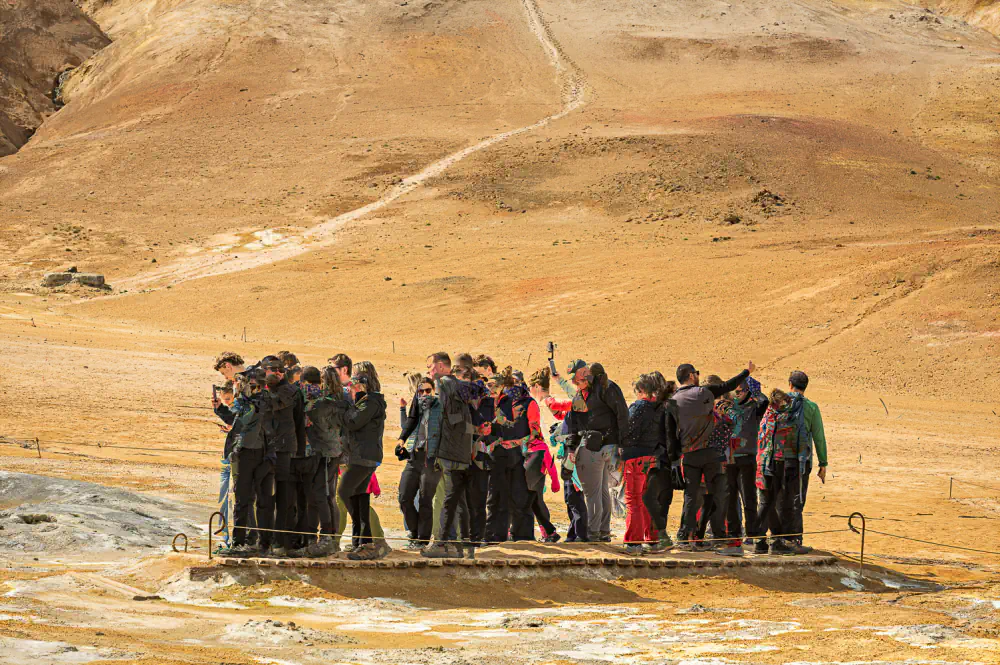
A closer view at Hverarönd brings a group of visitors into the foreground. Overlapping bodies gather on a narrow strip of ground, while the pale slope behind them remains largely empty. Small touches of colour persist within the dark cluster.
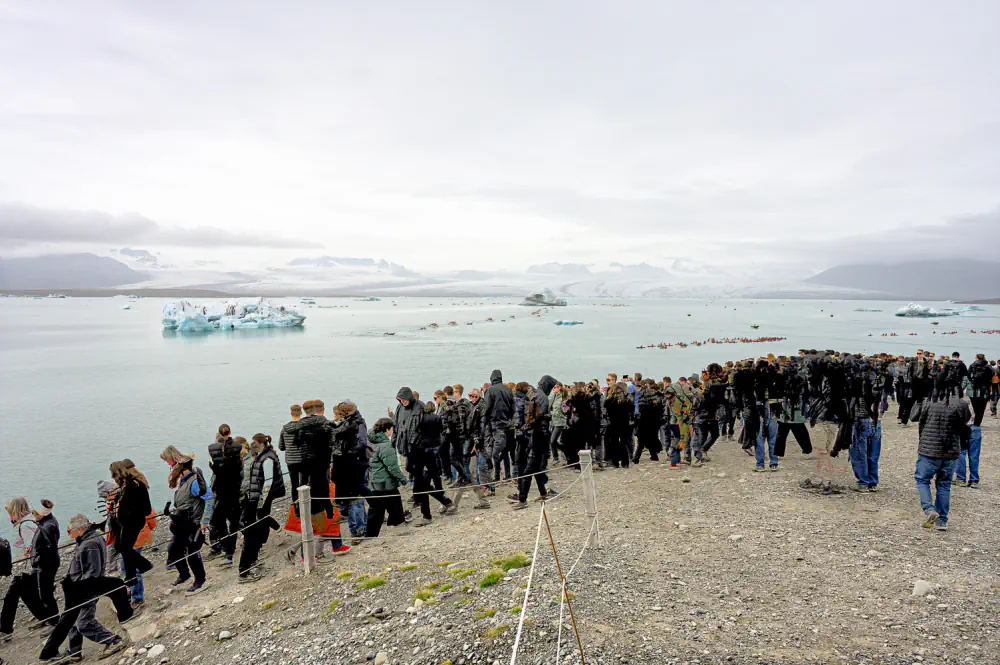
At Jökulsárlón, visitors gather along the edge of the glacier lagoon, facing the drifting ice. Their overlapping bodies form a continuous band across the foreground. The view remains open beyond them, while the shore concentrates the act of looking.
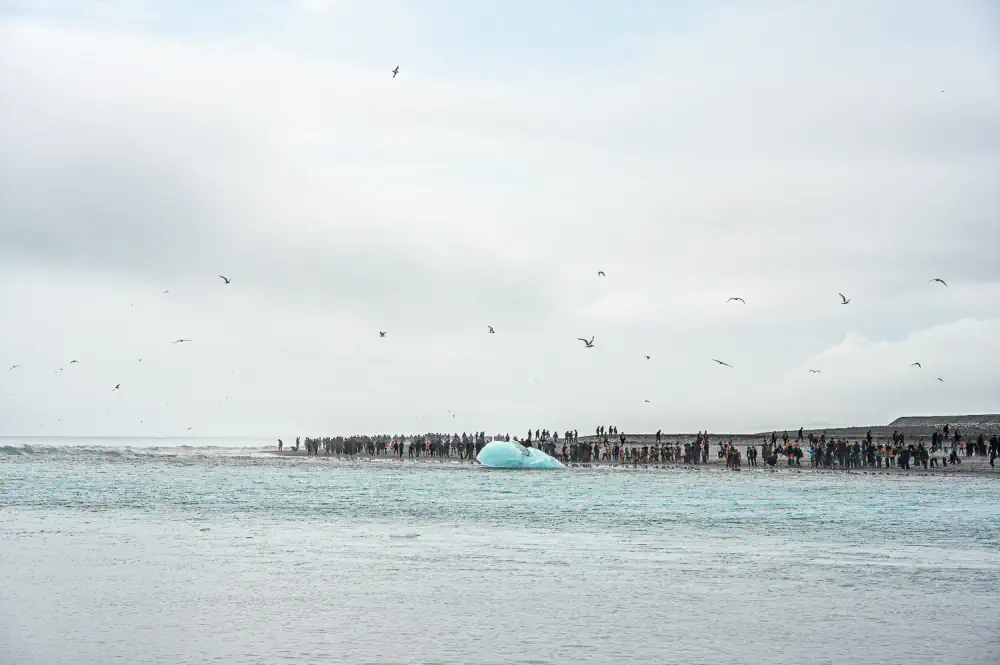
At Diamond Beach, visitors gather along the dark shoreline beside scattered ice fragments. Seen across the water, the crowd becomes a low band between sea and sky. The distance makes individual encounters with the ice difficult to distinguish.
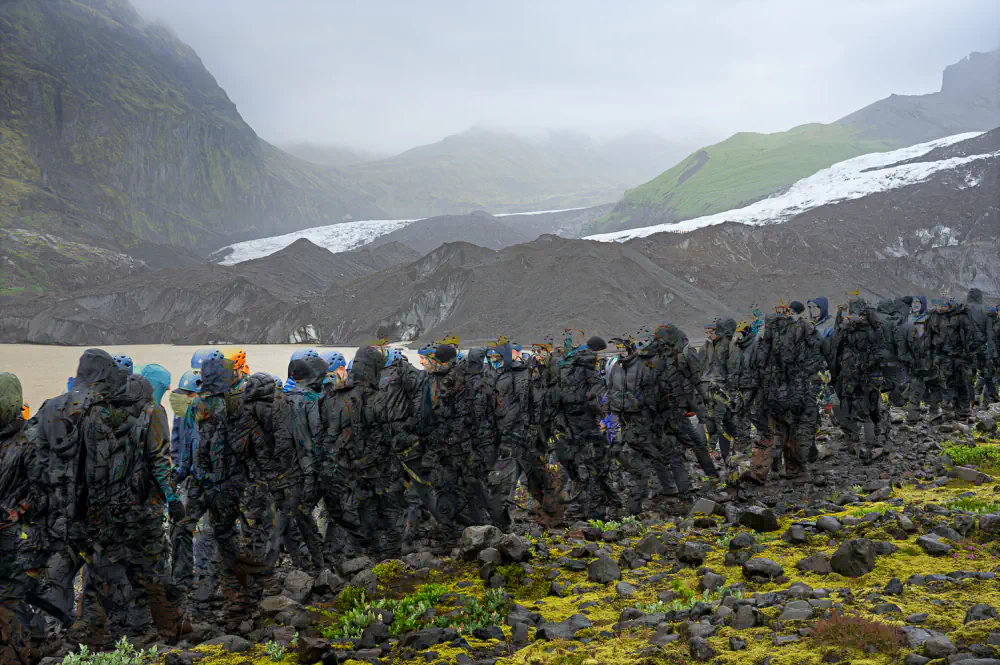
At Svínafellsjökull, overlapping visitors form a dense line across the foreground. The glacier and the surrounding slopes remain visible beyond them. Faces and gestures become indistinct, while small areas of bright clothing remain within the dark accumulation.
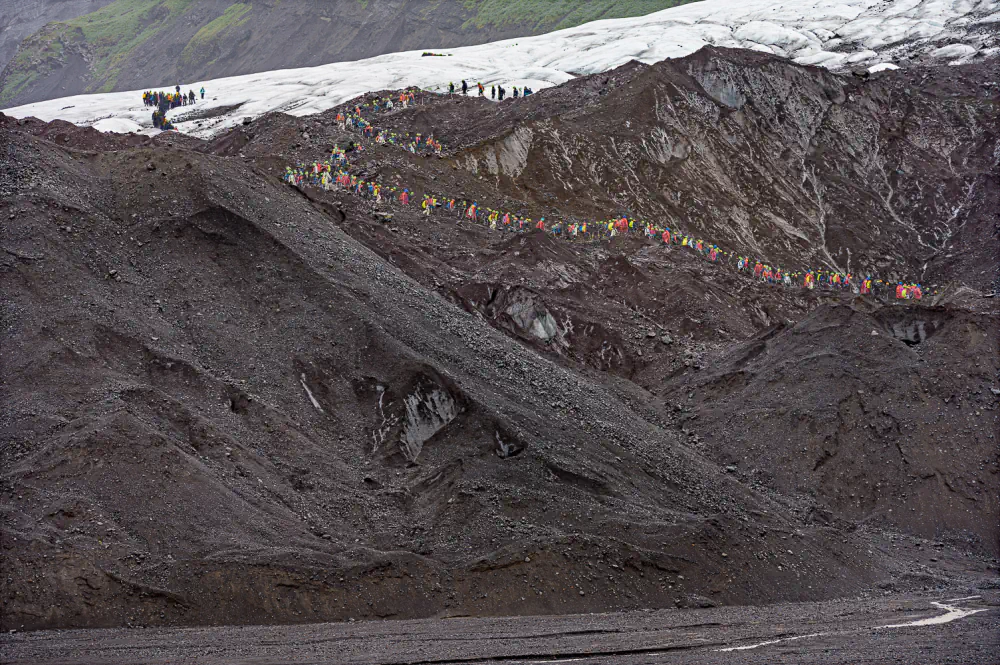
From a distance, visitors at Svínafellsjökull become a thin line across the broad grey slope. Their small scale changes the balance of the image: the route is discernible, but the surrounding terrain occupies most of the view.
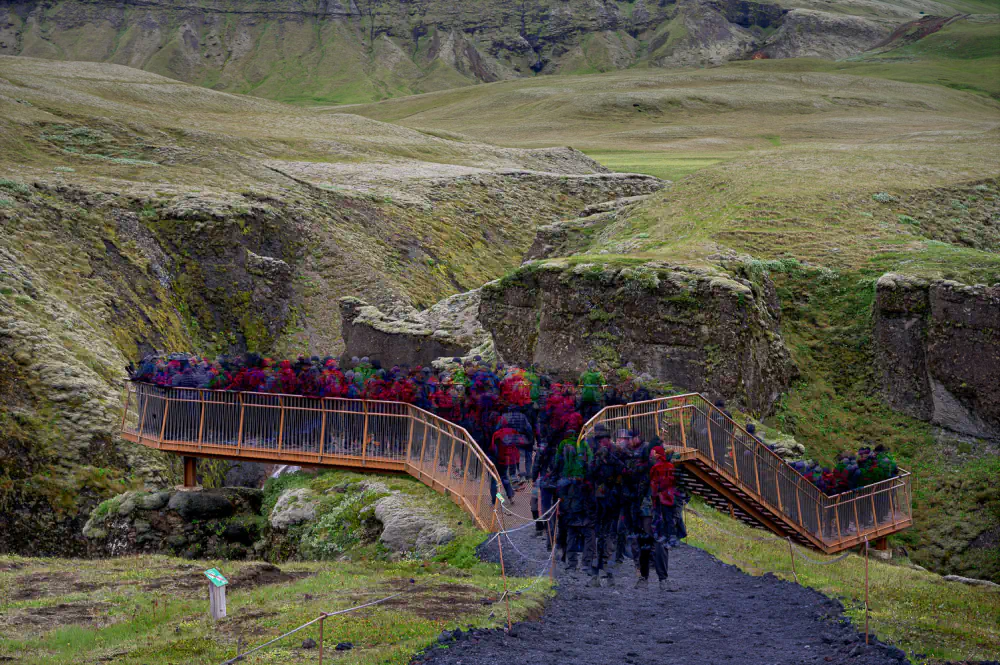
This view of Fjaðrárgljúfur shows the platform and its approach as a single structure set against the canyon. Visitors accumulate at the bend and along the railings, outlining the place where movement gives way to looking.
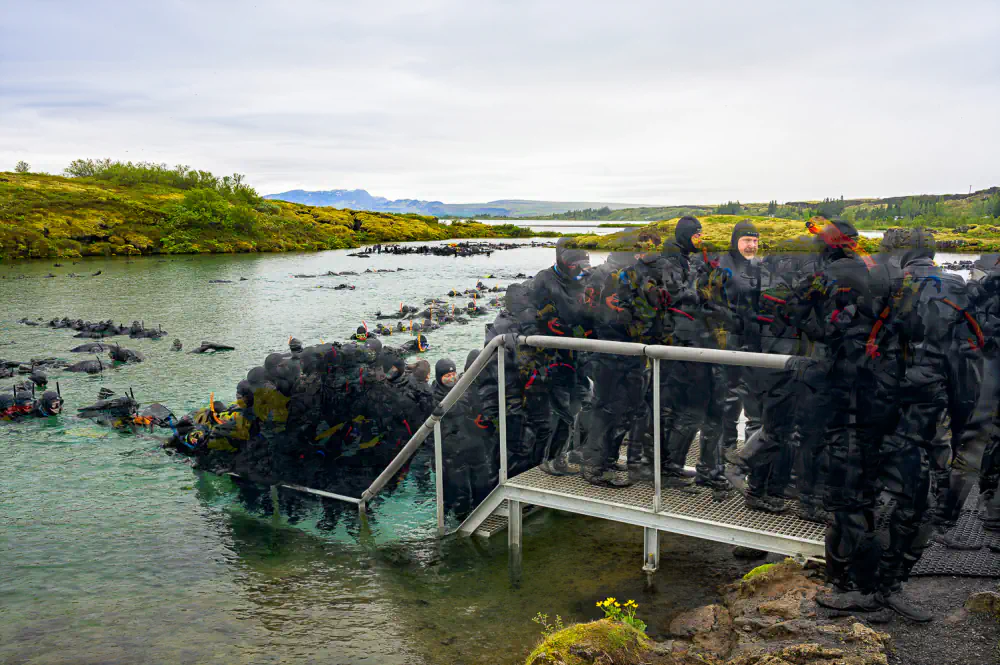
At Silfra in Þingvellir, visitors in dark suits gather around the steps leading into the water. The small access structure concentrates their movements within a narrow space, making the entry point more visually prominent than the fissure itself.
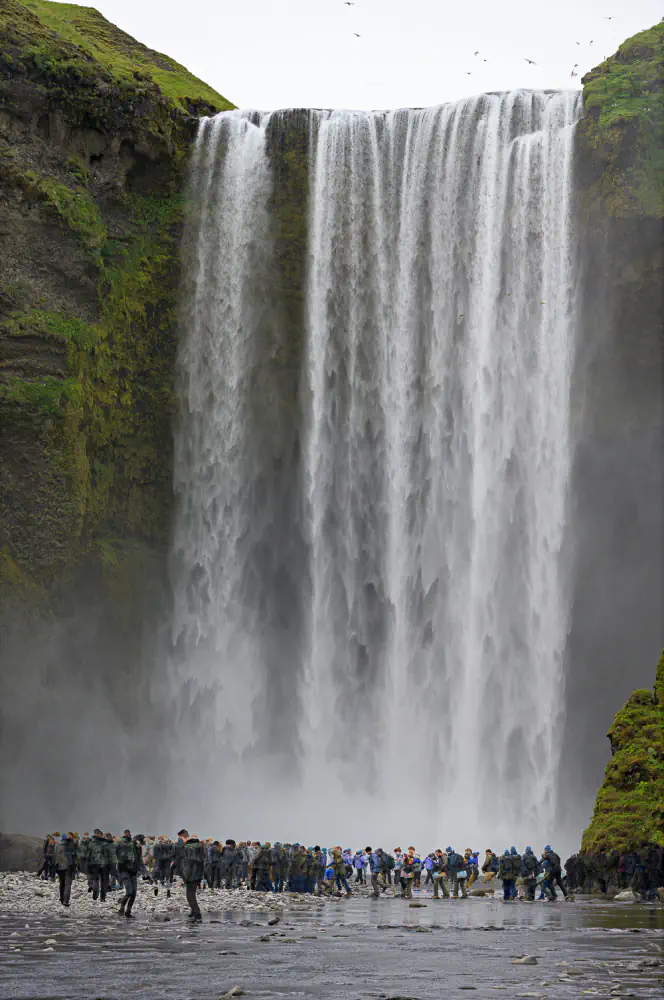
The vertical framing at Skógafoss emphasises the height of the falling water. Visitors gather in a low band at its foot. The difference in scale remains pronounced even as repeated arrivals thicken the human presence.
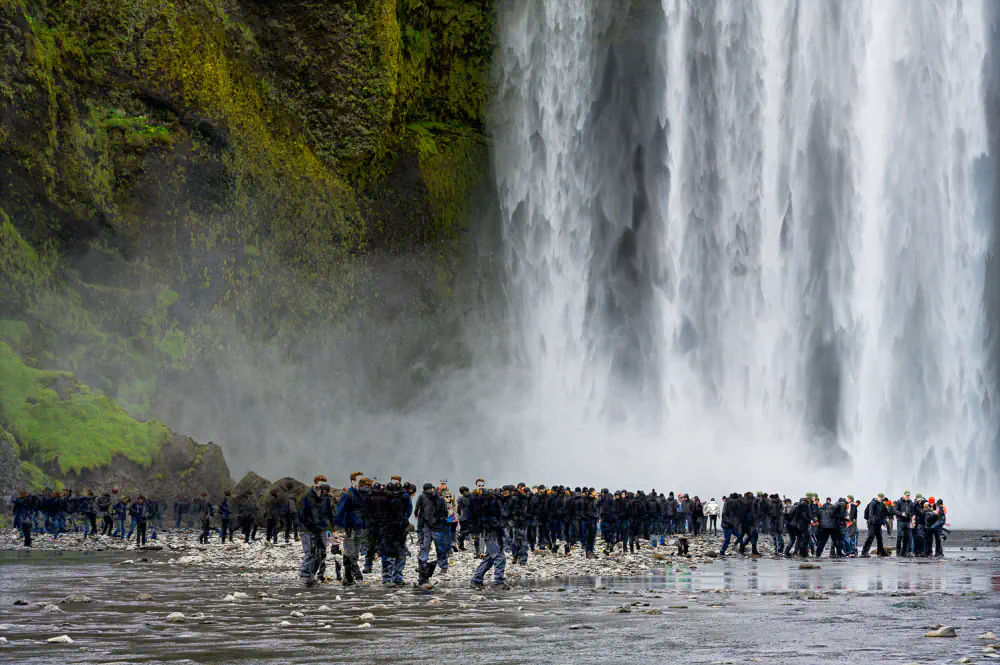
Closer to Skógafoss, the crowd extends across the foreground beneath the falling water. Spray softens the boundary between the figures and the falls. Individual bodies remain partly visible within a nearly continuous band of human presence.
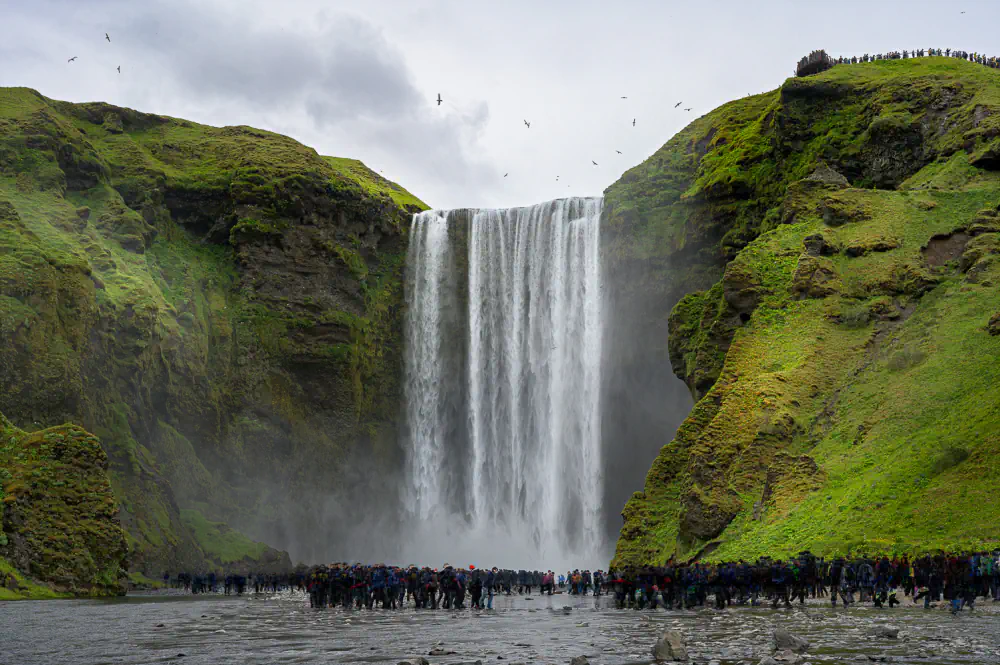
At Skógafoss, a broad view sets the visitors against the waterfall and the green cliffs. Their accumulated presence forms a dark band at the base of the falls, revealing how the open ground becomes a shared viewing area
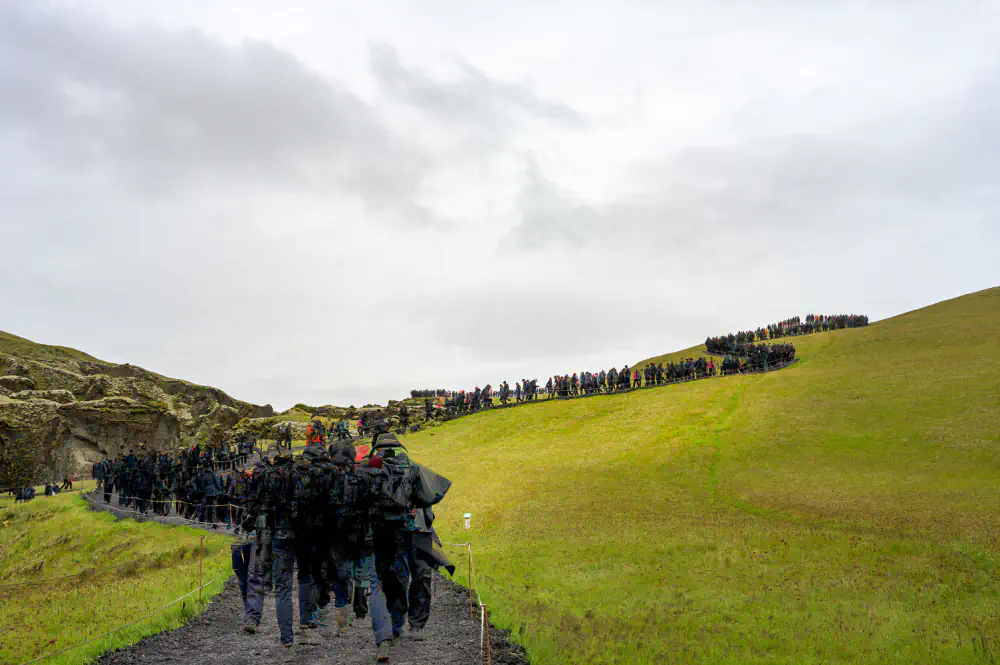
Above Fjaðrárgljúfur, visitors follow a path across the grassy slope. The overlapping figures are dense in the foreground and recede into a thin line along the ridge. The route connects these different scales of human presence within one image.
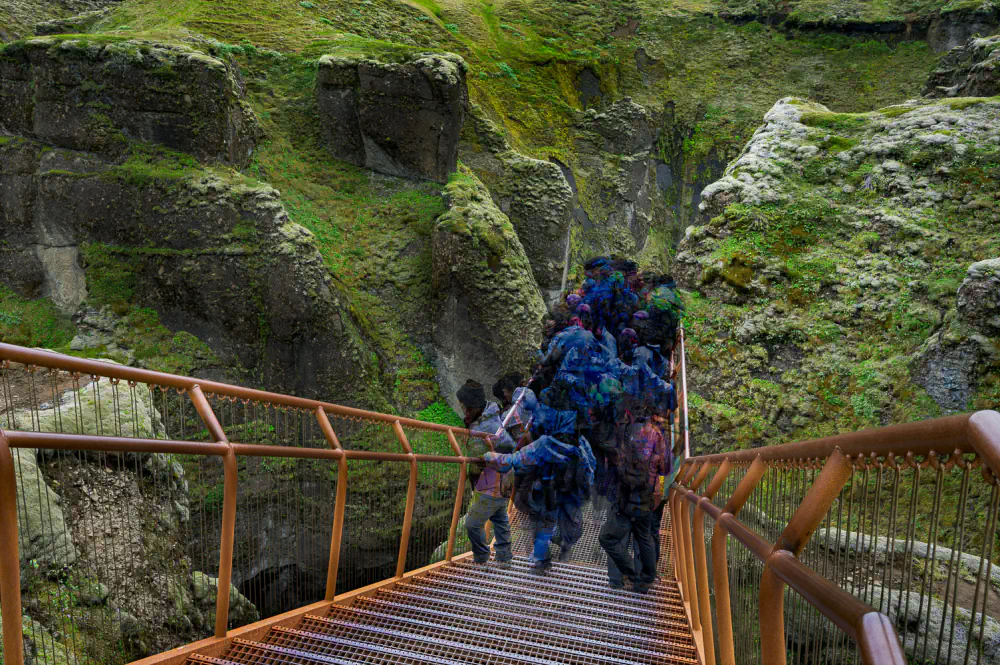
At Fjaðrárgljúfur, visitors overlap on the narrow approach to a viewing platform. The railings frame their bodies and direct the view into the canyon. The confined passage brings human presence close to the viewer.
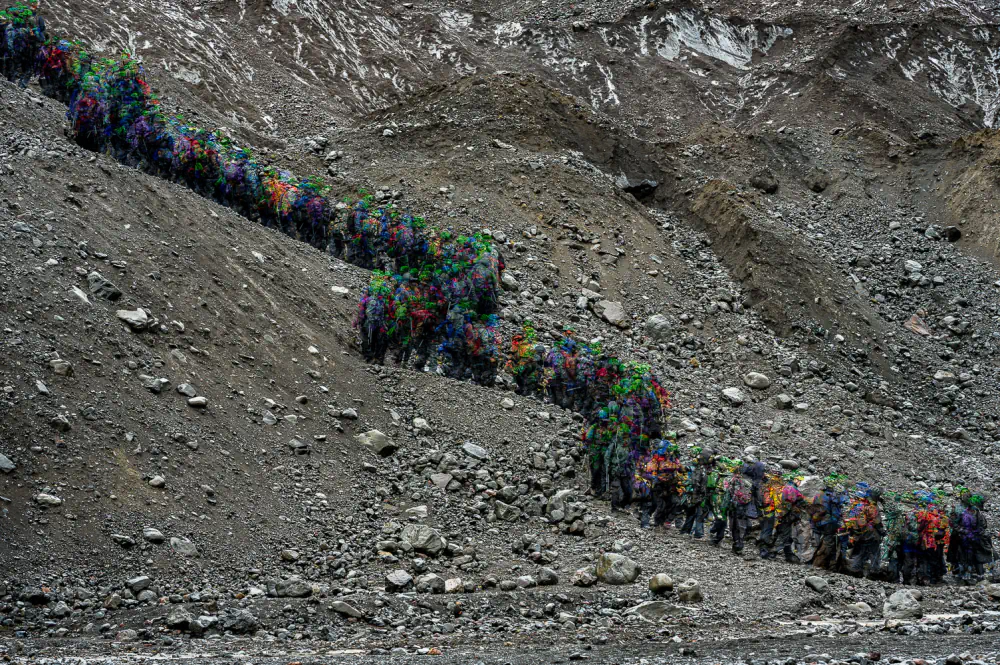
In this closer view at Svínafellsjökull, the accumulated figures form a dark ribbon across the stony ground. Colour and fragments of bodies remain visible within it, but the line of movement becomes more legible than any individual visitor.