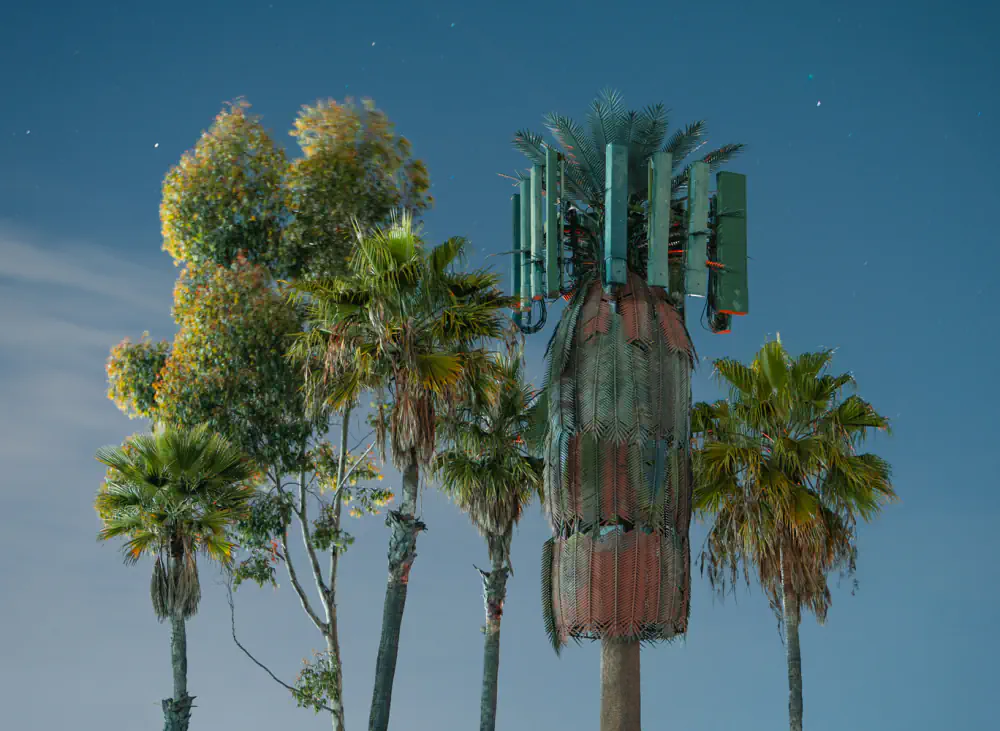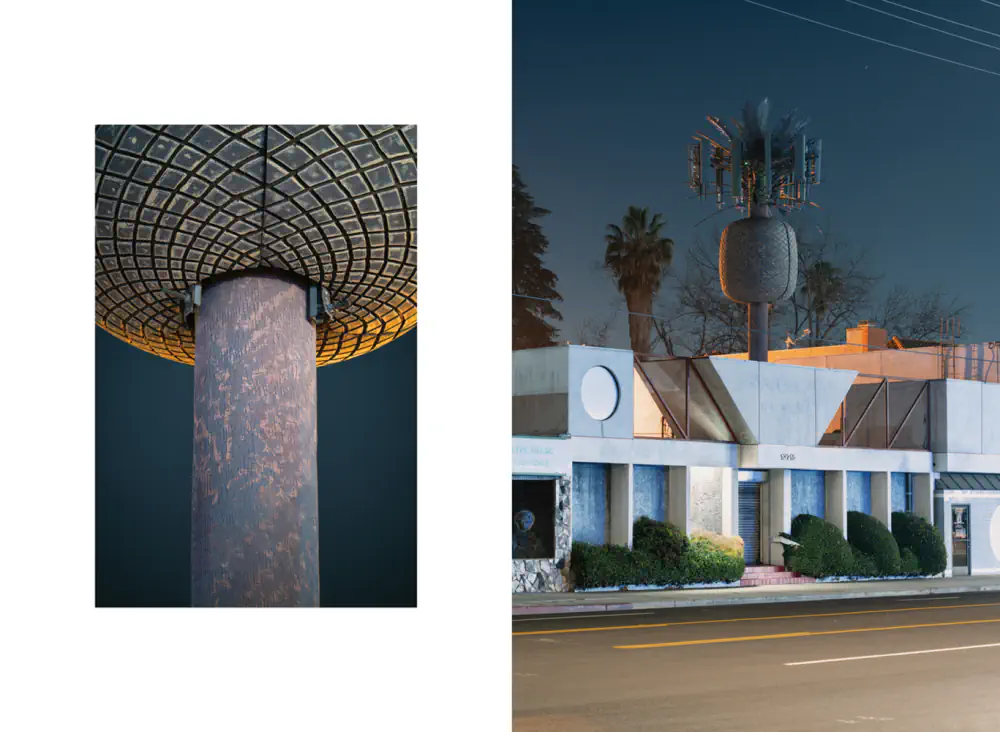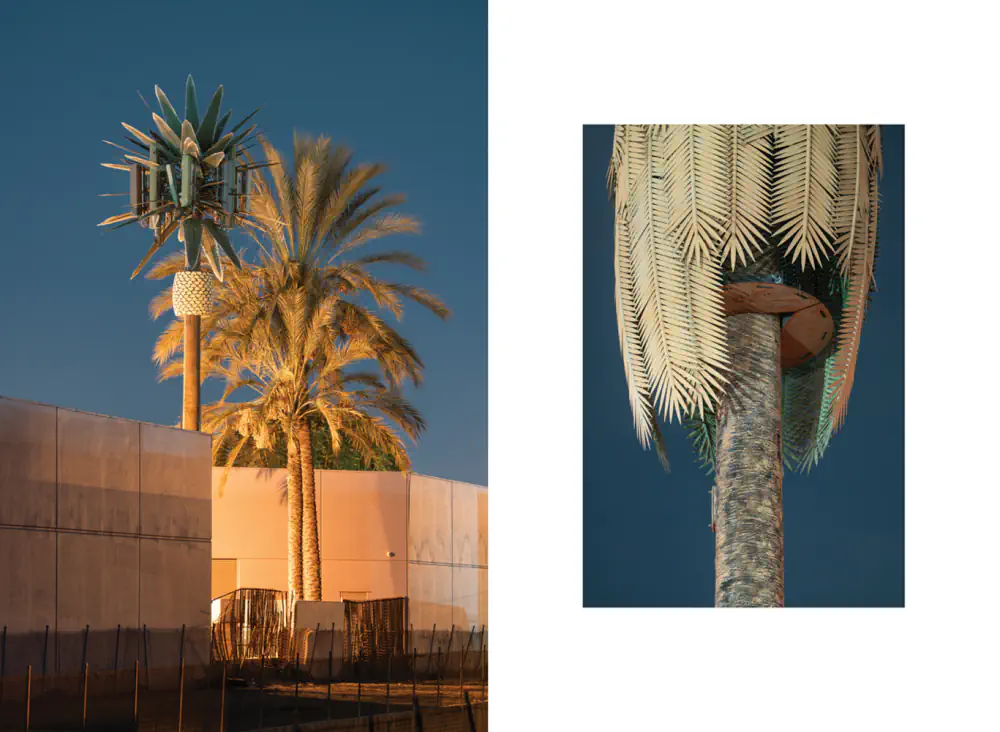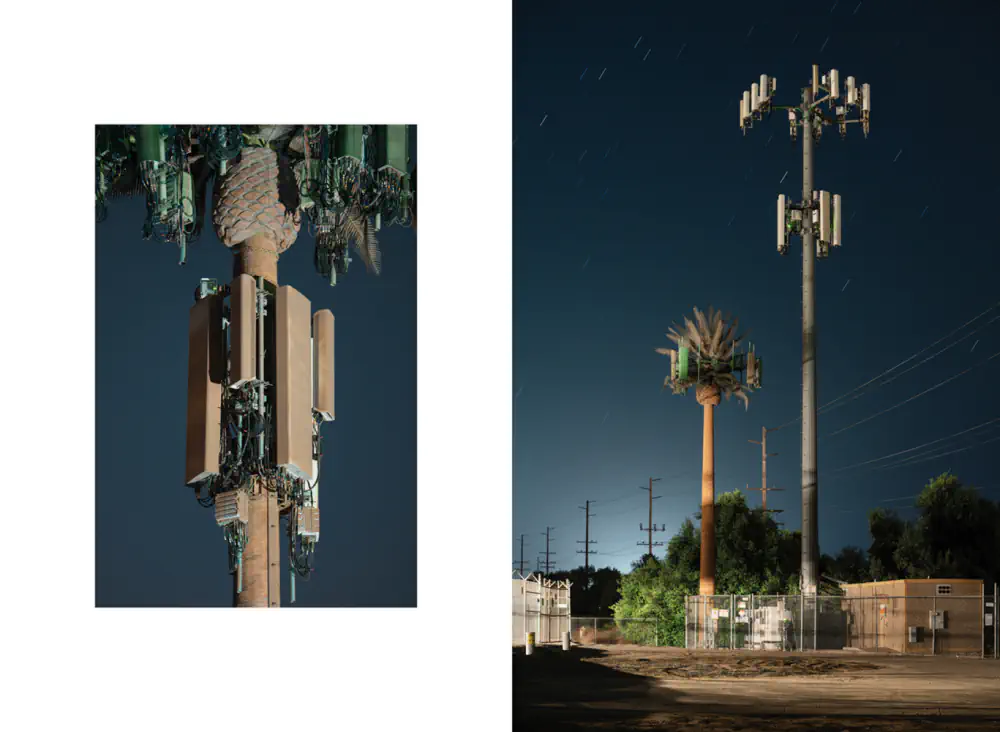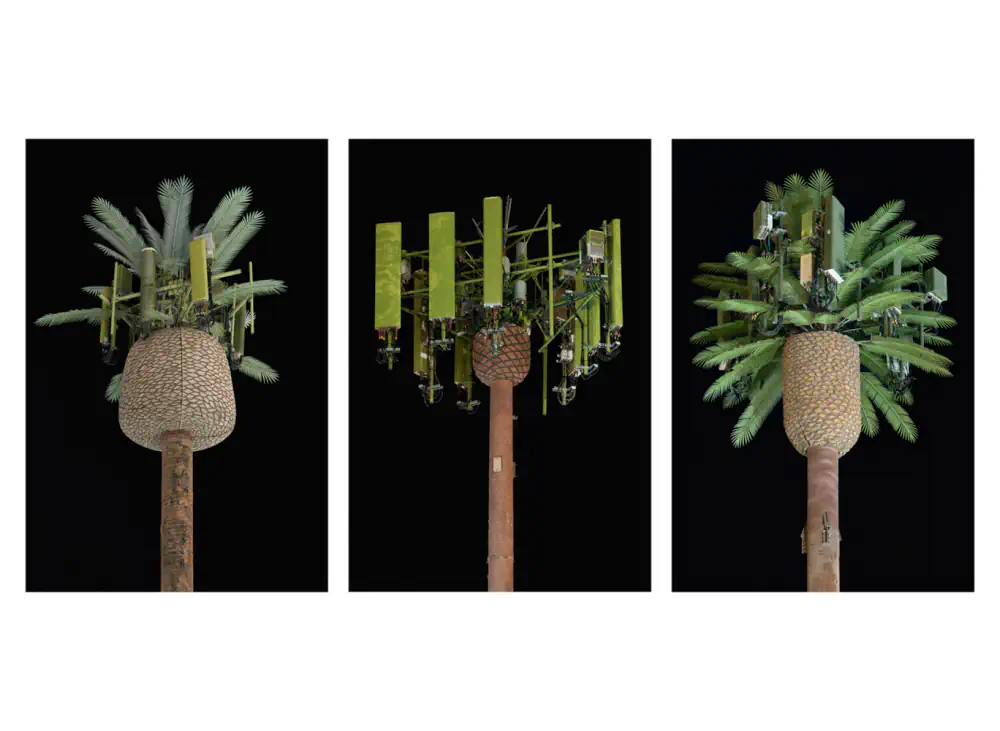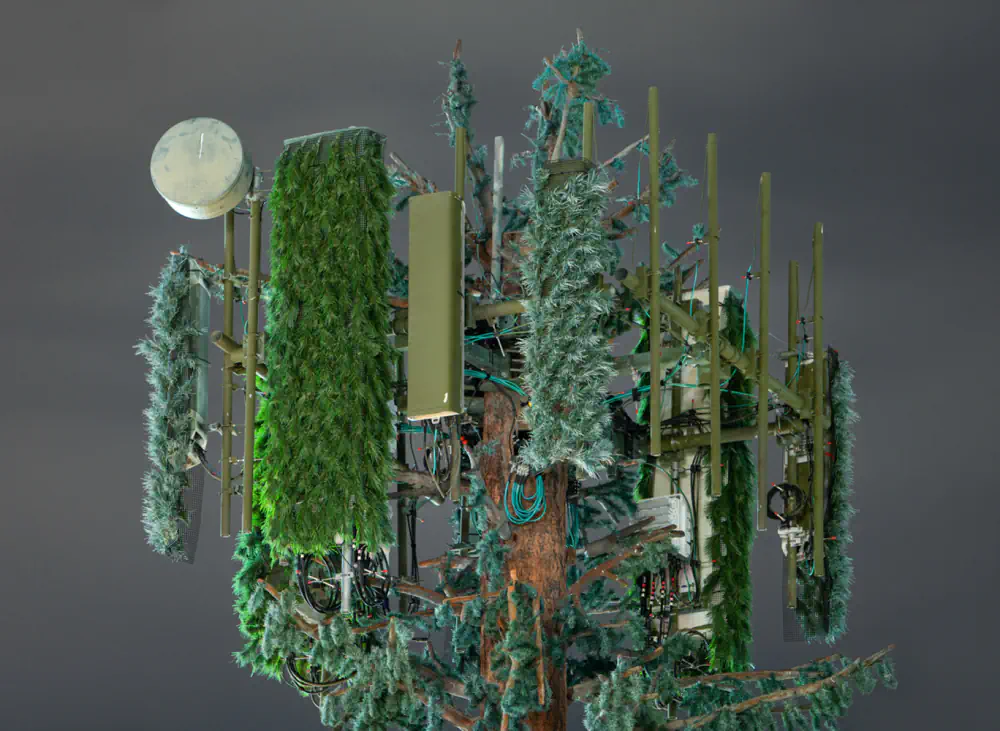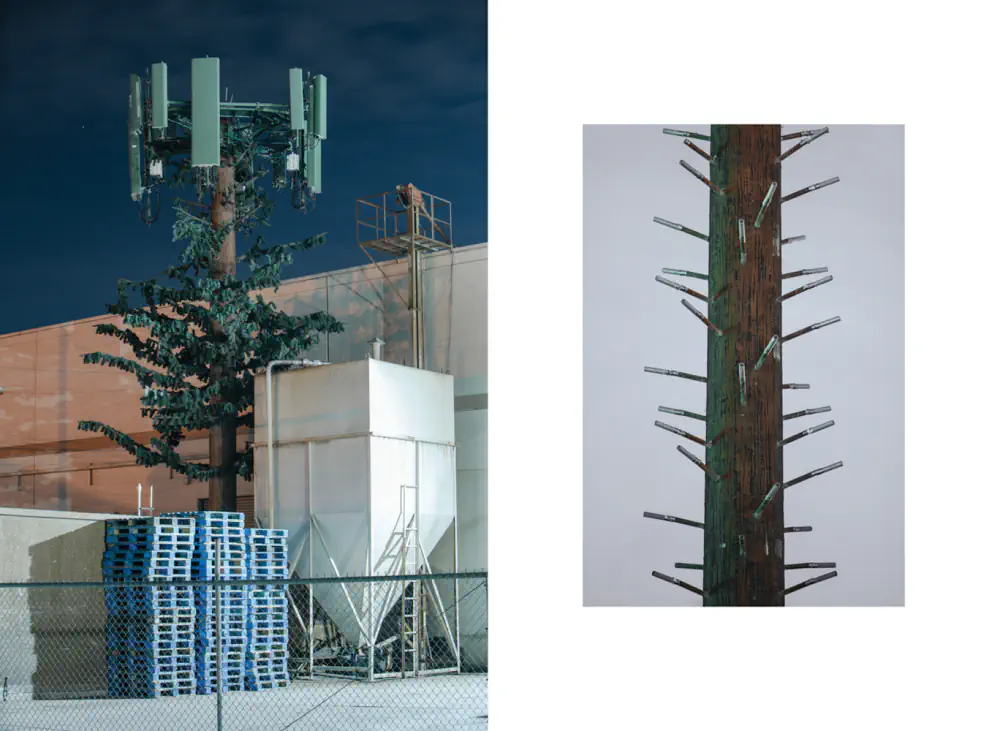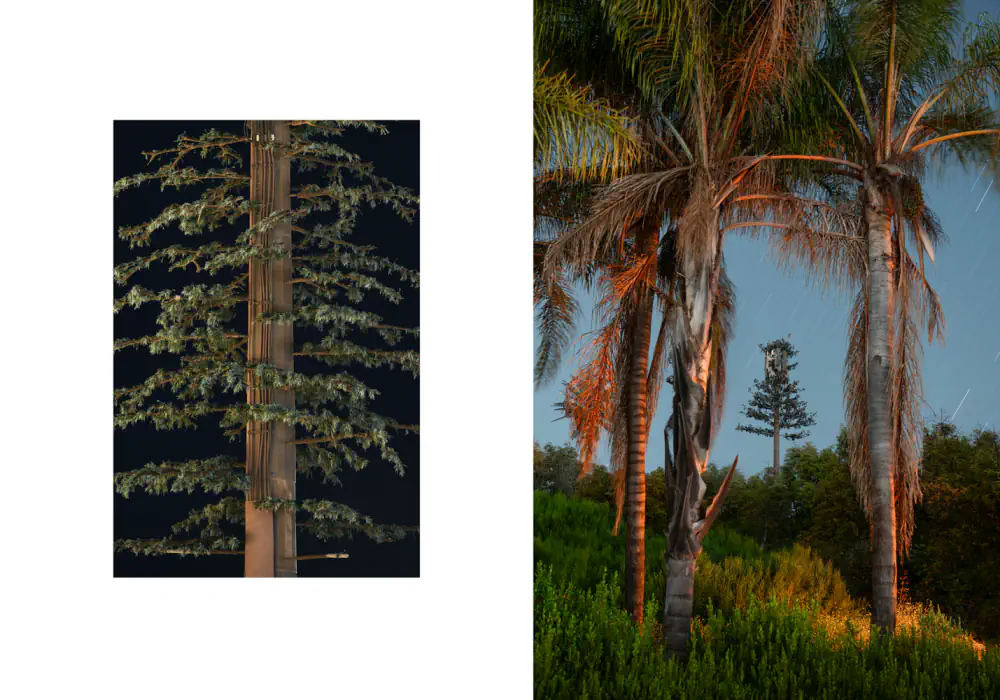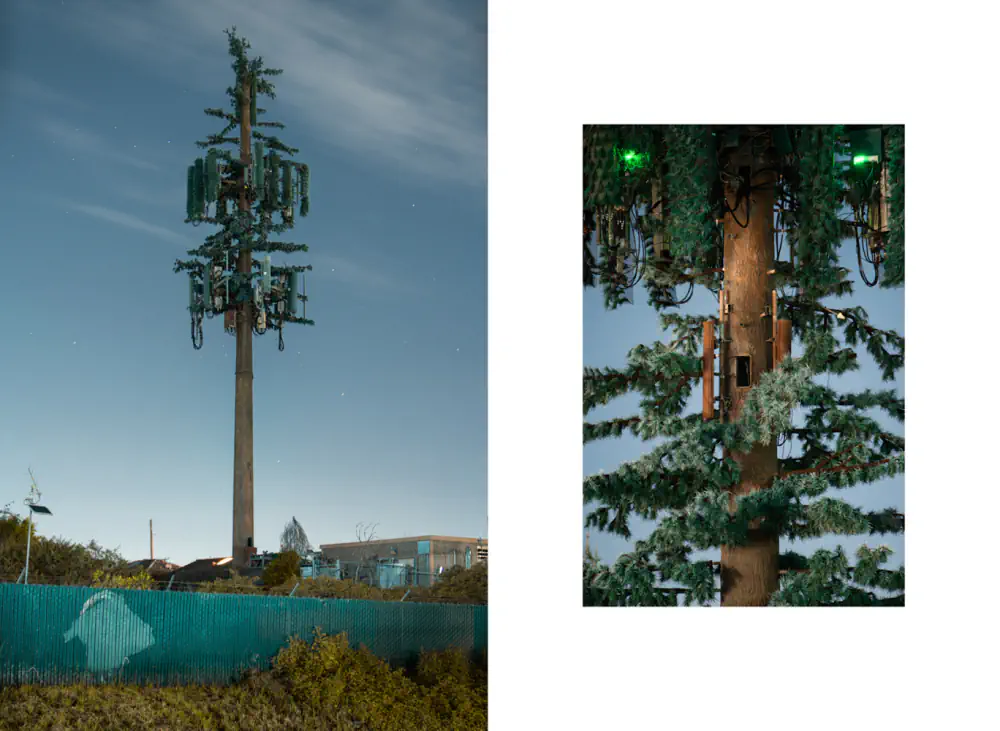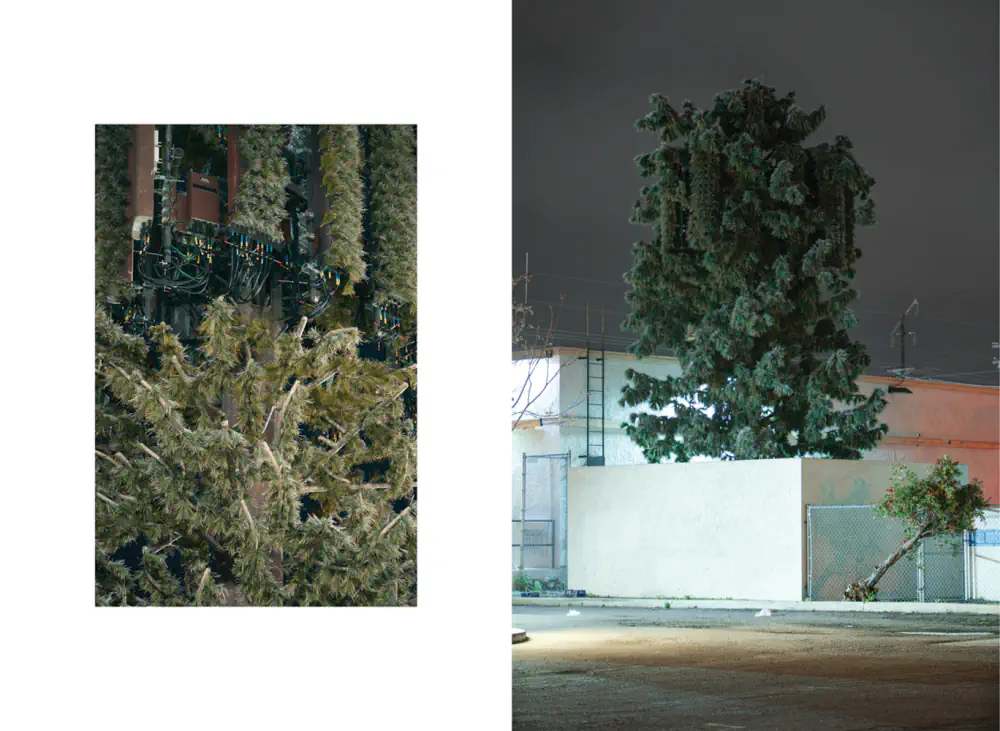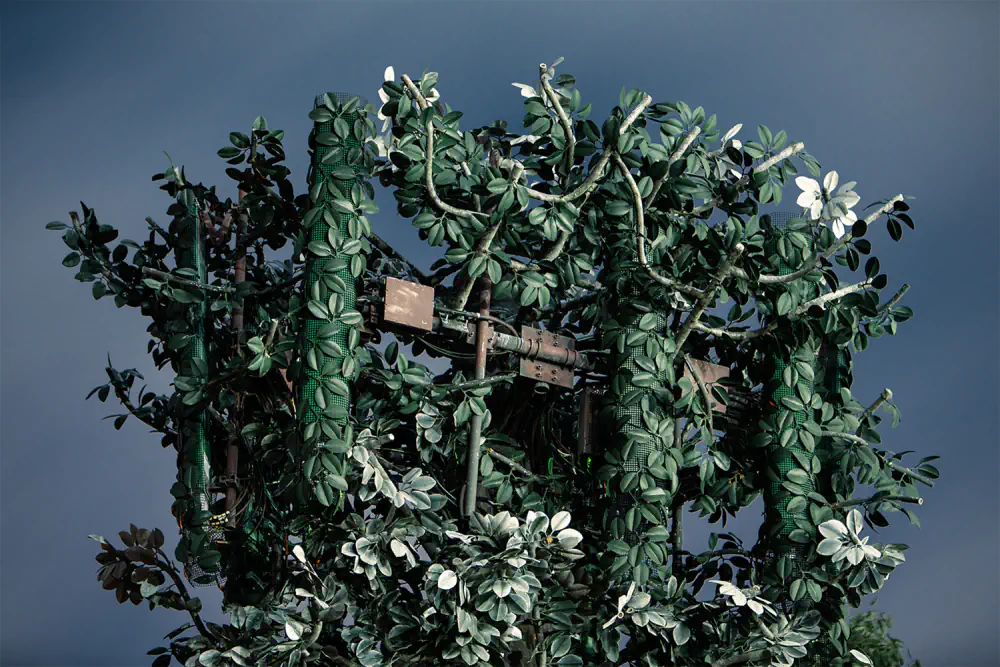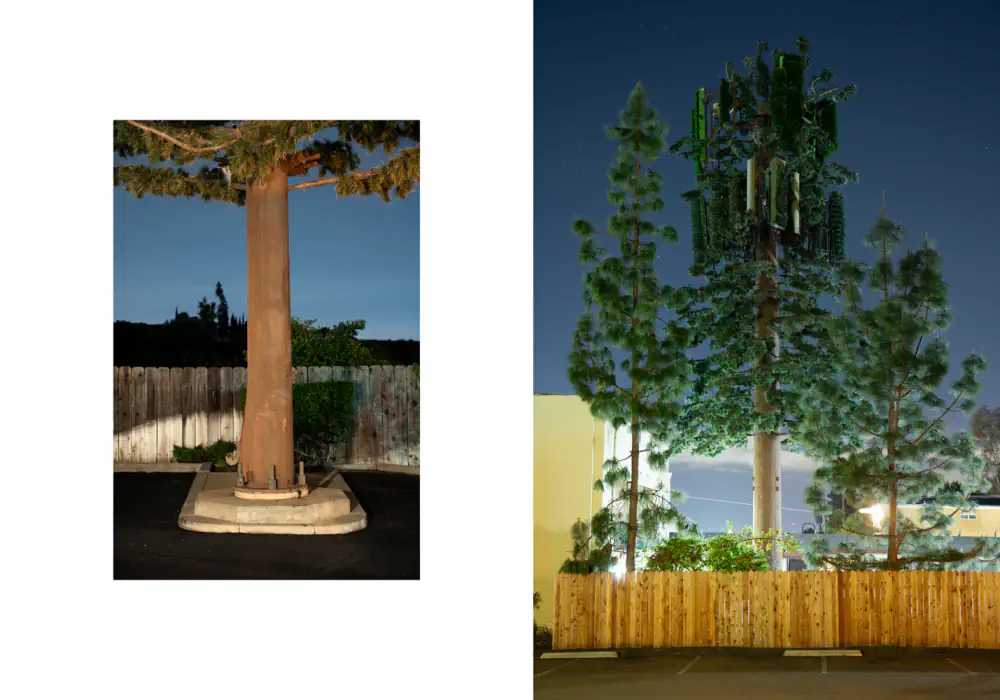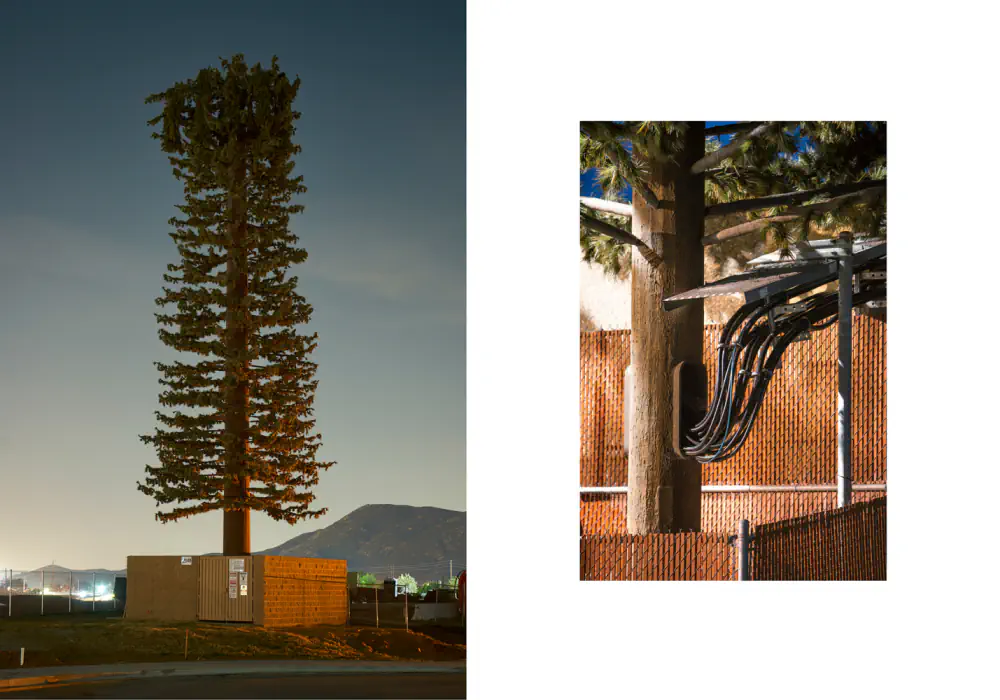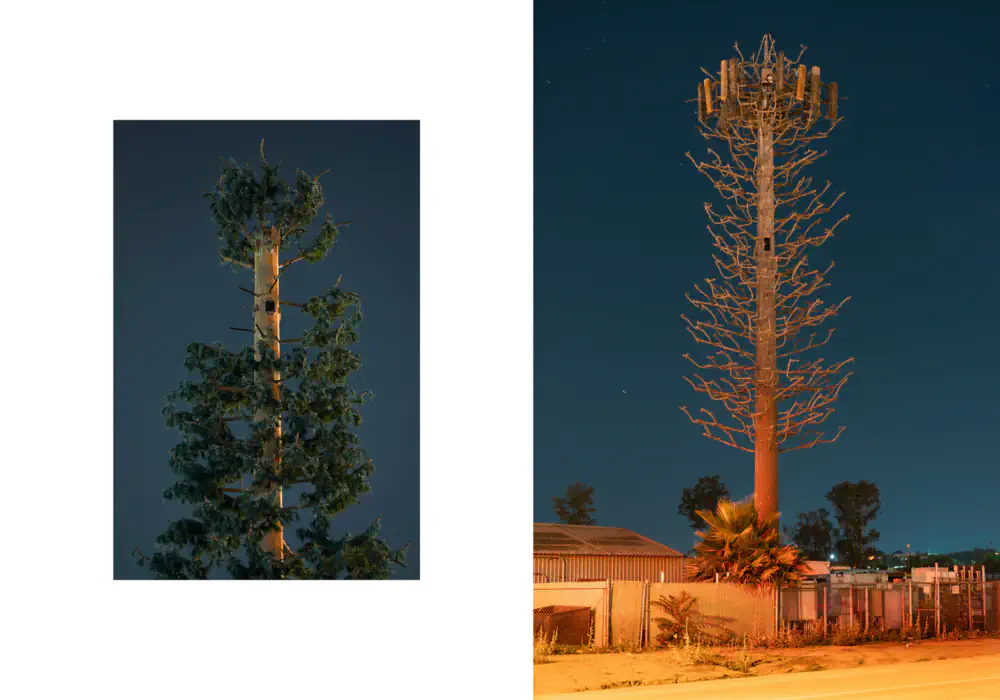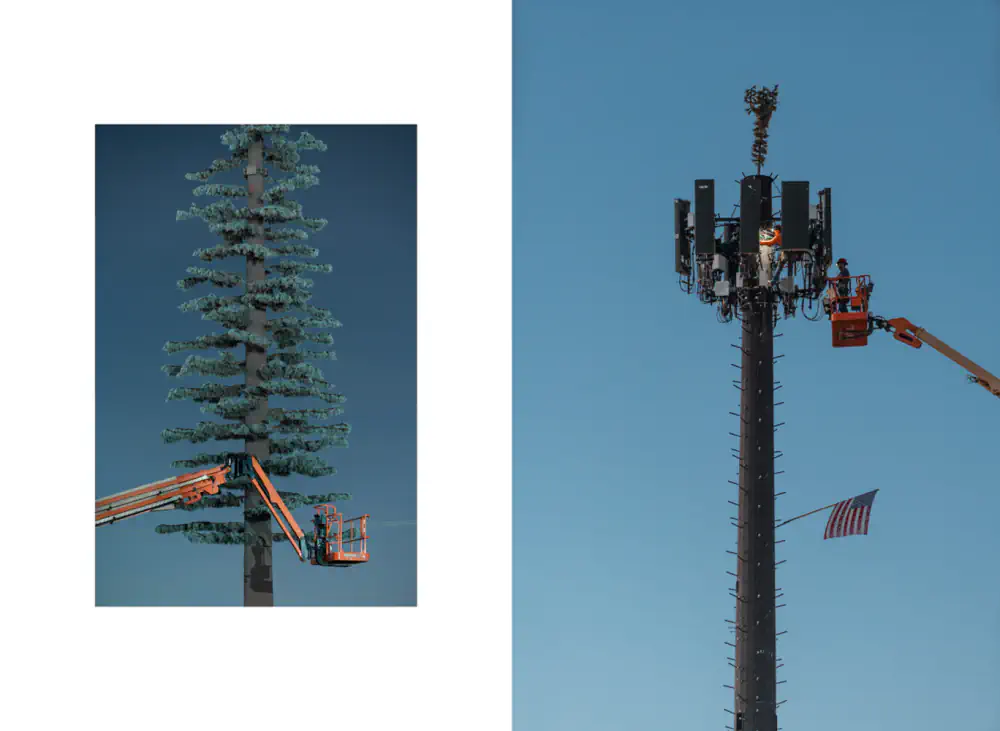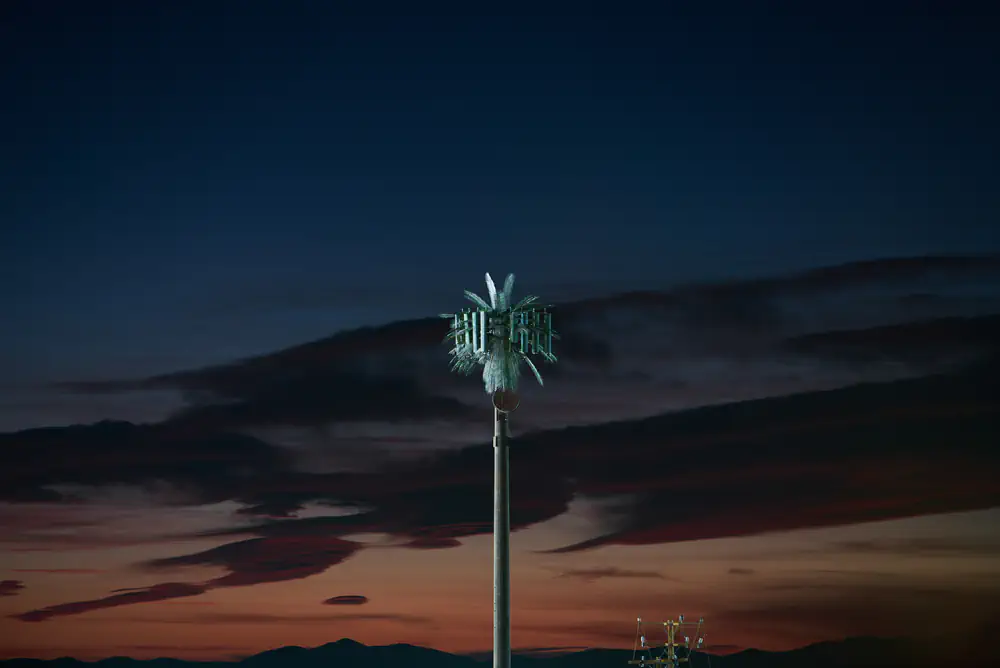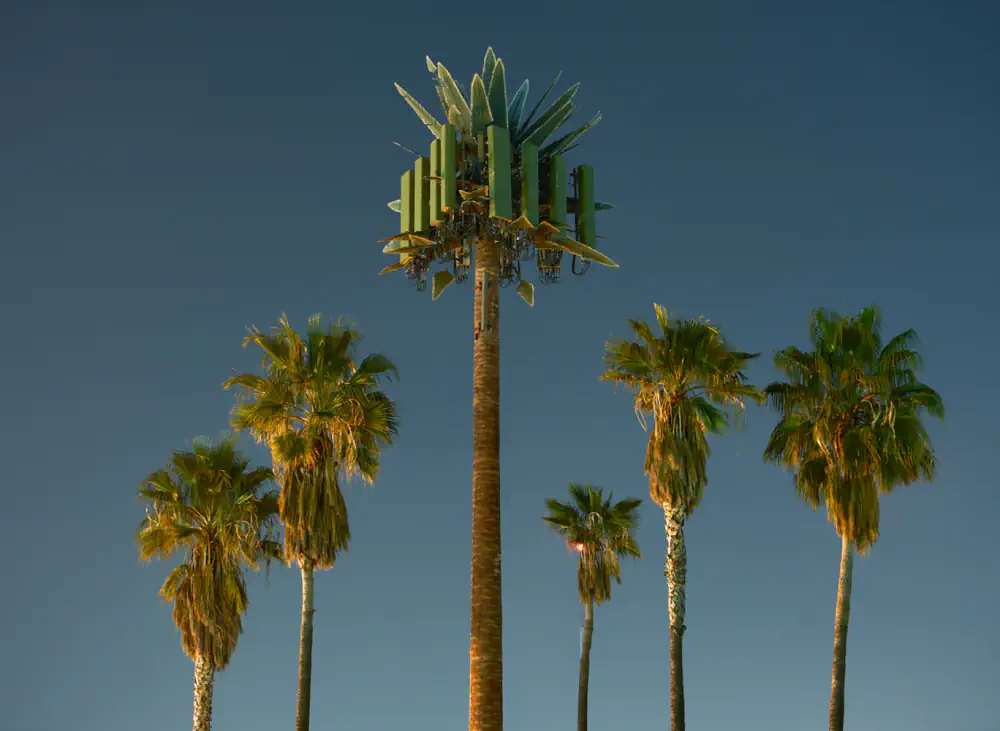

Second Nature documents the cell towers disguised as trees that populate Southern California’s landscape.
Taking the form of palms, pines, and other artificial vegetation, these structures conceal telecommunications equipment beneath manufactured bark and synthetic foliage.
They promise an uninterrupted connection while preserving the appearance of an uninterrupted landscape. We approach them as everyday monuments to a contradiction: we depend on technological infrastructure, yet often prefer its physical presence to remain out of sight.
In Los Angeles, where we live, this practice extends well beyond telecommunications. Oil drilling facilities sit behind façades resembling ordinary office buildings, their industrial functions obscured by familiar architectural forms. Offshore in Long Beach, the THUMS Islands take concealment to the scale of an entire landscape. Built in the 1960s, these artificial oil islands use palm trees, sculptural walls, waterfalls, and architectural screens to soften the sight and sound of extraction. From the shore, their appearance can suggest a holiday resort rather than a drilling operation. These structures establish a local context for the cell-tower trees: environments in which industrial activity is accommodated by giving it the appearance of something else.
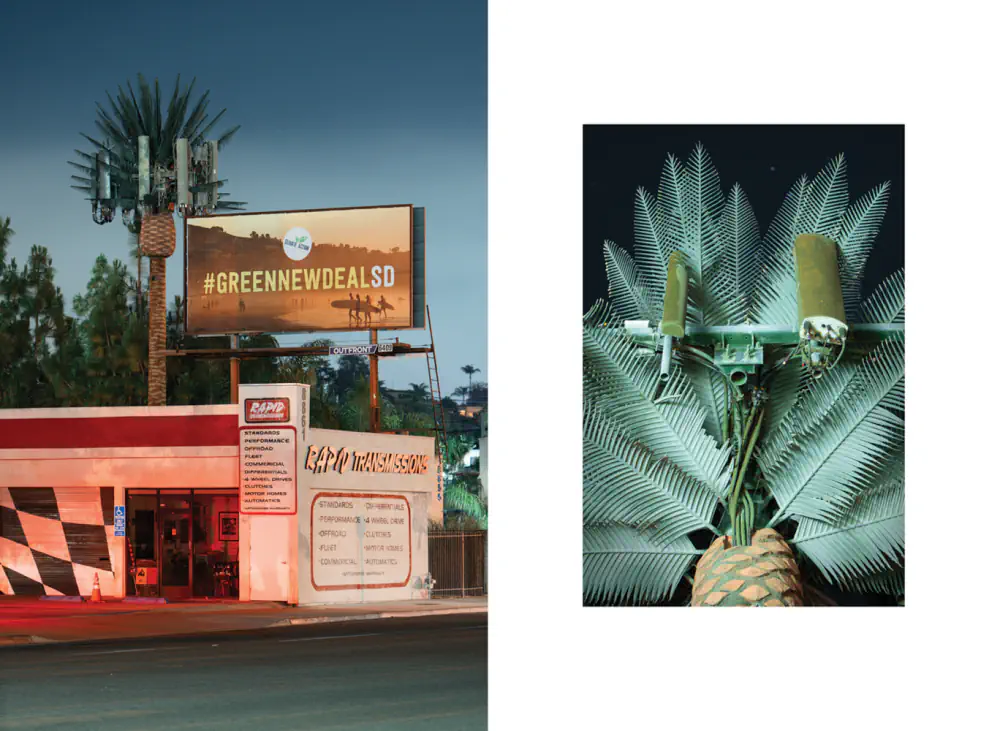
The history of the artificial antenna tree can be traced to a mountain community called Monument in Colorado. After local officials rejected a proposed cellular tower in 1992 because of its visual impact, the carrier sought a way to conceal it. Larson, a company experienced in creating artificial landscapes for theme parks, aquariums, and zoos, helped transform the tower into a pine tree. Techniques developed to construct immersive entertainment environments became tools for negotiating the appearance of everyday infrastructure. What began as a solution to a local permitting problem subsequently developed into an international industry of concealment. The disguise is not a negligible addition. According to industry representatives quoted by the Los Angeles Times, a tree tower can cost up to twice as much as a conventional tower of the same height.
Architectural historian Amy Clarke, who contributed to our Second Nature monograph, situates such structures within a broader history of what she calls “fool’s gold architecture”: buildings and objects that appear to serve one purpose while functioning as something else. Houses conceal electrical substations, residential façades mask ventilation facilities, and trees disguise antennas. Her writing suggests that their significance lies not simply in whether they successfully deceive us, but in the desires and compromises they express. A disguise can remain effective as an aesthetic agreement even when its actual function is widely understood.
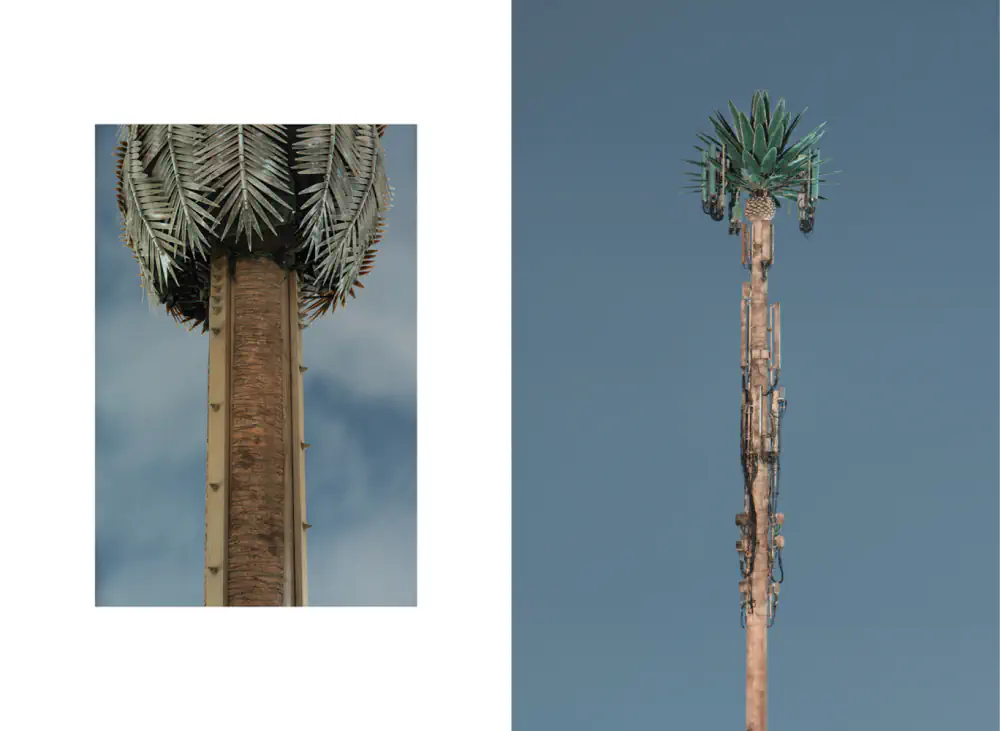
For us, the cell-tower trees are particularly revealing because their camouflage so often fails. Repetitive branches, oversized trunks, and unlikely proportions draw attention to the very structures they are intended to obscure. Yet this failure does not necessarily invalidate their purpose. They offer a recognisable sign of nature, allowing an industrial object to become more socially acceptable without becoming natural. Their awkwardness exposes the negotiation between technological demand and scenic reassurance.
Beneath the synthetic foliage, however, the infrastructure remains material. Equipment hums, fences restrict access, and warning signs interrupt the promise of a benign landscape. During our fieldwork, fallen artificial branches and palm fronds exposed the camouflage as a surface that can break, deteriorate, and become debris. These encounters complicate the apparent immateriality of digital communication. Connectivity depends on physical installations, while the attempt to conceal them introduces additional manufactured materials into the environment, contributing to pollution.
The title Second Nature connects this constructed vegetation with the habits through which technological dependence becomes ordinary. These trees are neither simply convincing replicas nor merely absurd failures. They give visible form to a willingness to preserve an image of nature while expanding the systems that transform it.
About Kaya & Blank
Kaya & Blank are lens-based media artists whose work explores the ways in which humans shape and inhabit the world. The influence of neoliberal politics on contemporary life has been an important aspect of their artistic practice in recent years. Their projects often focus on traces of economic infrastructure to examine the politics embedded in built environments and how humanity’s dominance over nature manifests itself in everyday architecture.
In their work, they erase the physical distances between existing structures and create dense compositions of industrial fragments to construct new landscapes that appear both alien and familiar. Deeply grounded in documentary practices, their approach is characterised by a strong emphasis on research. However, by pushing the boundaries of how reality can be depicted, they transcend conventional representation and create entirely independent, often hyperreal visual worlds. As a result, the boundaries between reality and fiction become blurred.
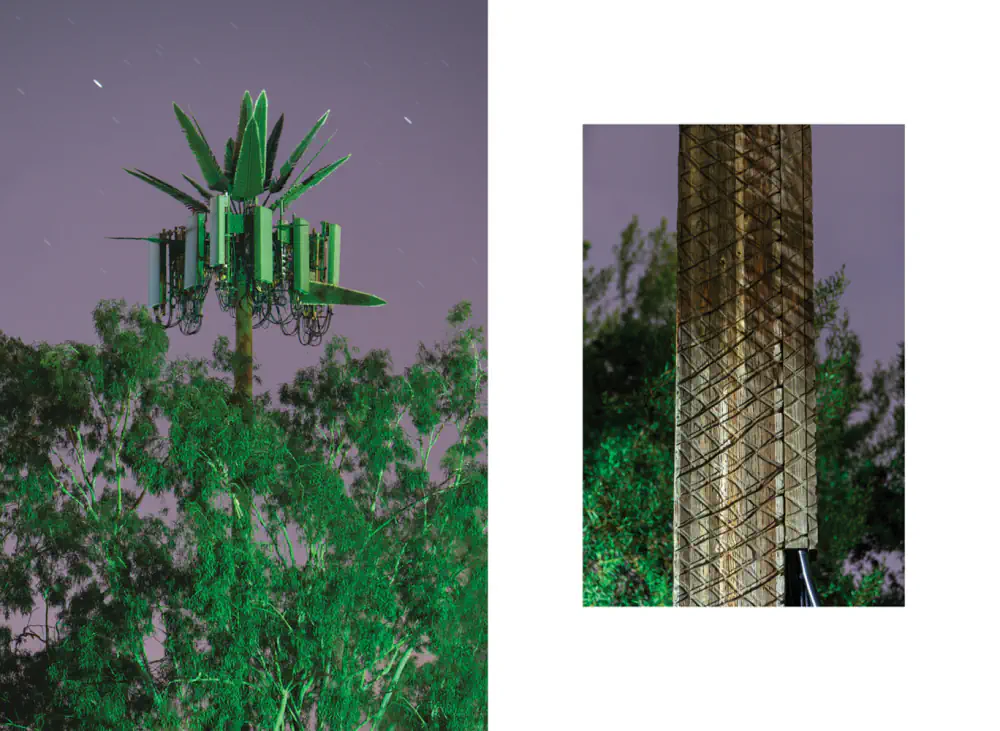
By photographing their subjects almost exclusively at night, they aim to accentuate the artificial and uncanny qualities of contemporary urban environments. This visual strategy often leads viewers to interpret the documentary elements of their work as computer-generated imagery.
In exhibitions, they transform their research and discoveries into multilayered installations. Photographs and videos are frequently complemented by texts and objects, often establishing a direct material connection to the subjects depicted in their visual work.
Through these complex spatial compositions, Kaya & Blank offer viewers an immersive experience that combines conceptual depth with rigorous formal execution. [Official Website]