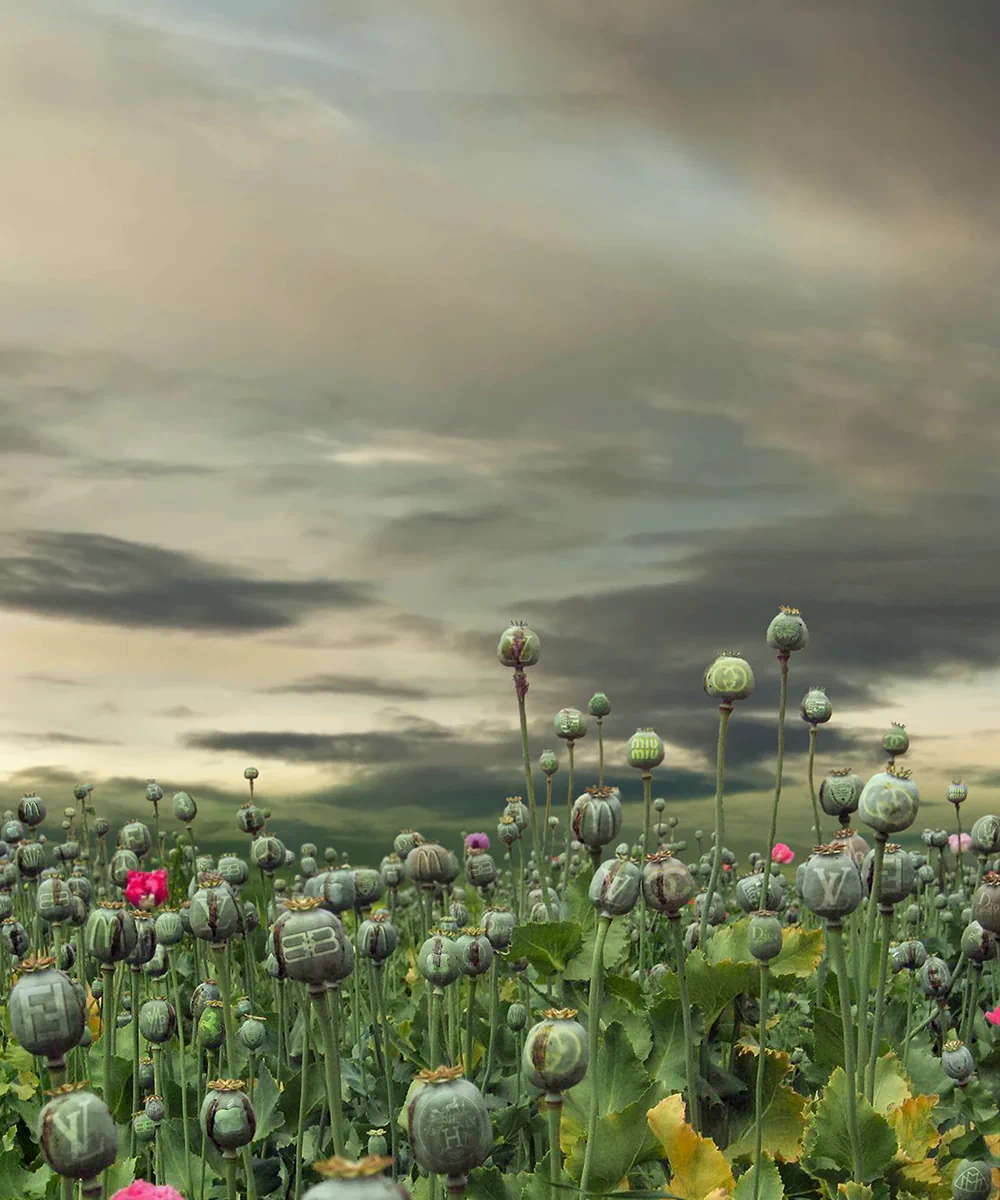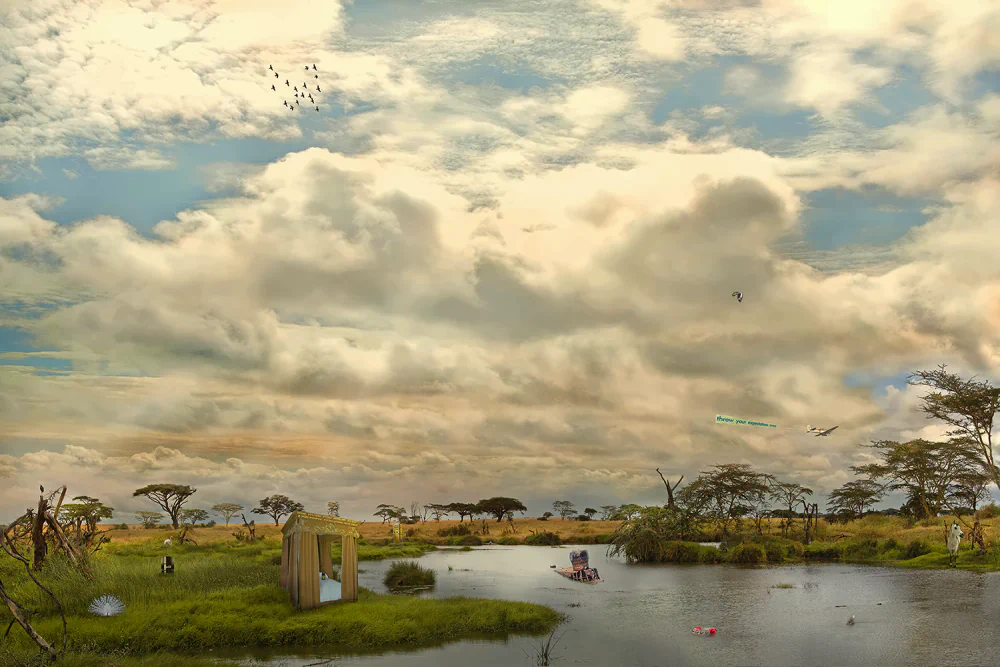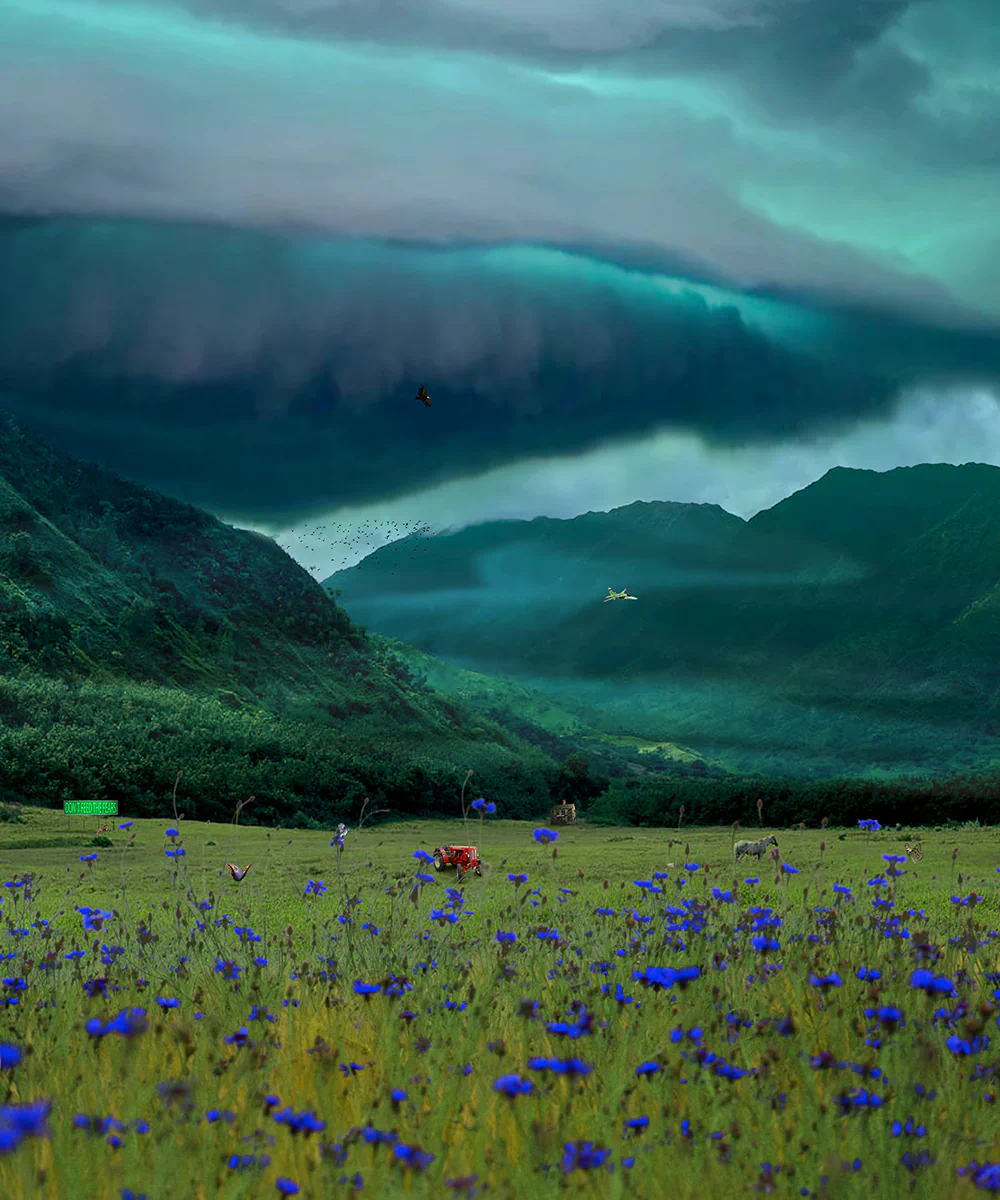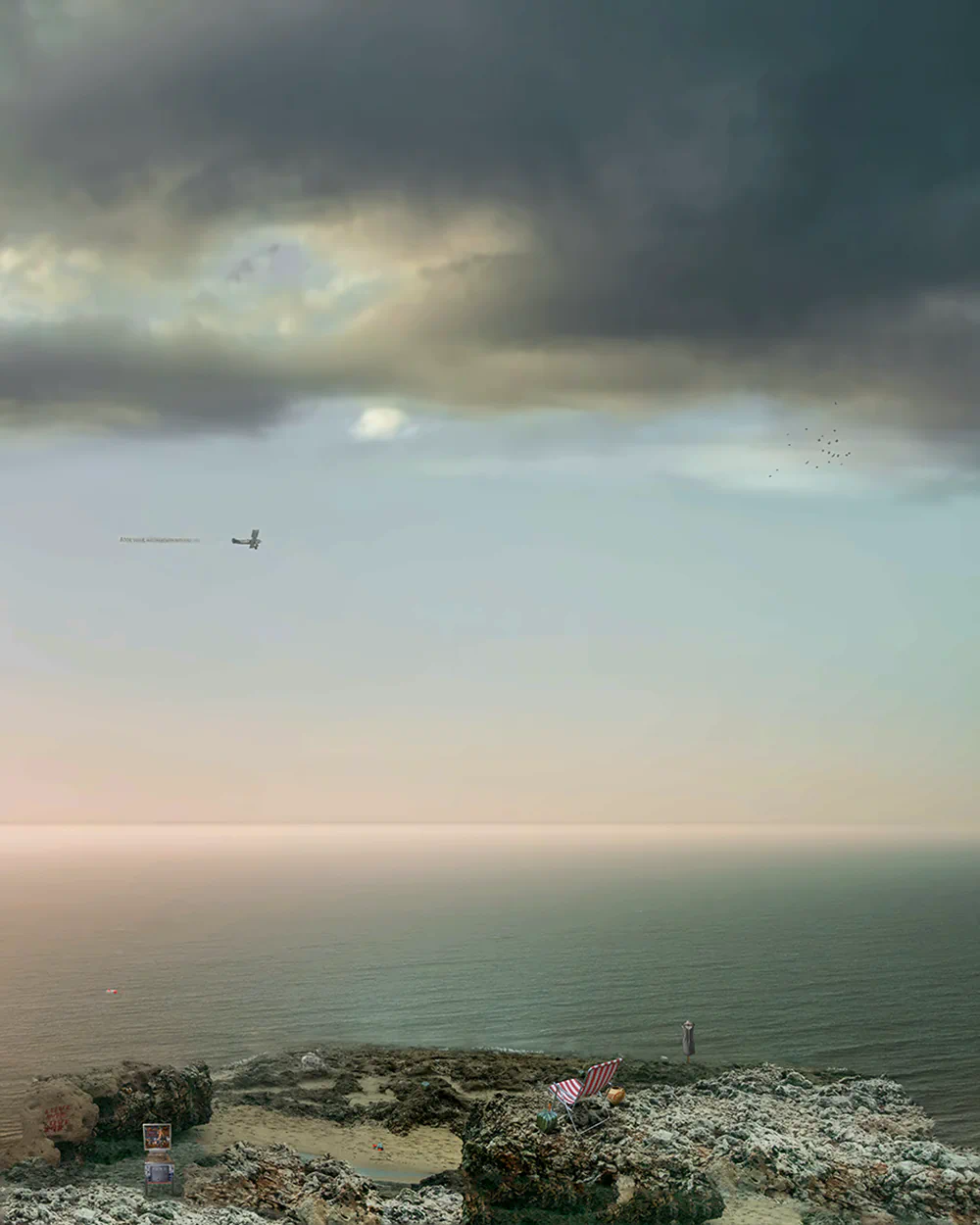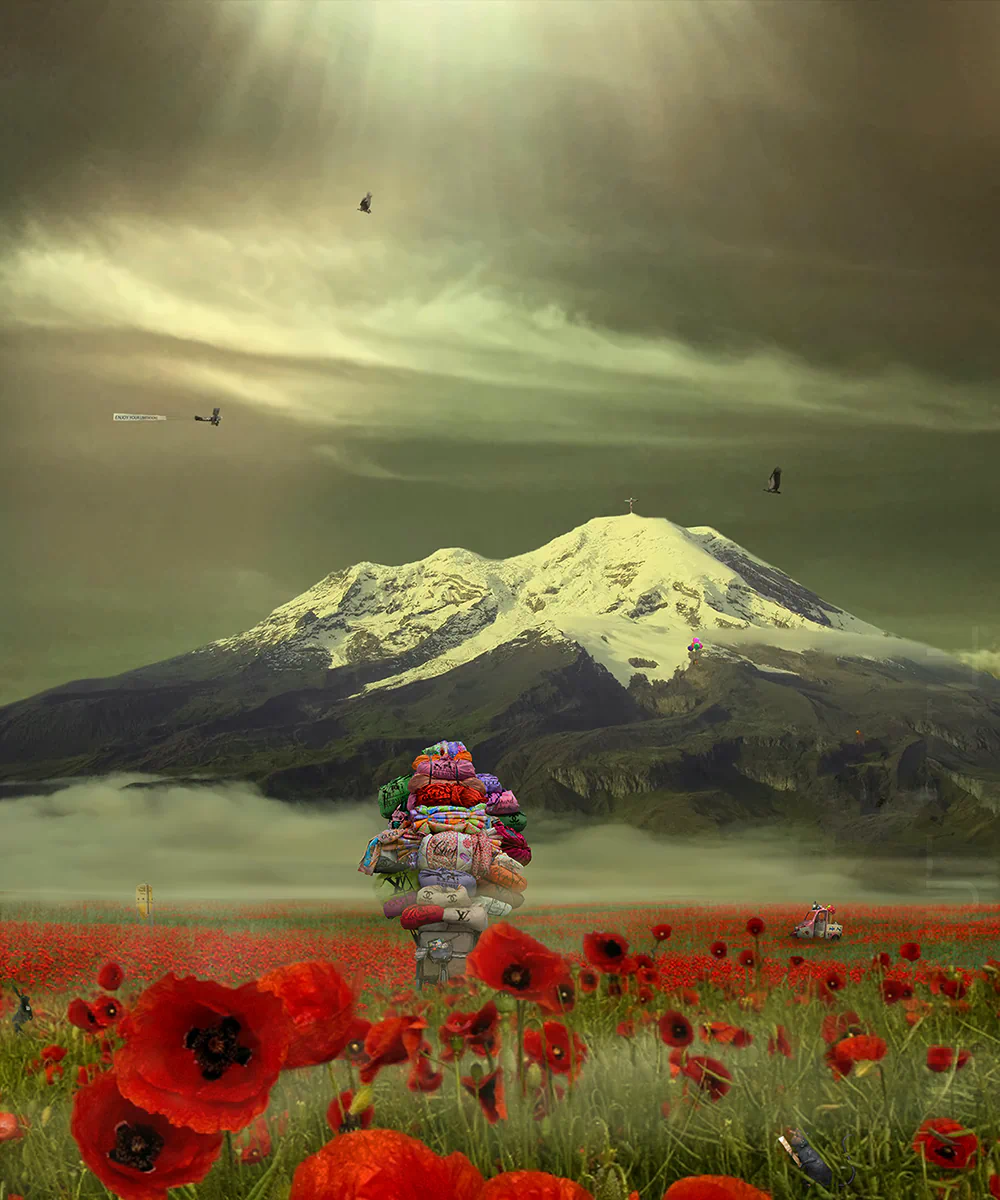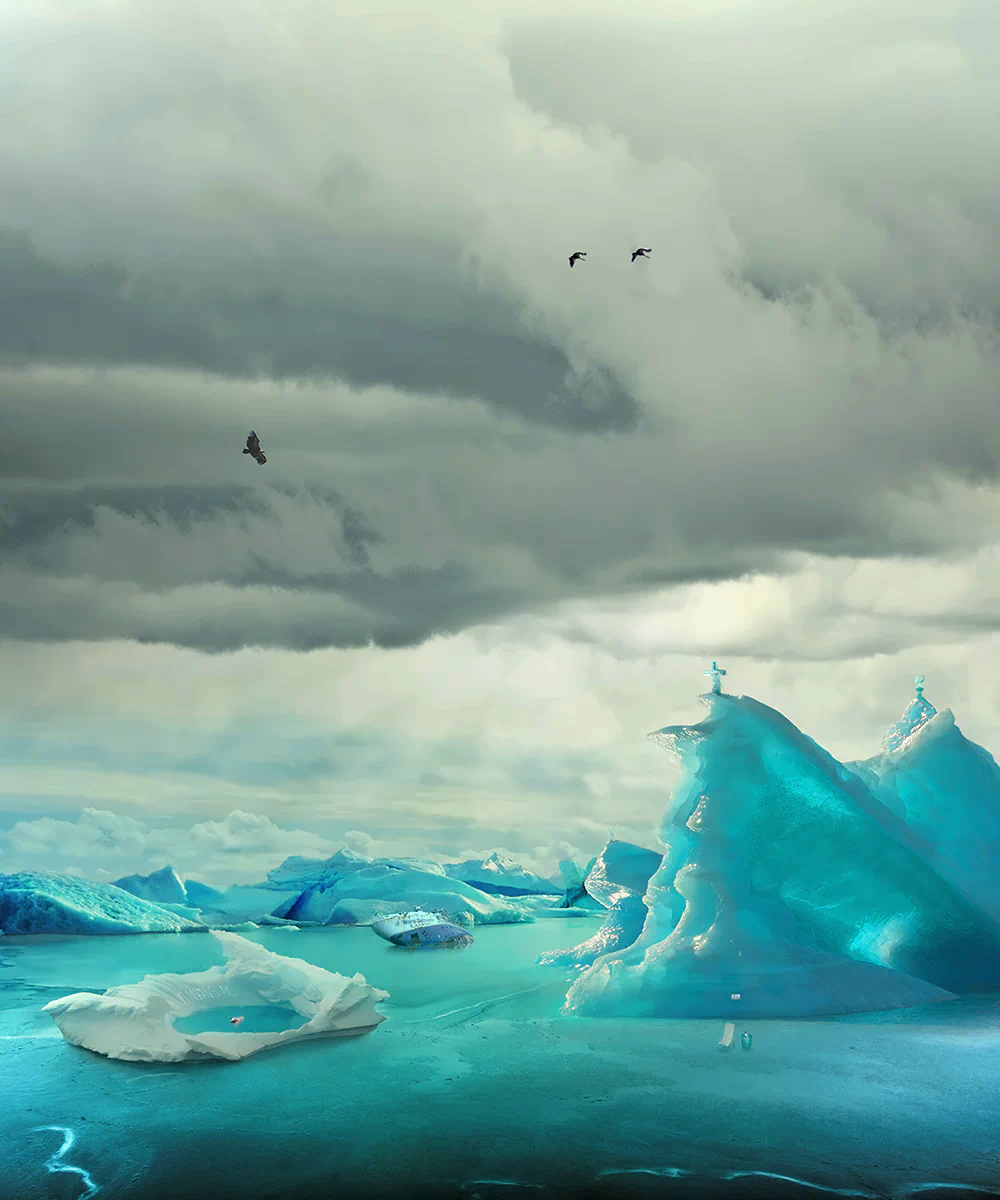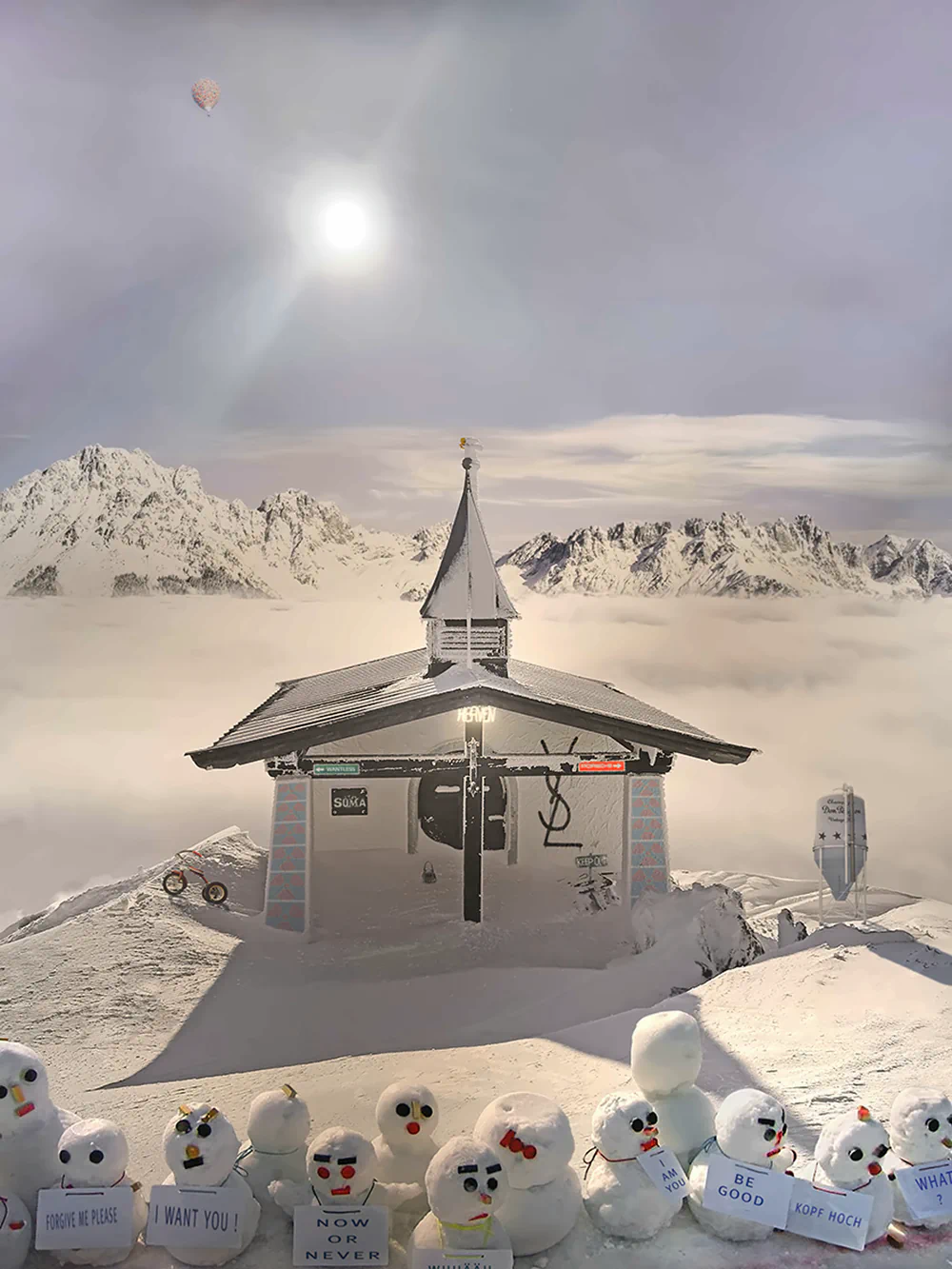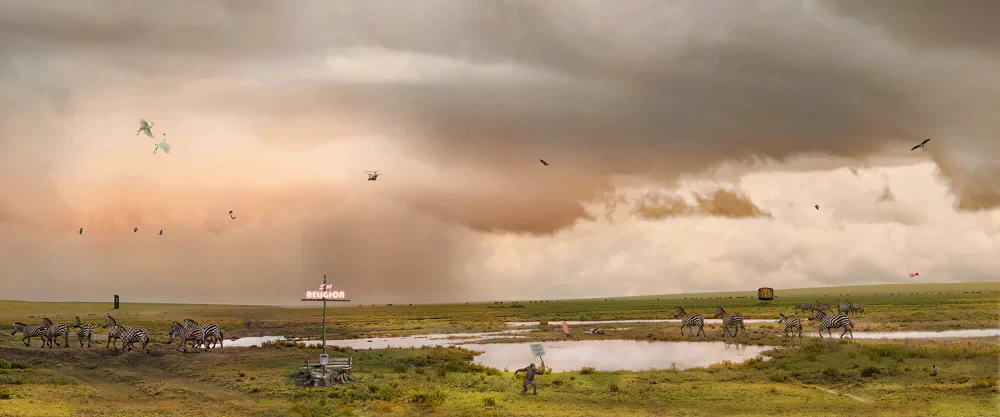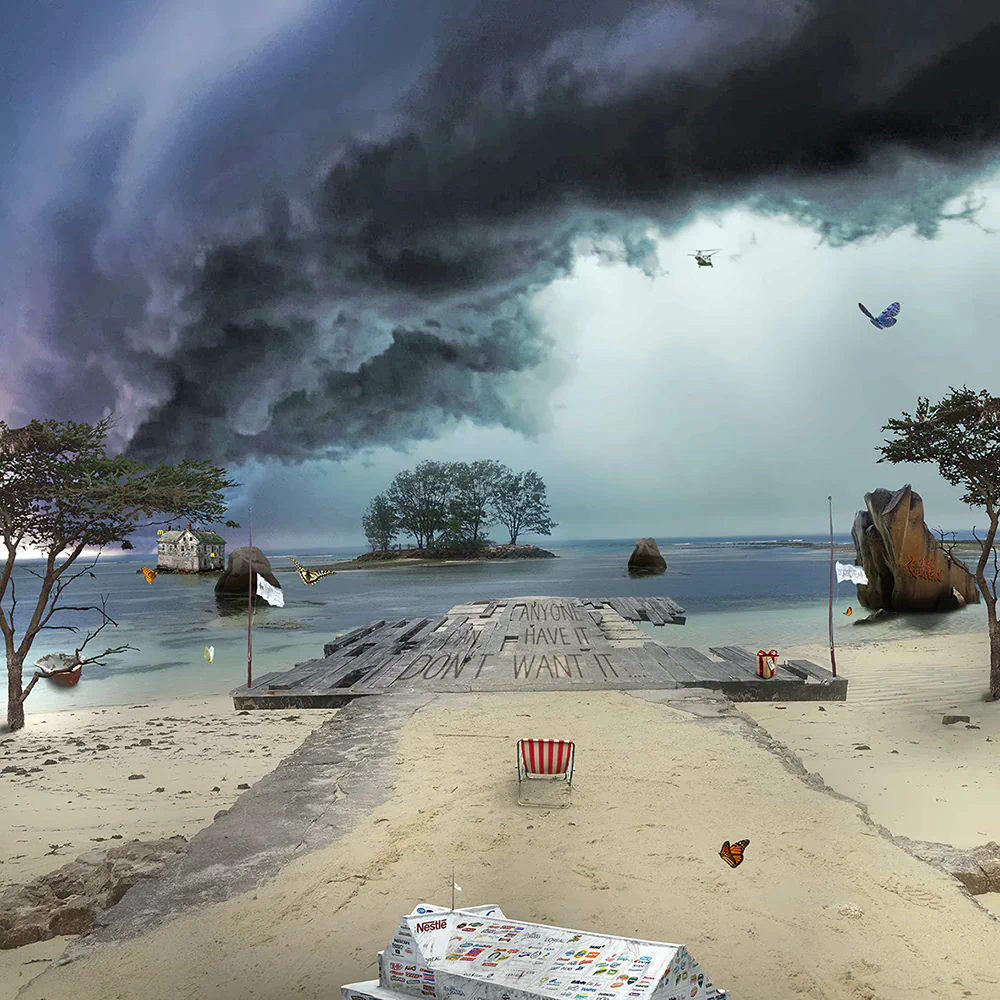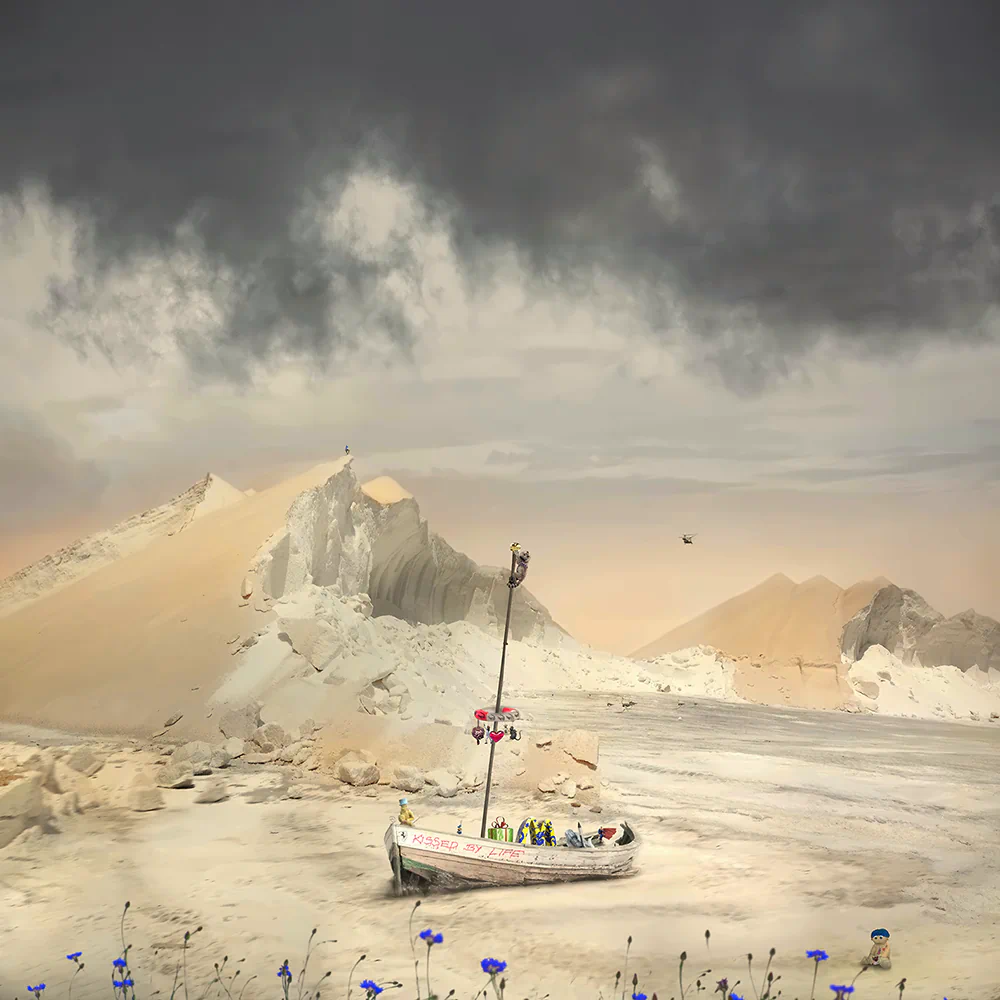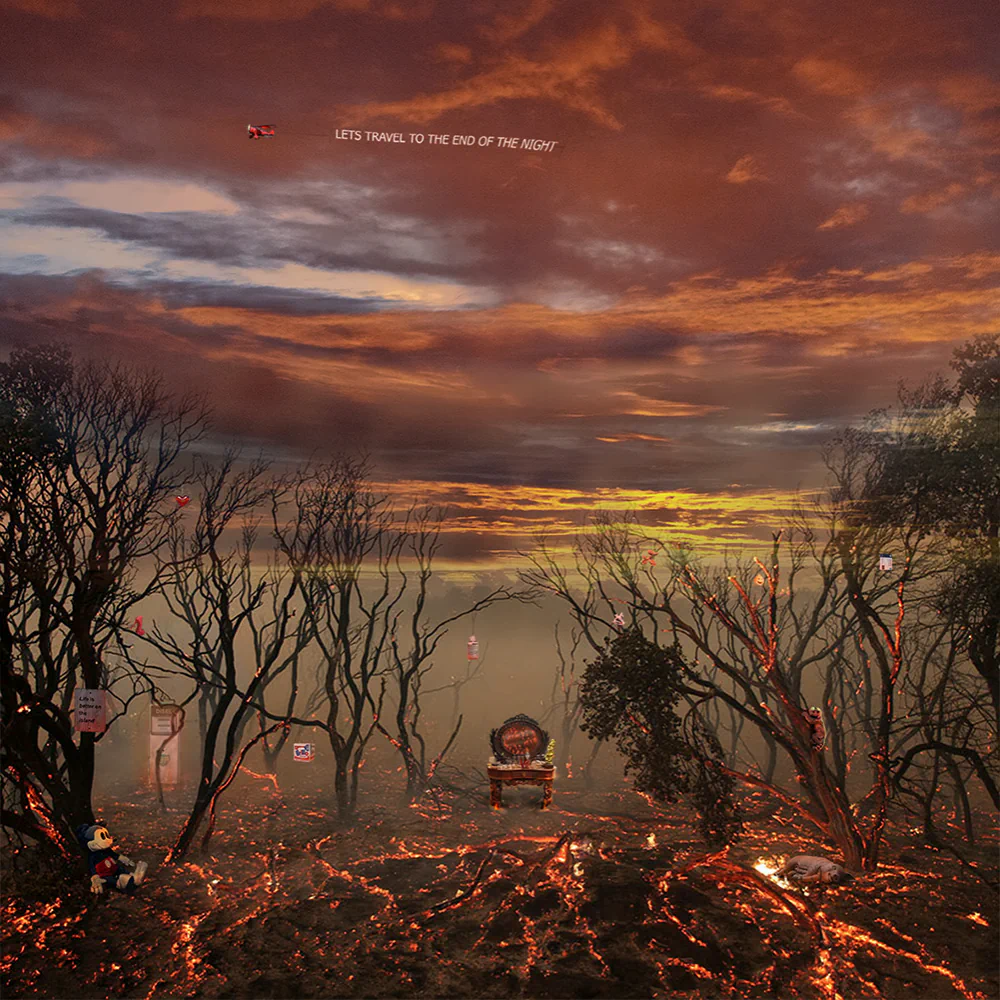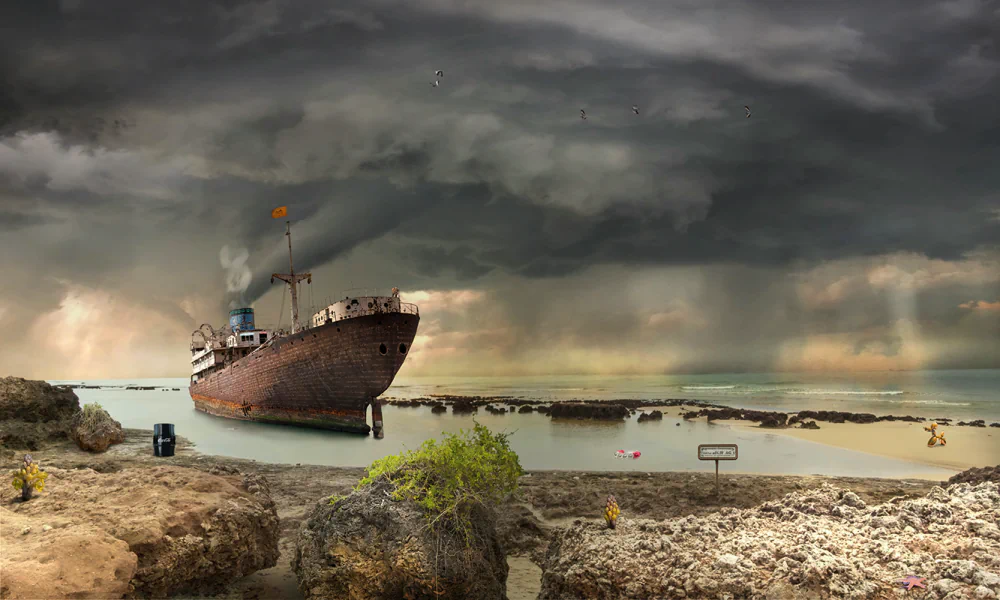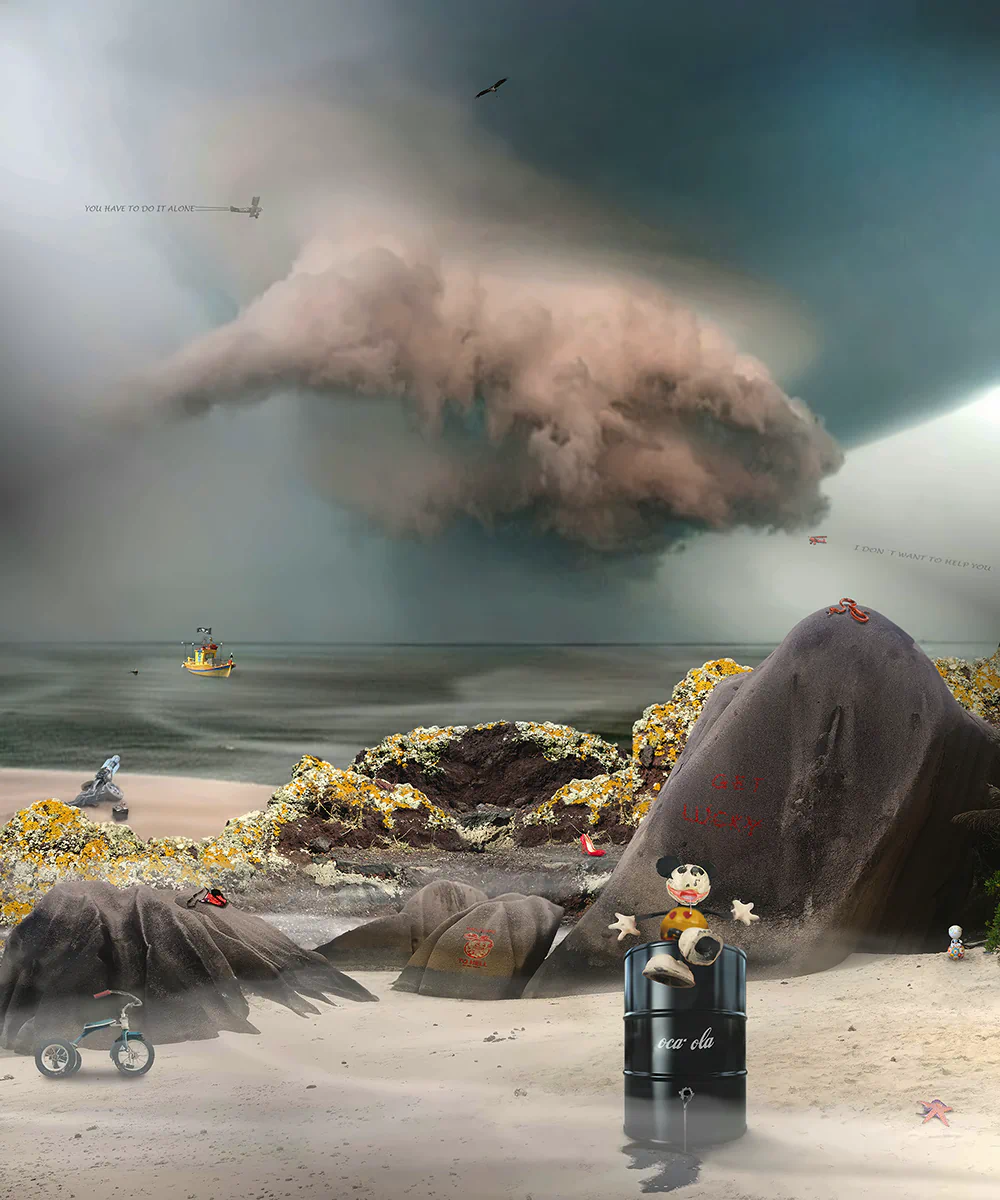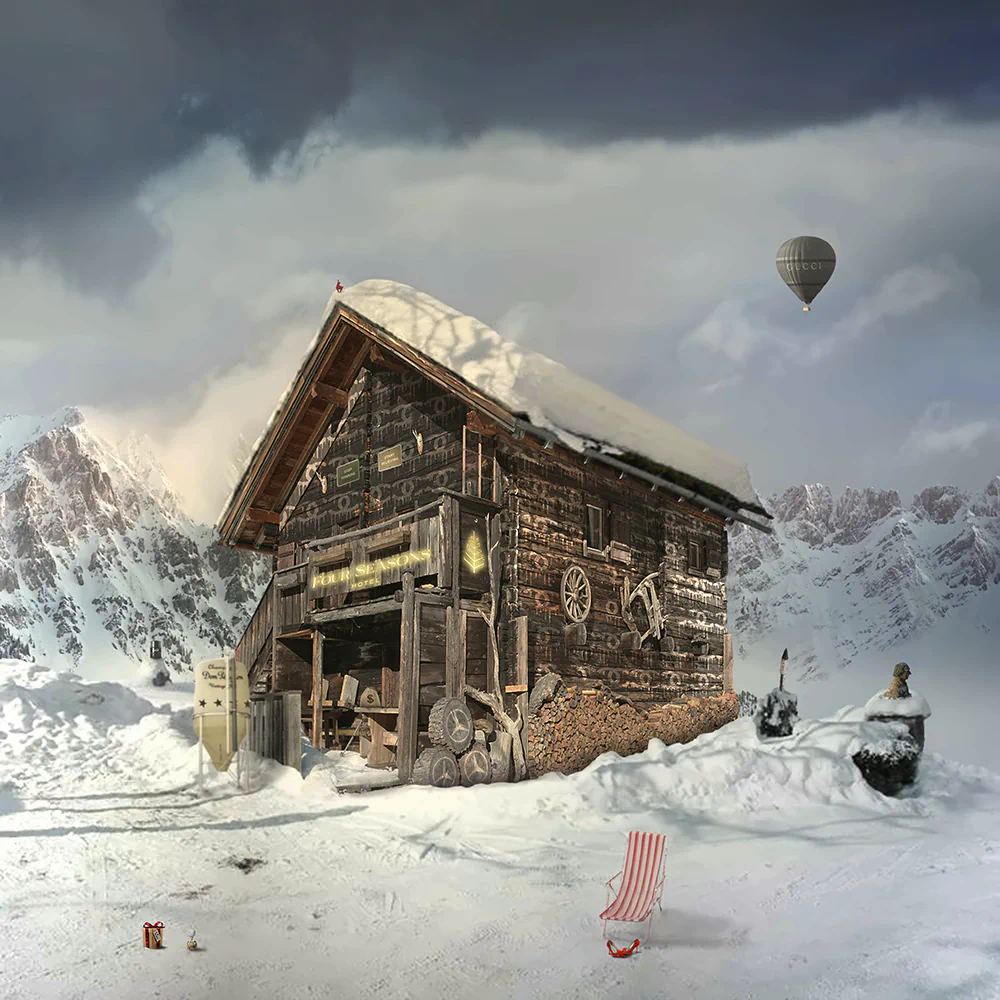
The wildly romantic garden of Epicurus, the vast African savanna, or the icebergs of Antarctica form the seemingly harmless backgrounds to Helmut Grill’s constructed photographs.
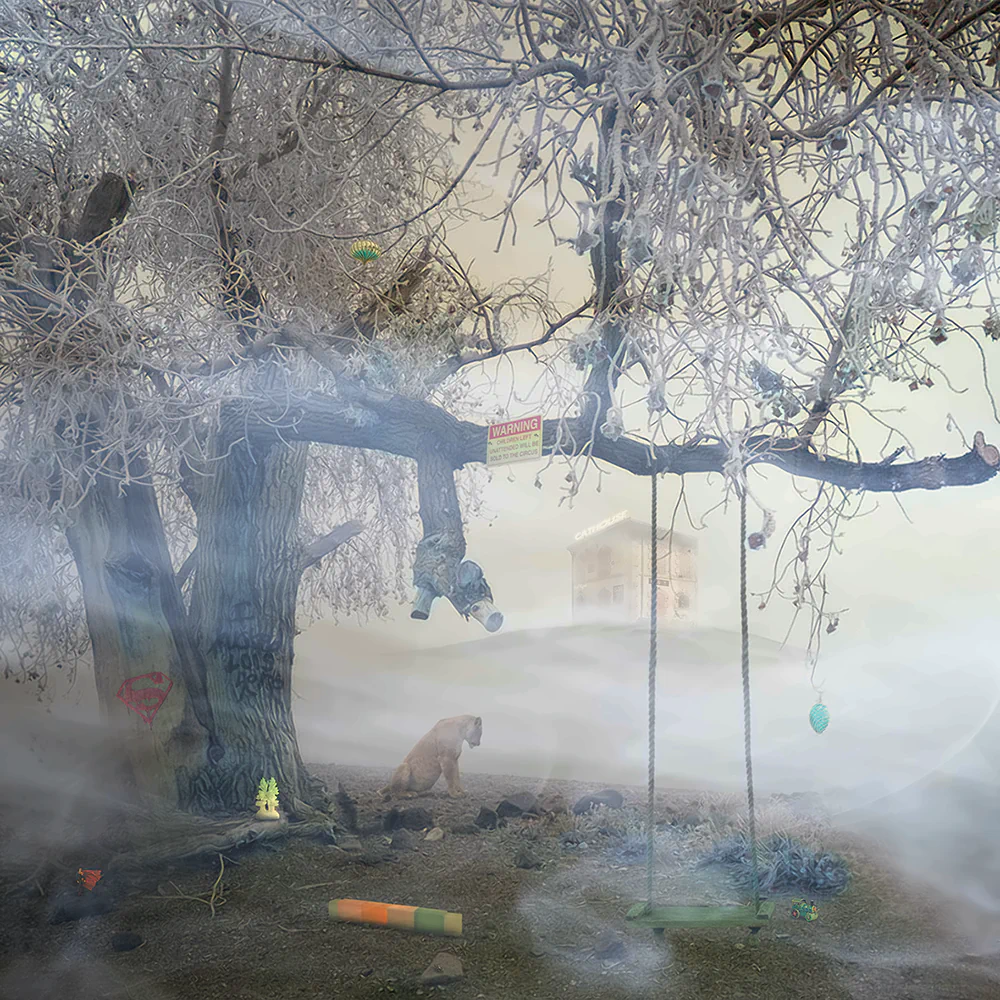
However, the details he hides within them raise questions, mislead, confuse, and even disturb.
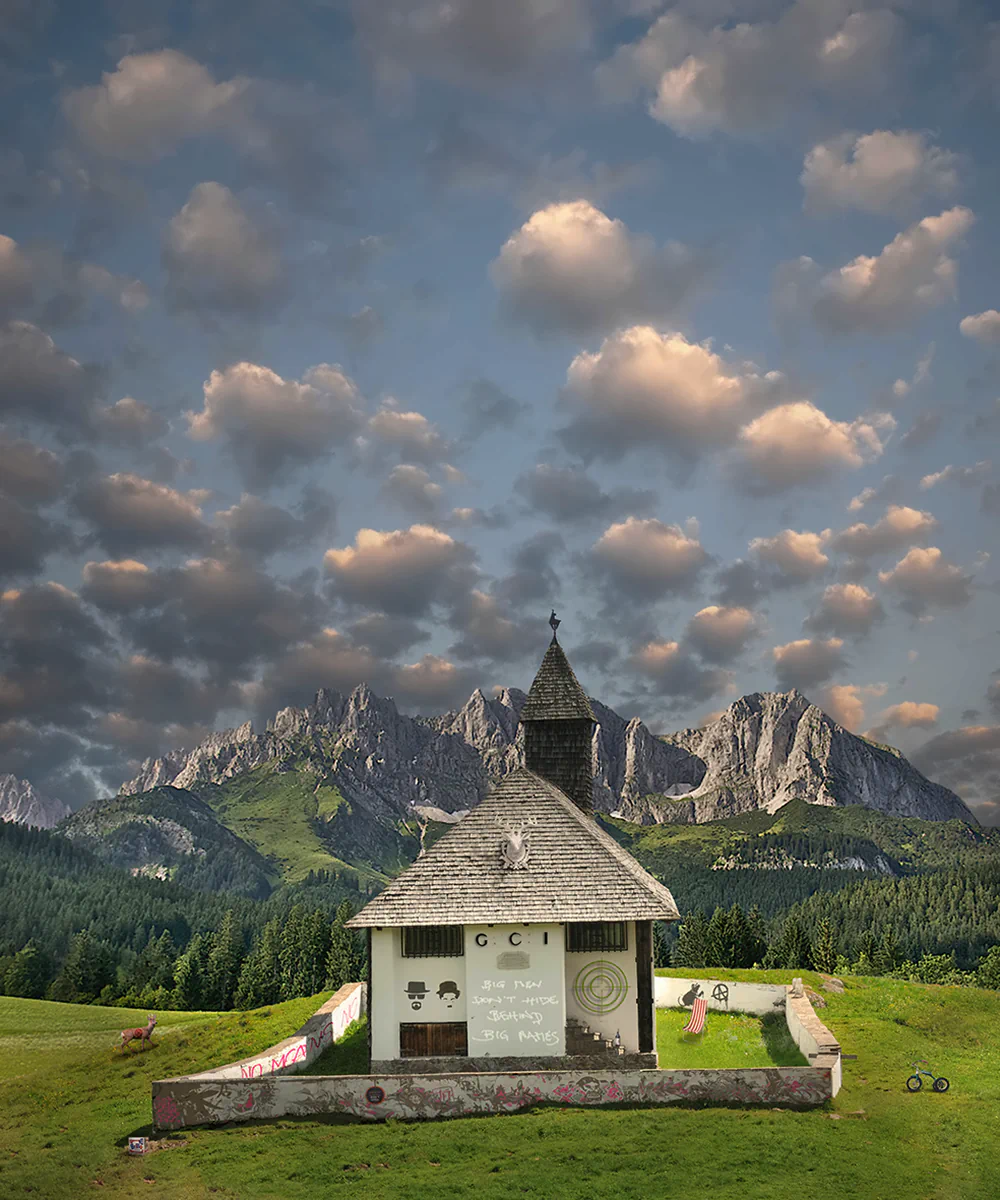
A dollhouse, a four-poster bed, a plastic dog, Christmas presents, a butterfly, a carousel, a children’s tricycle, a fat Hitler statue and a fat Barbie doll, gilded hamburgers, or even artworks by Takashi Murakami and Ai Weiwei: these are the things that Helmut Grill gleefully hides in his atmospheric landscapes, while neon signs featuring advertising slogans and his own texts carry messages out into the world. Out of many different photographs, a large-scale work is crafted that tells apocalyptic stories entirely without people.
“As in painting, I start with a white surface,” Grill says, describing his working method. It is filled with small-scale images, electronically merged, painted over, and enhanced with lighting effects that create depth, sharpness, and atmosphere. “It works like a collage,” he says, and it often takes months before the artist is satisfied—and the viewer is sufficiently challenged to invent a story for themselves that can explain what they see.
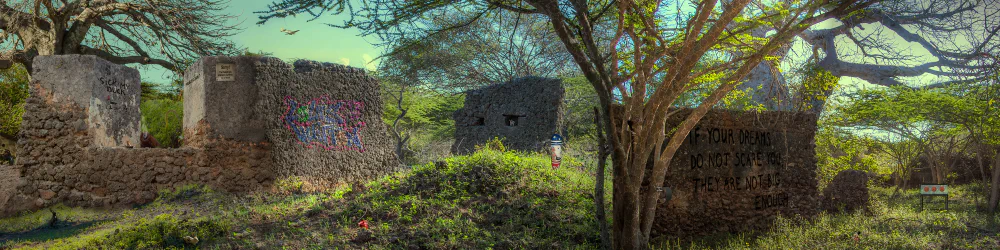
The written messages are very important to Helmut Grill. Placed above doors, readable on signs, or waiting to be discovered as lettering somewhere in the work, they contain statements that bear witness to the artist’s humorous and critical spirit. “The Stupid Are Cocksure,” it says where Hitler stands; “Blow Me Away” can be read on a banner towed by an airplane; “Don’t Feed the Fears” appears at a feeding station for artists; and “Happy Mess”—all encourage the viewer to reflect or smile.
Helmut Grill learned his trade from the ground up. As a retoucher for the advertising industry in the 1980s, he manipulated images and beautified both people and objects. A massive computer system in a fully air-conditioned room served as his workspace. “It looked like the Starship Enterprise,” he recalls today, and when the first Apple computers and Photoshop hit the market, “I threw myself into art.”
After some experimentation, the large-format works for which Grill is known today soon followed. Photos from the internet, from current TV series, or his own amateur pictures are assembled into imaginary worlds and given connotations under series titles. For “Writings,” Helmut Grill overwrote virtual faces with text. “Relations” was an experiment in seeing: three versions of a photo, each with altered proportions, question reality; and in “The Refuge,” Helmut Grill puts feelings to the test: the cozy-looking house has lifelessly closed windows, the alpine hut bears the inscription “department mindcontrol,” and next to the harem window, graffiti reads “human upgrade now!”
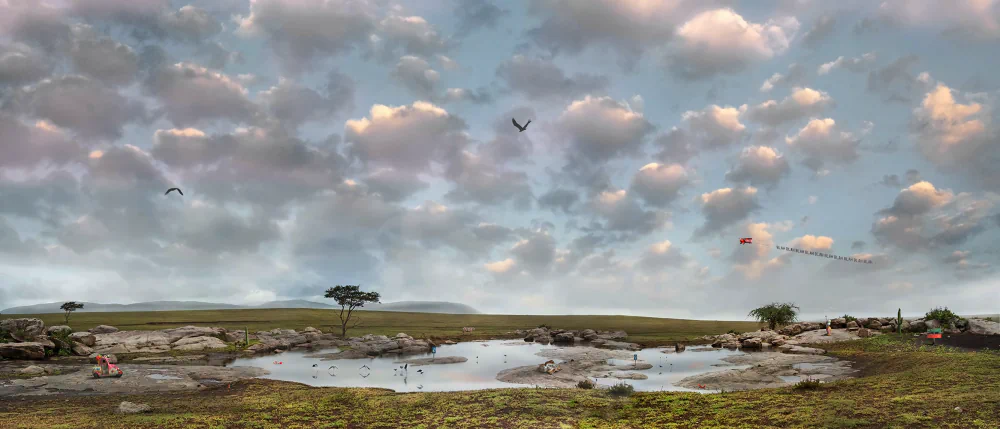
Currently, Helmut Grill is working on “Sceneries,” unreal landscapes whose mandate could be “look closely”: the tips of the iceberg bear a summit cross and a crescent moon, a beautiful old-fashioned carousel stands in the savanna, and forgotten toys lie scattered in Epicurus’ garden. These and other works from “Sceneries” will be on display in February and March in a solo exhibition at the Hausgalerie of the Künstlerhaus in Vienna.
The English titles and messages reveal that Grill travels abroad frequently and gladly. New York, Miami, London, Paris, India, and Tanzania are just a few of the destinations that inspire him, and gallerists have been taking his works to international fairs for years. Rudi Budja is one of them. He accompanied Grill as a mentor for a long time and brought him from Graz to the world. Martin Suppan and “Yoshi Contemporary” in Vienna, Lili Ubel in Paris, Juan Ruiz in Miami, and several others repeatedly exhibit Helmut Grill’s work. As a native of Salzburg, he has also left his mark there. The Museum der Moderne has purchased several of his works.
Helmut Grill’s studio is simultaneously his archive. The most recent works in various formats hang or lean against the walls. The rest of the light-flooded room is filled with a large desk, multiple monitors, a laptop, and a graphics tablet. It is state-of-the-art technology that Helmut Grill masters and with the help of which he populates unreal landscapes with bizarre things. At first glance, his pictures look like realistic photographs full of mood and harmony. Only at a second glance does “what cannot be seen” emerge, as the artist describes it, inviting the viewer to reflect on what lies beneath. [Official Website]