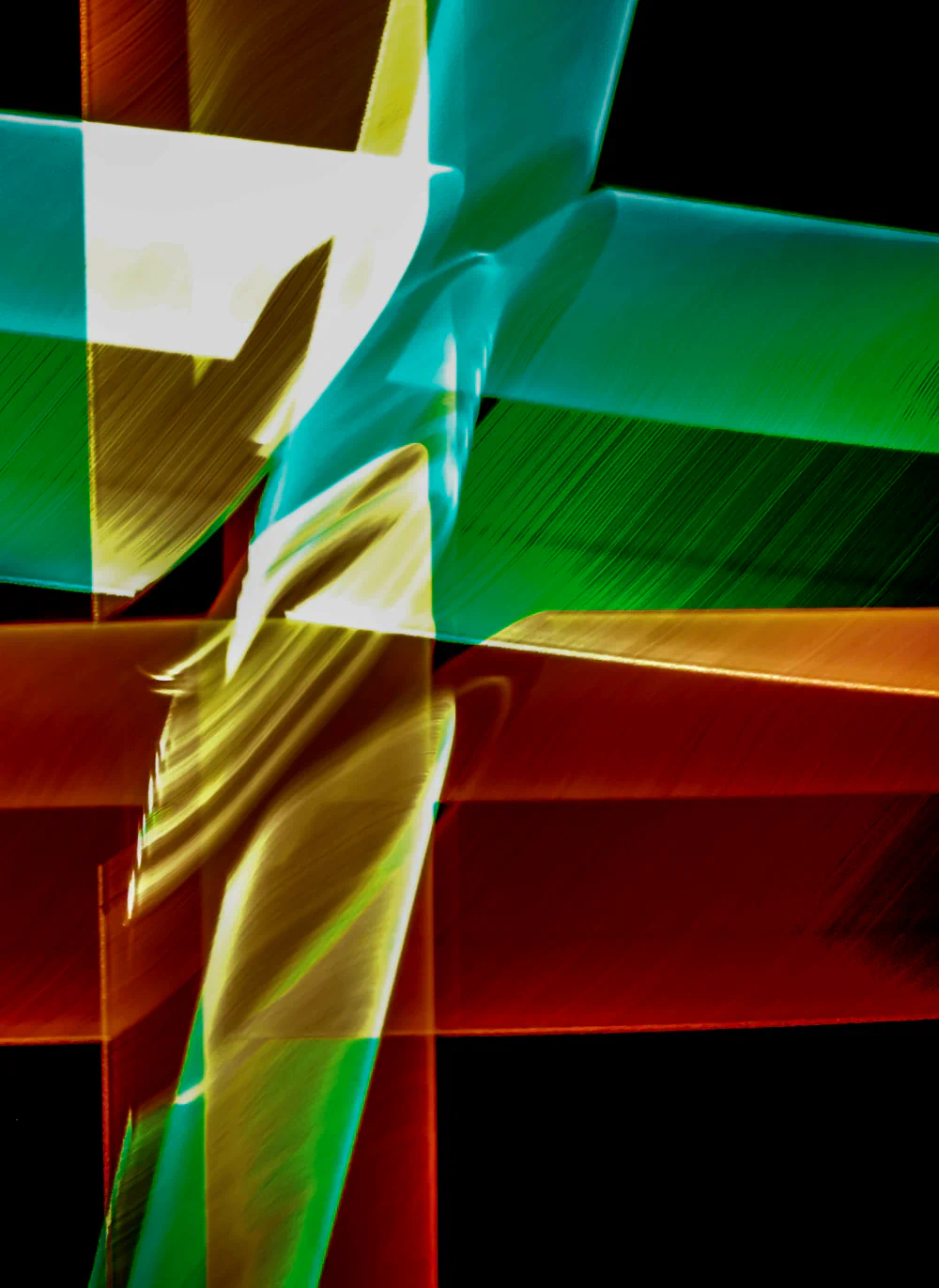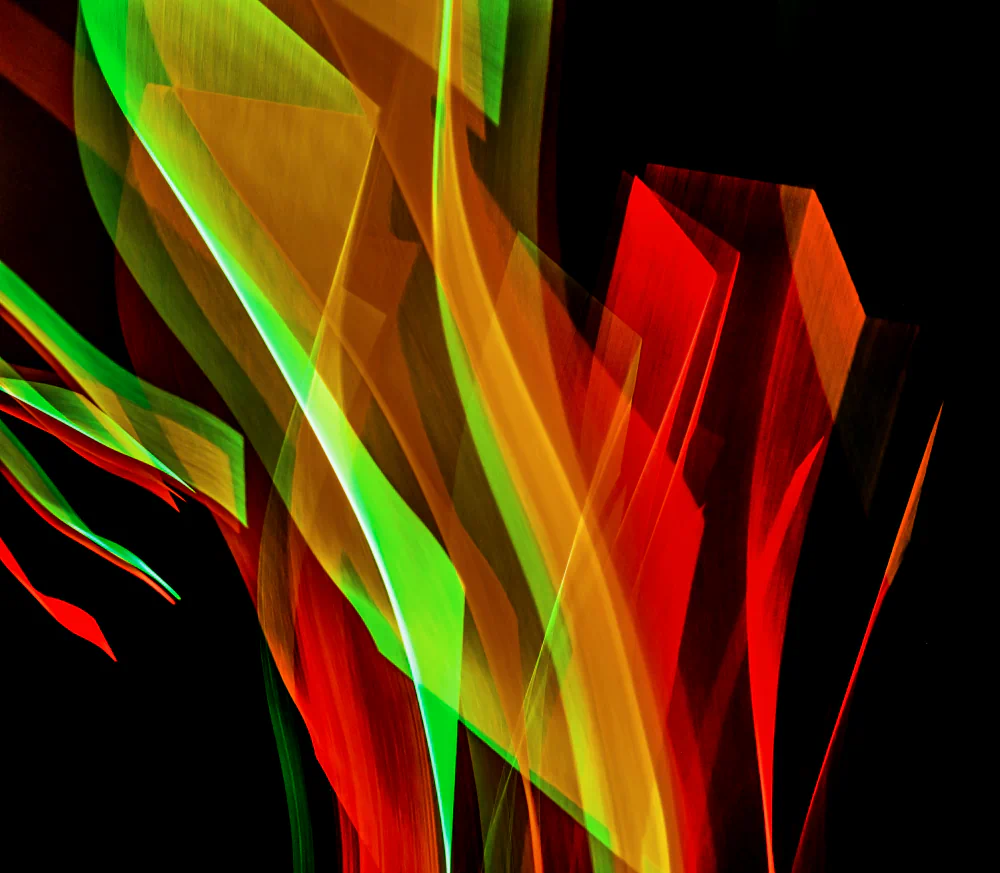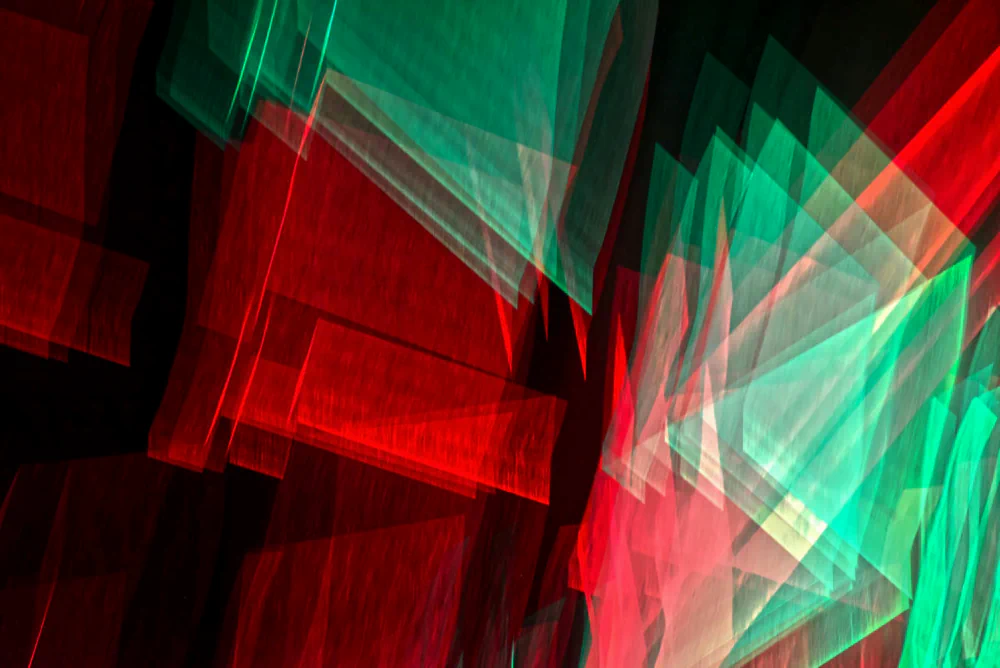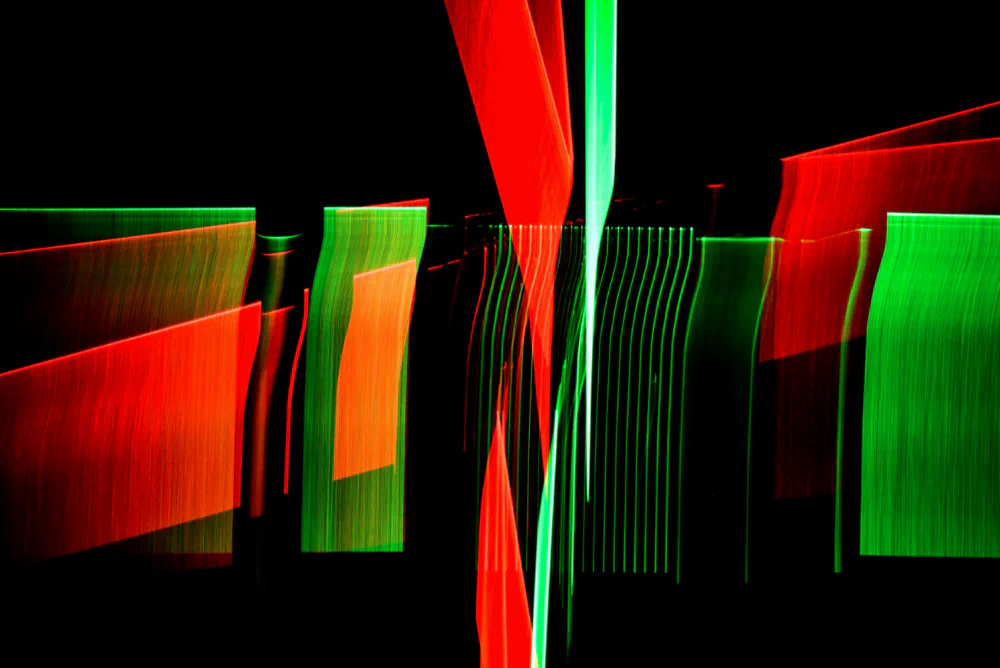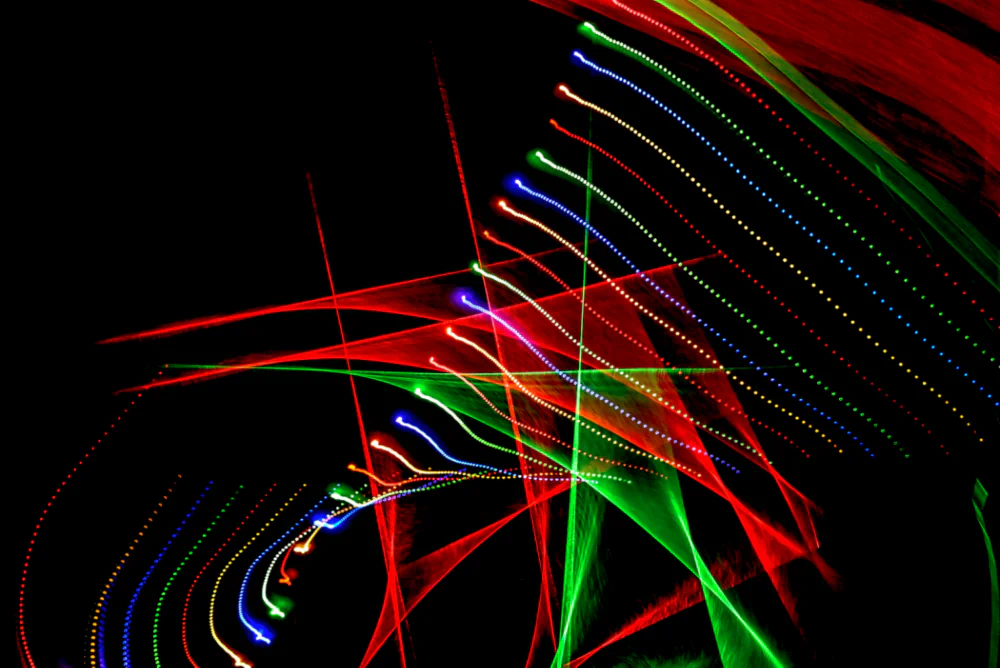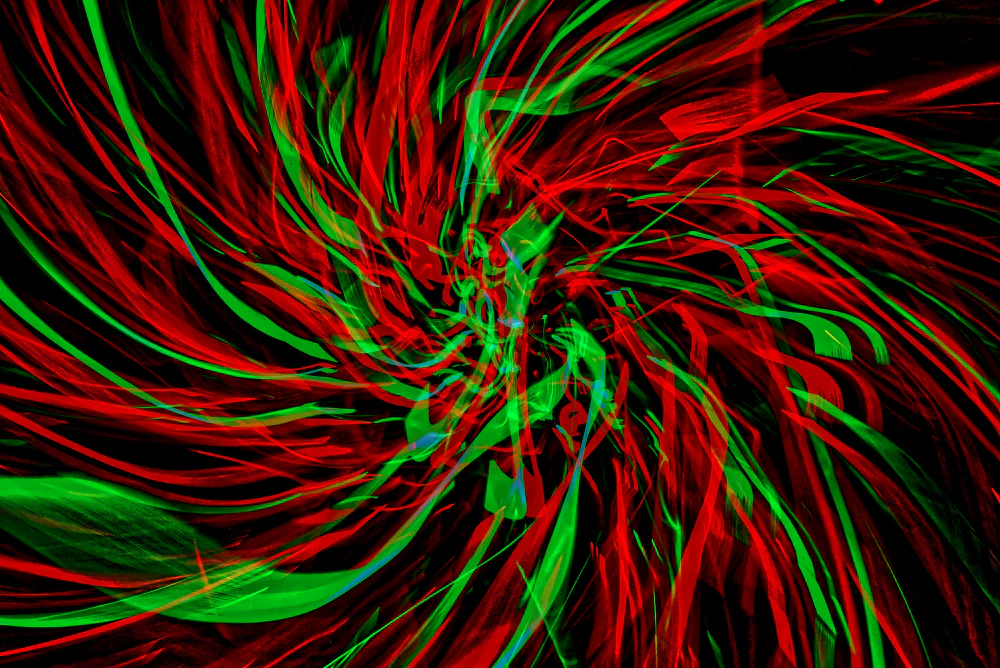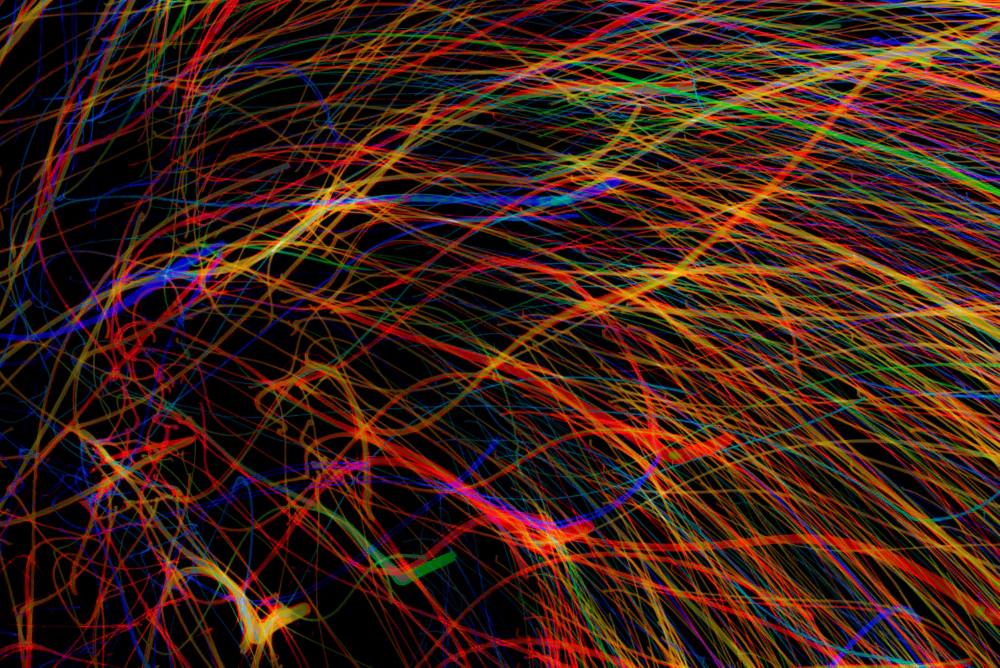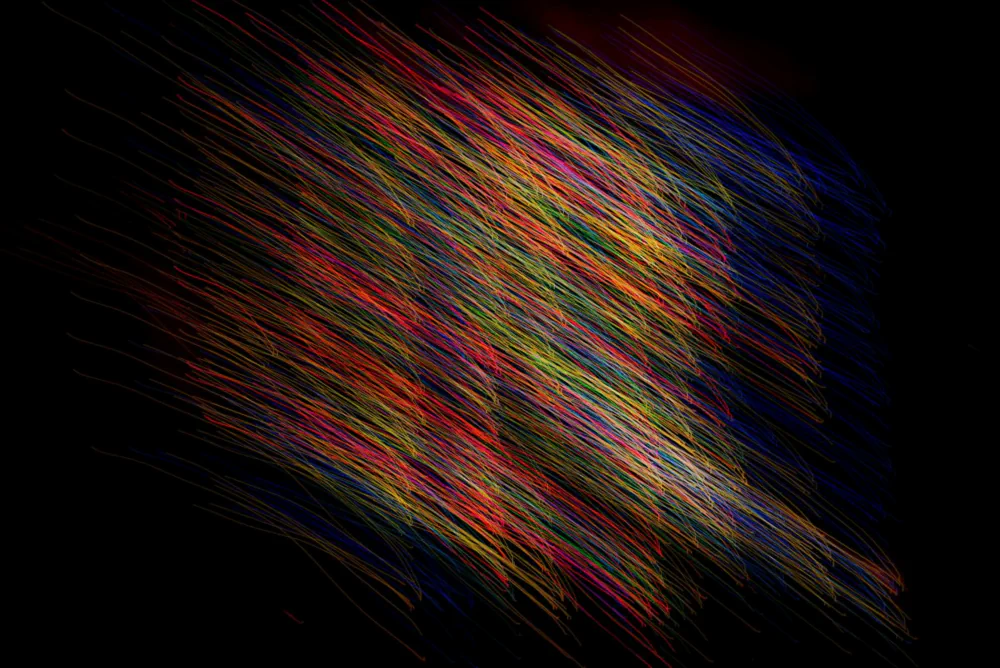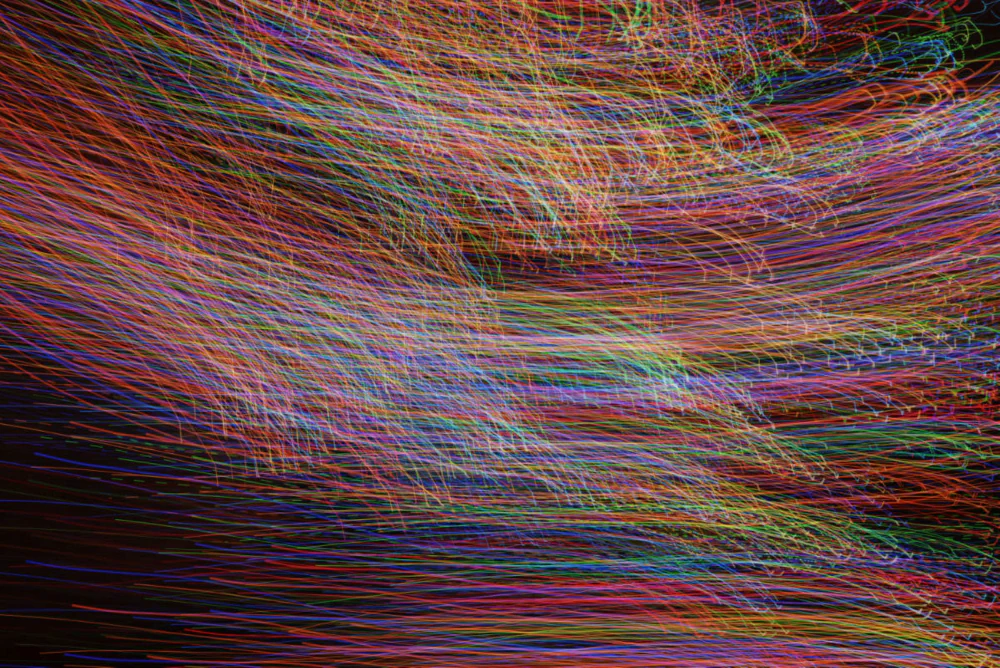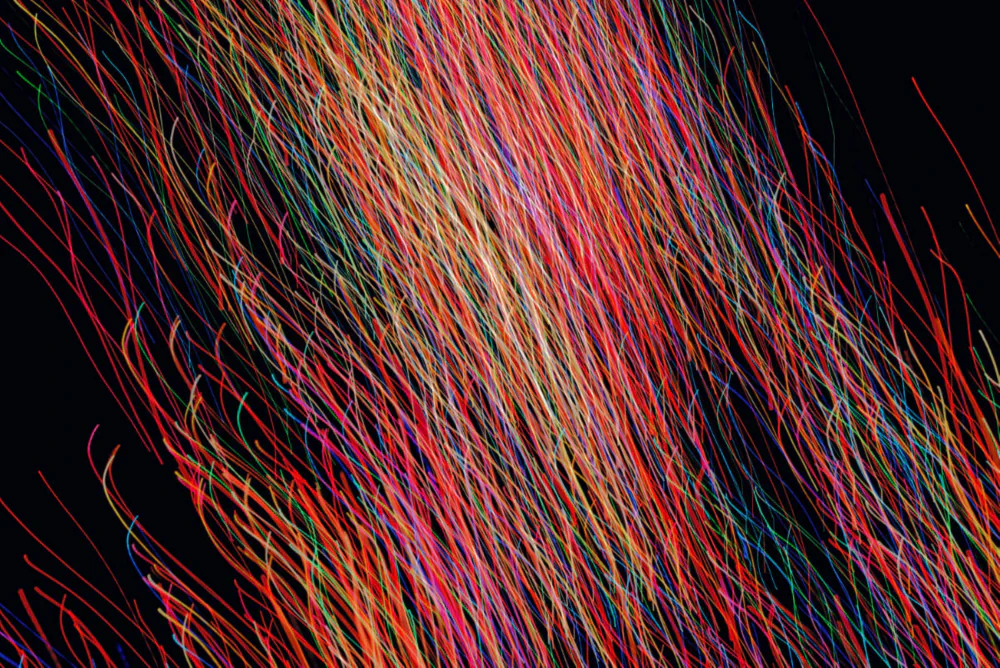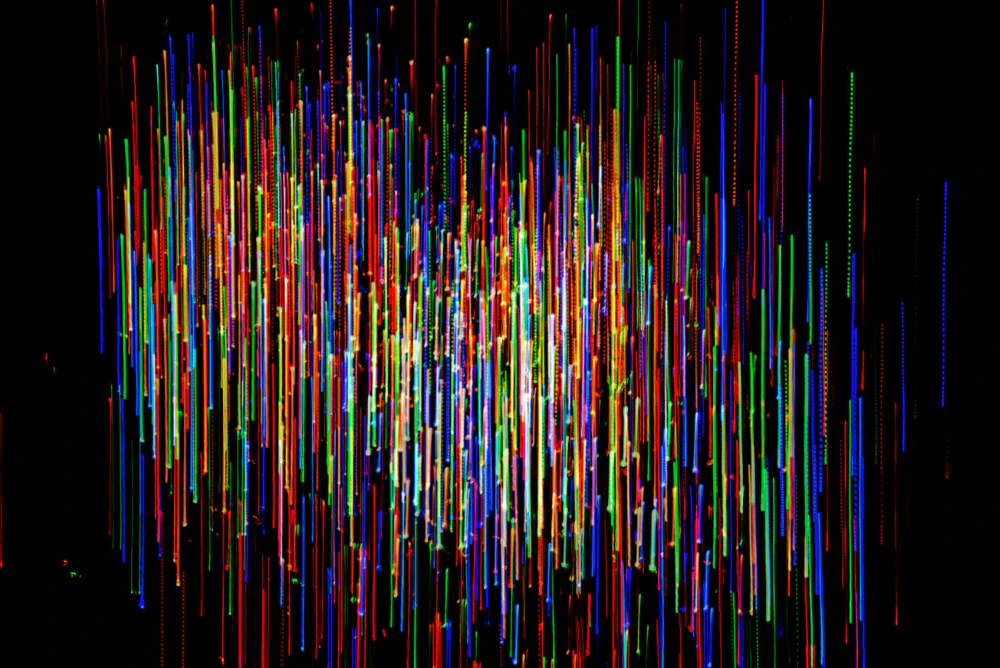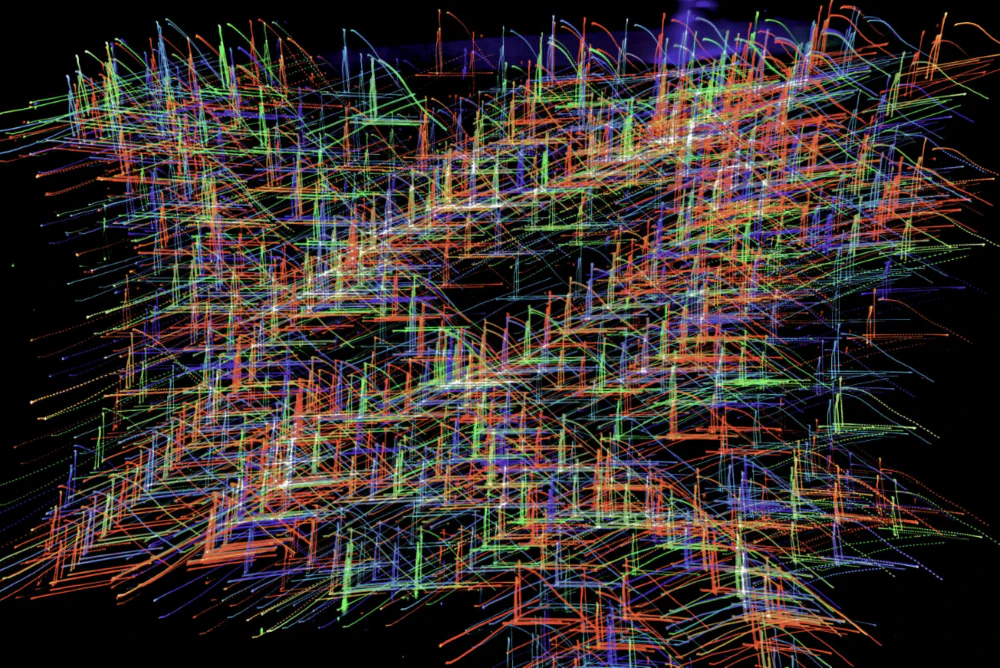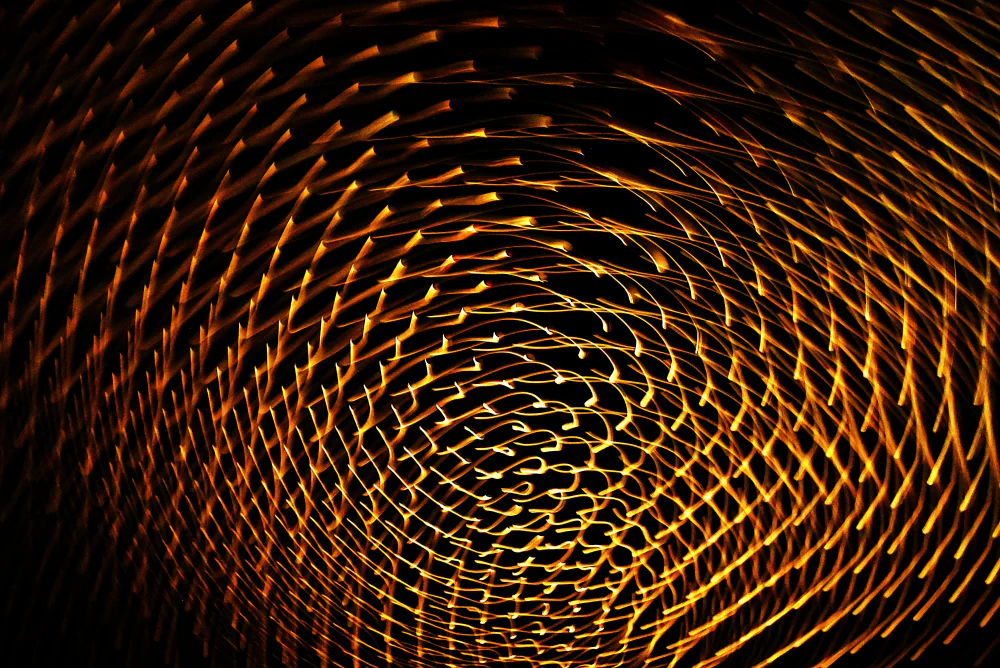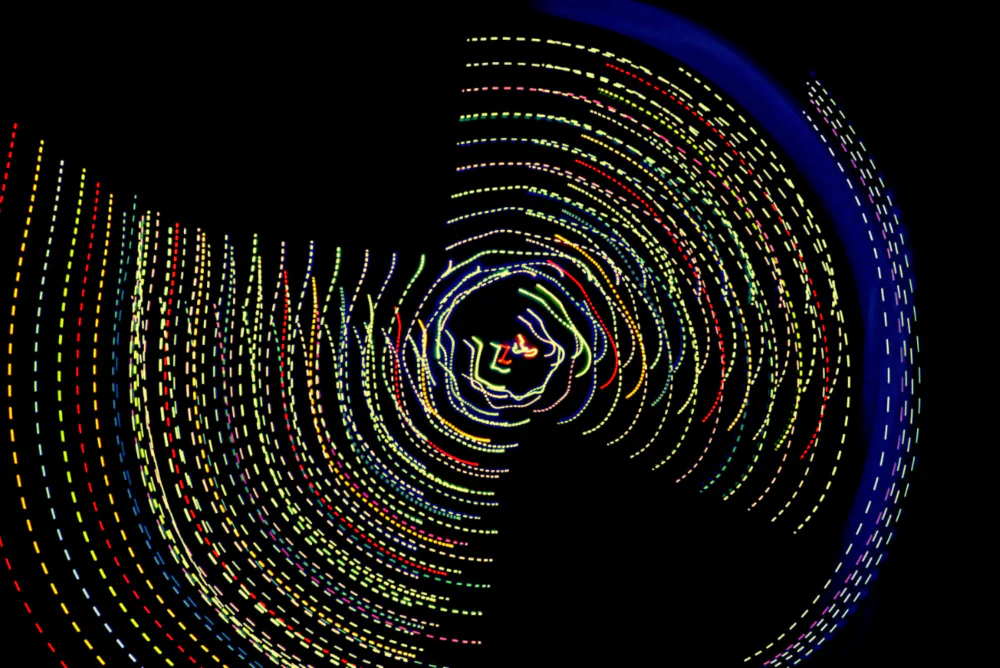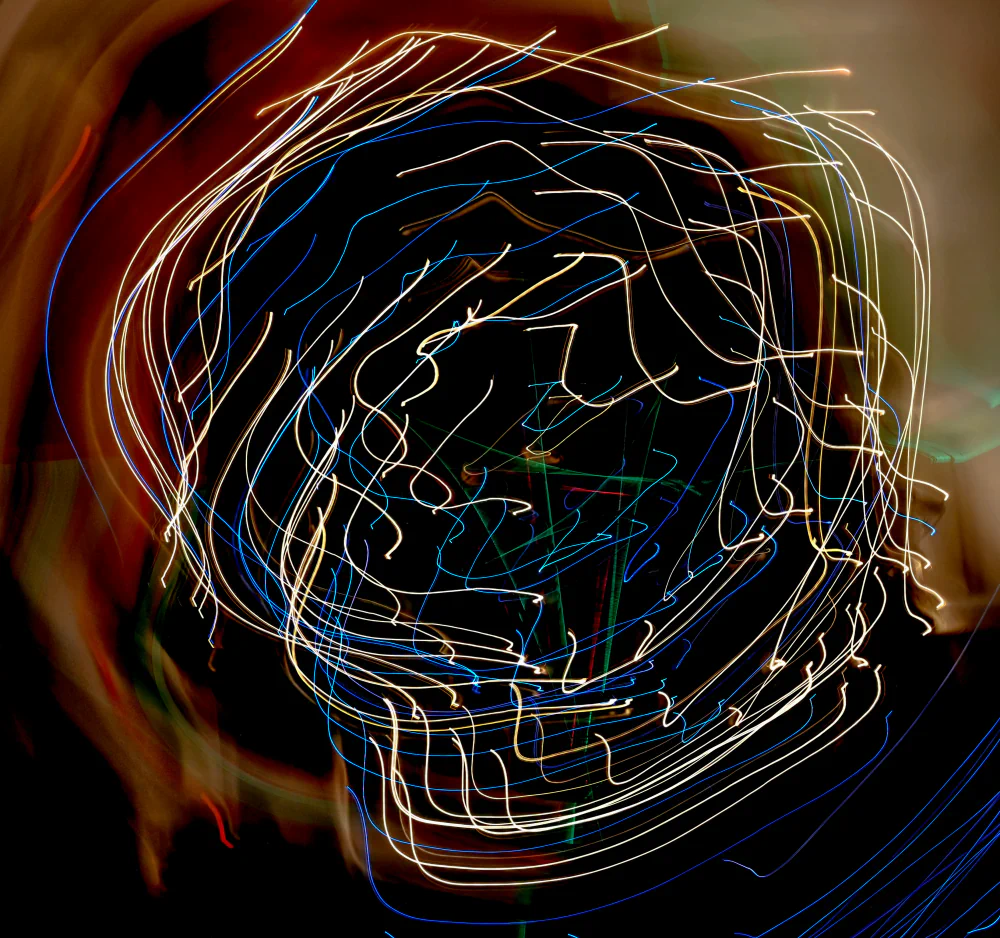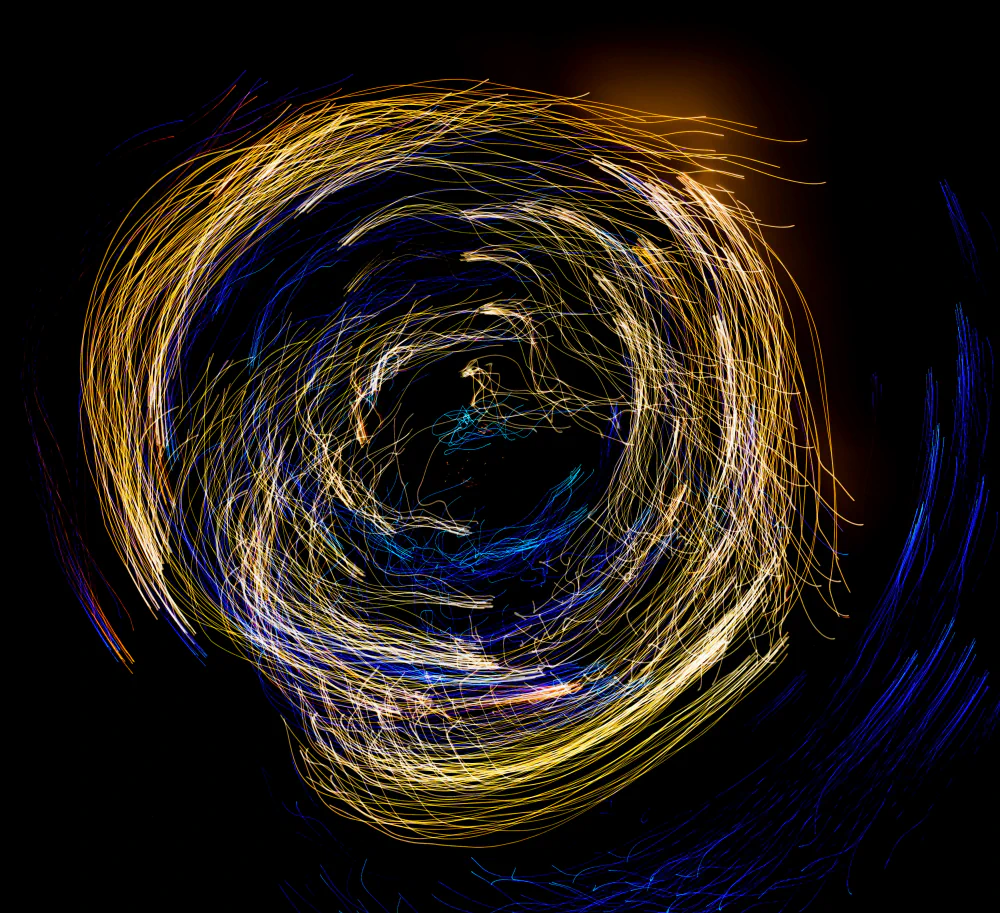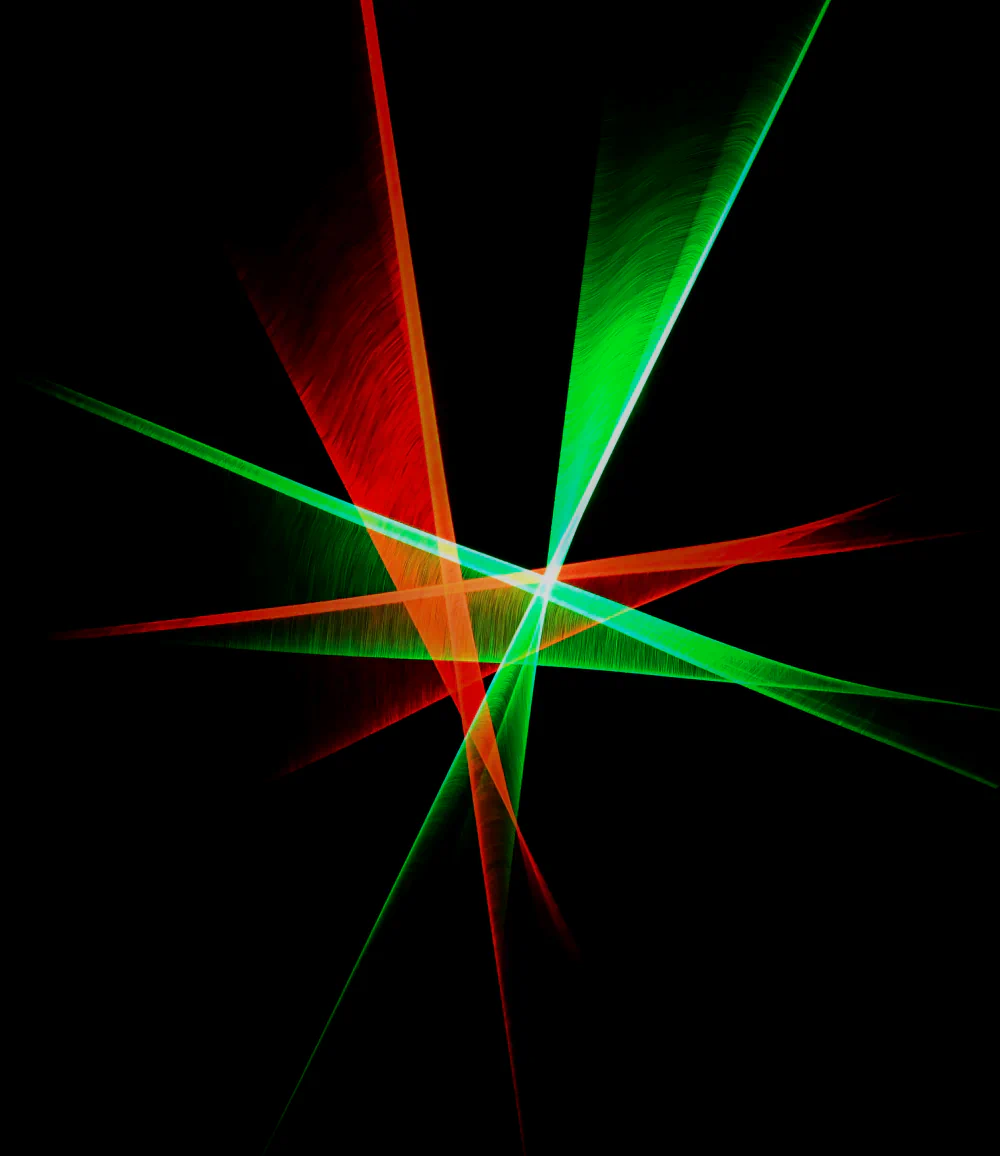


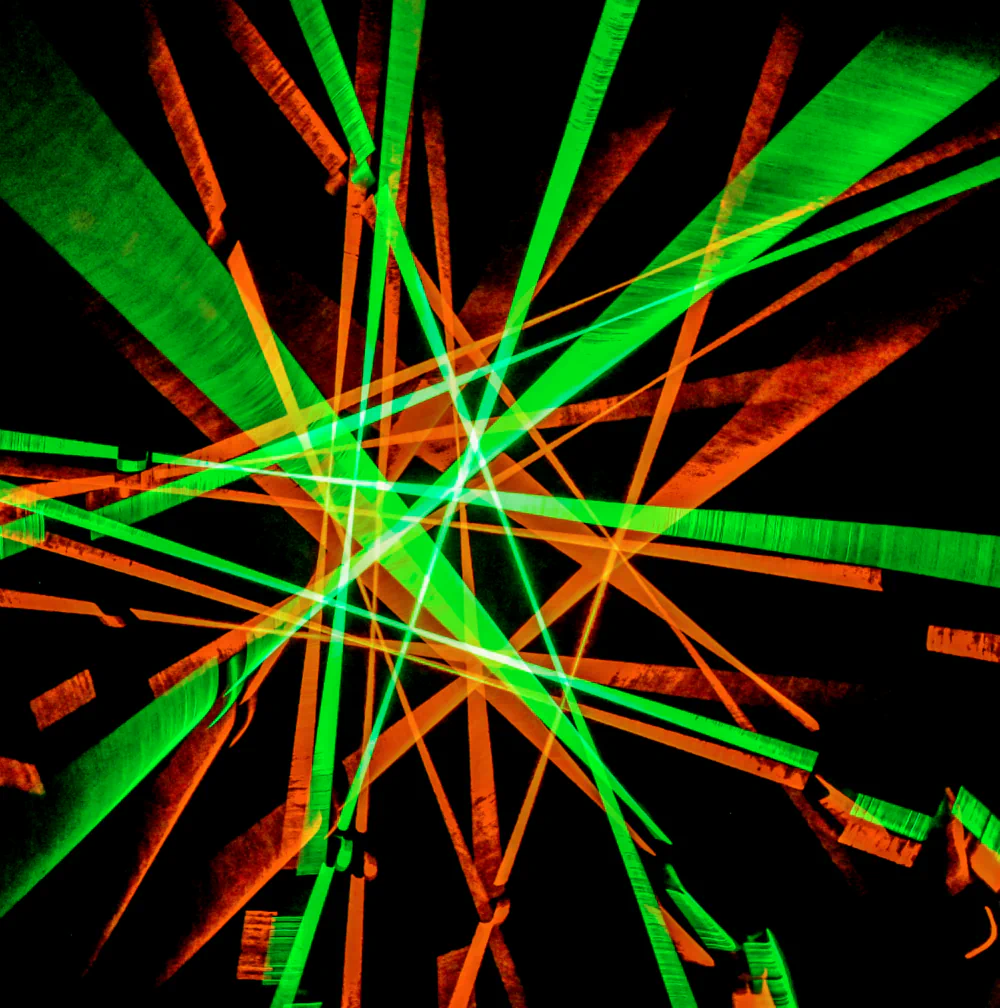
Rooted in Wassily Kandinsky’s fundamental theory that many of our discoveries are composed of a knowledge of light, and informed by Futurist, Constructivist, and Rayonist principles, each photograph in this project is created entirely by shaping static beams or scaffolds of light through the controlled movement of a handheld Nikon Z5 digital camera.
This technique is commonly referred to as Intentional Camera Movement (“ICM”), but unlike most ICM images, these photographs do not incorporate a physical object or scene. Rather, the “object” of inquiry is light itself and the ways in which it informs us.
The precise camera movement chosen at any given moment when composing an abstract image becomes instinctive and ultimately deliberate through practice and repetition. Thus, what may initially be discovered and captured by chance can later be intentionally reproduced and refined to create images of choice. The outcome and the sensation of creating it go hand in hand, simultaneously conveying the energy of movement and the image born from it.
Whereas the Italian Futurists of the early twentieth century understood that movement expressed through chromatic and linear shifts could capture the dynamism and energy of the modern world, these explorations seek truth in first-person interior experience rather than third-person objectivity.
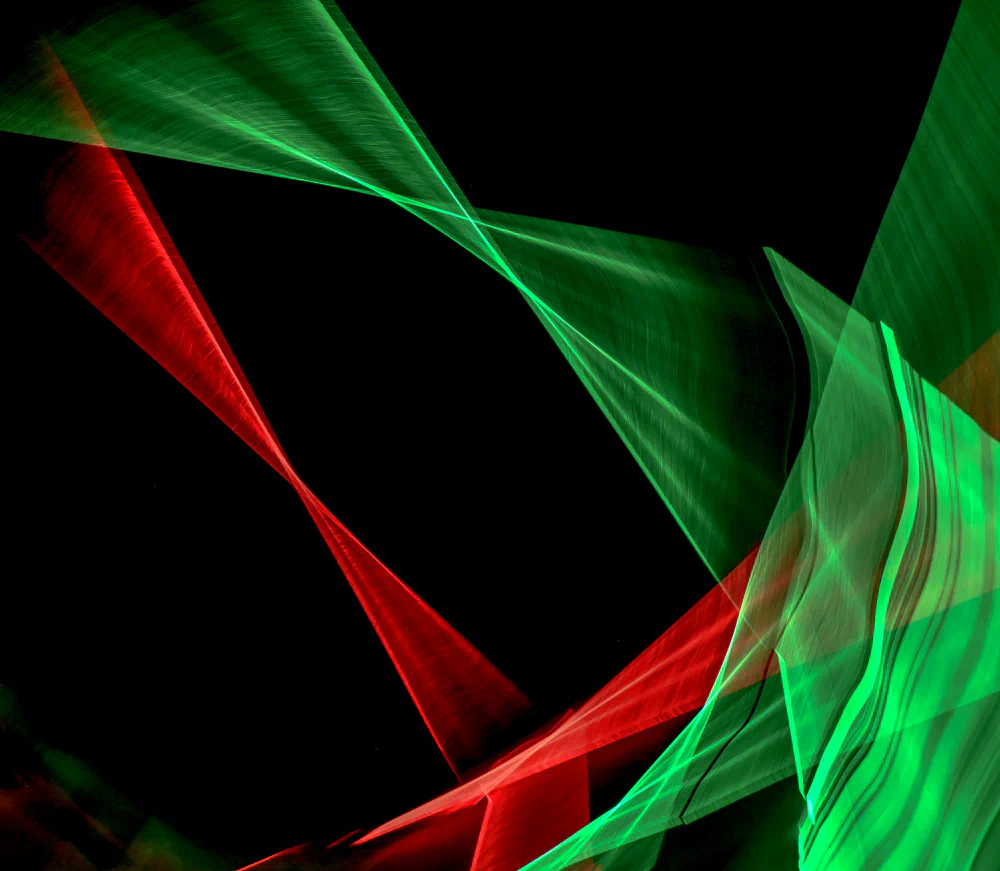
Living in the Abstract is a project that began a decade ago with the completion of a series of photographs exploring the abstract and astral qualities of common objects. Exhibited at the Chabot Space and Science Center in Oakland, California, the work challenged viewers to discover the reality of an object transformed by its abstract expression. As was explained at the time, when a familiar object is photographed in a way that prevents us from imposing our experience upon it, realism and abstraction merge to confirm that we live in a world of abstract relationships as much as we inhabit a physical one.
An outgrowth of that initial exploration was a deeper personal recognition that meaning in abstract art not only resides in the dialogue between image and viewer, but that this dialogue is what László Moholy-Nagy meant when he wrote that photography helps us understand how “light creation” informs us. The project therefore evolved into an examination of the role of light and motion in photography as a means of resurrecting memory and experiences stored in abstract form.
In other words, accepting the axiom that our memories are composed of a knowledge of light, kinetic photographs consisting solely of shaped light can help us recall the epiphanic energy that accompanies the act of remembering, which is ultimately a moment of learning about the world or oneself. Accordingly, by shaping light itself, the artist sought a direct dialogue with memory.
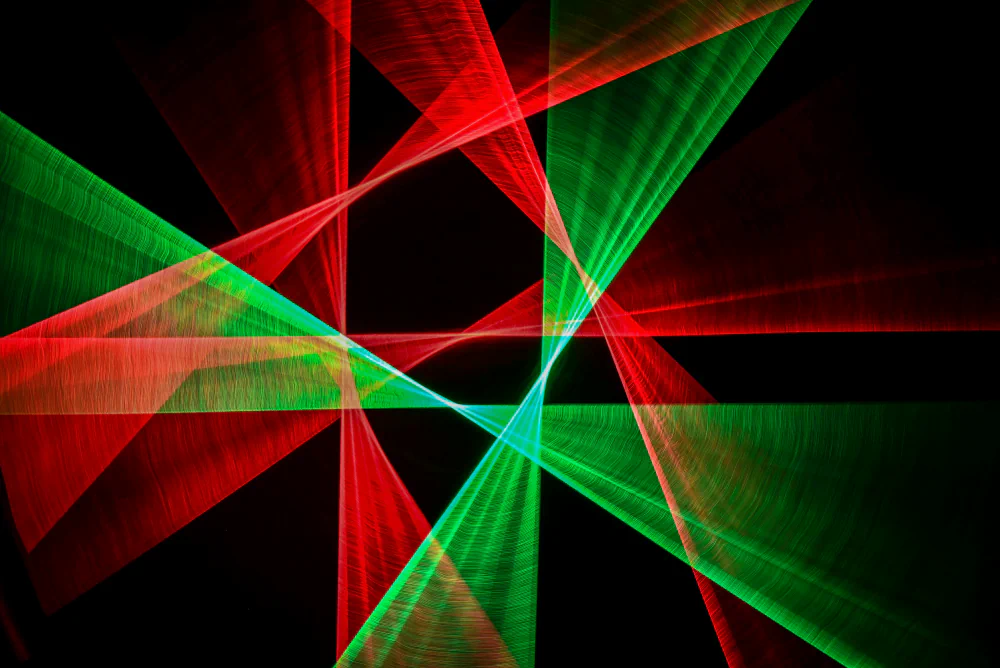
Whether composed intuitively, randomly, or with planned geometric precision, the results of these light explorations were initially not entirely coherent. It takes time to understand what geometry and color relationships reveal about oneself; to paraphrase Rilke, one must often simply live one’s way into the answers. Through this period of reflection and conversation with these abstractions, the artist came to believe that much of this kinetic photography project concerns the resurrection of moments in personal development, year by year, from birth through the age of twenty-five.
These images were not created chronologically and have instead been reordered according to the sequence in which they came to be understood, as expressions of a state of being at each age of formative development. Each photograph is numbered accordingly, although each also carries a title (for example, the title of image #1 is Birth). The titles of the remaining images have been intentionally omitted so as not to interfere with the viewer’s experience, as it is not the artist’s role to begin the conversation with anything other than the image itself.
In fine, the artist firmly believes that when emotive experiences emerge from the subconscious as abstract images, they are no longer merely re-experienced but understood for the first time, and that through such visualizations, the connecting threads of one’s life experience may be discovered.
About Andrew Wiener
A decade ago, during an extended stay in Paris, photographer Andrew Wiener had the opportunity to meet Spanish photographer Juan Manuel Abellán. Under Abellán’s guidance, Wiener began his long-term project Living in the Abstract, a body of work that has remained the primary focus of his photographic practice ever since, largely to the exclusion of his other photographic pursuits.
His abstract photographs have been exhibited in galleries, art centers, and online publications, including the Glasgow Gallery of Photography (Scotland), the Sacramento Fine Arts Center (California), F-Stop Magazine (Issues 131 and 137), the Piedmont Center for the Arts (California), Dada Gallery (San Francisco), Blue Koi Gallery (online), and Chateau Gallery (Kentucky).
A five-photograph series from Living in the Abstract received an Honorable Mention in the Fine Art Abstract category of the 2025 ND International Photography Awards. Based in Oakland, California, Wiener continues to explore abstraction through photography. A selection of his work can be viewed at [Official Website]