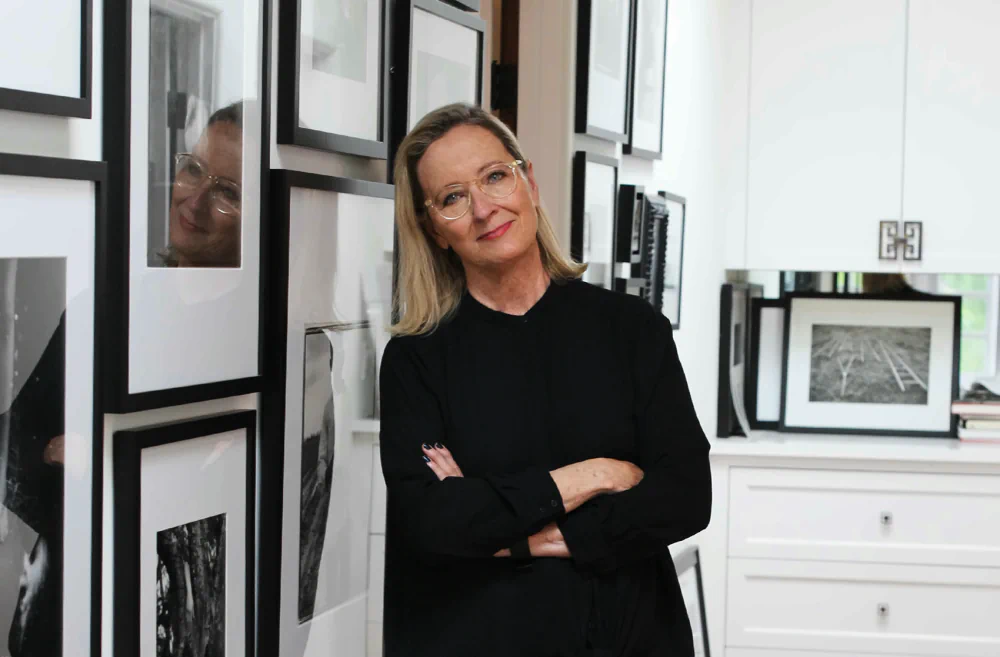
Aline Smithson is one of the most generous and consistent voices in contemporary photography. An artist, educator, editor, and founder of Lenscratch, she has devoted much of her career to creating spaces where photography can be seen, considered, and shared with depth.
Since 2007, Lenscratch has become a reference platform for both emerging and established photographers, combining publication, criticism, community, education, and real support for new voices. But behind that collective work, there is also a personal body of work shaped by memory, the body, family, humor, vulnerability, and a deeply physical relationship with the photographic image.
In this interview, we speak with Aline Smithson about the origins of Lenscratch, the invisible work that sustains an independent platform, her own artistic practice, the place of photography in the age of artificial intelligence, and the future of a visual community that is increasingly broad, complex, and necessary. [Lenscratch]
Lenscratch was born in 2007, when the internet still seemed like a more open, slower, and perhaps more generous territory for photography. What did you see at that time that made you feel there was a need for a space dedicated to looking at, writing about, and sharing the work of other photographers every day?
2007 was the era of the personal blog. Ironically, it was also the year when digital photography profoundly disrupted analog practices—darkrooms shuttered, films and papers disappeared, and communities were lost. Most importantly, the family photo album moved from the page to the computer screen, losing the tactile and tangible legacies that could once be passed down through generations. It’s something I think about often.
Like many photographers in 2007, I created a personal blog and would post an image or two, waiting for all three of my followers to give me the thumbs up. After a few months, the exercise felt hollow and a bit ridiculous. I realized I could instead use a blog to learn about my photographic community. I was teaching at the time and constantly searching for inspiration to share with my students, so I made a vow to feature a different photographer every day. What the hell was I thinking?
When I started, there were only a handful of photography blogs, all created by men, and it wasn’t a particularly welcoming community. The first few years involved discovering work I liked online, pulling images from the internet, and featuring them. Eventually, I realized I needed to establish relationships with artists and reach out directly. It made the process more complex, but those connections became incredibly meaningful.
Before becoming a recognized platform, Lenscratch was almost an intimate decision: to dedicate time and attention to the work of others. What changed in your own understanding of photography when you began to look systematically at the work of other artists?
It was indeed an intimate decision. I had been working in isolation for a long time. Through looking at so much work, I began to notice trends in photography and the ways photographers influence one another. In 2007, there was a significant amount of work about family being made by fathers, which I loved, and I curated several exhibitions around those ideas.
When I began my photographic journey in earnest in the mid-1990s, the photography world felt fairly sterile—a focus on perfectionism, strict rules about cropping, and imagery still deeply tied to darkroom traditions. In graduate programs, photography had separated from broader art studies and became its own singular discipline. In many ways, photography felt less creative as the system became structured around the 20-image portfolio and accompanying artist statement.
Thankfully, over the last 30 years, I’ve seen a return to artistic intervention within photography. In my opinion, the medium has become far more experimental, expansive, and interesting.
Publishing photography every day for so many years means developing a very particular way of listening to images. What signs tell you that a project has something to say beyond its visual surface?
For me, it’s when concept, process, and subject matter align and are elevated by a meaningful artist statement. Sometimes I encounter work that initially feels uninspiring, but then I read a well-considered statement and it causes me to look more deeply. Other times, the work is stellar but the statement falls flat. Artists who can successfully achieve both are often able to communicate their work in a more profound way.
What is Lenscratch like from the inside? Who is part of the team, and how is the daily work divided?
At the end of the day, it still boils down to me checking every post before it goes live. In the beginning, several of my students came on to help—two of them, in particular, still run the back end of the site. Another became the art director and helps with visuals, while others contributed as resource editors.
Over the last ten years, more photographic artists and educators have asked to contribute regular columns or share work and exhibitions they’ve encountered. I think of the site as a community, and at present we have about 35 people contributing in ways both large and small. It’s a very relaxed environment, and I never want to overload or stress the editors—we all work for free and already have busy lives as educators and artists.
Trust me, I am so grateful to everyone who has contributed to the site over the years.
A platform like this is not sustained by publishing images alone. What part of the invisible work do you think people do not see from the outside?
It’s the constant slog of putting everything together. There have been many holidays spent watching TV while simultaneously assembling Lenscratch exhibitions, especially those with hundreds and hundreds of submissions—which nearly kill me.
There’s also the ongoing concern of fundraising for our Student Prize Awards. The site has now grown so large that we require our own server, which has become a major expense.
I think those on the outside don’t fully understand the amount of work and commitment the site requires. It’s easy to make a throwaway negative comment on Instagram without understanding how much time, effort, and care it takes to create and maintain the site—all of it time taken away from our own photographic practices.
How do you decide which projects deserve space on Lenscratch? What signs make you feel that a body of work needs to be shared?
One area I used to respond to frequently was book projects. I understand how important a monograph can be to an artist’s career. Now I receive three to five book submissions a day, and it’s impossible to feature everything. Just as today everyone is a photographer, now everyone is also a published photographer.
I’m always looking for projects with meaning behind them—work that shows me something in a new way. Sometimes I organize an entire week of posts around a shared theme so educators can use the material directly in their classrooms.
After so many years of looking at, editing, and supporting the work of other photographers through Lenscratch, when do you return to your own work and recover the silence needed to look as an artist?
I tend to make a lot of work during the summer, when we move to the East Coast for a few months. I’ve definitely slowed down and now focus on perhaps one project a year. I do more thinking than making.
When did photography first appear in your life, not as a profession, but as a way of looking at the world?
I come from an art background rather than a photography background, although photography was always present in my life. My father had a darkroom in the basement and was a hobbyist photographer, my uncle was an editorial photographer, and during my ten-year career as a fashion editor in New York City, I often stood beside some of the great figures in fashion photography. So I was always conscious of photography as an art form, but at heart I was a painter. I owned a camera in college, but it wasn’t my primary focus.
It wasn’t until I became a mother and was designated the family photographer that I began shooting seriously. I took a photography class at UCLA and discovered my uncle’s 2.8F Twin Lens Rolleiflex from the 1960s sitting in the garage. I began working in medium format and realized I could make art with a camera. It was a profound revelation, and needless to say, I was completely hooked.
My family gave me tremendous support, and my children graciously allowed me to experiment with all sorts of ideas. Truly, they were incredible collaborators and never said no to my visions.
Your work with Lenscratch constantly places you in front of other artists’ work. Does that daily exposure affect your own photographic practice?
Not really, other than taking time away from my own practice. I have a strong sense of who I am and what I want to explore in my work. Our best work comes from our own histories and interests, and that is unique to each individual. I’m not interested in replicating someone else’s ideas or style. My more recent work feels more experimental and is bringing me back to using the camera as a tool for making art.
Your work often moves between the familiar and the unsettling, between humor and a kind of quiet melancholy. Do you consciously look for that tension, or does it appear naturally?
I think it’s simply who I am. I have a strong sense of humor—both of my parents were quirky and funny—but I also feel a deep sense of pathos for the human experience. It’s interesting that you mention melancholy, because it’s a feeling I carry often, especially as I get older. I also think the images that the Rolleiflex creates feel a bit nostalgic.
I’m not afraid to look at difficult things or talk about them openly, but I’m also not afraid to make fun of myself.
One of the projects that impressed us most, and that we also had the pleasure of publishing in Dodho, was The Embarrassment of Being Human. In this series, you approach the body through vulnerability, discomfort, mortality, and everything we usually try to hide. What led you to look at the human body from such an uncomfortable, but also deeply honest, place?
As a mother, I had to become comfortable with a wide range of bodily functions—my children’s and my own. Many people are disgusted by things that actually fascinate me. As an art student, I learned to draw from a cadaver, and I have witnessed death many times. I love taxidermy, my walls feature various animals, and I’m oddly drawn to fake body parts. Living in Los Angeles, with its incredible prop stores, only fed that fascination.
Where this interest comes from, I honestly don’t know. But this stew of physicality—everything that makes us human—compelled me to create work about it. Why should we be ashamed of what is simply part of being alive? Why can’t men look at a bloody tampon? Why do we feel the need to hide our humanness?
At a time when an image can be generated without a camera, without a body, and without any direct experience of the world, what do you think will continue to make photography necessary?
I am worried about the future of the photographic image. Photography has long been the one language that nearly everyone on the planet can understand. We are consumed by visuals in our everyday lives, and I don’t see that changing. But the most troubling question now is: what is true?
Artificial intelligence is profoundly changing the way we produce, read, and valuei mages. As an artist, editor, and educator, how do you see the future of photography in this new context?
I recently featured my first AI artist on Lenscratch: Phillip Toledano. He uses AI to critique and satirize AI itself, but the post received such backlash that I realized many people misunderstood what he was doing.
I haven’t yet had students working significantly with AI, but I think we are going to have to learn to live with it. That said, I believe most artists will continue pursuing more traditional paths, at least for the foreseeable future.
Looking ahead, what new projects are you working on now, both in your artistic practice and through Lenscratch? Is there any direction, idea, or territory that feels especially urgent for you to explore at this stage?
I have several book projects I’d like to bring to fruition, along with a personal project about my father that I need time to develop. I want to continue making work about what we are losing now that technology has eliminated so many tangible records of our existence—printed photographs, photo albums, letters, ephemera, and physical archives.
I’m also deeply interested in the reality that all hard drives will eventually fail—and who, after we die, will maintain those digital memories? I recently had a large exhibition exploring these ideas titled The Ephemeral Archive. (https://lenscratch.com/2024/01/aline-smithson-the-ephemeral-archive/)
Finally, considering your long experience supporting photographers and giving visibility to their work, how do you perceive the work we do at Dodho Magazine within the international photography community?
First, a huge thank you for considering me and Lenscratch for a feature in Dodho Magazine. I grew up savoring and collecting magazines, and I still love seeing work in print.
Dodho Magazine has become an influential platform within the contemporary photography world by creating visibility for photographers outside the traditional gatekeeping structures of museums, major publishers, and galleries. Dodho has helped shift that system, allowing photographers from around the world to participate in and be exposed to global conversations regardless of geography or institutional affiliation. The magazine operates not only as a publication, but as a connector within an international creative community.
Dodho does so much to elevate and support photographers through features, awards, books, and more—it is truly remarkable. Thank you for all the time, energy, and effort you extend to photographers around the globe. We are deeply appreciative.