

Are We Living in a Computer Simulation?
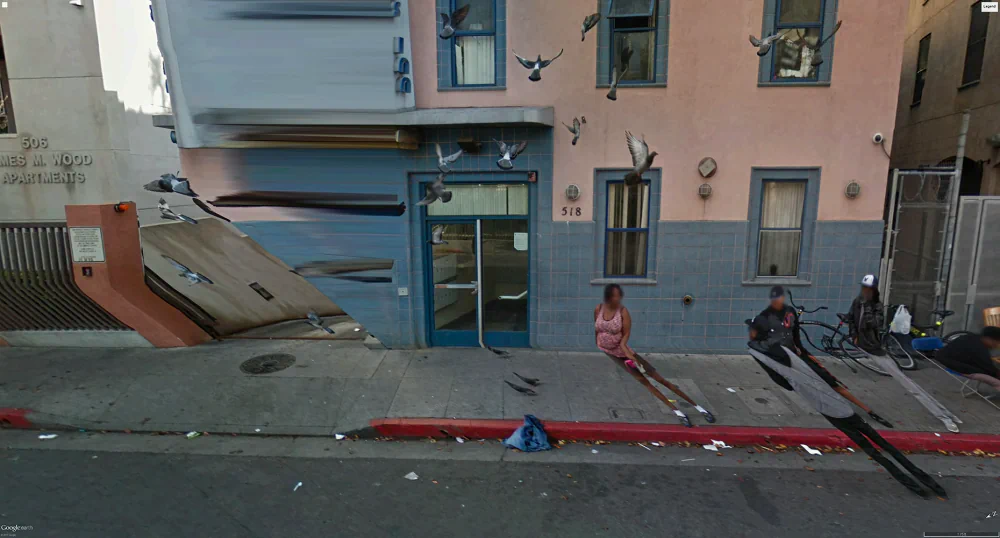
Google Glitches began with a simple observation: when moving through Google Street View, the world does not behave exactly like the physical world it represents.
Streets, buildings, vehicles, trees, signs, and people are reconstructed from a sequence of 360-degree photographs and computational processes. As one panorama gives way to the next, space stretches, compresses, folds, and briefly loses the stability that we normally expect from photographic representation.
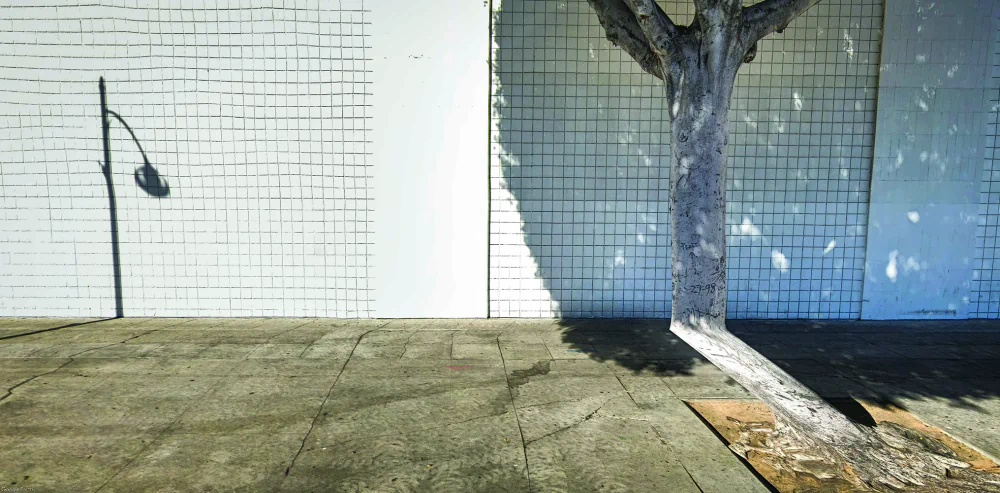
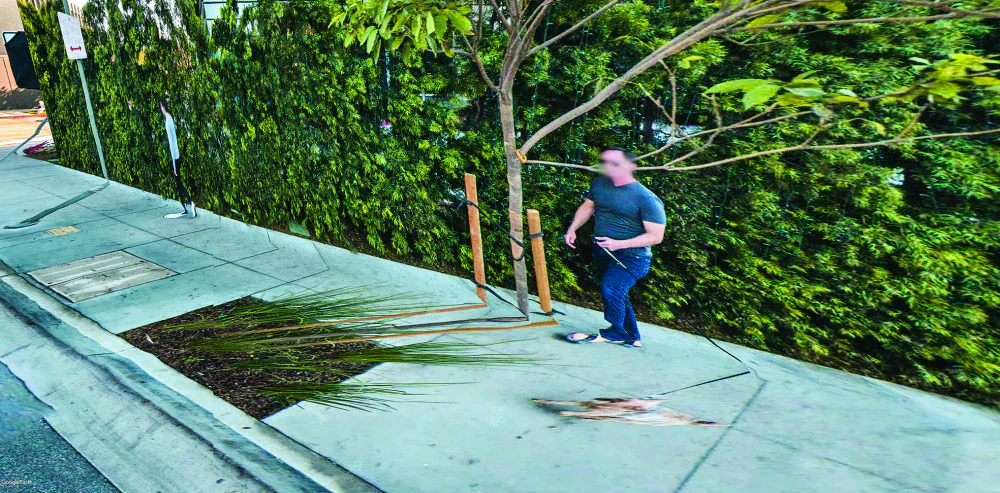
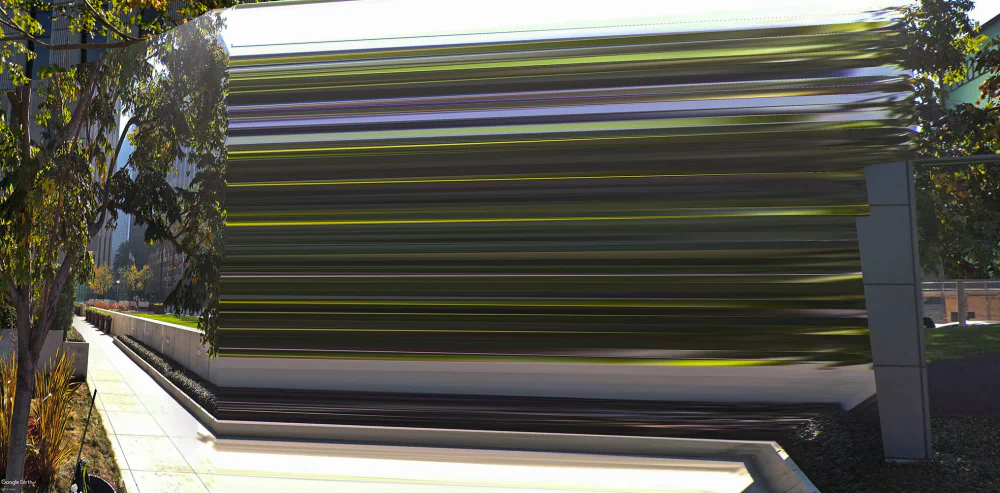
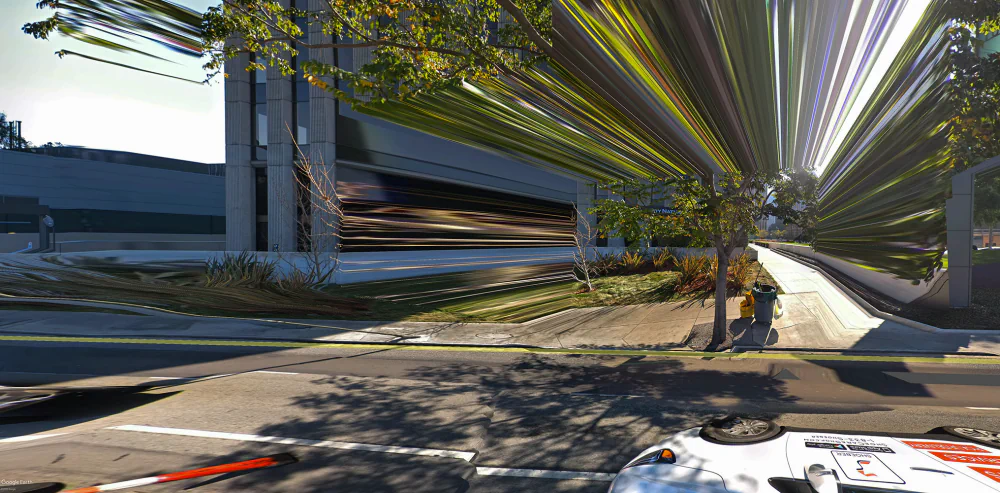
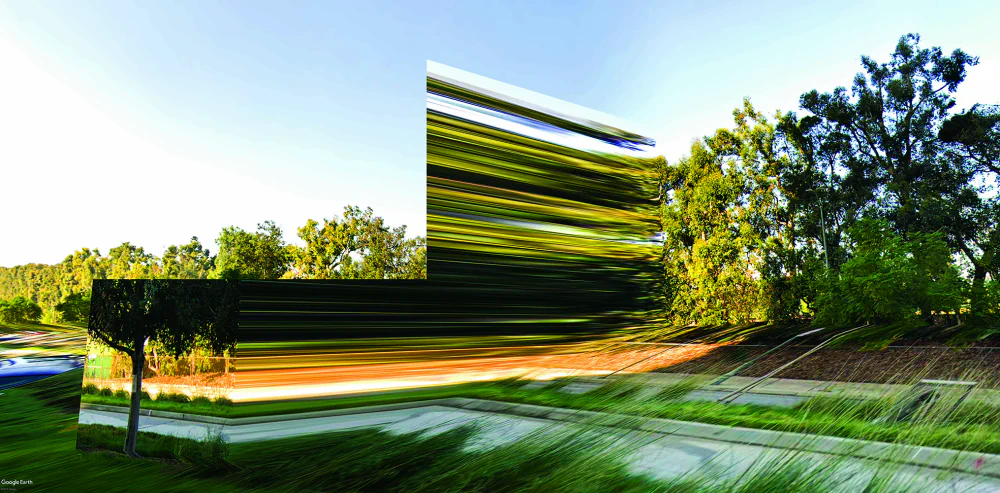
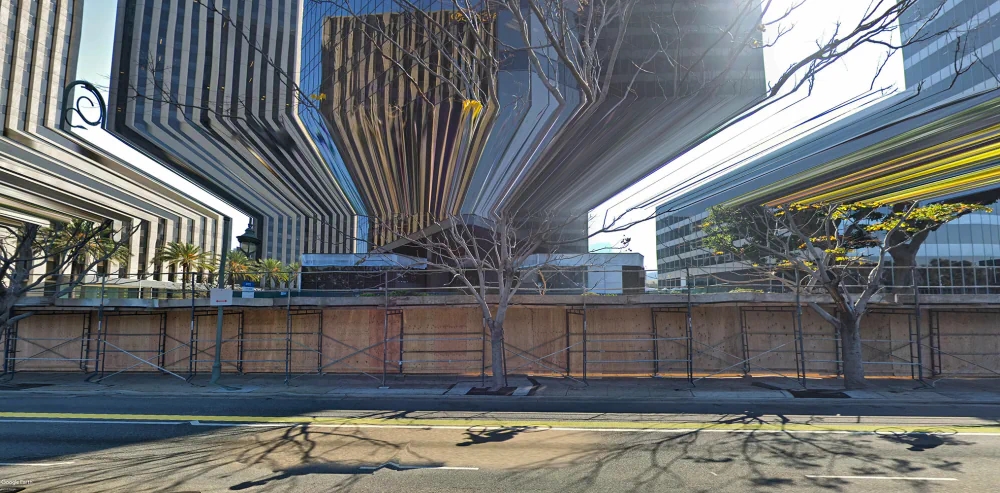
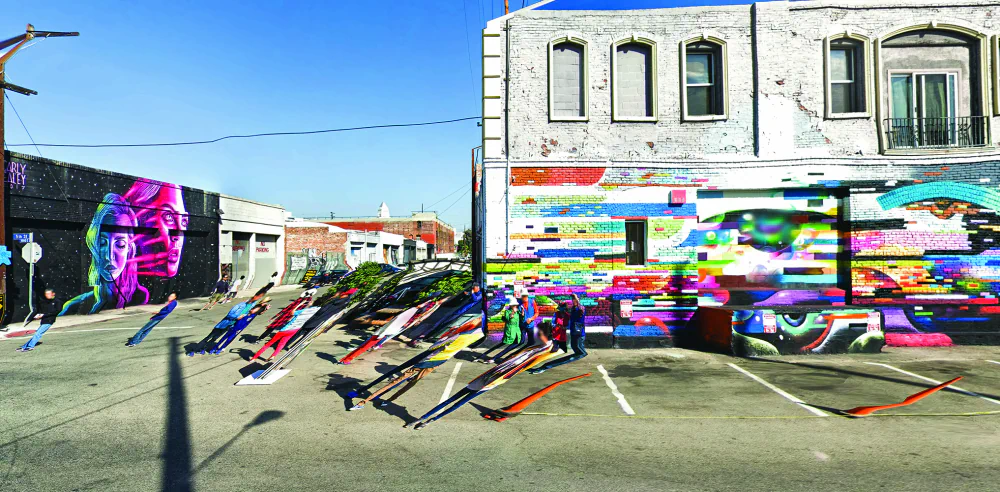
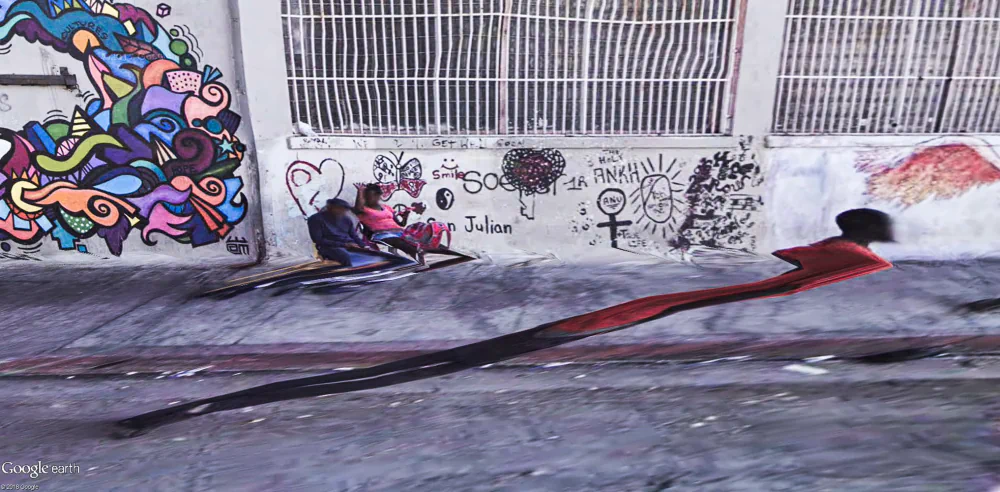
I became interested in these transitional moments, particularly in earlier generations of Google Street View, when the mechanisms of reconstruction were often more visible. Objects could flatten against the ground or a wall, architectural surfaces could bend, and the space between one viewpoint and another could appear to melt or morph. At times, the system seemed to build an invisible geometric container around the photographed world: floor, walls, depth, and direction were present, but they did not always agree with the objects placed inside them.
Technically, many of these images are not “glitches” in the usual sense. They are traces of a system attempting to translate physical reality into a continuous, navigable virtual environment. The distortion appears because several forms of information—photographic, spatial, geometric, and computational—must be reconciled. What interests me is precisely the moment when that reconciliation becomes visible.
Photography has historically carried an assumption of directness: something existed in front of a camera, light touched a surface, and an image was produced. Google Street View and Google Earth complicate that relationship. Their images originate in the real world, yet what we finally encounter on the screen is already a reconstruction. The physical world has been photographed, mapped, measured, stitched, modeled, compressed, and reassembled before we see it. I use these systems as a kind of camera, but a camera whose lens is distributed across machines, databases, software, and time.
For me, the resulting images open a larger philosophical question. If a convincing virtual world must first deconstruct reality into data and then reconstruct it as an experience, what might that process tell us about our own perception of reality? The simulation hypothesis becomes useful here less as a scientific claim than as a metaphor. The images do not attempt to prove that we live inside a computer simulation. Instead, they create a visual space in which the idea can be considered.
A glitch is usually understood as evidence that a system has failed. In this project, however, the apparent failure can also be a moment of disclosure. The image reveals something about the structure that normally remains hidden. A road surface becomes a plane. A building becomes a skin. A vehicle stretches between viewpoints. Perspective detaches itself from ordinary vision. For a fraction of a second, the virtual world exposes the scaffolding behind its realism.
This is where Google Glitches becomes photographic for me. I am not interested only in collecting strange digital accidents. I am interested in the act of seeing: recognizing a meaningful configuration within a continuously changing visual system, selecting a moment, framing it, and transforming an ordinary navigational environment into a still image. The source may be computational, but the photographic decision remains one of attention, timing, interpretation, and composition.
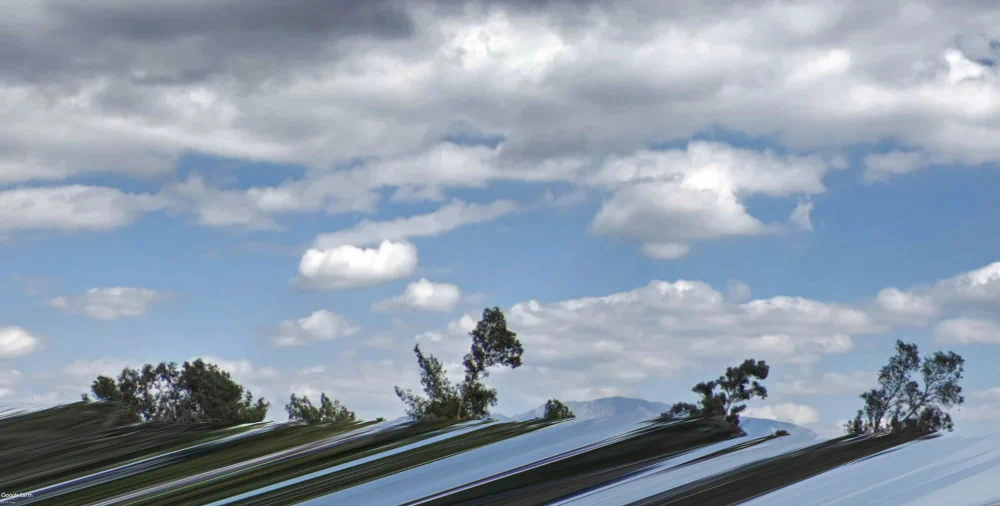
Google Earth expands the same question from the street to the planetary scale. It presents a model based on the physical Earth, yet the experience of that Earth is produced through layers of images, data, rendering, and simulation. It is simultaneously familiar and constructed. We recognize the world, but we encounter it through an interface.
The project therefore sits between photography and virtual reality, documentation and abstraction, observation and speculation. These images originate in technologies designed to make the world more legible and accessible, yet their unstable moments remind us that every representation is also an interpretation. What appears to be a broken image may instead be a brief view into the machinery of representation itself.
Google Glitches asks the viewer to remain in that uncertainty: between the real and the reconstructed, between a photograph and a model, and between an error and a revelation.
Source Note:
This project incorporates imagery accessed through Google Street View, Google Earth, and related Google services. Google attribution visible in the source imagery has been retained where applicable.
About Medford DeForest
Medford DeForest is a photographer and visual artist whose work investigates the shifting boundaries between photography, technology, perception, and constructed reality. His practice frequently uses existing imaging systems—including digital mapping, virtual environments, and machine-mediated forms of seeing—as photographic tools, examining how technologies designed to describe the world can also transform our understanding of it.
DeForest received an MFA in Studio Art from the University at Buffalo in 2022 and a BFA in Photography from the New York Film Academy in 2019. His MFA thesis exhibition, A Mirrored Image in the Mirror Stage, was presented at CEPA Gallery in Buffalo. His work has been exhibited in the United States and internationally, including exhibitions in Buffalo, Los Angeles, Norfolk, and Tehran.
His photographic work has received recognition from the International Photography Awards, including a Silver Prize in 2003 and Honorable Mentions in 2016, 2017, and 2018, as well as an Honorable Mention from PX3 Prix de la Photographie Paris in 2019. Earlier, his work was included in the 8th International Photo Competition at the Museum of Contemporary Art in Tehran in 1999. His photographs have also appeared in FAYN Magazine and in group exhibitions, including a 2016 Hasselblad Bulletin exhibition.
Across his projects, DeForest is interested in the point at which a photograph stops functioning simply as a record and begins to reveal the systems—human, technological, philosophical, or perceptual—that shape what we call reality. [Official Website]