

Walls listen. They shelter the lives of those who inhabit them and become fragments of a hospitable cosmos, allowing life to grow through seduction, through the struggle of making dignity out of very little.
Walls speak. They tell us ancient stories, events that history has handed down to us, the everyday lives of ordinary people layered upon one another through time. Posters are pasted onto walls; phrases are written on them to make them indelible. Walls often become the canvas of impromptu artists, the tangible mark of their existence.
But walls are also accomplices, and the word must be taken seriously. An accomplice is inside the scene and shares responsibility for what takes place. Complice il Muro (The Wall as Accomplice) begins with the suspicion that a painted wall is never merely a backdrop, and that no one standing before it is ever simply a passerby. The images in this series bring a painted figure and a living body into the same frame, observing what they have to say to one another.
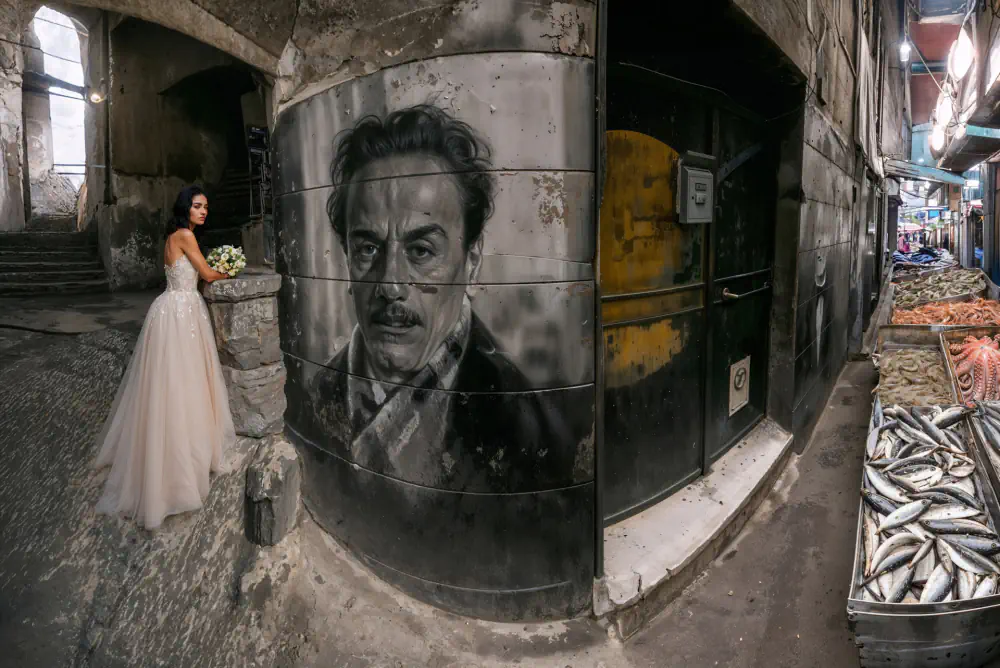
A Shadow Traced on a Wall
Pliny the Elder tells us that painting was born from a wall. In Corinth, on the evening before her beloved was to leave, the daughter of the potter Butades traced the outline of the shadow cast by an oil lamp onto a wall. Her father filled that outline with clay. At the origin of the image lies a body about to be absent, and a surface that preserves its silhouette.
This founding scene is the point from which the series turns itself inside out. In the myth, the image takes the place of someone who is no longer there. Here, the body is present, flesh and blood, before the camera, and the painted figure has become as present as the body itself. Two presences, one made of pigment and the other of flesh, occupy the same space, and neither is an absence. From this situation emerge different ways of being together, and these are what deserve to be explored.
The Wall That Imitates
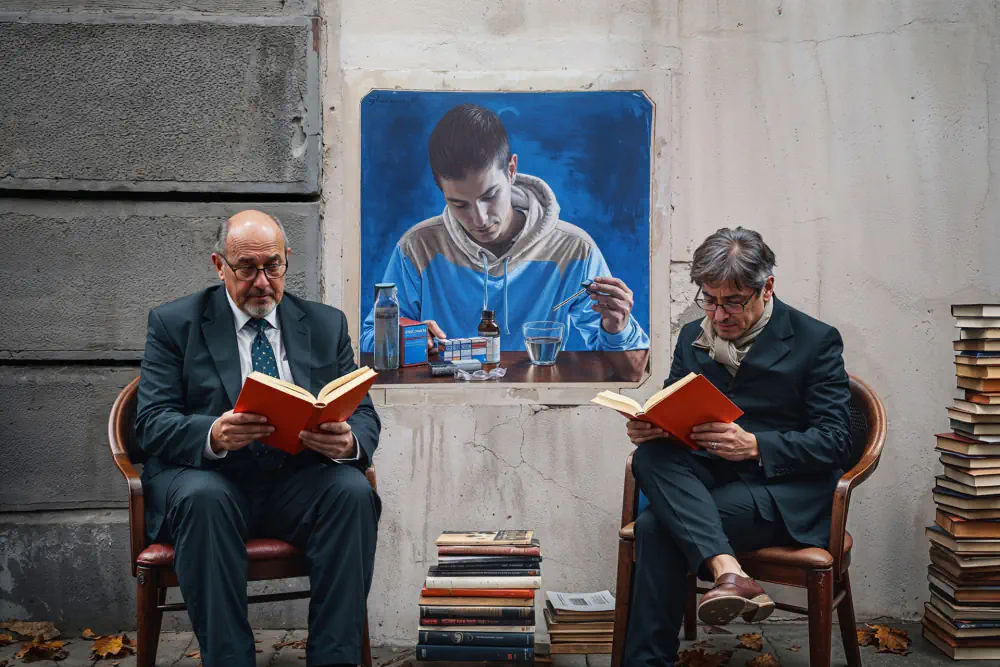
The quietest form of complicity is imitation. In The Chemistry of Reading, two men sit in their chairs, reading. Between them, at the same height, a third conducts a chemical experiment: he is painted on the wall. No one is surprised. The scene holds together because the wall does nothing unusual: it simply takes its place, like a third guest whom no one invited and whom no one thinks of sending away.
This is the image in which complicity comes closest to friendship. The wall experiments, and we let it.
Yet it is precisely its serenity that is instructive. A wall that imitates the living tells us that the difference between image and body, between what is painted and what breathes, is a convention we have grown accustomed to respecting.
The Wall That Watches and Judges
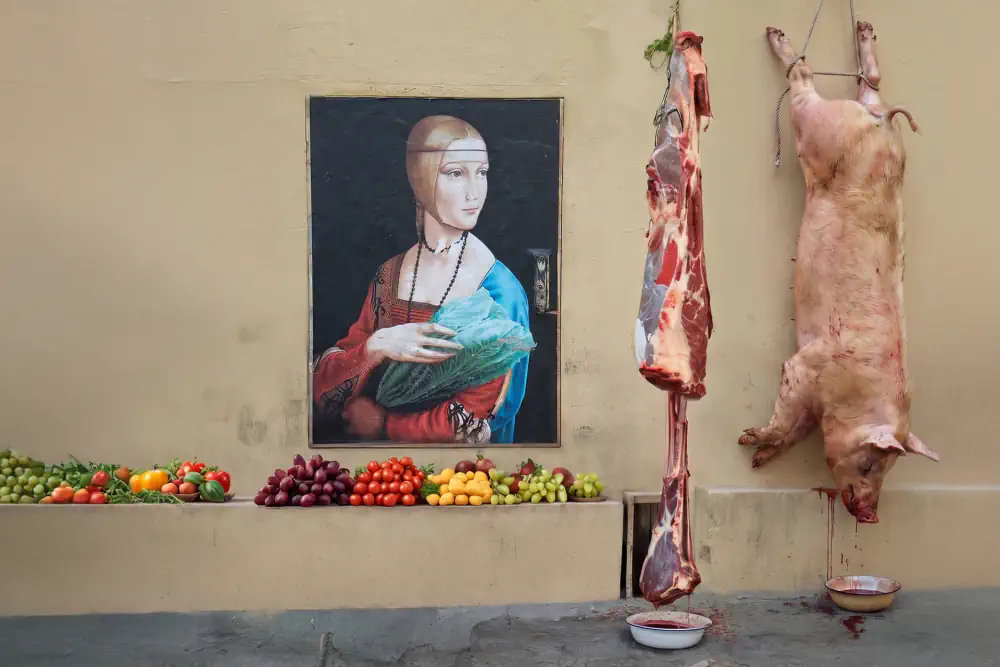
With Carneficina, complicity becomes surveillance. Leonardo’s Lady holds her ermine above the butcher’s counter; around her, meat hangs and drips. She does not look at it. She looks at those who look. Georges Didi-Huberman gave a book its title to this reversal: What We See, What Looks at Us. Before certain images, we are not merely observers, because the image itself also concerns us. The slaughterhouse is the scene, but the accusation, if there is one, is directed at us.
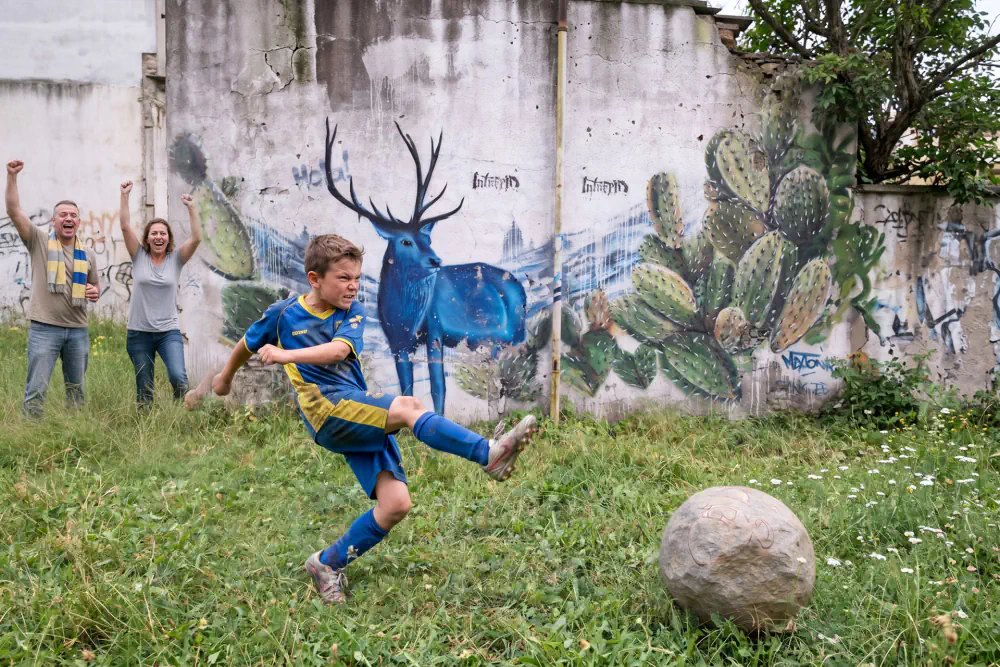
In Football, the same gaze becomes testimony. A boy kicks a stone ball while a painted deer looks on. The ball is made of stone: what weighs upon a game that should be light? The wall no longer judges, but it does not look away.
The Wall That Mocks
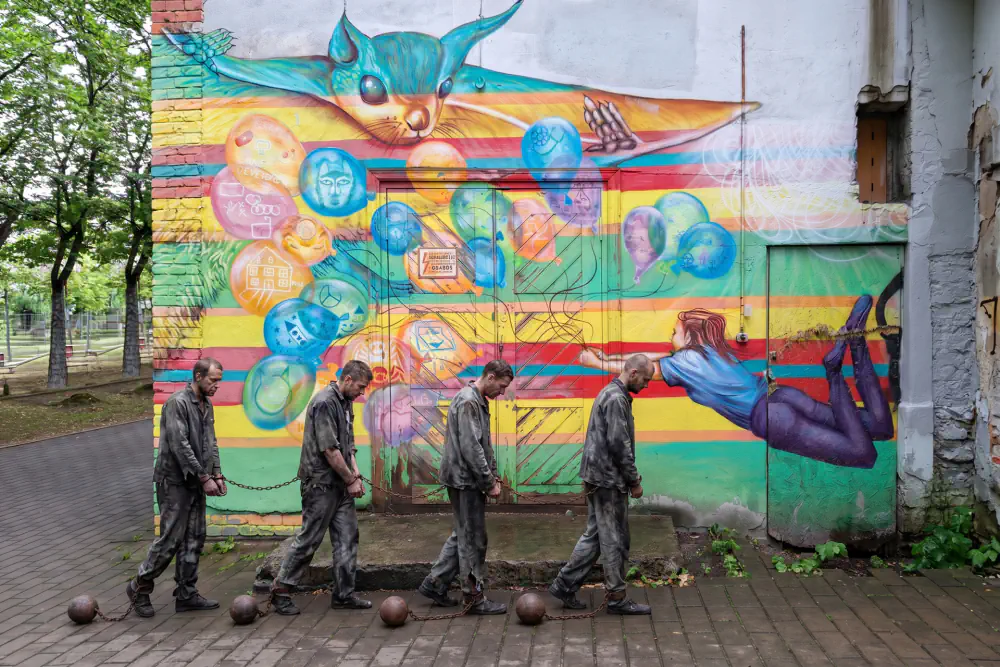
In The Chained, grey men drag their iron balls in a line, while behind them the wall is a carnival of color. All the joy is painted. None of it belongs to them.
This is where complicity becomes cruel, because the wall offers these bodies precisely what they lack, and offers it as a spectacle. Those who look at the photograph see two conditions that do not communicate: the celebration on display and the toil that sustains it.
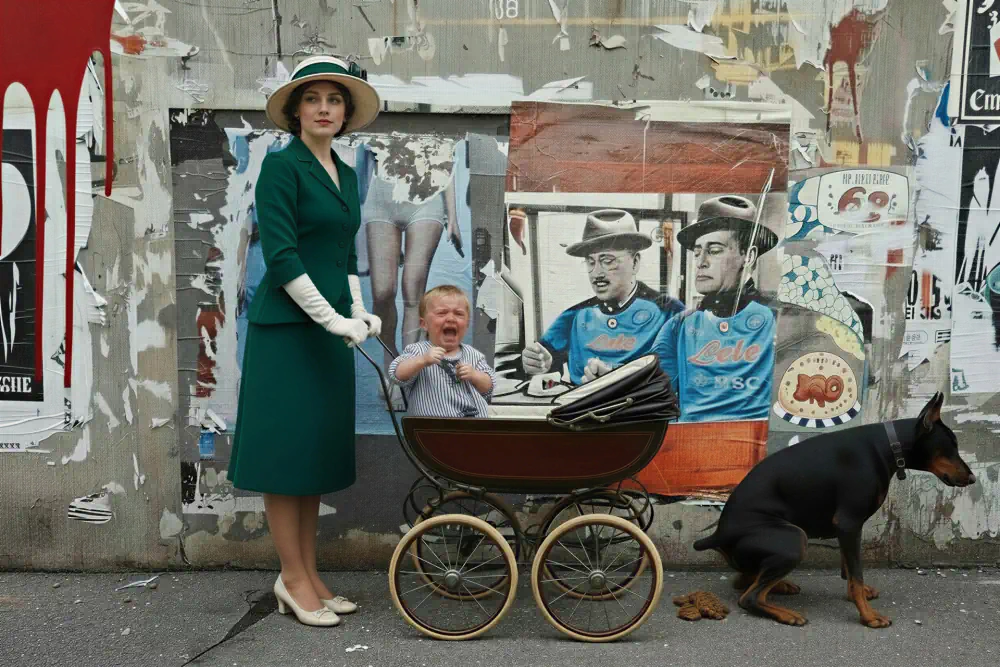
The Woman in Green also works with a disparity, though a more discreet one. A composed mother, a child crying in a stroller, a dog carrying on with its indifferent life, and behind them, the actors of Neapolitan comedy painted on the wall. The street has granted those idols a devotion that it grants neither mother nor child. Everything is in order, and nothing is at peace. The wall enthrones what the street ignores.
The Wall That Speaks Like an Ancestor
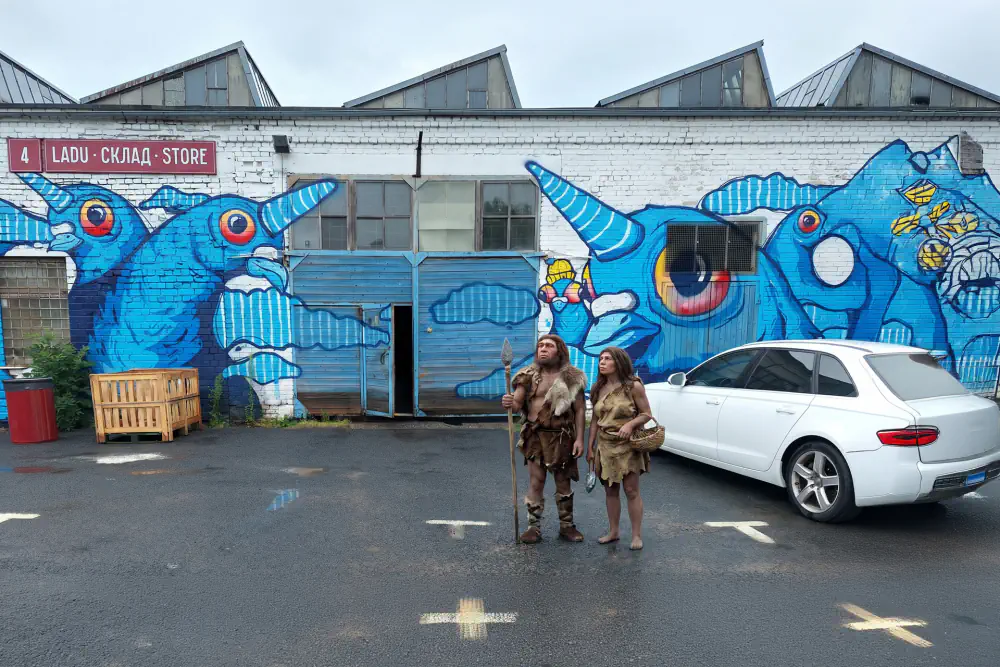
In Prehistory, two figures from the Stone Age stand before a wall of painted beasts; beside them, a white car waits. Which of the three belongs to the present? The wall, which has witnessed all three eras, speaks in the voice of those who came before. The past comments on the present without explaining it.
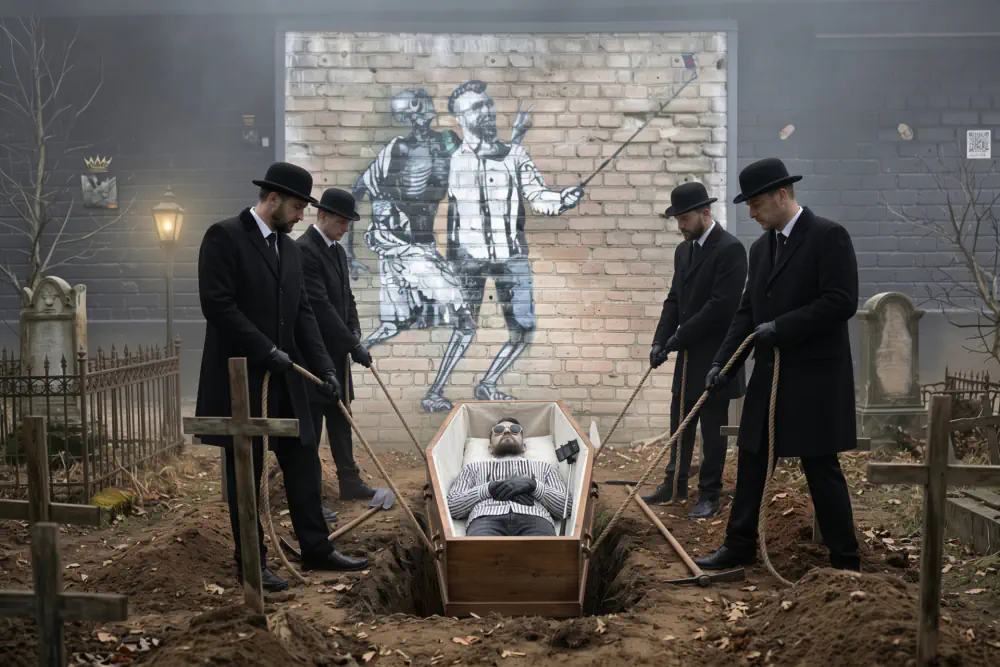
This voice takes on a peculiar tone when it speaks of death. In She Who Is Near, men in bowler hats lower a coffin into the earth, while the cause of death is painted on the wall. The wall already knows how it ends.
In The Scooter and the Coffin, the same knowledge becomes part of everyday life: a blue scooter parked on the street, and leaning against it, upright, a coffin left there like any ordinary object. The memento mori becomes an everyday object.
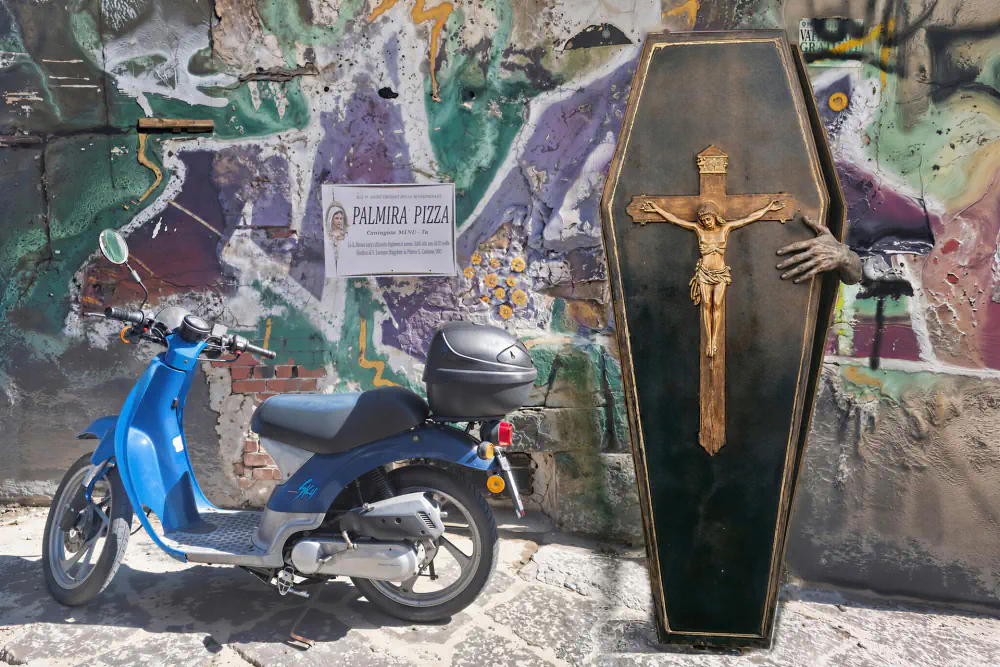
The presence of death in these images is not a matter of tone. If the image is born from a shadow and a departure, it is only natural that the wall should remember what it has always remembered.
The Wall That Swallows

In The Hooded, purple-robed penitents cross the square, and the painted wall repeats their procession endlessly. At the edges, a small figure pauses on a threshold. Where does the ritual lead?
The wall has absorbed the procession and sends it back in a loop: the present immediately becomes a fresco. The image leaves its ending open, and with it the possibility that someone standing on the threshold might choose not to enter.
This is a more unsettling form of complicity than the others, because it takes no position. The wall does not imitate, judge, or mock: it absorbs. Whatever happens before it enters its repertoire, and what is a living ritual today will be another layer of paint tomorrow, another page in that everyday life that accumulates in layers of time.
The Wall That Steps Outside Itself
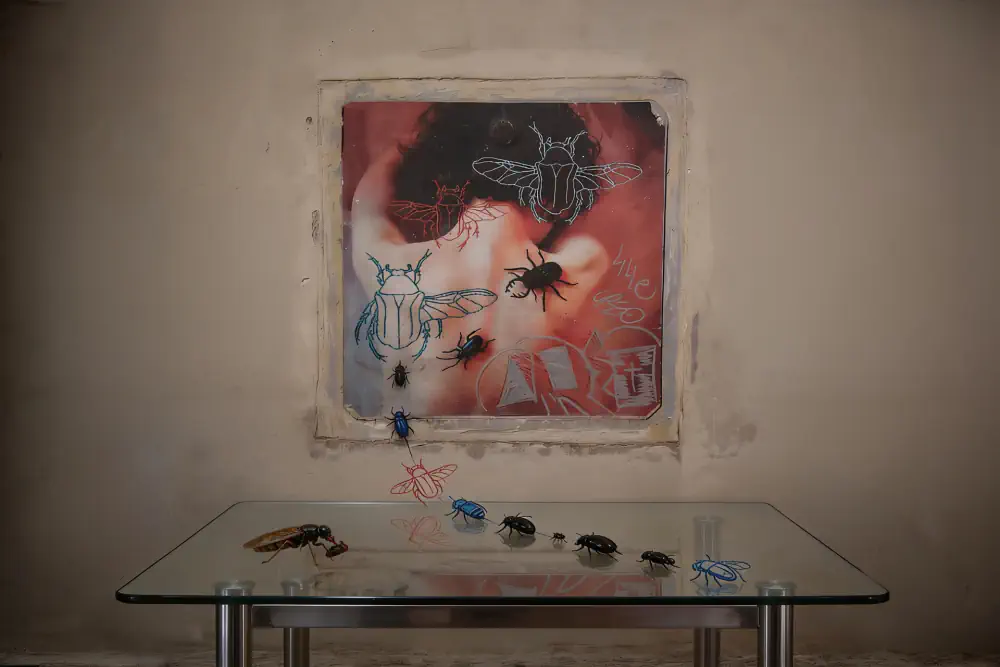
The final image, Insetti, is also the limiting case. The painted insects do not remain on the wall: one by one, they leave it, cross the bare plaster, and reach the glass table, where they are no longer drawn but real, casting their own shadows. The first to arrive has already begun devouring the next. The wall neither watches nor judges: it empties itself into the room, and what was painted, having become real, begins to feed. Here, the circle with Butades closes. In the myth, the body departed and its shadow remained on the wall. In Insetti, the figure leaves the wall and acquires a shadow, that is, a body.
The Crack
Every image in the series begins with a photograph of a real place: a street, a corner, a façade that already bears its own painted image. Something that could not belong there is introduced into that place, and the boundary between the documented and the impossible remains visible. Each photograph certifies that something was there before the camera. The series begins with that certificate: the place exists, and the wall is the one it appears to be. And then it cracks that certainty.
This line is the crack, and it is left visible so that no one mistakes what they are seeing for an unaltered photograph. The work does not seek deception: the viewer must feel both the “it has been” of the place and the “it has not been” of the event, and understand that the distance between the two is the true subject. In these photographs, porosity concerns the image itself: the wall allows what it shelters to pass through.
Accomplice
The wall in these photographs is not a witness, because it does not remain outside the scene, and it is not a defendant, because it answers for nothing. It is folded into the same scene as we are.
Each image documents a different form of this entanglement, and together they form a small catalogue of how representation behaves in the presence of life, from quiet complicity to open invasion.
One question remains, and rightly so, remains open: if the wall is an accomplice, what is it complicit in?
Perhaps in what every accomplice safeguards: a shared secret. In this case, the secret is that image and life were never two separate things, and that all it took was placing them in the same frame for them to admit it.