
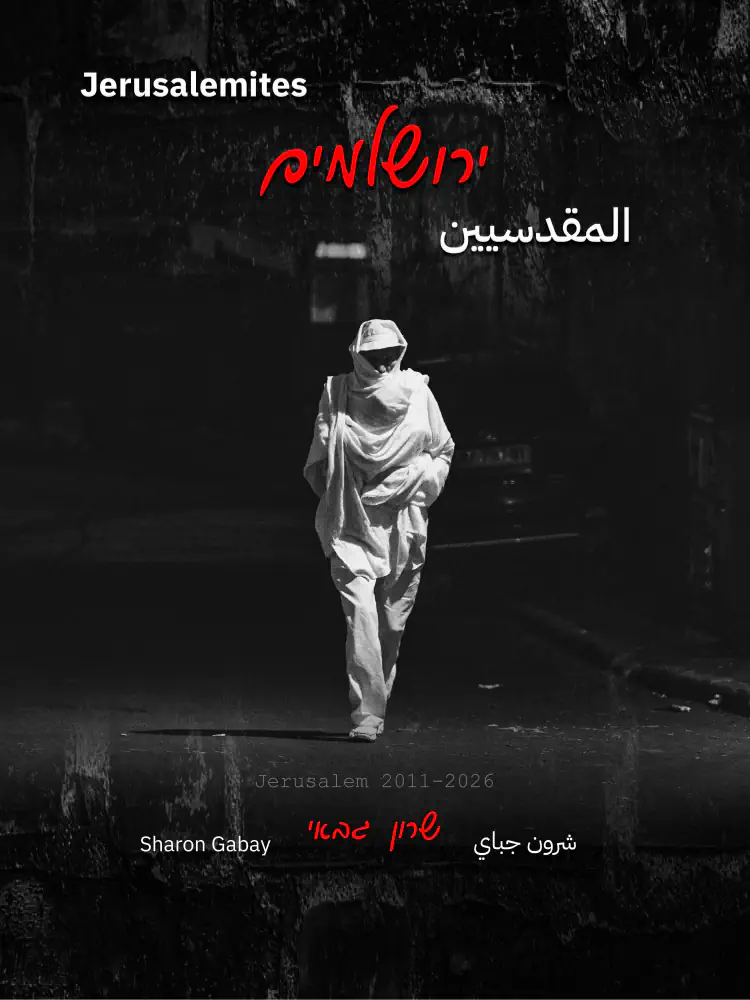
Jerusalem is often photographed through its stones: the Western Wall, the towers, and the walls that have shaped its monumental image.
In Jerusalemites, Sharon Gabay shifts his attention toward the people who inhabit that landscape.
The book brings together fifteen years of street photography, made between 2011 and 2026, and offers an approach to the city through its gestures, encounters, and everyday rhythms. Information about the project.
This change in perspective marks an evolution within his own work. As the photographer explains in his artist statement, images of an eternal, monumental Jerusalem accompanied his earlier books. In this publication, his intention is to move from symbols to the city’s living fabric, from myth to reality. The streets emerge as spaces inhabited by people whose lives unfold amid the familiarity, changes, and tensions of their surroundings.
Gabay’s perspective grows from a longstanding relationship with Jerusalem. Born in the city, he belongs to a family whose roots stretch back several generations. His work draws on the experience of living there: knowing the rhythm of the streets, recognizing recurring patterns, and noticing gradual transformations. This continuity allows him to observe both those who pass through and those who remain.
A City Observed from Within
Photographing Jerusalem means working in a space shaped by religions, identities, political tensions, and social divides. Gabay acknowledges this complexity as part of the conditions in which he develops his practice. Within it, he seeks everyday moments that do not necessarily attempt to represent a community or explain the city as a whole.
In his artist statement, he describes a scene that captures this approach: two nuns, a woman wearing a hijab accompanied by her children and a baby stroller, and an ultra-Orthodox man gather at the same gate of the Old City. They share the moment and the smell of the same bagel. His attention rests on that tangible proximity, on the shared experience of being in a place.
The camera functions, in the artist’s words, as an instrument of observation. Its purpose is to record incidental moments in which beauty and pain can coexist. Gabay describes the result as a Jerusalem without makeup, a city of flesh and blood. This intention directs the project toward the human experience of the city and the details that become visible when the photographer pauses to look. Book press kit.
Fifteen Years of Walking, Observing, and Waiting
Jerusalemites is the result of a sustained working process. Gabay speaks of thousands of hours spent walking, observing, and waiting. The book emerges from this accumulation of time and encounters, with the intention of creating a human archive of a city that changes while preserving its continuities.
The project’s duration is central to its approach. Fifteen years allow scenes from different moments to be brought together within a single publication. Urban life emerges as an experience shaped by presences, recurrences, and transformations.
The artist describes his work as deeply local, while seeking to speak in a broader language. The book is about Jerusalem, but also about a person living in a city: how they occupy space, encounter others, and participate in street life. This dimension connects the specificity of the place with an experience recognizable beyond its geographical boundaries.

The Dialogue Between Images
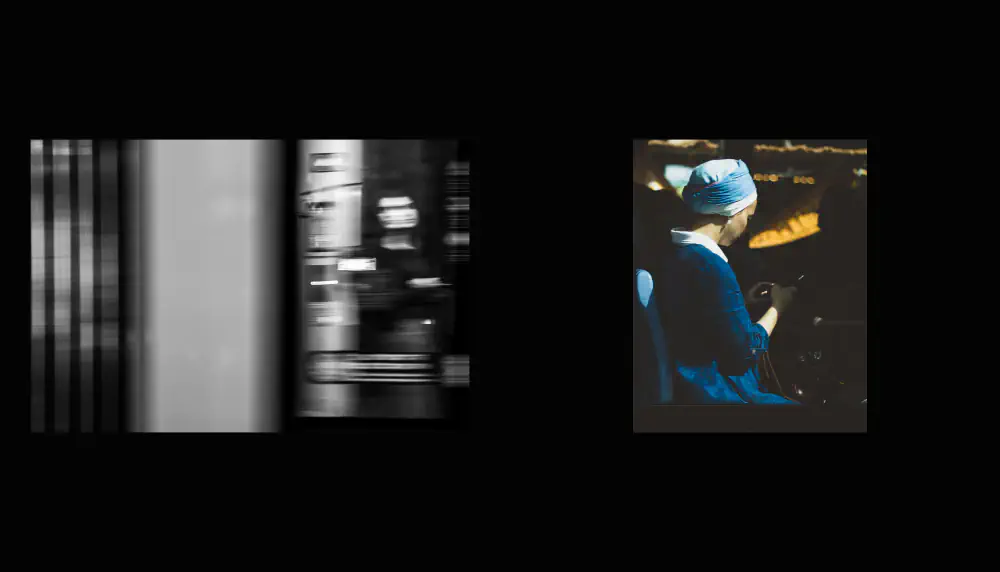
The project also has an exhibition format that helps explain how Gabay brings his photographs into conversation. The selection comprises thirty-three images arranged into twenty-one works: twelve pairs and nine individual photographs. It combines color and black-and-white imagery, portraiture, and street photography.
Within the pairs, photographs taken separately are placed side by side to establish a dialogue. According to the exhibition proposal, they depict communities that share the city but rarely share a frame. The relationship takes shape when the photographs are brought together: viewers can observe similarities and differences and develop their own interpretations.
This structure raises questions about what communities share that might otherwise go unnoticed. Juxtaposition makes these relationships visible, while the nine individual images retain their autonomy within the whole. This arrangement is specific to the exhibition, accompanying the book’s visual world and expanding the ways the work can be presented. Information about the exhibition proposal.
A Book in Three Languages
The volume comprises 304 pages and is published in Hebrew, English, and Arabic. The inclusion of all three languages in a single edition forms part of its approach to reaching different readers and reflects its attention to Jerusalem’s human diversity. The artist’s information about the book.
The Jerusalemites exhibition premiered at the Jerusalem House of Quality in May 2026. The book and exhibition share a body of work developed over fifteen years, while each format offers its own way of approaching the images: the continuity of the pages and the dialogue between photographs on the wall.
With Jerusalemites, Sharon Gabay brings together an extended chapter of his relationship with the city. His work invites viewers to observe Jerusalem through its inhabitants and to recognize, within everyday encounters, a human fabric that takes time and attention to become visible. More books by Sharon Gabay.