
Throughout the history of Western visual culture, the forest has occupied an ambiguous and profoundly symbolic position.
It has been refuge and threat, mythical stage and site of initiation, sanctuary and place of exile from civilization. In contemporary photography, however, the forest is no longer approached merely as romantic iconography or picturesque scenery inherited from painting.
It has evolved into something far more conceptually fertile: a liminal space where spirituality, cultural identity, collective memory and ecological awareness intersect within a phenomenological experience of looking.
The contemporary forest is not simply documented; it is interrogated. Photographers no longer approach it with the sole intention of describing it faithfully, but rather of crossing it as one would cross a threshold. And that gesture is decisive. The forest, more than a physical territory defined by trunks and pathways, functions as a symbolic structure capable of activating inner processes. Each season alters its appearance, each variation of light transforms its atmosphere, each human intervention reshapes its meaning. The forest is perpetual mutation, and for that reason it remains one of the most powerful metaphors for human existence itself.
Within a global context defined by hyperconnectivity, visual saturation and relentless acceleration, the image of the forest introduces a radical pause. It is not accidental that so many contemporary authors return to it. The forest demands time. It demands silence. It demands a form of attention that contradicts the fragmented logic of digital consumption. Where the urban world produces noise, speed and overstimulation, the forest proposes density, slowness and perceptual depth. The photography emerging from this territory is not built on spectacle but on immersion.
The constellation of projects recently published in Dodho reveals precisely this complexity. Each author works through distinct formal strategies—direct contemplation, luminous manipulation, conceptual intervention, idealized stylization or minimalist reduction—yet they converge on one essential intuition: the forest is a threshold. It is one of the last spaces where contemporary photography can recover symbolic density without falling into decorative cliché. It becomes a laboratory of perception, a site where the image regains depth, resonance and ethical urgency.
Light and Revelation: The Forest as Spiritual Experience
Seasonal transformation as inner metamorphosis
In Catherine Régnier – Myst(ic) Forest, Where Forest and Spirit Meet, the forest unfolds as a space of revelation. The transition from summer to autumn becomes more than a natural phenomenon; it becomes a perceptual transfiguration. Mist operates as a symbolic veil, and the morning light piercing through it inaugurates a different state of awareness. We are not confronted with a mere atmospheric scene, but with something closer to a liturgical experience.
The so-called light wells—those vertical shafts that descend through the lingering fog—act as vectors of transcendence. They do not simply illuminate damp earth; they open depth. The camera does not capture the forest from a distance but accompanies it, returning year after year in a ritualistic gesture of reconnection. The photographic act becomes pilgrimage, the forest a natural cathedral where breathing itself acquires meditative weight.
This approach restores to landscape photography a spiritual dimension that contemporary practices often displace in favor of irony or conceptual detachment. Here there is no cynicism, no spectacle. There is sustained contemplation. The forest functions as a sanctuary of perception where the image emerges from intimate experience rather than aesthetic strategy.
The Forest as Emotion and Visual Memory
Between tangible reality and dreamlike territory
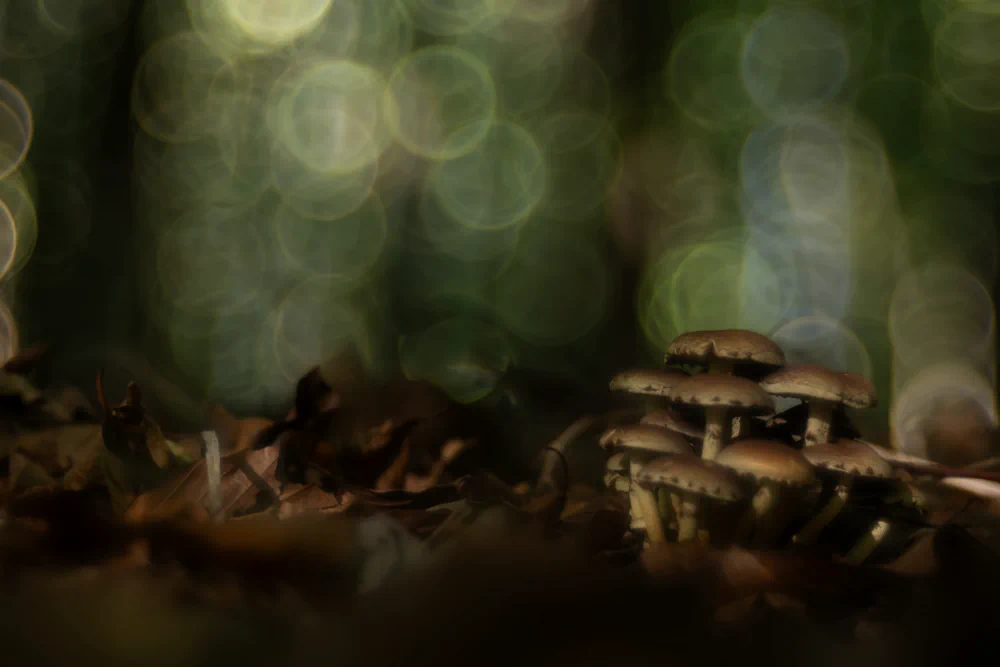
If Régnier works through direct contemplation, August Langhout adopts a different strategy in Step Into Whispering Forest by August Langhout: Where Nature Becomes Emotion. Here the forest becomes emotional construction. Multiple exposures and layered compositions dissolve the physical structure of trees into atmosphere, transforming branches and foliage into suspended sensations.
Chromatic manipulation introduces a constant tension between warmth and estrangement. Deep blues suggest introspection; golden hues evoke nostalgia; dense shadows create temporal suspension. The forest ceases to be a place and becomes memory, a fragment of experience constantly reconfigured in the act of viewing.
Langhout shifts the axis from representation to interpretation. What we encounter is not the forest as it objectively appears, but the forest as it feels. This displacement is crucial in contemporary landscape photography: territory becomes resonance. The viewer is invited not merely to observe nature, but to confront the emotional projections that shape perception itself.

Winter Minimalism: Structure, Silence and Radical Reduction
When absence becomes visual language
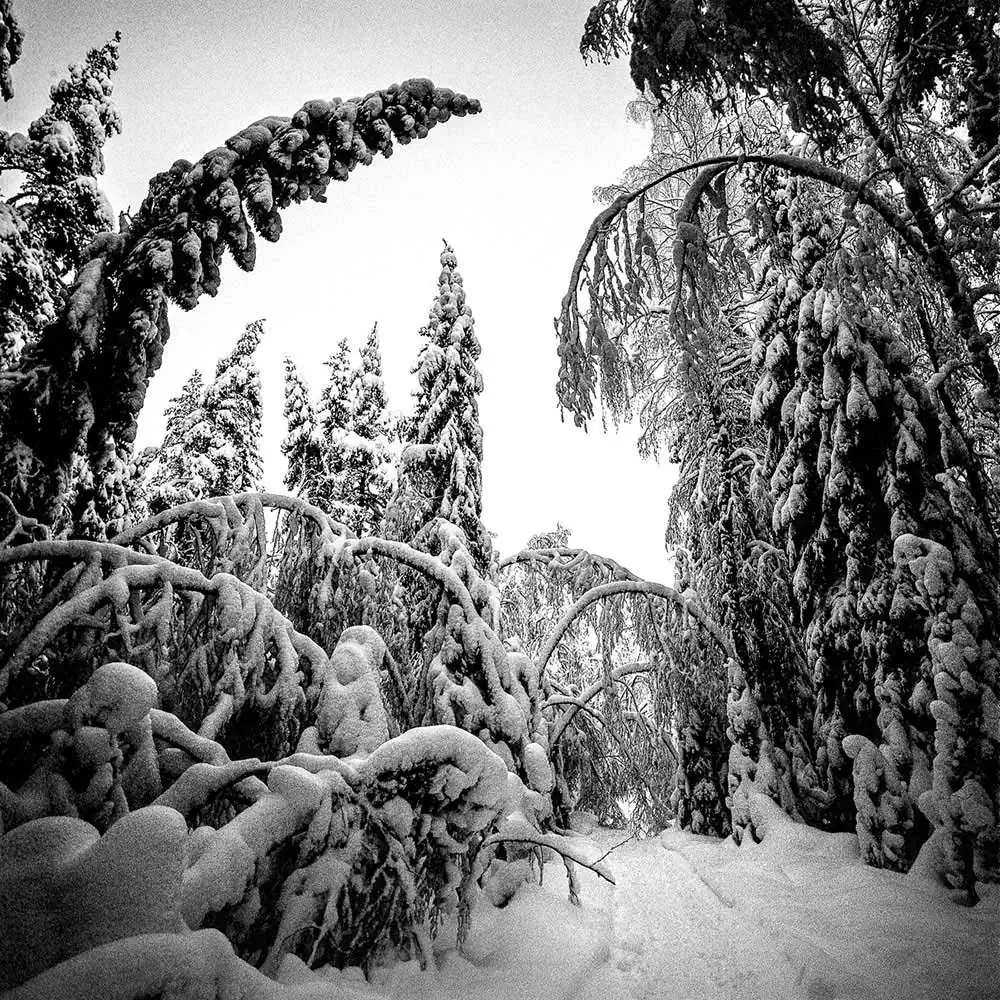
In Winter forest by Ari Jaaksi, the forest assumes a radically different form. Extreme cold, compacted snow and chromatic absence reduce the landscape to essential structure. Bare trees against white expanses. Vertical lines dividing space. Ephemeral light barely articulating volume.
Black and white emerges not as nostalgic choice but as inevitable consequence of the environment. Chromatic reduction intensifies rhythm, repetition and compositional balance. The forest transforms into natural architecture, into pattern demanding sustained attention.
This austerity produces a different kind of spirituality—one grounded in emptiness and restraint. Silence becomes protagonist. The project aligns with an aesthetic tradition that understands simplicity as depth, reduction as intensity. In this winter landscape, contemplation is sharpened rather than diminished.
Identity and the Cultural Construction of Landscape
The forest as inherited symbolic territory
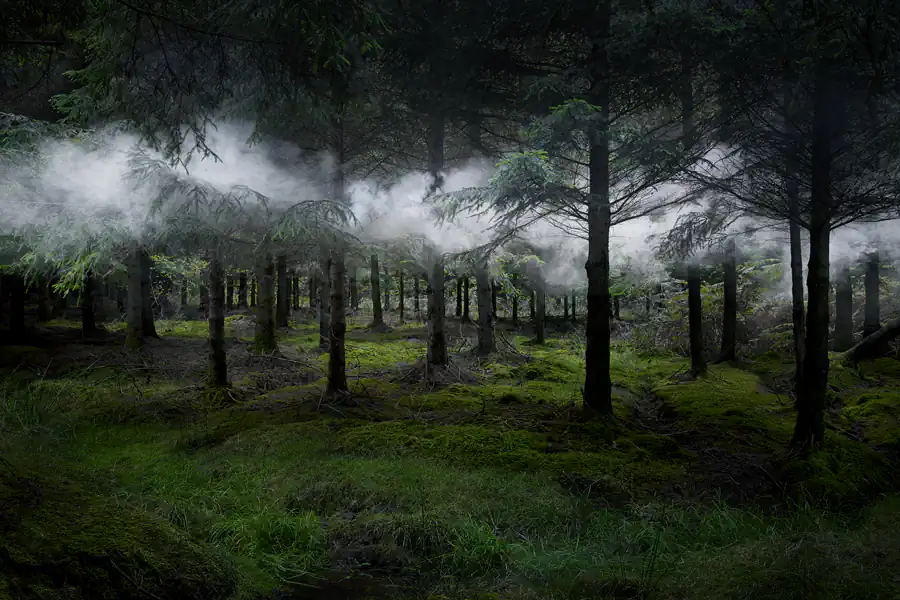
With Forests; Between the trees by Ellie Davies, the forest becomes an explicitly cultural construct. British woodlands have been shaped by centuries of human intervention, layered with folklore, myth and collective imagination. There is no untouched nature; there is interpreted nature.
Davies’ temporary and non-invasive interventions create ambiguous spaces between reality and fiction. The viewer stands in a gap where perception becomes unstable. That instability is essential. It reveals that our relationship with the forest is mediated by inherited narratives and symbolic frameworks.
The forest does not simply reflect identity; it participates in forming it. It is cultural matrix, psychological territory, symbolic reservoir. Photography here functions as critical tool, exposing how landscape is constructed through memory, myth and personal experience.
Primary Forests and Ecological Consciousness
Untamed nature as ethical horizon
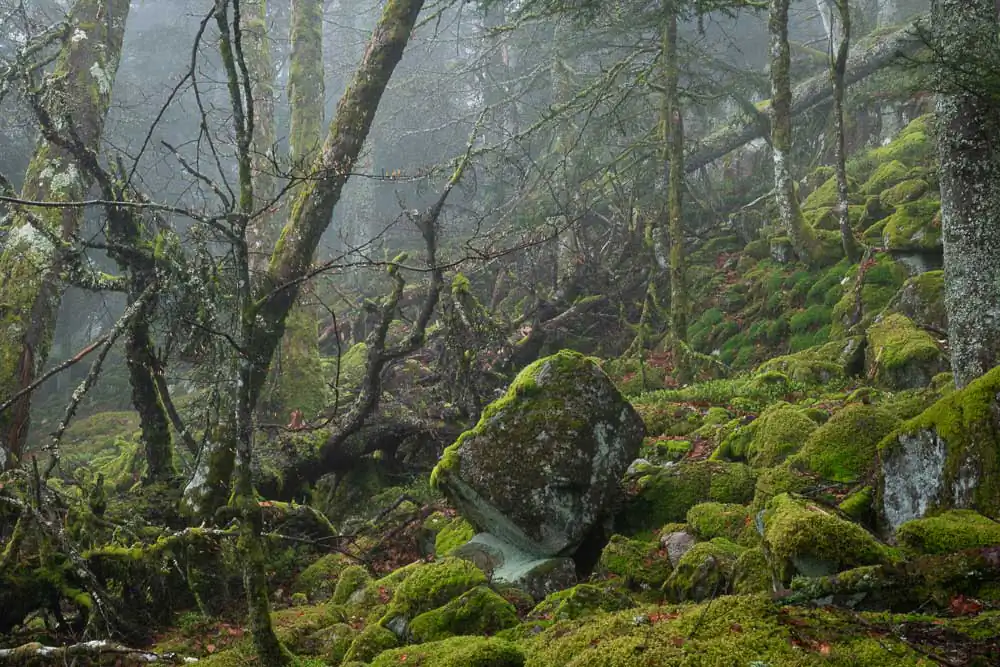
In The Forgotten Places by Frédéric Demeuse, the forest acquires explicit ecological dimension. Primary and well-preserved ecosystems appear not as exotic spectacle but as complex structures where apparent disorder reveals autonomous balance. Exuberance is not chaos; it is equilibrium.
The slow practice, the tripod, the prolonged observation reinforce an ethic of permanence. Photography does not invade; it integrates. These territories are not merely visually compelling—they are vital systems whose preservation is inseparable from planetary well-being.
Contemplation cannot be separated from responsibility. To photograph a primary forest is also to acknowledge its fragility. The image becomes testimony and warning simultaneously, reminding viewers that aesthetic experience and ecological awareness must coexist.
The Forest as Contemporary Laboratory of Vision
Between individual introspection and collective responsibility
Considered together, these series confirm that the forest remains one of the most complex and fertile territories in contemporary photography. Spiritual space, emotional archive, minimalist structure, cultural construct and ecological system converge within the same environment.
The forest is not decorative landscape. It is threshold. To cross it is to accept transformation. In an era defined by acceleration and visual excess, these works propose a radically different gesture: to pause, to observe, to breathe, and to recognize that the relationship between image and territory remains central to our time.
Contemporary photography finds in the forest not a backdrop but a mirror. And in that mirror we perceive both our longing for meaning and our responsibility toward the environment we inhabit.