
Ukraine has been photographed relentlessly since the beginning of the full-scale war, often through images of destruction that circulate fast and disappear just as quickly.
Yet some photographic projects resist immediacy. They do not aim to summarize the conflict or to shock through spectacle. Instead, they work from within lived experience, sustained presence, and personal involvement. The five projects gathered here do not document Ukraine as an abstract battlefield, but as a place where history fractures everyday life and where individual voices carry the weight of collective trauma.
In I Don’t Have My Home Anymore, Katrine Moite constructs a documentary space centered on the voices of fifteen Ukrainian women who were forced to flee their homes and seek refuge in the United States. The project is built around testimony rather than event. February 24 is not treated as a date in history, but as a rupture that divided life into a before and an after. Moite’s work refuses narrative distance. Pain, fear, loss, and disorientation are not illustrated through ruins alone, but articulated through memory and voice. The absence of home becomes the central subject, not as metaphor, but as a permanent condition that reshapes identity and belonging.
Alena Grom’s Stolen Spring emerges directly from the landscape of occupation and aftermath. Living in Bucha and working in Irpin, Grom photographs a reality that has become routine: destroyed streets, damaged homes, and the slow, fragile process of rebuilding. Her project enters into a historical dialogue with Polish photographer Michał Nash, who documented Warsaw after World War II, using decorative backdrops to mask devastation. Grom reactivates this strategy to expose its contradiction. The women she photographs stand against these artificial surfaces, embodying both survival and rupture. The series is not about recovery as triumph, but about resilience shaped by violence that has not fully receded.
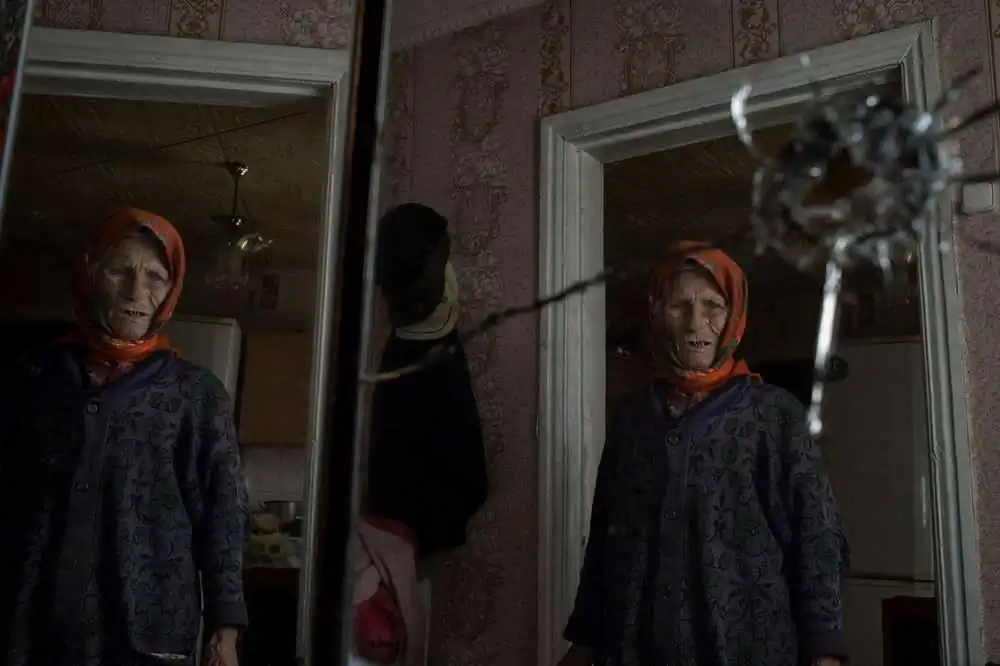
Patrick Enssle’s Life Under Shelling focuses on eastern Ukraine, where war has been part of daily existence since 2014. His work deliberately avoids graphic imagery, choosing instead to concentrate on presence, endurance, and psychological aftermath. The front line is not shown as a distant zone of combat, but as a condition that extends into domestic space. Elderly residents who stayed behind, partially destroyed homes, and improvised survival structures define the visual field. Enssle’s photographs are quiet, restrained, and deeply unsettling precisely because they resist sensationalism. Trauma is not dramatized; it is visible in posture, gaze, and the persistence of life in spaces no longer meant for living.
In Black Days of Ukraine, Valery Melnikov centers his work on civilians trapped between armed forces, those who became participants in war without choice. His photographs from Donbass document the last remaining residents of bombed-out villages, living without water or electricity under constant shelling. Melnikov’s approach is direct and uncompromising. He does not search for symbolic distance. The images confront the viewer with exhaustion, vulnerability, and the erosion of ordinary life. War appears not as ideology or strategy, but as a daily condition that strips people down to survival.
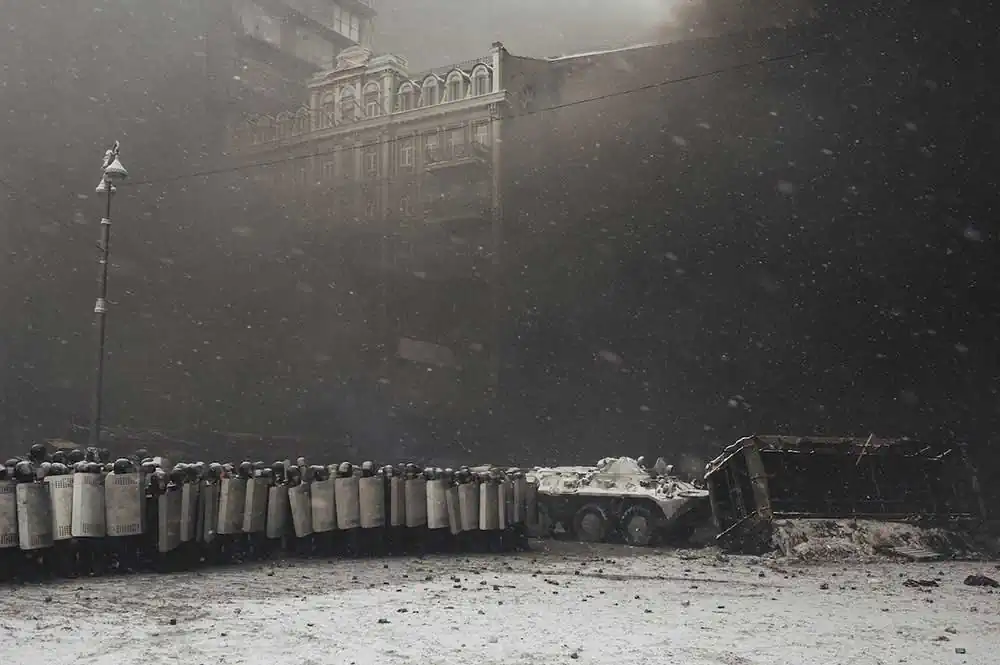
Maxim Dondyuk’s Culture of Confrontation shifts the focus slightly backward in time, to the Ukrainian revolution of 2013–2014. Yet this work is inseparable from the present. Dondyuk documents the Maidan protests as a moment when civic action transformed into violent confrontation, reshaping Ukraine’s political and emotional landscape. His photographs oscillate between documentation and abstraction. Smoke, fire, movement, and bodies collide in images that feel almost unreal. The revolution is presented not only as a historical event, but as a psychological threshold that set the stage for what followed. Violence becomes both specific and universal, grounded in place yet resonating far beyond it.
Together, these five projects form a fragmented but coherent testimony. They do not attempt to offer a comprehensive account of Ukraine. Instead, they insist on proximity, on working from inside trauma rather than observing it from a safe distance. Each photographer occupies a different position, yet all share a commitment to resisting simplification.
What connects these works is not style, but responsibility. Responsibility toward subjects who are not symbols. Responsibility toward history that is still unfolding. Responsibility toward photography as a medium that can either flatten suffering or hold space for it.
Documenting Ukraine from within means accepting incompleteness, contradiction, and emotional weight. These photographers do not claim objectivity. They acknowledge involvement. Their images do not close narratives; they leave them open, unresolved, and urgent. In a visual culture saturated with images of war, these projects remind us that photography still has the capacity to listen, to stay, and to bear witness without turning experience into spectacle.
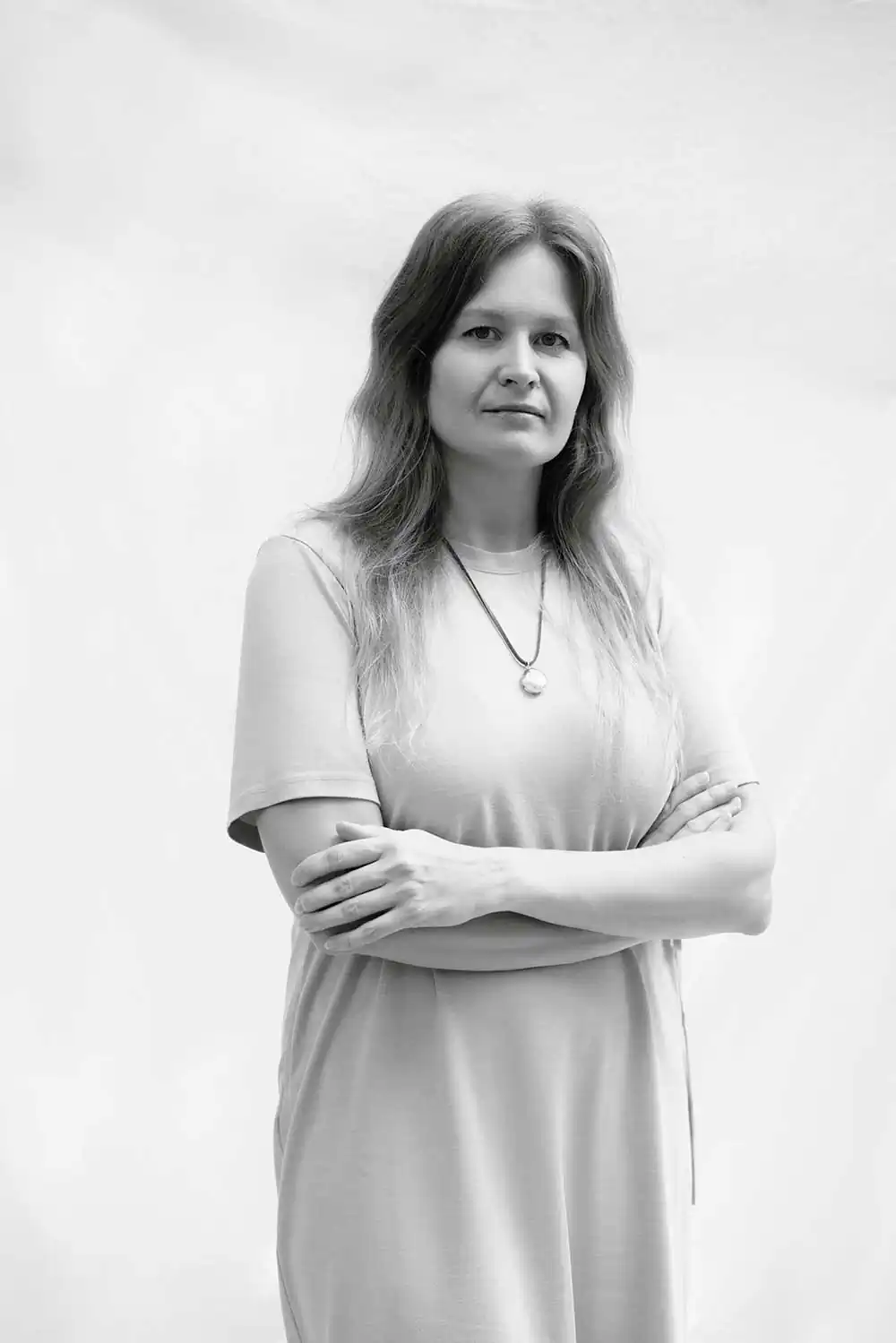
I don’t Have My Home Anymore by Katrine Moite
This is a documentary project dedicated to the stories of 15 Ukrainian women who were forced to leave their homes due to the full-scale war in Ukraine. The found protection and support in the United States. These are women´s voices narrating their stories intertwined with pain and loss. The date “February, 24” will be etched in the memory of every Ukrainian forever: the whistle of rockets overhead, the cold, damp basement of a shelter, lines at the borders that lasted for days and unbearable fear for everyone in the family. This feeling of depression, despair. This day has divided all Ukrainian lives into 2 parts: “before” and “after”. It is difficult to estimate the losses – the number of civilian deaths is officially measured in thousands, but it is still unknown how many people are buried in the ruins of Mariupol and other cities that have been wiped off the map, they don’t exist anymore… Read More
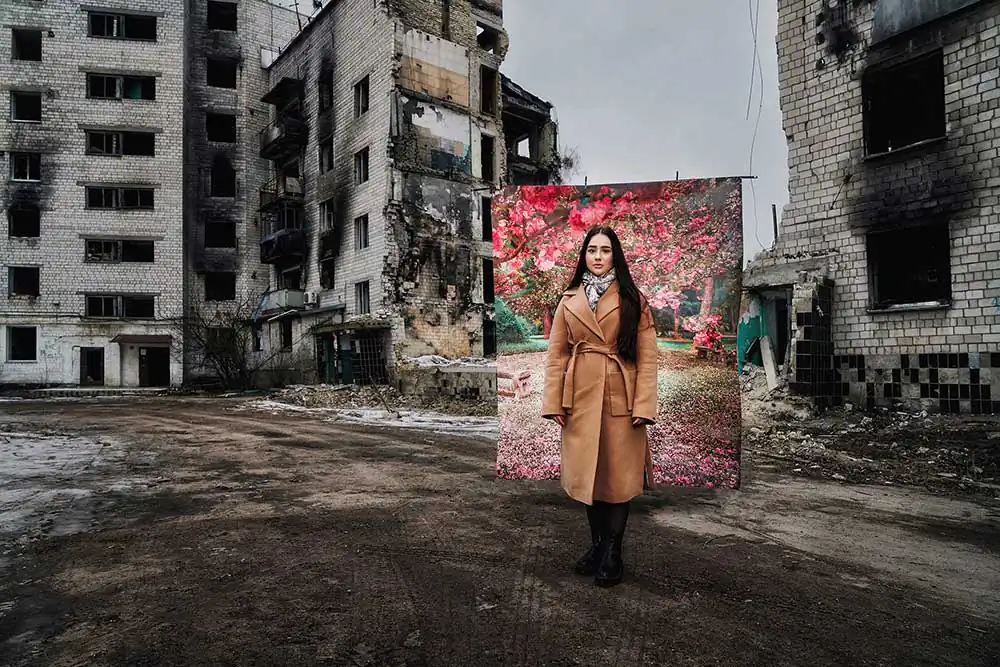
Stolen Spring by Alena Grom: A Photographic Tribute to War Survivors in Ukraine
I live in Bucha and work in Irpin. After the Russian occupation, these cities were left in ruins. The military landscape has become my reality and routine. Every day, I see people rebuilding their cities, restoring their personal lives from the wreckage, and looking toward the future. I created a series of photographs in historical dialogue with images by Polish photographer Michał Nash, who documented how a decorative backdrop was used to mask the ruins of Warsaw during World War II in 1945-1946. The subjects of my photographs are women who became victims of Russian aggression… Read More
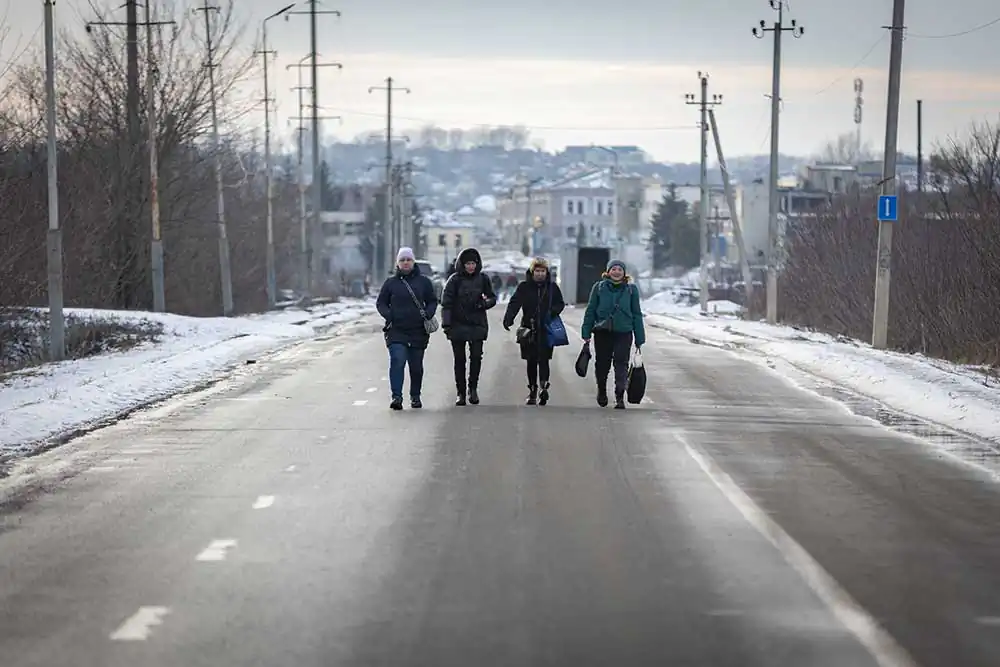
Patrick Enssle’s “Life Under Shelling”: Survival Stories from Eastern Ukraine
This series documents the struggle for survival in eastern Ukraine, where war with Russia has raged since 2014. Life is dominated by the front — a death zone stretching up to 30 kilometers inland. Artillery fires relentlessly; tanks and military vehicles thunder through the night. Those who could, fled. The elderly stayed behind. Even near the front, an estimated ten percent of residents remained. Many paid with their lives — like the school supply store owner, whose charred books now lie in ruins. Others, like Evgeniy, Victor, and Nicolai, barely survived the strikes that destroyed or damaged their homes. Physically unhurt but visibly traumatized, their hollow stares tell of deep psychological wounds. In Orikhiv, near Zaporizhia, Evgeniy lives in the ruins of his home — a single, patched-up room with no running water, frequent power cuts, and poor mobile reception. Life Under Shelling consciously avoids the graphic imagery that dominates headlines and social media, opting instead for focused, aesthetic storytelling…Read More
Black days of Ukraine by Valery Melnikov
Ongoing conflict in Ukraine between separatists and the Ukrainian government army led the country to the full-scale hostilities. There always at least two armed fighting sides in any war. For me as a human the most important side in this conflict was the third one – ordinary civil people. Disaster came into their lives unexpectedly. These people appeared the participants of the military confrontation against their will. They experienced the most terrible things: the death of their friends and relatives, destroyed houses and ruined lives of thousands of people. The locals had to survive without any water and electricity under the daily shelling. And each new day could become their last day. This series of photos was taken in Donbass. It depicts the last remaining residents of bombed out villages in the combat zone… Read More
Ukrainian revolution; Culture of confrontation by Maxim Dondyuk
Culture of confrontation speaks to the turning point in the history of Ukraine, that touched the whole world, the Ukrainian revolution of 2013-14. It started as a completely peaceful demonstration on Kyiv’s Independence Square (in Ukrainian ‘Maidan Nezalezhnosti’) against the decision of the former President of Ukraine to suspend an integration deal with the European Union. The events that supposed to be over in a day, turned into a three months of bloody clashes, tears, Molotov cocktails, burning car tires and deaths.On the Maidan, at some point, the emotions for me took on an abstract, or universal character. The battles on the streets appeared almost unreal, as though occurring in some medieval fable or legend… Read More