

Gabi Steiner develops a photographic practice shaped by attentive observation and a deep respect for the cultures she engages with.
Her work moves away from spectacle, focusing instead on what endures: gestures, daily rhythms, and the relationships that define a way of life. Through a restrained and thoughtful gaze, she constructs images that do not seek to explain, but to bring the viewer closer.
In her project “The Poetry of Dust and Horn”, Steiner immerses herself in the Mundari cattle camps of South Sudan, where the relationship between humans and animals goes far beyond function, becoming identity, memory, and continuity. The series unfolds between the soft light of dawn and the dense atmosphere of dust, creating a visual narrative that speaks of belonging, responsibility, and connection. [Issue #36]

How did your relationship with photography begin, and at what point did it become a central part of your life?
My relationship with photography began through my travels. I’ve always been an avid travel photographer who, after every trip, would carefully compile photo albums and combine my pictures with small souvenirs to preserve the memories in a tangible way.
Over time, I reached a point where I wanted to deepen my understanding and move beyond a purely intuitive approach. I searched for a form of training that truly appealed to me and initially considered the Prague School of Photography. As part of the application process, I signed up for a preparatory course led by Helga Partikel. Her teaching style and sensitivity to imagery inspired me deeply. Instead of continuing at the Prague School, I decided to join her German online photography college, foto.kunst.kultur, in 2017.
Over the course of three years, I completed a wide range of courses—from the technical fundamentals of photography to image critique, image editing, presentation, book design, and long-term project work. During this time, photography evolved from a hobby into a true passion.
To this day, the connection between travel and photography remains at the heart of my work—this is where I feel most connected and creatively fulfilled.
You have developed your vision through both formal studies and extensive travel. What has influenced your work more: technical training or lived experience?
I believe the two are in balance. To engage in serious photography, a solid foundation is essential— of composition, color theory, the nuances of light, and the creation of depth within the image. Before my studies, I mostly photographed during my travels, often in a more spontaneous and intuitive way.
During my education, I learned to photograph consistently in my everyday surroundings. This was, in many ways, more challenging, but also incredibly rewarding—especially through long-term projects that required patience and deeper observation.
Travel photography, on the other hand, is richer in immediate experiences and often more visually stimulating. It inspires and excites me. But it is only through technical knowledge and visual awareness that these spontaneous moments can be translated into strong images.
For me, meaningful photography emerges precisely from the combination of both: lived experience and the ability to shape it consciously.
Your work focuses on specific communities and cultures. What draws you to these environments?
My interest in specific communities and cultures began with a moment of deep resonance. While preparing for a journey to Myanmar in 2018, I came across Jens-Uwe Parkitny’s Marked for Life. The images and stories stayed with me, and I felt compelled to experience this reality for myself.
I undertook the long and demanding journey into Chin State to meet the women with facial tattoos. At that time, many of them were already in their eighties, as the tradition had long been forbidden. Not long after my visit, the military junta took power, and Myanmar became inaccessible. Today, it is uncertain how many of these women are still alive.
Encounters like this shape the core of my work. I am drawn to places and communities that exist at the edge of disappearance—where ways of life, identities, and memories are slowly fading. Photography, in this context, becomes more than observation; it becomes a quiet act of preservation.
What continues to fascinate me is the persistence of these indigenous cultures within a rapidly changing world. The women of Chin State were, in a sense, the beginning—a spark that led me toward these communities and has never quite let me go. It was also my first profound encounter with portrait photography, which has since become central to how I work and connect.
When arriving in a new place, how do you build the trust needed to photograph from an honest and respectful position?
When I arrive in a new place, I first try to connect with people without a camera. No one appreciates being approached like a paparazzi. For me, building trust begins with simple, human interaction.
Children are often the easiest way to start—they respond naturally to playfulness and small gestures, and through them, a first connection can emerge. Once I feel accepted, I begin to move more freely, observing, searching for perspectives, and allowing situations to unfold.
I don’t rush the process. I wait for the right moment before taking a photograph.
With the Mundari, for example, this was more challenging. People were constantly busy, and with the cattle always in motion, there was hardly ever a still moment. They rarely had the time to look into the camera. So I started calling out “Look, look” to catch their attention. It became a shared moment of humor—they found it amusing, and soon they would greet me the same way whenever they saw me.
We laughed together, and in that exchange, the distance disappeared. Trust grew naturally, and with it, the possibility for honest images.
You don’t limit yourself to a single genre. How would you define your photographic language today?
I don’t see myself as belonging to a single genre. While portraiture has become central to my work, I move fluidly between documentary and street photography—wherever a situation allows for an honest image to emerge.
If I had to define my photographic language today, I would call it deliberately reduced. I am not interested in complexity for its own sake. I look for clarity, for images that hold a strong center and do not compete with themselves.
A sentence from my teacher, Helga Partikel—“There is only one king in the image”—has shaped my way of seeing profoundly. It pushed me to strip away the unnecessary and to commit to what truly matters within the frame.
For me, photography is not about adding, but about deciding. About recognizing what deserves attention—and having the discipline to exclude everything else. What remains should be direct, quiet, and precise.
My images are not meant to overwhelm. They are meant to draw you in—and stay.
In your project “The Poetry of Dust and Horn”, you immerse yourself in the lives of the Mundari in South Sudan. What brought you there, and why did you choose to work in this context?
Travelling to South Sudan had been on my mind for a long time, but I hesitated. Many people around me considered it too dangerous and questioned my decision, given the travel warnings. Still, the images I had seen before—of the Ankole longhorn cattle, the Mundari with their ash-covered skin, and the soft, diffused light shaped by dust—stayed with me.
Much like my earlier encounter with Jens-Uwe Parkitny’s work on the tattooed women of Myanmar, I felt a strong desire not just to see, but to immerse myself in this world. I wanted to experience it from within.
And when I finally arrived, it was just as overwhelming and fascinating as I had imagined. It felt almost like stepping into a vast playground—visually rich, unpredictable, and full of moments waiting to be discovered. Everywhere I looked, something was unfolding.
At the same time, it was an intense, physical experience—the dust, the smoke, the constant movement. You didn’t just witness it, you became part of it.
It is the kind of photographic experience one hopes to encounter again at least once in a lifetime.
The series reveals a deep relationship between people and cattle, where animals represent identity, memory, and continuity. What struck you most about this connection?
As someone who feels a deep connection to animals, what struck me most was the respect and care the Mundari show toward their cattle. Their relationship goes far beyond utility—it is built on daily attention, responsibility, and a quiet sense of mutual dependence.
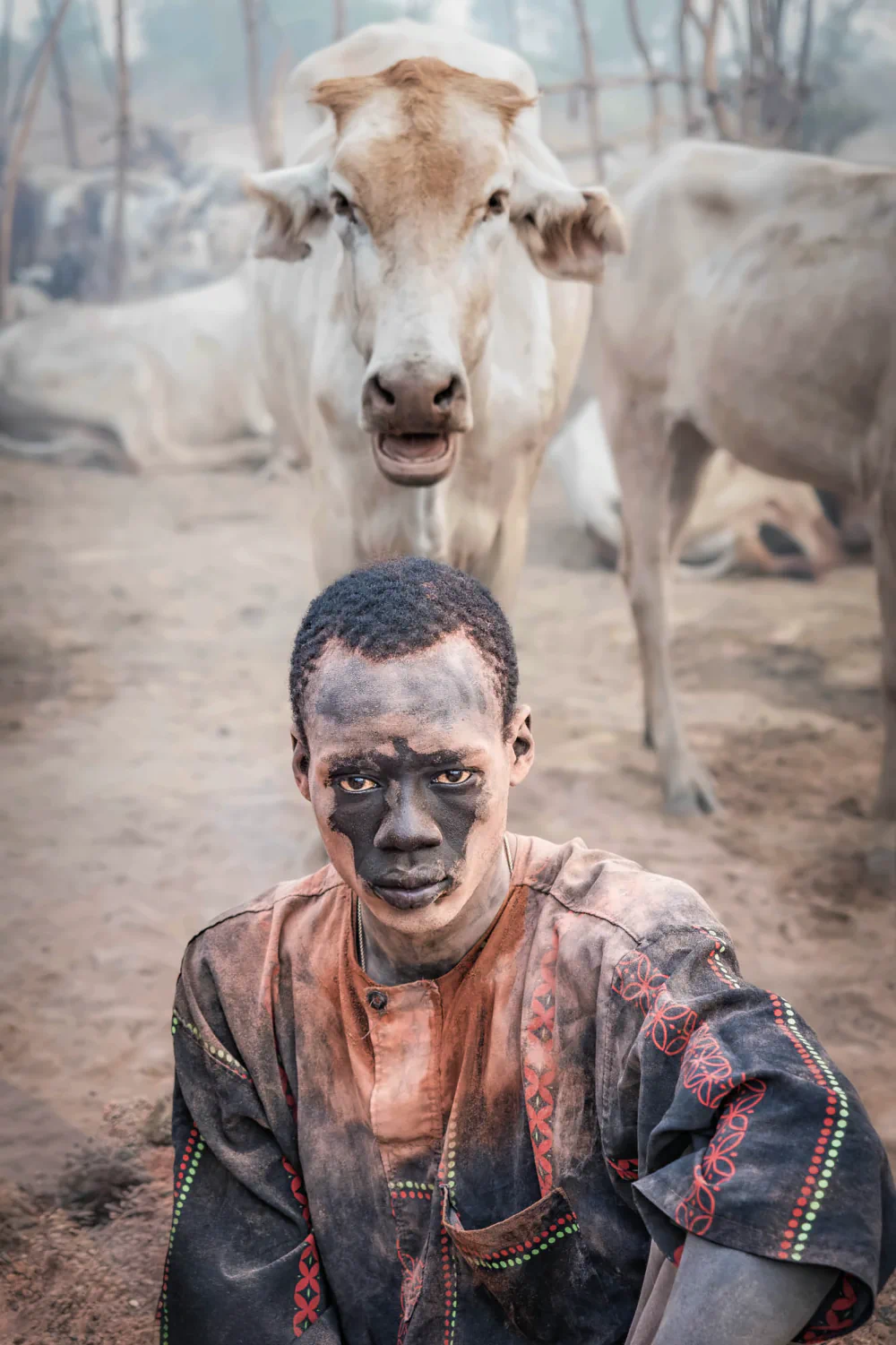
Each day, they tend to their animals with great dedication, covering them in ash to protect them from the harsh sun and mosquitoes. It is a simple but powerful gesture of care. Over time, it becomes clear that the cattle are not just possessions—they are an extension of identity, a source of pride, and a form of continuity.
What fascinated me equally was how the animals respond in return. In the evenings, when the Mundari call them—sometimes with drums—the cattle move back from the grazing fields toward their owners, as if guided by an invisible bond.
There is a deep, almost inseparable connection between people and animals. It is something that feels both ancient and immediate—and perhaps something that has been largely lost in our fast-paced modern world.
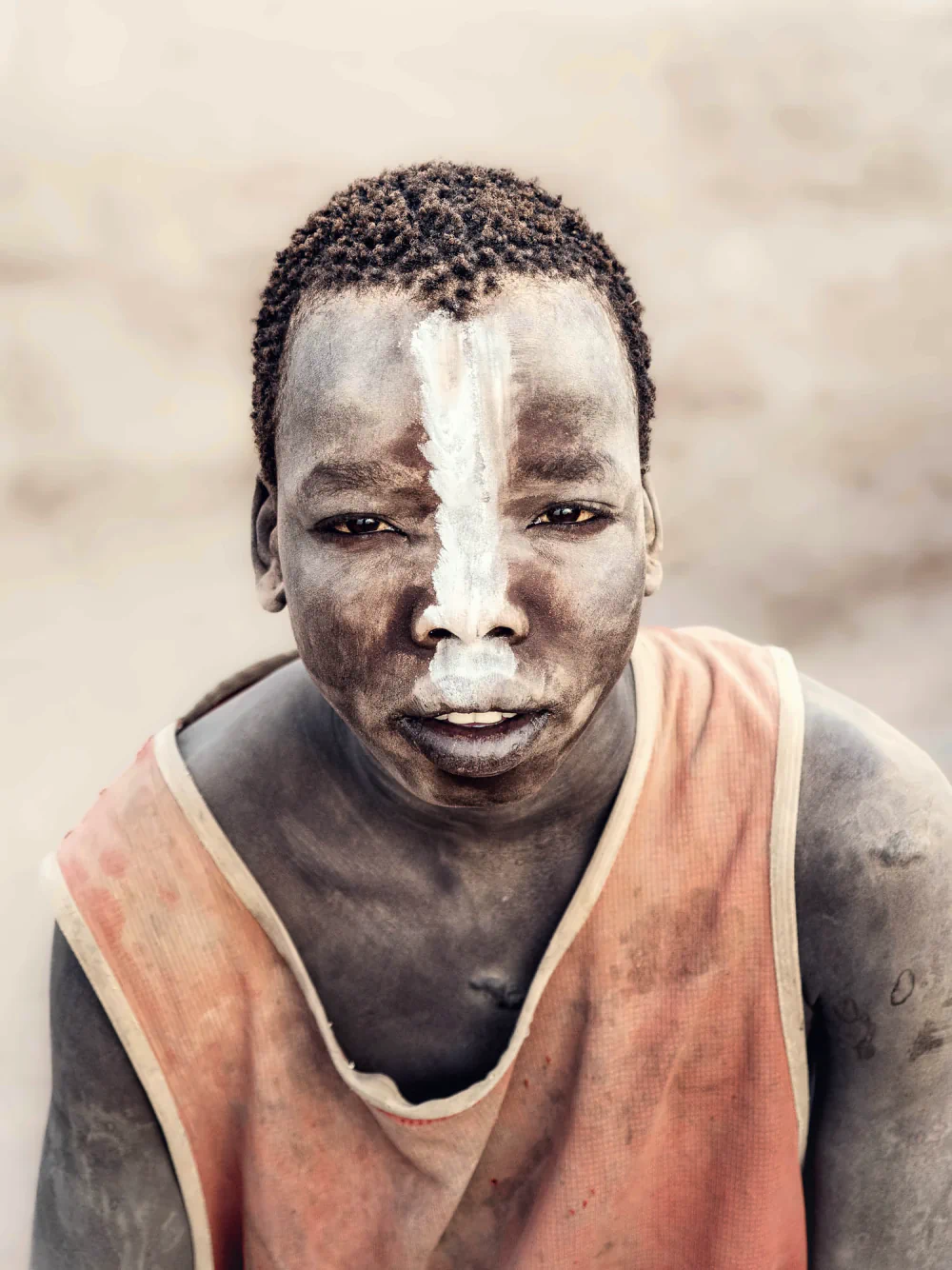
Dust, smoke, and light play a key role in shaping the atmosphere of the images. How do you work with these elements to build your visual language?
Dust, smoke, and light are, in many ways, exactly the elements a photographer hopes for—they create atmosphere, depth, and a certain visual poetry. But in reality, they can also become overwhelming when there is simply too much of them.
In South Sudan, this was often the case. The density of dust and smoke sometimes reduced visibility and contrast to a point where the subject risked being lost within the scene. So working with these elements was not only about embracing them, but also about controlling them—both in-camera and later in post-production.
I always shoot in RAW, which gives me the flexibility to refine the balance afterward. In this project, post-processing became especially important. I worked carefully to reduce excess haze around the main subject and to bring back structure and clarity without losing the atmosphere.
To enhance contrast and tonal depth, I also used tools like the Nik Collection. But for me, editing is never about altering reality—it is about translating what I experienced into an image that holds both presence and atmosphere.
In the end, these elements are not just visual effects; they are part of the story. The challenge is to let them breathe, while still giving the subject a clear and grounded presence within the frame.
There are moments of strong intimacy, such as children sleeping among the cattle or the gesture between a boy and a calf. What were you trying to capture in these scenes?
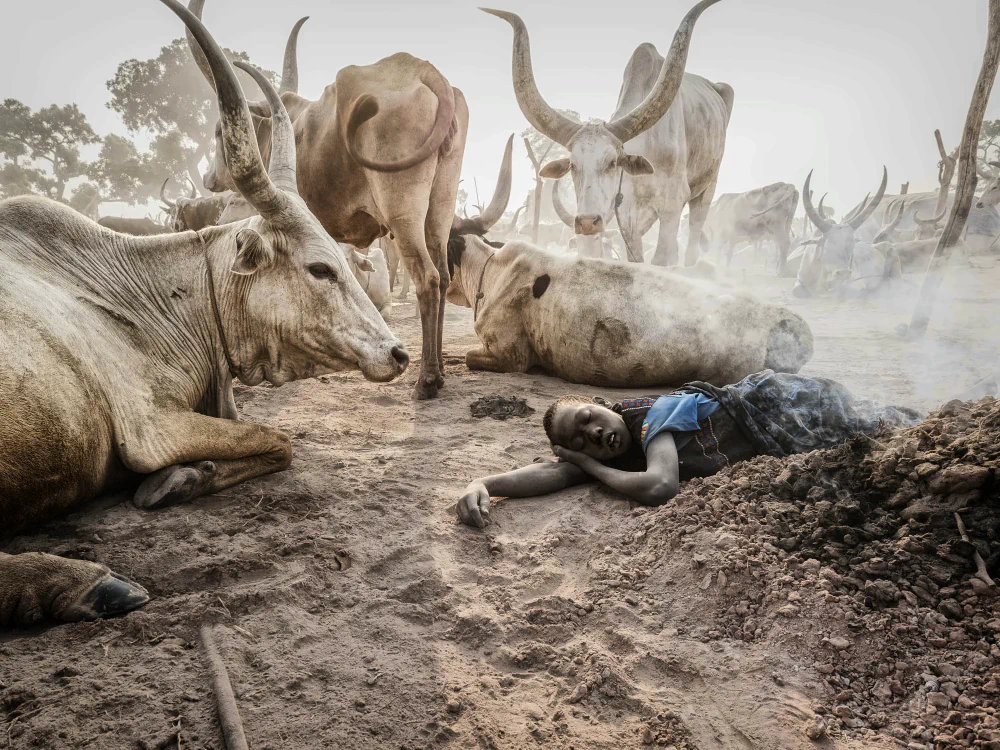
What I was trying to capture in these moments was the deep sense of care, respect, and responsibility that is naturally passed on to the children of the Mundari. Their relationship with the cattle is not taught in a formal way—it is lived, from a very young age.
One morning at sunrise, I observed a young boy sleeping among the cattle. At one point, he rose almost like a sleepwalker, gently moved one of the animals to a different spot, and then lay down again, continuing his sleep for another hour. By the time I took the photograph, the sun was already quite high, the light harsh—yet he remained completely at ease within this environment.
In another moment, a boy playfully touched his forehead to that of a calf while collecting dried dung. It was such a quiet, tender gesture—something that can only emerge from familiarity and trust. There was no distance between them, no hesitation.
These are the moments that stayed with me. They reveal a form of closeness that feels both natural and profound—something that goes beyond function and speaks of a deeply rooted connection between human and animal.
Ash appears as a recurring element, both practical and symbolic. What meaning does it hold for you within the project?
Ash was everywhere—it was an integral part of daily life. The boys collect the cattle dung each day, which is then dried and burned. The ash produced is used to protect the animals from the harsh sun and mosquitoes. The Mundari apply it to their own bodies for the same practical reasons.
But beyond its function, ash began to take on a deeper meaning for me. It feels like part of a continuous cycle—nothing is wasted, everything is transformed and returned. What comes from the animals is reused to care for them again, reinforcing a sense of connection and interdependence.
In this way, ash becomes more than just a byproduct. It is a substance that links people, animals, and environment. It carries both a protective and symbolic role, embodying a cycle of life that is still intact.
Within the context of the Nile floodplains, it is essential—not only for the health of the cattle, but also for the well-being of the people.
Beyond documentary, the project carries a strong poetic dimension. What do you hope the viewer experiences when engaging with these images?
There are already many images of the Mundari—often visually striking, sometimes even idealized. You see them at sunset, or standing proudly beside their Ankole longhorn cattle. These are powerful images, but I felt the need to move beyond this notion of beauty.
I wanted to focus on the reality of everyday life—the routines, the responsibilities, and the closeness between the boys and the animals they grow up with. It is not always easy or romantic; it is physical, demanding, and at times harsh.
And yet, within this reality, something else emerges.
Through the dust, the filtered light, and the quiet, intimate gestures between humans and cattle, there is an unexpected sense of poetry. The care, the familiarity, the deep connection—they soften the perceived harshness and reveal another layer of meaning.
What I hope is that the viewer moves beyond the surface. That they first feel the atmosphere, and then begin to recognize the relationships within it. Not as something distant or exotic, but as something deeply human—rooted in belonging, responsibility, and connection.
If there is poetry in these images, it is not created—it is discovered within the reality itself.
After this project, what new directions are you currently exploring, and where would you like to take your practice in the coming years?
After this project, I find myself less focused on defining a specific direction and more on staying open to what unfolds. Personal experiences have taught me not to force things, but to remain attentive and patient.
In many ways, my approach to photography reflects this. I don’t try to control or construct images—I observe, I wait, and I trust that the right moments will reveal themselves. I approach future projects in a similar way.
Of course, there are still many places in the world I feel drawn to, and I imagine that my work will continue to engage with indigenous communities. But I prefer not to plan too rigidly. When the time feels right, things tend to move quite quickly.
What excites me most about photography is that it is an ongoing process of learning and evolving. Each experience shapes the next, often in unexpected ways.
For now, I am simply staying open—ready for whatever comes next.gab