

Documentary photography occupies a unique place in the history of the medium.
While photography has always maintained some connection to reality, documentary photography transforms that relationship into its central purpose. The camera becomes more than a device for capturing images; it becomes a tool for observing, recording, and interpreting the social world. Through documentary photography, photographers attempt to reveal how people live, how societies function, and how historical forces shape everyday life.
From its earliest decades, photography possessed an inherent documentary potential. The medium was capable of recording visual information with a level of detail and credibility that painting or drawing could not easily replicate. Early photographers captured architecture, landscapes, and portraits with remarkable precision, yet it was not until the late nineteenth century that photographers began consciously using the medium to investigate social realities.
The rise of modern cities and industrial societies created a context in which documentary photography could emerge as a distinct practice. Urban growth produced new forms of inequality, poverty, and labor exploitation that were often hidden from the public eye. Photography offered a way to make these conditions visible. Images could circulate in newspapers, books, and exhibitions, confronting audiences with realities that statistics or written reports alone could not convey.

What distinguishes documentary photography from other photographic genres is its commitment to real situations and real people. The documentary photographer does not stage scenes or construct fictional narratives but engages with events that already exist. The intention is not simply to illustrate reality but to examine it. Documentary images often raise questions about power, inequality, identity, and the structures that shape human life.
Yet documentary photography is not synonymous with objectivity. Every photograph involves choices made by the photographer. The angle of view, the moment of exposure, the framing of the scene, and the context in which the image is published all influence how the photograph is interpreted. Documentary photography therefore occupies a complex position between observation and interpretation. It records reality while simultaneously offering a perspective on it.
Throughout the twentieth century, documentary photography became one of the most influential forms of visual storytelling. Governments, newspapers, magazines, and independent photographers used the medium to explore social issues ranging from urban poverty and migration to war, civil rights, and environmental change. Documentary photographs often function as historical records, preserving moments that later become central to collective memory.
At the same time, documentary photography has consistently raised ethical questions. What responsibility does the photographer have toward the people being photographed? How can suffering be represented without exploitation? Is the act of photographing a form of witnessing or a form of intrusion? These questions have accompanied the genre since its beginnings and continue to shape contemporary debates about photography.
The history of documentary photography is therefore not only a history of images but also a history of ideas. It is the story of how photographers have attempted to understand and represent the world through the camera. Within this history, certain photographers have played a crucial role in defining the language and purpose of the genre. Their work established many of the visual strategies and ethical principles that continue to guide documentary photography today.
Among the figures who shaped this tradition are Lewis Hine, Jacob Riis, Walker Evans, Dorothea Lange, and Gordon Parks. Their work spans different periods of the twentieth century, yet together they reveal how documentary photography evolved from a tool of social reform into a broader form of cultural and historical reflection.
Understanding documentary photography requires examining the contributions of these photographers, not as isolated artists but as part of a larger movement that sought to use photography to interpret reality.
The Historical Foundations of Documentary Photography
From social reform to visual evidence
The roots of documentary photography are closely tied to social reform movements of the late nineteenth and early twentieth centuries. At a time when industrialization was transforming societies, photography became a means of revealing conditions that were largely invisible to the political and economic elites.
Early documentary photographers recognized that images possessed a persuasive power capable of influencing public opinion. Photographs could serve as visual evidence, demonstrating the existence of problems that might otherwise remain abstract. By presenting concrete scenes of overcrowded housing, exploitative labor, or rural poverty, documentary images translated social issues into human experiences.
The earliest practitioners of this approach were often journalists or reformers rather than artists in the traditional sense. Their objective was not primarily aesthetic but political and ethical. Photography functioned as a form of advocacy, exposing injustices and encouraging social change.
Jacob Riis represents one of the most significant figures in this early stage. Through his photographic investigations of New York tenements, Riis revealed the living conditions of immigrant communities in the city’s poorest districts. His work demonstrated that photography could be used as a tool of public awareness and reform.
Lewis Hine extended this approach during the early twentieth century by documenting child labor across the United States. His photographs of young factory workers were instrumental in campaigns that led to labor legislation. Hine’s work illustrated how photography could function simultaneously as documentation and as moral argument.
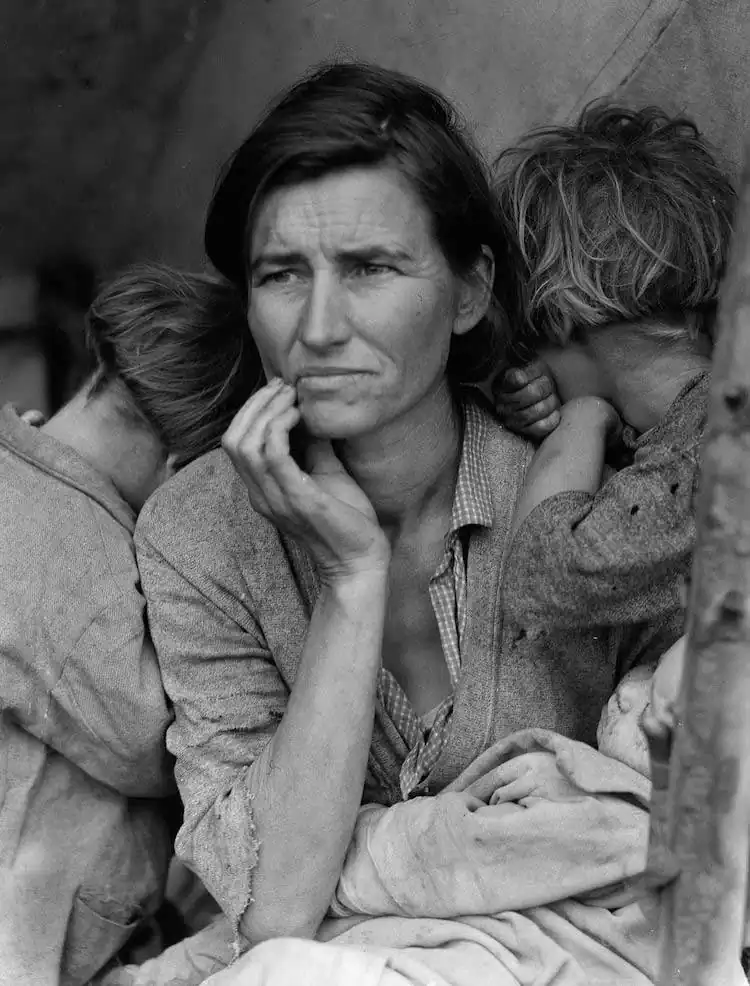
By the 1930s documentary photography had expanded beyond reform campaigns and entered a broader cultural context. The Great Depression prompted large-scale photographic projects aimed at recording the economic crisis affecting millions of Americans. Within this environment, photographers such as Walker Evans and Dorothea Lange produced images that have since become icons of the period.
Their photographs did more than record poverty. They explored the psychological and emotional dimensions of hardship, portraying individuals and communities facing uncertain futures. Documentary photography thus began to move beyond simple evidence toward a more nuanced exploration of human experience.
Gordon Parks later expanded the tradition further by addressing issues of race, identity, and inequality within American society. Working as both photographer and filmmaker, Parks used documentary imagery to challenge racial discrimination and give visibility to marginalized communities.
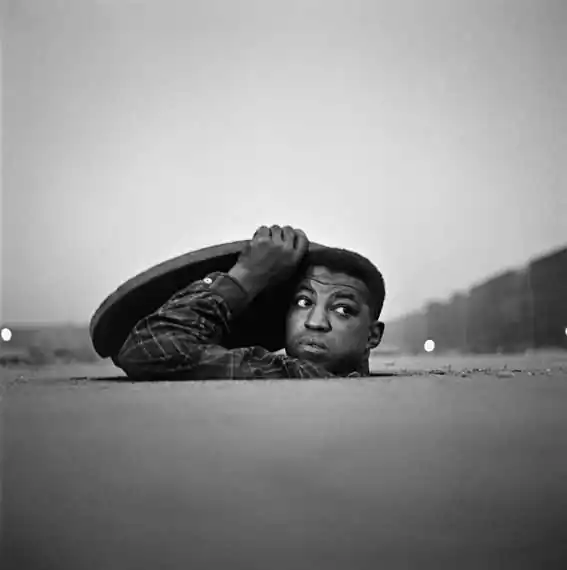
Together these photographers represent key moments in the evolution of documentary photography. Their work demonstrates how the genre developed from early social investigations into a complex visual language capable of addressing historical, political, and cultural questions.
Through their images, documentary photography established itself not only as a record of reality but also as a form of interpretation. It reveals how societies function and how individuals navigate the structures that shape their lives. In doing so, documentary photography continues to serve as one of the most powerful visual tools for understanding the modern world.