


The history of photography is often narrated through a sequence of technological breakthroughs and iconic images that transformed visual culture, yet behind that vast and complex evolution stands a quiet experiment carried out in the early nineteenth century by the French inventor Nicéphore Niépce, whose image View from the Window at Le Gras is widely recognized as the first permanent photograph ever created.
This image, produced around 1826 or 1827 in the rural estate of Le Gras in Burgundy, may appear modest or even obscure to contemporary viewers, yet its significance is profound because it represents the first moment in history when light itself was fixed onto a surface in a way that allowed the image to survive beyond the instant of its creation.
What makes this photograph remarkable is not the subject it depicts but the transformation it represents in the relationship between reality and representation. Before Niépce’s experiment every visual depiction of the world required the mediation of the human hand, whether through painting, engraving, drawing, or other artistic processes that interpreted the visible world through technique and perception. Even the most realistic paintings were ultimately translations of reality rather than direct imprints of it. With Niépce’s photograph something fundamentally new occurred because the image was not drawn but formed by the action of light itself, which transformed a chemical surface and produced a trace of the physical world without the intervention of an artist’s brush.
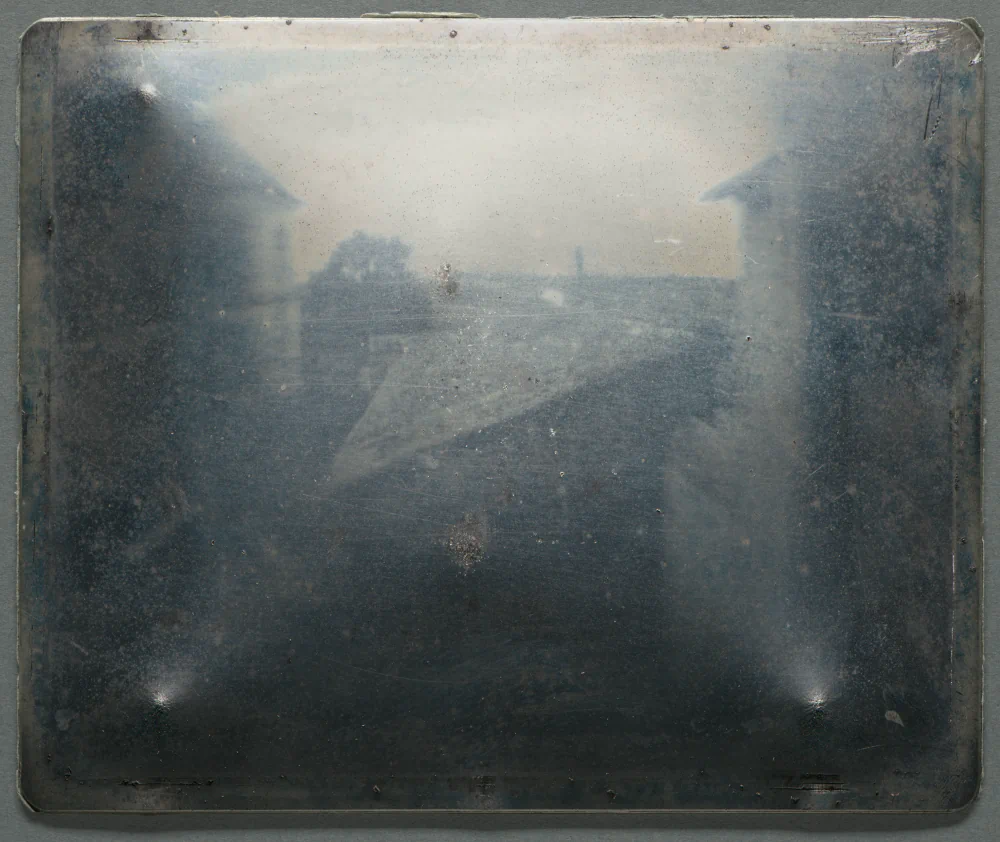
The photograph shows the view from a window in Niépce’s country house overlooking the courtyard and surrounding buildings of the family estate. At first glance the image appears almost abstract because the contrast is extremely limited and the shapes are difficult to decipher, yet careful observation reveals the rooftops, walls, and architectural structures that form the quiet rural landscape of the property. The scene itself is ordinary and lacks the dramatic qualities that later photographers would seek, but the importance of the image lies in the fact that it demonstrates for the first time that the fleeting projection inside a camera obscura could be made permanent.
The camera obscura had been known for centuries and was widely used by artists as an aid for drawing because it allowed them to observe a projection of the outside world inside a darkened chamber, yet the image created by the device vanished the moment the light disappeared. Niépce’s ambition was to find a way to preserve that projection and convert it into a stable image. Achieving that goal required years of experimentation with materials and chemical processes, during which he tested various substances in search of one capable of reacting to light in a controlled and lasting way.
The method he eventually developed relied on an unusual material known as bitumen of Judea, a natural asphalt that hardens when exposed to light. Niépce dissolved this substance in oil of lavender and applied a thin coating of the mixture onto a polished pewter plate. Once the plate was prepared, it was placed inside a camera obscura and exposed to the scene outside the window. The areas that received light gradually hardened while the portions that remained in shadow stayed soluble. After the exposure Niépce washed the plate with a solvent that removed the softer areas, leaving behind a permanent image formed by the hardened material.
Although the process was conceptually brilliant, it had a major limitation because the material was extremely insensitive to light. The exposure required many hours, and historians estimate that the photograph may have taken between eight and twenty hours to complete. This long exposure produced a curious visual effect in which light appears to illuminate the buildings from two different directions at once. The reason for this phenomenon is that the sun moved across the sky during the exposure period, illuminating different surfaces of the courtyard at different times of the day. As a result, the photograph does not represent a single instant but rather an accumulation of light over an extended period.
This characteristic gives the image an unusual temporal dimension because it compresses an entire day into one photographic surface. Modern photography is associated with the idea of capturing a fleeting moment, yet the first photograph in history represents the opposite approach since it gathers hours of sunlight into a single visual record. In this sense the image functions less as a snapshot and more as a slow inscription of time produced by the gradual action of light on a chemical surface.
Today the original plate is preserved at the Harry Ransom Center, where it remains one of the most historically important artifacts in the history of photography. Because of its fragility and the sensitivity of the materials used in its creation, the plate is rarely exhibited, yet its preservation allows historians and photographers to reflect on the moment when photography first became technically possible.
Heliography and the technological foundation of photography
Writing with sunlight and the invention of a new visual medium
Niépce referred to his photographic process as heliography, a term derived from Greek words meaning “writing with the sun,” and the name accurately reflects the conceptual ambition behind the experiment because the process allowed sunlight itself to inscribe an image on a prepared surface. This approach represented a radical departure from traditional image making methods, since the creation of the image no longer depended on manual drawing but on the interaction between light and chemistry.
The heliographic process began with the preparation of a metal plate that served as the photographic surface. Niépce carefully polished a sheet of pewter in order to obtain a smooth reflective base, after which he coated the surface with a thin layer of bitumen dissolved in oil of lavender. The coated plate was then placed inside a camera obscura equipped with a lens that projected the external scene onto the prepared surface.
During the exposure light gradually altered the chemical properties of the bitumen. Areas that received strong illumination hardened and adhered firmly to the metal plate, while areas that remained in darkness retained their solubility. Once the exposure was complete Niépce washed the plate with a mixture of solvents that removed the softer portions of the coating, leaving behind the hardened sections that formed the image. The result was a permanent visual trace of the scene that had been projected through the camera.
Although the process appears primitive when compared with modern photographic techniques, it represents a crucial conceptual breakthrough because it demonstrated that light could produce a stable chemical image. Niépce’s heliography therefore established the fundamental principle that would underpin all later photographic processes, even though the method itself was too slow and impractical for widespread use.
Recognizing both the potential and the limitations of his discovery, Niépce eventually entered into a partnership with another French experimenter who was also attempting to develop a method for fixing images created by the camera obscura. That collaborator was Louis Daguerre, an artist and entrepreneur who had gained recognition through his work with theatrical diorama displays that used large painted scenes and controlled lighting to create immersive visual illusions.
In 1829 Niépce and Daguerre formed a formal partnership aimed at improving the photographic process and developing a more sensitive method of recording images. Unfortunately Niépce died in 1833 before the collaboration produced a fully practical system. Daguerre continued the research independently and eventually introduced the daguerreotype, a process that dramatically reduced exposure times and produced images of remarkable clarity.
The daguerreotype was officially announced in 1839 before the Académie des Sciences in Paris, and the invention quickly generated global attention because it offered a new way of capturing reality with unprecedented precision. Within a few years photographic studios began to appear in cities across Europe and North America, and the camera rapidly evolved from a scientific curiosity into a widely used visual tool.
Although Daguerre initially received much of the public recognition for the invention of photography, historical scholarship has gradually restored the central role of Niépce in this development. His heliographic experiment at Le Gras remains the earliest surviving example of a permanent photograph and represents the foundational moment from which all later photographic technologies emerged.
The cultural transformation initiated by the first photograph
How Niépce’s experiment changed the meaning of images
From the perspective of contemporary photography, the image produced by Niépce may appear technically crude and visually ambiguous, yet its historical importance lies in the way it transformed the relationship between images and reality. Prior to the invention of photography visual representation was always an interpretative process shaped by artistic skill, cultural conventions, and individual perception. Photography introduced a radically different mechanism in which the physical world itself could generate an image through the interaction of light and chemistry.

This shift had profound consequences for science, art, journalism, and collective memory because it created a new form of visual evidence. Astronomers soon began using photography to document celestial phenomena, scientists employed it to record experiments and specimens, and archaeologists relied on it to capture the details of ancient sites with unprecedented accuracy. The ability to create images that appeared to be direct traces of reality transformed photography into a powerful instrument of documentation.
At the same time photography reshaped the cultural understanding of time. Paintings and drawings often represent symbolic or imagined moments, whereas photographs suggest the existence of a specific instant that once occurred in front of the camera. Even when photographs are staged or manipulated they retain an aura of having been physically connected to reality at a particular moment.
This characteristic gradually turned photography into a vast archive of lived experience. Portraits preserved the faces of individuals long after their lifetimes. Landscapes recorded the appearance of cities and environments that would later change or disappear. Historical events became embedded in collective memory through photographic images that circulated in newspapers and books.
Paradoxically, the first photograph in history does not capture a brief instant but rather a long duration of time. Because of the extended exposure required by Niépce’s process, View from the Window at Le Gras represents an accumulation of sunlight rather than a frozen moment. Only later innovations in photographic chemistry would reduce exposure times and allow photographers to capture fleeting moments with increasing precision.
Among the pioneers who advanced this transformation was William Henry Fox Talbot, whose calotype process introduced the concept of photographic negatives and allowed multiple prints to be produced from a single image. These developments accelerated the spread of photography and expanded its cultural impact throughout the nineteenth century.
Over time photography evolved into an essential medium of modern life, influencing fields as diverse as journalism, art, science, cinema, and digital communication. The camera became both an instrument of observation and a tool of creative expression capable of shaping how societies perceive themselves and their history.
Despite the immense technological progress that has occurred since the nineteenth century, the entire visual culture of photography can ultimately be traced back to Niépce’s patient experiment at Le Gras. From a quiet window overlooking a rural courtyard he aimed his camera toward the outside world and allowed sunlight to inscribe an image over the course of many hours. In doing so he demonstrated for the first time that reality could leave a permanent visual trace of itself.
That discovery marked the beginning of photography and initiated a transformation that continues to shape the way humanity records, remembers, and interprets the visible world.