

Chance has always been one of the defining forces of street photography. Unlike controlled photographic practices, where lighting, composition, and subject can be arranged in advance, street photography unfolds within environments that resist planning.
The photographer enters a field of uncertainty where events occur independently of intention. What distinguishes the practice is not the elimination of chance, but the ability to work with it.
Urban life generates an endless flow of unscripted situations. Movements intersect, gestures emerge and disappear, reflections transform ordinary surfaces, and relationships between people and space shift continuously. These phenomena cannot be choreographed. Street photography depends on recognizing that the meaningful image often arises from coincidence rather than design. The photographer does not create the moment; the moment presents itself, briefly and unpredictably.
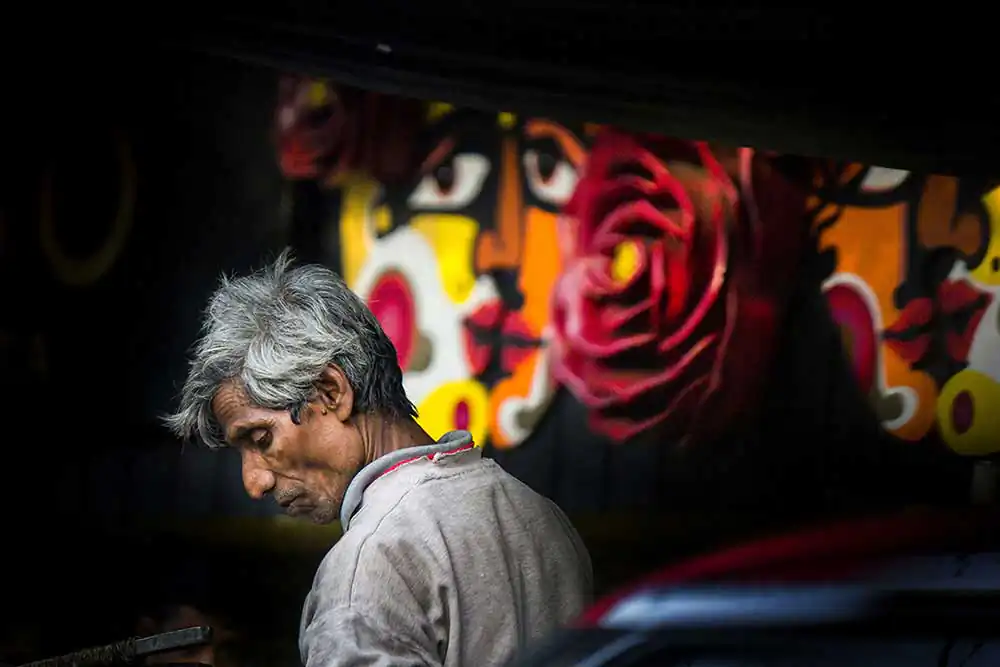
This reliance on contingency has sometimes led to the misconception that street photography is purely accidental. In reality, it involves a disciplined form of attention. Photographers cultivate a sensitivity to patterns within apparent disorder. They learn to anticipate how bodies move through space, how light changes across a façade, or how a background might suddenly align with a passing figure. What appears spontaneous is often the result of sustained observation and readiness.
Timing becomes crucial in this process. The difference between an ordinary image and a resonant one may lie in fractions of a second. A step forward, a turn of the head, or the closing of a shadow can transform visual relationships. Street photographers operate within this narrow temporal window, responding instinctively rather than analytically. Their decisions are shaped less by calculation than by accumulated experience.
Intuition, therefore, functions as a working method. It is developed not through abstract theory but through repeated engagement with the environment. By returning to similar locations, observing recurring rhythms, and learning how unpredictability manifests, photographers refine their capacity to respond quickly. The camera becomes an extension of perception, allowing action to follow recognition without delay.
The presence of chance also alters the role of authorship. In studio-based practices, the photographer maintains near-total control over the image. In street photography, control is partial. The final photograph results from an encounter between intention and circumstance. This shared authorship between photographer and environment challenges traditional ideas of mastery, suggesting instead a collaboration with the world as it unfolds.
Urban settings amplify this dynamic because they concentrate diversity and movement. Crowds, traffic, signage, architecture, and shifting light create complex visual layers. Within this density, unexpected juxtapositions emerge constantly. A reflection may echo a gesture, a shadow may isolate a figure, or two strangers may momentarily form a composition that dissolves immediately afterward. Street photography transforms these fleeting alignments into lasting images.

The unpredictability inherent in the genre also carries philosophical implications. It reflects an understanding of reality as unstable and contingent, shaped by encounters rather than fixed narratives. Street photography resists the idea that meaning must be constructed in advance. Instead, it suggests that significance can arise from attentive engagement with ordinary situations.
Technological changes have not diminished this role of chance. Although digital cameras allow rapid shooting and immediate review, they do not replace the need for perceptual awareness. The abundance of images risks confusing quantity with insight. What continues to distinguish strong street photography is not the ability to capture many moments, but the capacity to recognize the one that matters.
Editing becomes the final stage in negotiating chance. After photographing, practitioners must evaluate which images genuinely convey the tension or harmony they perceived. This selection process transforms raw contingency into coherent expression. Chance initiates the photograph, but judgment shapes its survival.
Street photography thus exists in a productive balance between unpredictability and intention. It neither abandons control nor fully embraces randomness. Instead, it operates within a zone where awareness meets accident, where preparation allows the unexpected to become visible. By working within this fragile intersection, photographers reveal how everyday life is structured not only by plans and systems, but also by moments that occur without warning.
In this sense, chance is not an obstacle to be overcome. It is the very condition that makes street photography possible, allowing the camera to register the fleeting configurations through which urban experience continually renews itself.