
There are images that endure because they are beautiful, others because they are tragic, and a rare few because they compress an entire historical era into a single silver surface. Lunch atop a Skyscraper belongs to this last category.
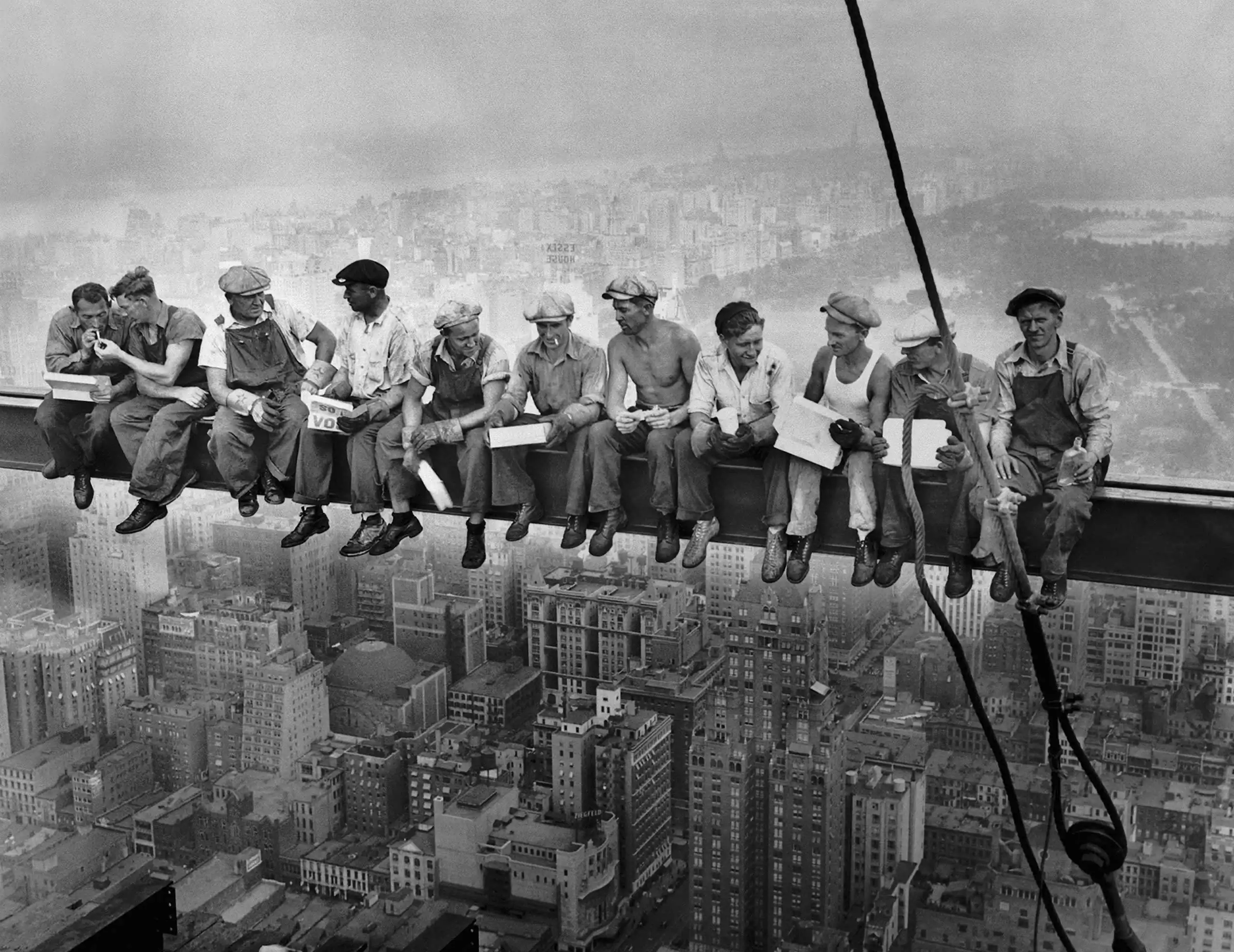
The scene is instantly recognizable even to those who have never set foot in New York: eleven steelworkers seated along a beam suspended more than 250 meters above Manhattan, sharing lunch with a composure that appears incompatible with the void opening beneath their boots. The photograph has crossed wars, financial collapses, cultural revolutions, and technological transformations without losing intensity, as though a dormant historical voltage were embedded within it, reactivating each time the world begins to wobble again.
What makes this image iconic, however, is not simply its height or its implied danger, but the intricate web of interests, silences, and ambiguities that surround it. Who actually made it? Was it a spontaneous moment or a carefully orchestrated publicity exercise? What function did it serve in the midst of the Great Depression? And perhaps more importantly, why do we continue to require it as a symbol nearly a century later?
Answering these questions requires shifting attention away from the heroic surface and toward the invisible architecture that sustains the myth.
Authorship as Contested Territory
Charles C. Ebbets and the Industrial Logic of Corporate Photography in 1932
For decades, the photograph has been attributed to Charles Clyde Ebbets, a photographer hired to document the progress of the Rockefeller Center complex during its final steelwork phase. This attribution gained traction in the early 2000s, when Ebbets’s family presented employment records demonstrating his contractual relationship with the project in 1932. Since then, his name has frequently appeared in museum captions, publications, and digital archives, though often accompanied by careful scholarly hesitation.
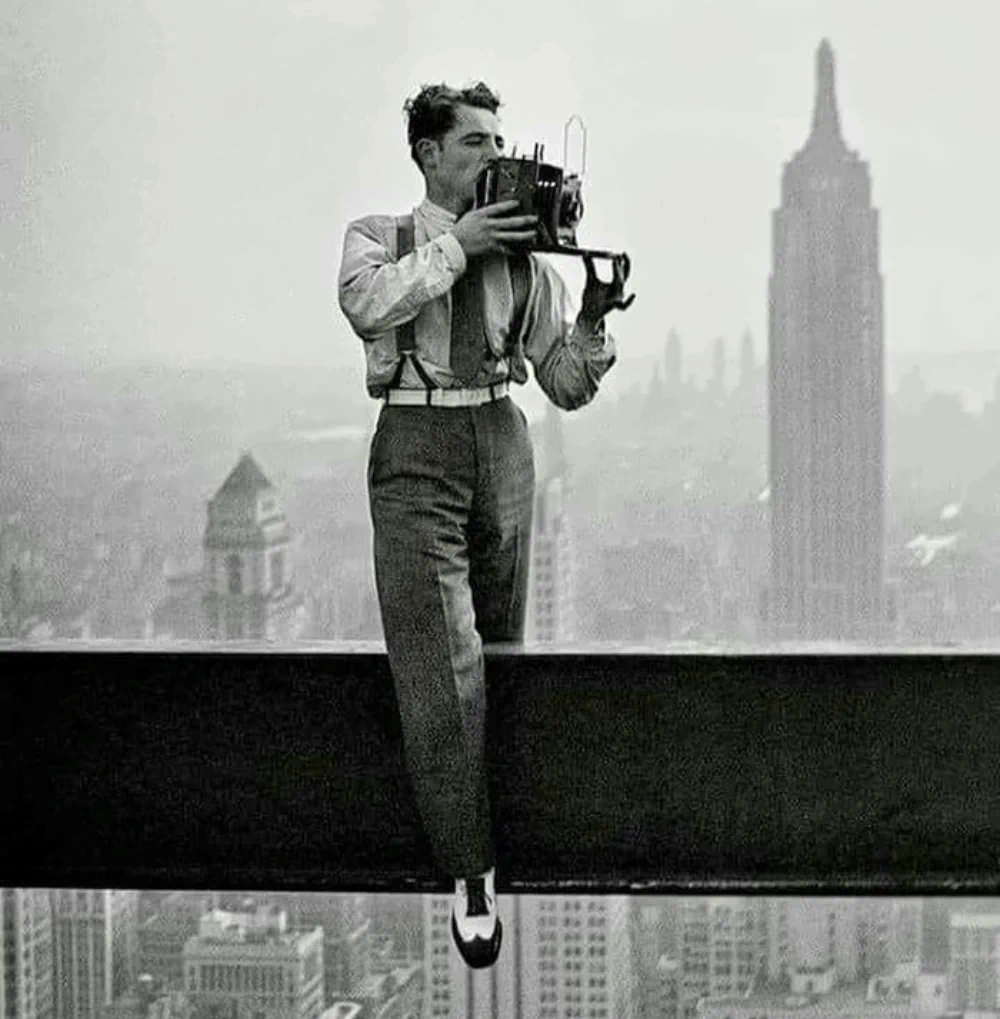
The complication lies in the fact that Ebbets was not alone on the girders that day. Archival records indicate that other photographers, including Thomas Kelley and William Leftwich, were also present, producing promotional images of what would later become known as 30 Rockefeller Plaza. The original negatives carry no definitive signature, and when the image was first published on October 2, 1932, in the New York Herald Tribune, it appeared without byline, embedded within a spread celebrating the building’s near completion.
This detail is not incidental but structural. Within the corporate logic of the early 1930s, the photographer was not primarily understood as an autonomous artistic author but as part of an industrial apparatus. Images were owned by the project, not by the individual behind the lens. The romantic conception of the photographer as singular genius, fully sovereign over his work, is a later cultural construction shaped by the consolidation of photography within the art market.
In that sense, the ambiguity surrounding authorship mirrors the image’s own subject matter. Just as the eleven workers remain largely anonymous, so too does the photographer. Authorship dissolves into a collective framework where recognition was secondary to communicative efficiency.
The unresolved credit has, paradoxically, strengthened the myth. The question “Who took Lunch atop a Skyscraper?” continues to generate sustained interest, and the absence of definitive authorship adds another layer of narrative openness. The photograph appears to have been produced by the very system it celebrates: a collaborative machine in which individual identity yields to structural purpose.
What ultimately matters is not simply assigning a name but understanding that the image was born within a strategic institutional context, designed to shape public perception of a monumental architectural enterprise during a moment of national instability.
Staging and Truth
When Propaganda Frames Rather Than Fabricates Reality
One of the most persistent debates surrounding the photograph concerns its documentary status. Was the scene captured spontaneously during a genuine lunch break, or was it arranged by Rockefeller Center’s publicity department? Historical research strongly suggests that the session was organized and that the workers were invited to pose along the beam as part of a series of promotional images, several of which depict similarly theatrical gestures.
Far from diminishing its power, this knowledge deepens its interpretive complexity. Staging does not necessarily equate to falsification. The height was real. The risk was real. The working conditions were real. What was carefully constructed was the symbolic gesture: men eating calmly above the void, embodying steadiness at a moment when the national economy trembled.
In 1932, at the depths of the Great Depression, the United States required images capable of countering financial panic and public despair. Rockefeller Center represented the largest private construction project of its time, a daring architectural bet on the future. To display steelworkers suspended above Manhattan, relaxed and smiling, was to transmit a silent yet forceful message: progress continues, confidence endures, stability persists.
The photograph thus operates as refined propaganda, not in the crude sense of deceit, but in the classical sense of meaning construction. It does not invent an imaginary scenario; it selects and organizes real elements into a persuasive narrative. Even the most “objective” photograph involves choices of angle, timing, and framing, each shaping interpretation.
The workers’ composure, whether entirely natural or partly performative, carries a theatrical dimension that enriches rather than undermines the scene. They are not merely laborers; they are participants in a symbolic act that transforms industrial risk into visual reassurance. Their casual posture against the abyss performs resilience before it was ever commodified as motivational rhetoric.
Understanding the image as staged does not strip it of authenticity; it reveals the intelligence of its construction. The photograph crystallizes a moment in which economic uncertainty and architectural ambition intersected, converting vulnerability into confidence through visual choreography.
Immigration, Anonymity, and the Construction of National Identity
The Nameless Men Who Sustained the Skyline
For decades, the eleven men depicted remained largely unidentified, functioning less as individuals than as archetypes. Subsequent research has tentatively linked certain faces to specific names, including Gustáv Popovič, a Slovak immigrant whose family preserved a newspaper clipping as evidence of his presence. Other identifications have been proposed, though the complete roster remains unresolved.
This partial anonymity has paradoxically amplified the photograph’s universality. The skyline of Manhattan was erected by waves of immigrants who exchanged physical risk for economic opportunity. Irish, Italian, Slovak, Scandinavian, and other laborers found in steelwork a profession that demanded nerve and balance while offering wages in a precarious era.
The photograph condenses this collective narrative into a single frame. The men do not appear as victims but as agents of modernity, calmly occupying a space where gravity threatens to dominate. Their presence reorients architectural history away from financiers and engineers toward the bodies that physically assembled the structures.
The absence of full identification allows viewers to project familial memory onto the beam. Any immigrant ancestor might be imagined there, boots swinging above a city still in formation. In this way, the image functions as a transgenerational bridge, linking industrial labor to contemporary urban identity.
The frequent association with Mohawk “skywalkers,” though not conclusively verified in this specific photograph, reflects a broader cultural need to connect modern skyscraper construction with traditions of balance and endurance. Whether historically precise or not, such associations underscore the degree to which the image has become a symbolic vessel for narratives of courage and belonging.
Ultimately, the photograph does not merely record a lunch break; it contributes to the myth of a nation built by hands willing to confront height, uncertainty, and physical danger in pursuit of stability.
Formal Power and Enduring Modernity
Composition, Balance, and the Aesthetics of Controlled Vertigo
Beyond its historical and symbolic dimensions, the photograph remains compelling because of its formal precision. The steel beam cuts horizontally across the frame, establishing a compositional axis that divides sky from city. The workers’ bodies punctuate that line rhythmically, creating a visual cadence that guides the eye across the image.
The chosen angle compresses depth, intensifying the sensation of exposure without revealing structural supports beneath the beam. This compositional decision amplifies tension subtly, relying on suggestion rather than spectacle. The workers’ relaxed postures contrast with the implied drop, generating a dual emotional register that oscillates between calm and peril.
The exposure achieves a remarkable balance between metallic highlights and shadow detail, especially given the harsh midday conditions. Textures remain legible; the steel gleams without overpowering the figures. The skyline recedes into atmospheric haze, reinforcing the separation between human scale and monumental architecture.
Perhaps most significantly, the photograph reverses traditional hierarchies. The skyscraper, emblem of financial power and technological triumph, becomes backdrop. The true protagonists are the workers whose labor renders such structures possible. This inversion preserves the image’s contemporary relevance in an era saturated with high-resolution aerial imagery and digital spectacle.
What sustains the photograph’s longevity is not technical novelty but narrative compression. Humor, risk, camaraderie, economic anxiety, and architectural ambition converge within a single frame without overt dramatization. The image does not shout; it holds.
In a visual culture driven by excess and immediacy, Lunch atop a Skyscraper persists through restraint, density, and structural clarity. It reminds us that the strength of a photograph lies not solely in its subject matter, but in its capacity to condense historical tension into an equilibrium of line, body, and void.
And perhaps that equilibrium is why we continue to return to it: not merely as documentation of a bygone era, but as a recurring metaphor for how societies balance hope and uncertainty on the narrow beams of their own unfinished futures.