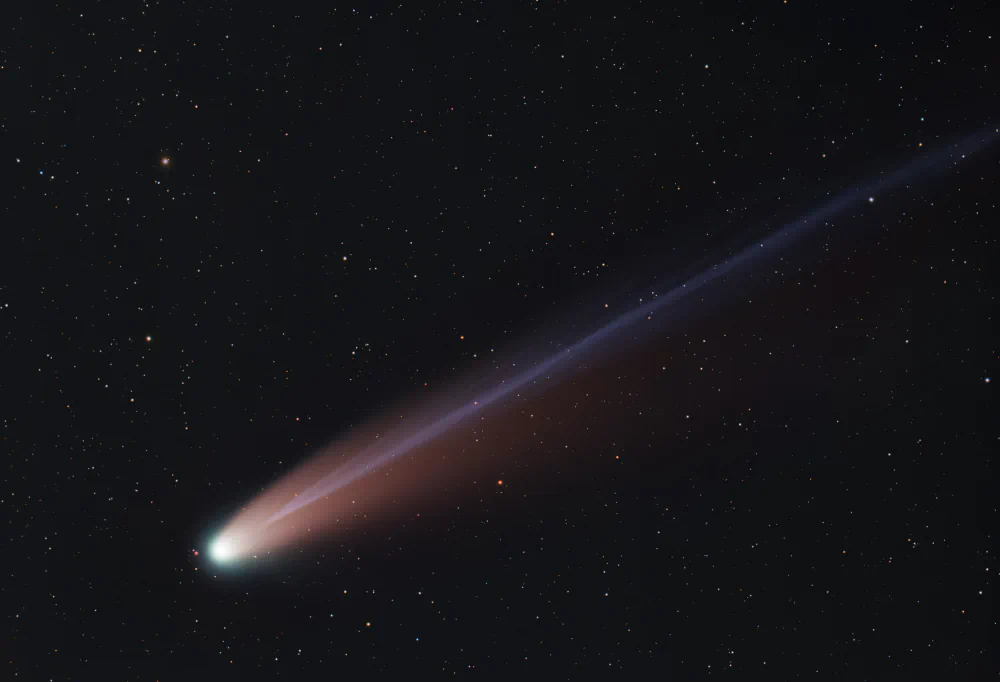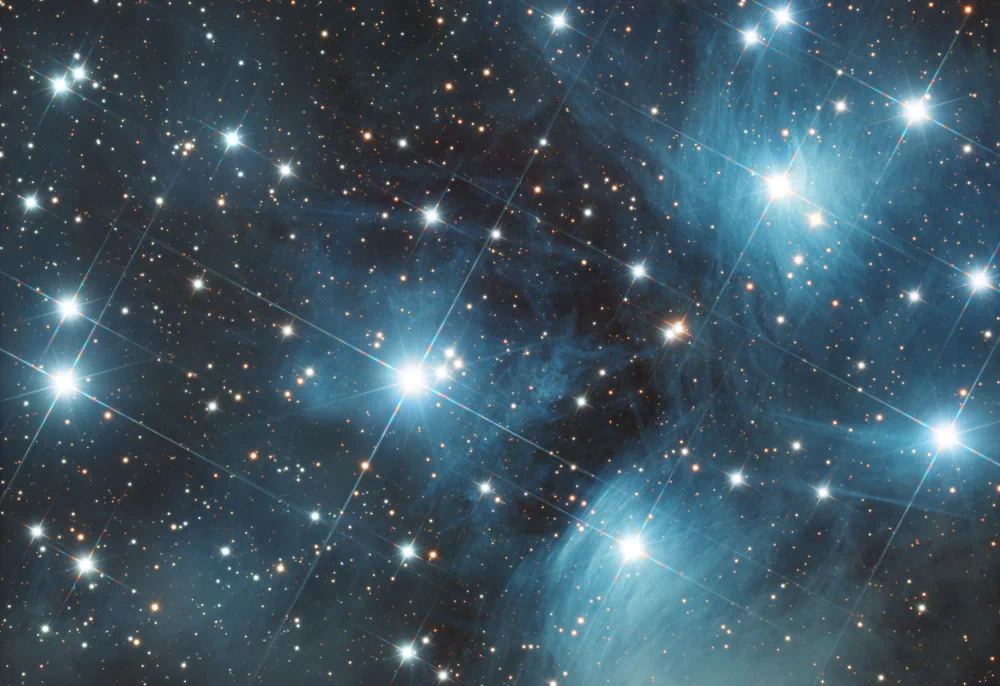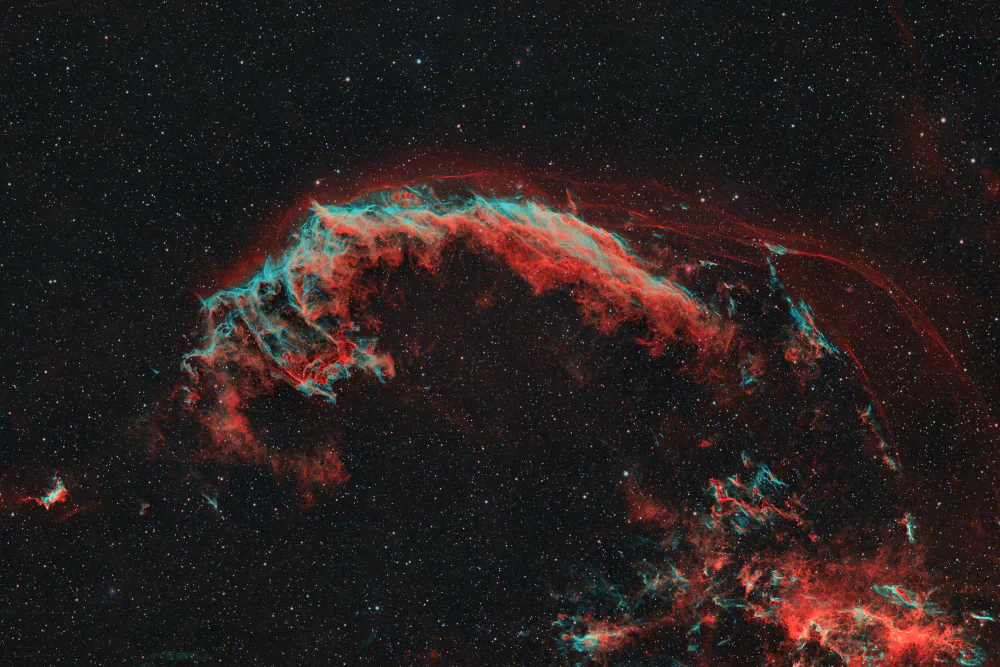

Through deep-sky astrophotography, Carlotta Roda explores the universe as a space of continuous transformation, where time, matter, and perception exist beyond the human scale.
Nebulae, galaxies, and stellar formations are approached not as distant scientific objects, but as symbolic landscapes shaped by processes unfolding across immense temporal and spatial dimensions.
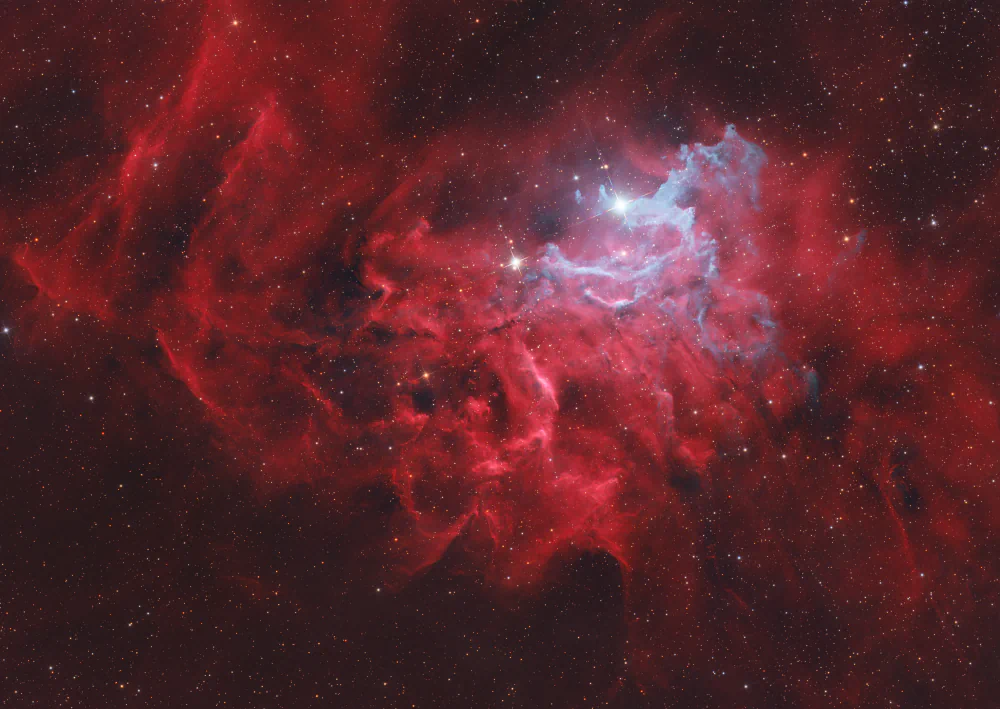
What emerges is not a descriptive account of the cosmos, but an invitation to contemplate its mutability and its distance from human experience. In cosmology, transformation is an intrinsic condition of existence. Stars are born, evolve, and collapse; nebulae disperse and reorganize; galaxies interact and change form over timescales that exceed any human measure. These transformations occur gradually, through slow and silent processes that continuously redefine the structure of the universe. Roda’s images engage with this perpetual state of becoming, capturing fragments of a cosmos that is never static, never fully present.
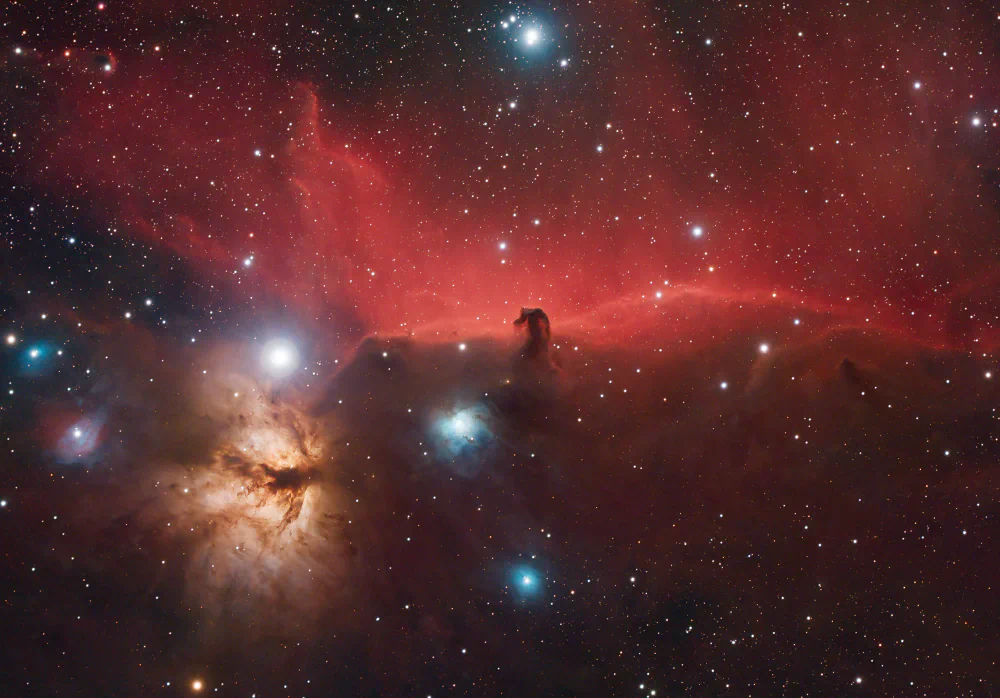
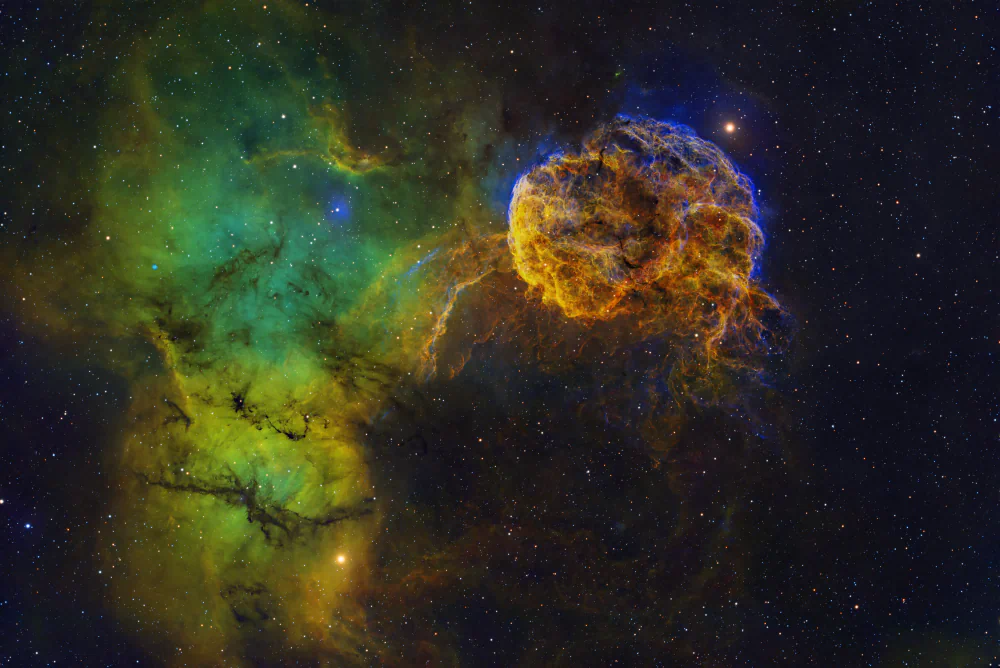
Deep-sky photography inherently confronts the limits of human perception. The human eye is incapable of perceiving the true luminosity and complexity of distant celestial bodies. Colors, structures, and contrasts remain invisible unless revealed through prolonged exposure and the accumulation of light over time. Roda embraces this limitation as a conceptual foundation of her practice. Each image is the result of an extended process of observation, patience, and technical precision, in which time becomes both subject and medium.
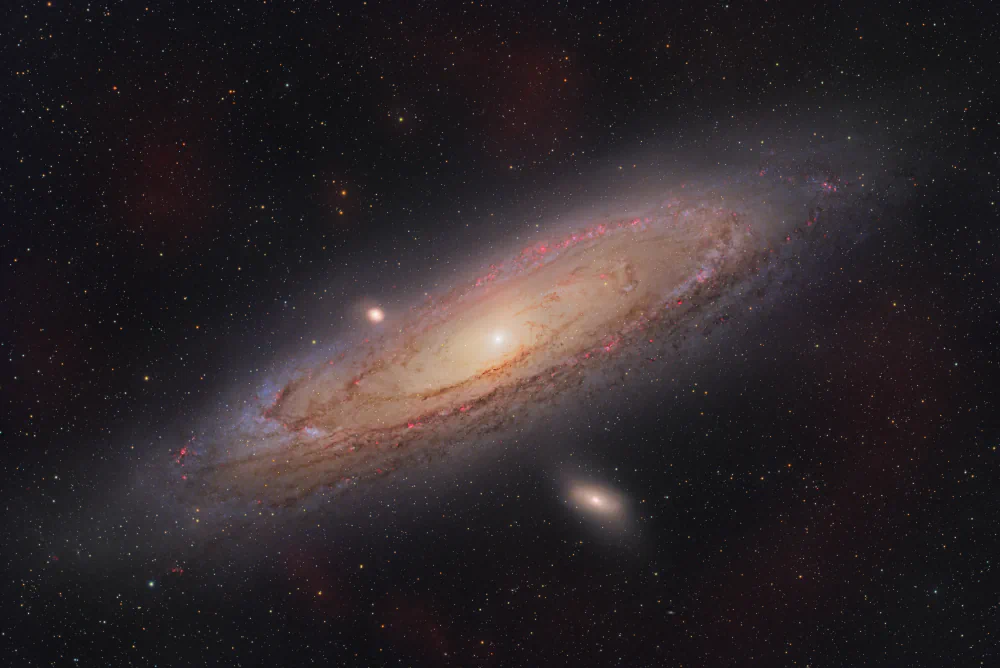
This temporal dimension introduces a fundamental paradox. The light recorded in these images has traveled for thousands or millions of years before reaching the observer. What appears present is, in reality, already past. The photographed universe no longer exists in the form we see; it has already transformed. In this sense, the images function as traces rather than representations, visual remnants of something that can never be fully accessed in the present.
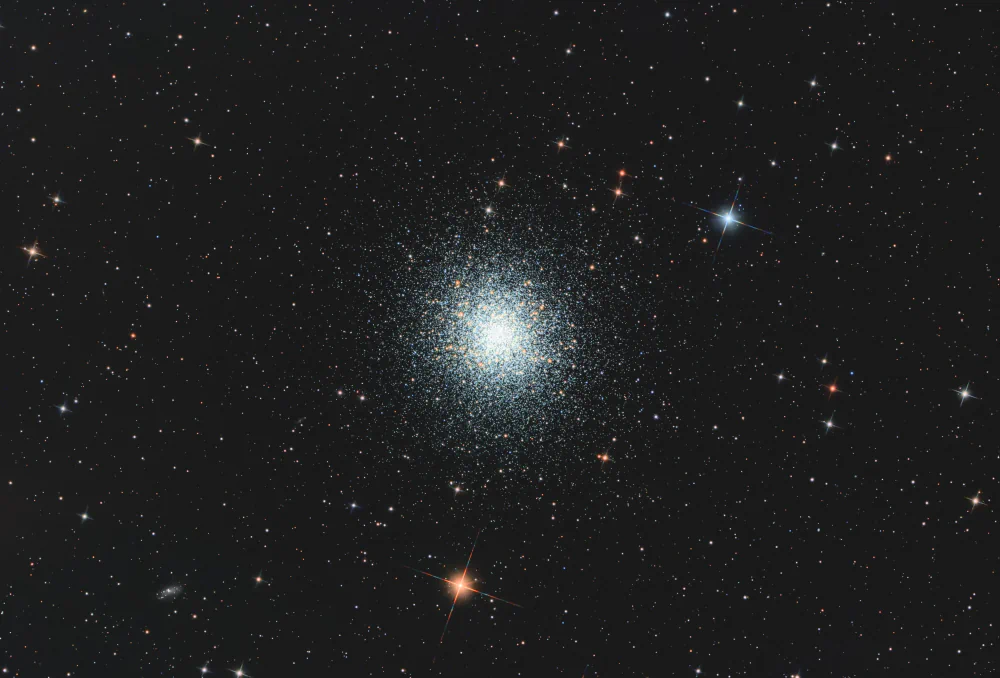
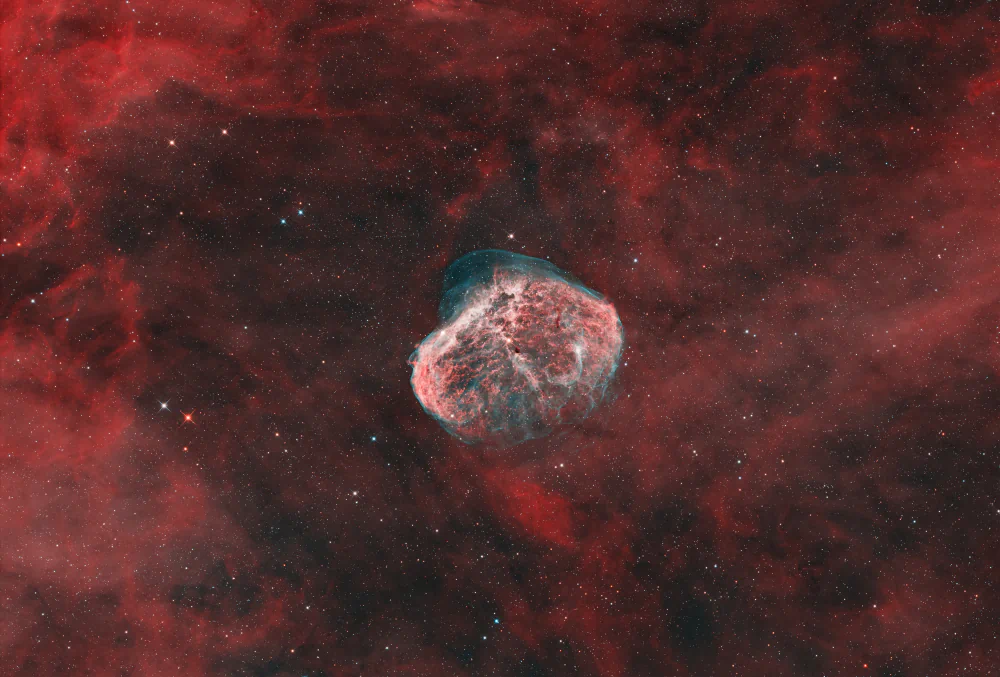
Beyond their scientific origin, the celestial forms captured in this body of work evoke imaginary and symbolic spaces. Nebulae dissolve into fluid, almost organic structures; galaxies appear as fragile concentrations of light suspended within vast fields of darkness. These images resist a purely documentary reading and instead open themselves to contemplation. The cosmos becomes a territory where knowledge gives way to wonder and certainty dissolves into mystery.
The act of observing the deep sky becomes an exercise in awareness of scale. Faced with the immensity of the universe, the observer is confronted with their own finitude. The images do not diminish the human presence; rather, they place it within a broader context, where existence is measured against distances and durations that defy comprehension. The vastness of the cosmos becomes a mirror through which questions of belonging, fragility, and continuity emerge.
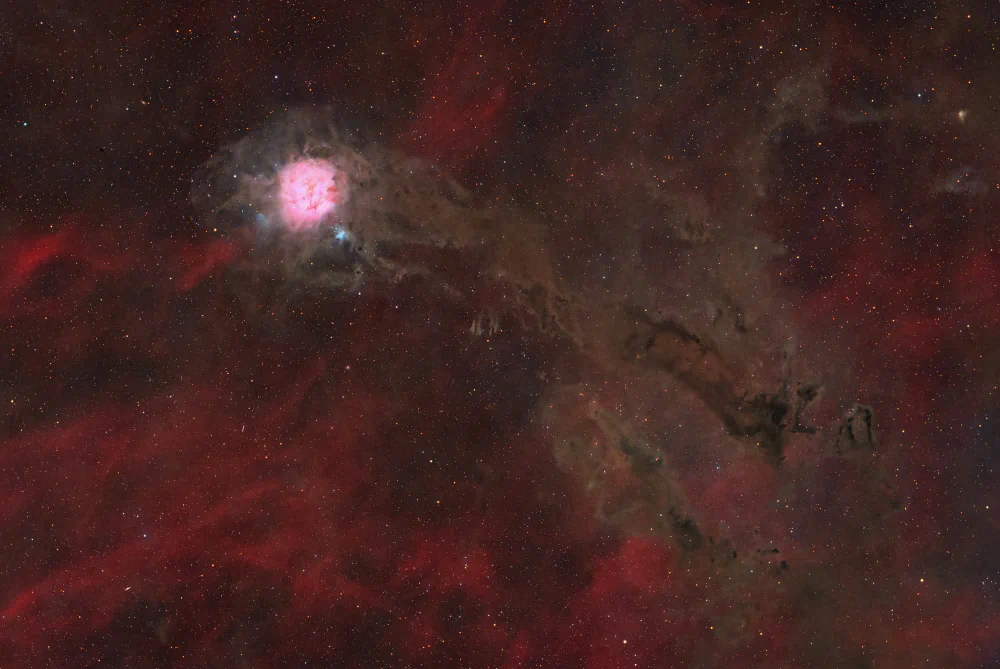
Darkness plays a central role in this exploration. It is not treated as absence, but as a necessary condition for revelation. Only through darkness can distant light be perceived; only through obscurity can form slowly emerge. In this tension between light and shadow, Roda’s work proposes a slower and more attentive gaze, opposing the contemporary impulse toward immediacy and constant visibility. The night sky demands stillness, duration, and a willingness to remain within uncertainty.
What unfolds is a dialogue between the macrocosm and human perception. The images do not aim to define or contain the universe, but to create a space in which observation becomes experience. The cosmos is presented as something that can be approached, yet never fully grasped—seen, yet always exceeding comprehension. This distance is not a limitation, but a generative space for reflection.
Ultimately, this body of work investigates the relationship between humanity and the infinite. The universe appears vast, remote, and in constant transformation, offering no fixed point of reference. Within this immensity, the act of looking becomes an act of positioning oneself in relation to something immeasurable. The viewer is suspended between light and darkness, presence and absence, awareness and uncertainty.
Rather than offering answers, the images open questions. In contemplating distant light and unreachable structures, the observer is invited to reflect on their own temporality and their place within a universe that exceeds all human frameworks. The deep sky thus becomes not only a physical reality, but a space of thought, where transformation is both cosmic and internal, and where looking outward inevitably leads inward.
Who are we, really?
About Carlotta Roda
Carlotta Roda (born 1999) is an Italian fine art and astrophotographer. She graduated in Photography from IED Milan, where she developed an interpretative approach to the medium, using photography as a tool to explore darkness, perception, and the relationship between humanity and the universe.
Her work focuses on deep-sky astrophotography and nocturnal landscapes, investigating the tension between light and darkness, presence and absence. Light pollution becomes both subject and metaphor: when present, it shapes captivating urban scenarios; when absent, it reveals astral visions that evoke awe and reflection. Through her images, Roda seeks to go beyond what is visible, creating spaces of mystery that invite viewers to confront the vastness of the cosmos and the fragility of everyday life.
Her work has been exhibited in Italy and internationally, including Milan, Jesi, Glasgow, Minneapolis, and New York. [Official Website]