
Her work moves within a territory where photography enters into direct dialogue with the body, the stage, and identity, constructing images charged with emotional tension and physical presence.
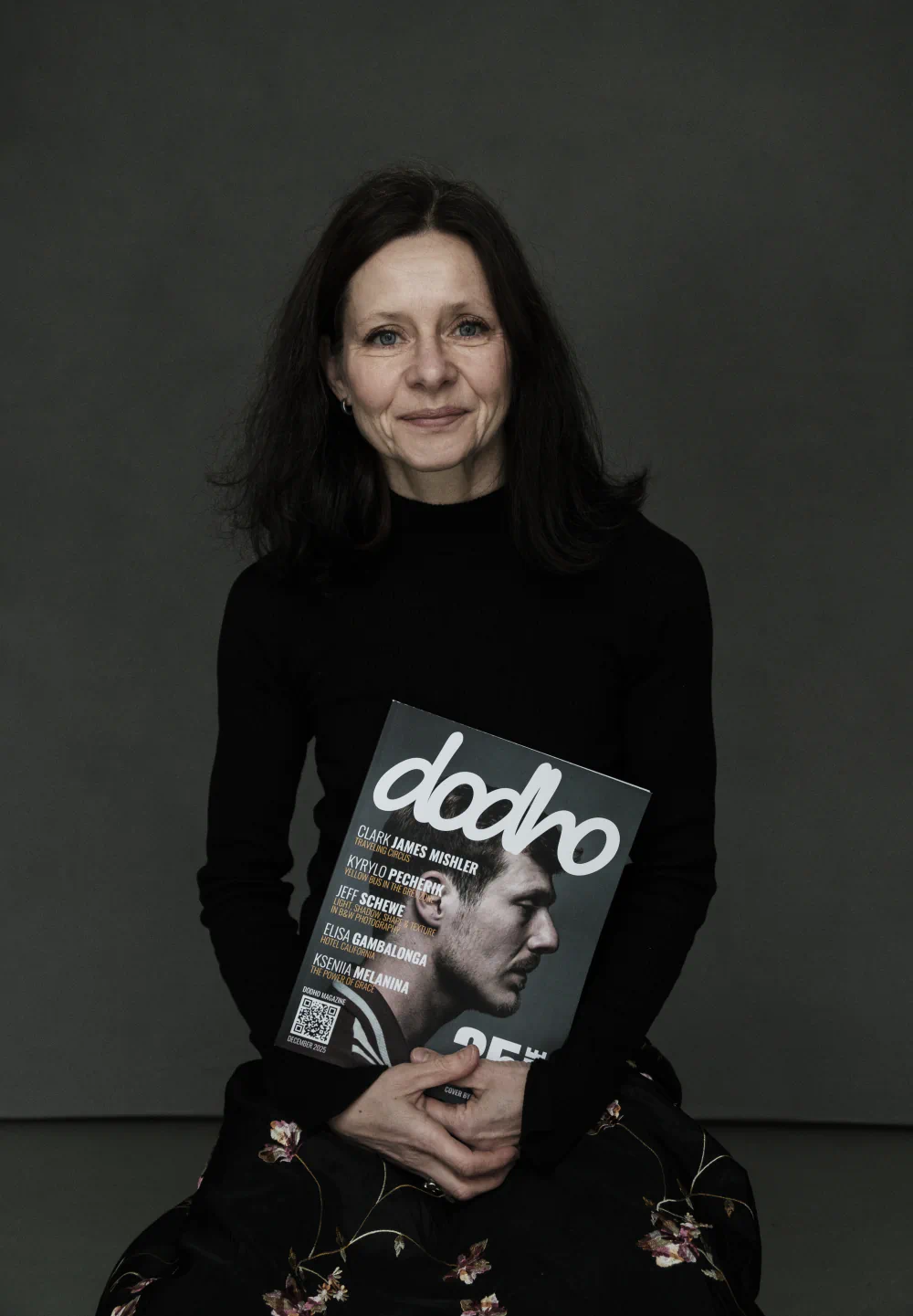
With a gaze deeply shaped by her background in contemporary dance and visual arts, Middelberg develops a practice that explores portraiture and theatre and dance photography from an intimate, almost performative dimension, where every gesture carries narrative weight. In this interview, we speak with her about her career, her creative process, and the personal and artistic journey that has led her to this cover. [Official Website] [Issue #35]
How did this specific image come about? Was it a commission, a personal session, or part of a larger series?
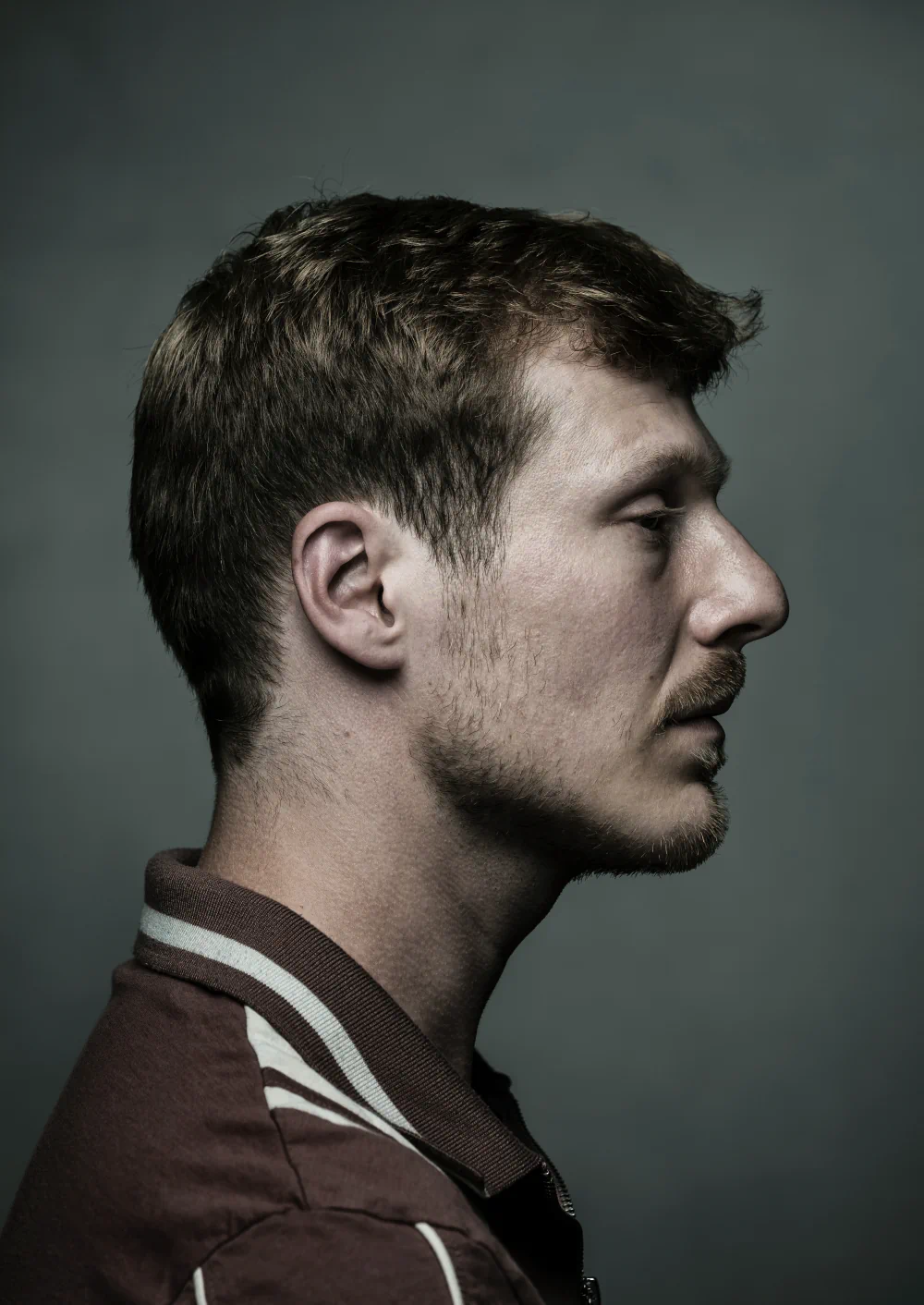
The cover photo is a portrait of the actor Martijn Schrier. It was a commissioned photo. Martijn is an actor, mime, and theatre maker. He asked me to take casting photos of him. Besides being a photographer, I am also an actress. Often, I am asked to make casting photos. My wish, however, is to create deeply personal portraits. Before the shoot, I have conversations with the actor: what kind of work they do, what kind of roles they want to attract, and what talents they wish to highlight. In the studio, I use this insight to capture photos that reveal their personality.
In your work there is a clear tension between strength and fragility. What draws you to this duality, and how do you recognize it in a person?
I think I am drawn to it because it is something I recognize in myself. I also believe that everyone carries this duality within them. Of course, the balance varies from person to person. Without vulnerability, I cannot see anything of the other person, nor can I show anything of the other person. When vulnerability and strength coexist, anything can happen. Strength allows you to act and creates creativity. Vulnerability brings soulfulness. That combination makes it possible for beautiful things to emerge. I believe humans exist to create. Every person can express themselves in life by creating what reflects their potential.
When I work in the studio, I try to sense the other person: what suits them, when do they feel in their element, when do they express themselves fully? By experimenting and tuning in, I uncover both their vulnerable and strong sides. It’s a collaborative, creative collaboration.
For you, what distinguishes a “beautiful” portrait from a “true” one? What do you look for in a face: character, emotion, history, silence, or something more physical?
An honest portrait is beautiful. That is what beauty is: truthfulness, honesty. At least, that’s how I see it. I am not looking for certain faces, emotions, or physical features. I very much want real contact with the person I photograph. When that connection is there, anything can happen. I have no preconceived plans for the outcome. If I am surprised by what happens, I am very happy. And I am happy if the person I photograph is surprised by themselves. When that happens, it’s a great gift. It means we’ve collaborated well.
How do you choose whom to photograph: intuition, connection, features, personal story, energy?
Most of the portraits I create today are commissioned, usually of actors. I am very grateful to photograph actors. I find actors fascinating. They are aware of emotions—not in the sense of being self-conscious about how they appear, although that is true too. That has two sides: positively, because actors quickly pick up on cues; negatively, because they tend to want to control how they are perceived.
What I mean is that they are conscious of their inner world. I like that. An actor must be willing to be vulnerable and sensitive. Actors tell stories of other people; they step into a character that is not themselves. They ask who their character is, what their character wants in life, what beliefs they have, how they think and feel. Actors are constantly working with emotions.
The people I photograph outside of commissions are those who touch me through what they do and who they are. For example, musicians whose music moves me, actors or dancers whose work affects me. I know brave people working in new media whom I would love to photograph because I am impressed by who they are. They are people I like, admire, or find inspiring—or people I simply adore.
How do you prepare a session so the subject lets their guard down? Do you talk a lot beforehand, work from silence, give directions? What ultimately leads in your studio: light, time, conversation, intuition?
I always prepare if I do not know the person. I research them online to get a sense of who they are. I also always start with a conversation, asking many questions. I try to understand why they want a portrait. Often, there is more beneath the surface than just practical reasons. Even someone coming for casting photos usually has a deeper motivation.
From there, I decide on the approach for the portrait, including lighting, etc. During the shoot, I tune in to what the person needs and what I need, and what they are capable of. Often very personal conversations arise while photographing. I never leave the person to their own devices—they should not feel lost. I give directions. Sometimes I let the person improvise while providing guidance.
How do you manage the distance between what you see and what the subject wants to see of themselves?
That’s a good question! I aim for a strong portrait, but the subject seeks one in which they feel they look good. That’s a difference. Most people do not care if the photo is good when it features themselves. Everyone views their own portrait with bias, because we are all obsessed with the things about ourselves that make us insecure. Most people only focus on that. That is understandable and human.
A photograph becomes strong because it affects the viewer. I try to help people experience that when looking at their portraits. This often takes time. People may initially be unsure about an image I love because they notice something in it they don’t like about themselves. I ask them to step away, revisit it later, or see it through someone else’s eyes. I also encourage them to ask others what they think of the photo. Often, with distance, they come back to appreciate it fully.
At the same time, I try to respect what the person wants to convey with the photo, especially in commissioned work. But even then, I remain true to myself.
How do you decide when to stop? At what moment do you know that it is done?
That happens naturally. I stop when I feel I have captured everything I need, when I’ve photographed what fascinates me about the person and explored all my ideas for that day.
Would you like to tell something about the background of your self-portraits?
In March 2025, I photographed myself. Over the past months, these portraits have won many awards. When you submit work for a competition, you are usually asked to write a story about the photograph. With these portraits, I did not do that. I couldn’t. It surprises me that I won awards nonetheless.
For me, my self-portraits are not just a portrait of me, but something I create for a reason. A portrait is the expression of a story or an emotion.
I made these portraits at a time when I felt an overwhelming fear, sadness, and confusion. But I could not explain what lay beneath those feelings. The emotion itself was completely clear—intense and undeniably present.
By now, I understand what lay underneath. I still cannot fully comprehend it.
For the past eight years, I was in a relationship with a very special man, whom I loved deeply—and whom I still love. And he loved me very much. At least, I thought he did. The final year was difficult. More and more things happened that I did not understand—cruel things that confused me and made me afraid. When my mental state continued to decline, I sought help from a medical therapist. She referred me to The Lost Self, an organization of therapists specialized in narcissistic abuse. She had treated several former partners of my partner, all of whom showed trauma symptoms and shared similar stories about him. I also spoke with his former girlfriend. In this way, I discovered that my partner was living a double life.
During the last nine months of our relationship, he had told everyone around him that we had already broken up. At the same time, he and I were still together, and he was making plans for me to give up my home and move into his house. Many more lies surfaced. When I confronted my then-partner, he admitted that it was all true. More than that—he told me this was a pattern in his life, something he had done throughout his entire adult life:
When a relationship becomes difficult, he tells his surroundings that it is over and that he is looking for a new love. Meanwhile, he keeps his partner in the relationship until he has found another woman. During this time, he lives two parallel lives—sometimes even with three or four women at the same time. Once the new relationship is strong enough to replace the old one, he disappears from the life of his first partner without saying goodbye. From the moment this process begins, he starts isolating his partner from her surroundings. I no longer saw our friends. He also begins telling people that his partner is mentally unstable, so that when he eventually disappears from her life entirely, no one will believe her when she speaks about what happened within the relationship.
In an emotional conversation, my then-partner told me that he had done this in every relationship since his first marriage. He also admitted that he had controlled me for years by manipulating my fears and past traumas. He said he knew me so well that he knew exactly what to say to touch my deepest wounds and make me utterly terrified. At the same time, he knew exactly what to do to calm me and make me feel safe—and he used this knowledge whenever it suited him to achieve his own goals.
He said he no longer wanted to live this way, that it had to stop now because he did not want to lose me. He promised to go into therapy. I felt relieved because, at that moment, he was honest. I believed him and felt full of trust and hope. A few weeks later, he left me in exactly the same way he always had—without saying goodbye, without saying or explaining anything.
The portraits were made at a time when I still knew nothing about his double life, the manipulation, and the lies. They were created during the period in which my ex-partner had begun telling our friends that we had broken up—something I did not yet know. But I felt a horrific, indefinable fear and sadness. Without being able to explain why, I had to make those photographs. Now, in hindsight, everything falls into place. I understand what I felt back then—what I could feel, but not yet see.
I never knew my partner. For eight years, I loved a stranger.
What is the most common mistake you see in contemporary portraiture, and how do you avoid it in your own practice?
I cannot say there is a common mistake because it is a matter of taste. Personally, I am turned off by portraits that are so “perfect” that the person is indistinguishable from an AI-generated image. That perfection bores me. If you remove all humanity from a portrait, why photograph people at all? You can already create excellent portraits with AI. For me, people are beautiful because of everything that makes them human. That is what I photograph.
You come from dance and also work in theatre. What did the body and the stage teach you that is still alive in your portraits today? Which artists or references have truly influenced you, in photography, painting, or cinema, and what did they give you?
I think everything you do, see, hear, or feel influences who you are and what you create. When I see art—any art, visual or performing—I ask myself whether it moves me, and why or why not. Everyday life also affects us in ways we are not aware of.
When I was dancing and touring with performances, you could certainly see that in my photography. At that time, I made photos that almost resembled theatre scenes, complete with set design. I lived in theatre. Now, my photos are influenced by film because I watch a lot of films and often spend time on film sets.
Being a dancer also affects how I work with people while photographing. I don’t ask people to evoke emotions—that feels forced. Instead, I give physical guidance so they can relax and get out of their head.
There are many people who inspire me; I cannot name them all. Someone who will always inspire me is Pina Bausch. Her influence runs through my work as a dancer, actress, and photographer. I also greatly admire the Belgian photographer Stephan Vanfleteren, who has an immense talent for capturing someone’s personality in his own way. In film, Wim Wenders is a major inspiration; I am deeply moved by the melancholy and serenity in his films.
How does the reading of a portrait change when it appears on a cover, isolated, compared to when it is seen as part of a series?
Of course, a portrait for a cover must meet requirements that suit the cover design. The image must be simple, as there is still a lot of text on the cover. The image becomes part of the design. In that sense, an image on a cover is separate from the series it comes from. It takes on a different function—it becomes a new image.
In the series, Martijn’s portrait is part of a collection of artist portraits, each showing authenticity in its own way. The overall impression of all these unique people is not visible on the cover. On the cover of Dodho, the portrait becomes almost visionary. The text on one side and Martijn’s gaze on the other create a strong dynamic. It’s almost an invitation to open the magazine.
Do you think your portraits call for an emotional reading, a psychological one, or both at the same time?
I hope my images evoke something in the viewer. So, I hope the viewer feels something. I think of myself as somewhat psychological, and perhaps that shows in my portraits. That my work might provoke a psychological analysis is not my intention, but it is allowed. Once the photo is out in the world—online or in a physical exhibition—its effect belongs to the viewer, and that is different for everyone.
What are you working on right now, and what would you like to explore that you have not yet pushed to its limits?
I will continue making portraits of actors. I enjoy the contact with actors and find working with them inspiring. In my personal work, I want to experiment more.