

Among the many names that populate the history of photography, few are as decisive as Nicéphore Niépce.
Long before photography became a widespread medium, before cameras were portable and before images circulated across newspapers and magazines, Niépce achieved something that had never been done before: he managed to fix an image created by light so that it would remain permanently visible.
In doing so, he produced what is generally considered the first photograph in history, an achievement that did not merely introduce a new technical process but quietly initiated a profound transformation in the way humanity records and remembers the world.
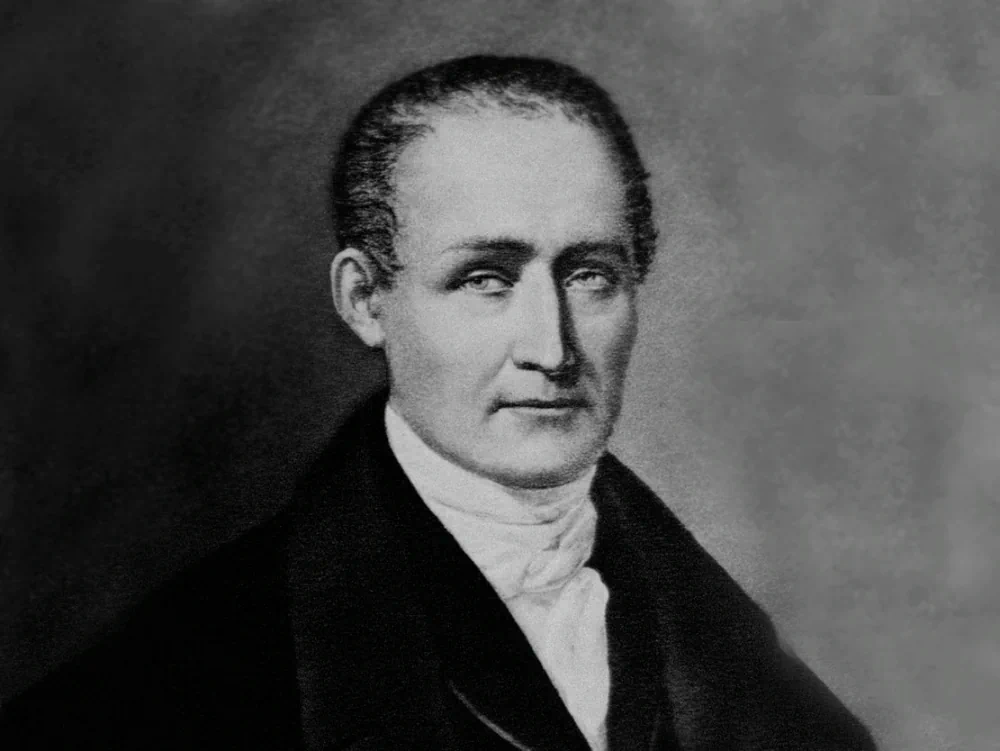
For centuries artists had attempted to reproduce reality through painting, drawing, engraving, and printmaking. These practices allowed the visual appearance of the world to be translated into images, yet they always depended on the interpretation and hand of the artist. What Niépce pursued was something fundamentally different. He sought a way for nature to record itself, for light itself to leave a trace that did not pass through the mediation of artistic skill. This ambition would eventually lead to the invention of photography, although the word itself did not yet exist when Niépce began his experiments.
Early life and the curiosity of an inventor
Joseph Nicéphore Niépce was born in 1765 in the French town of Chalon-sur-Saône, in the Burgundy region. His family belonged to the provincial bourgeoisie, a social position that provided him with the education and resources necessary to cultivate intellectual interests. Like many curious minds of the Enlightenment and post Enlightenment period, Niépce did not limit himself to a single discipline. Throughout his life he explored a wide range of technical and scientific pursuits, developing inventions and conducting experiments that ranged from mechanical engineering to early forms of chemical research.
Together with his brother Claude, Niépce even developed one of the earliest internal combustion engines, known as the Pyréolophore, which was successfully tested in 1807. Although this invention is now largely overshadowed by his photographic work, it demonstrates that Niépce belonged to a generation of inventors who approached technological problems with remarkable creativity and determination. His interest in the reproduction of images emerged within this broader context of experimentation and invention.
At the beginning of the nineteenth century there was a growing desire to find mechanical methods capable of reproducing images without the laborious process of manual engraving. Lithography had recently been introduced and offered new possibilities for printing images, yet it still required a skilled artist to draw the original composition. Niépce wondered whether it might be possible to bypass the artist altogether and allow light itself to generate the image.
The search for a permanent image
The scientific foundation for photography was already partially understood by the early nineteenth century. It had long been known that certain chemical substances react when exposed to light. In particular, silver salts darken under illumination, a phenomenon that several researchers had observed. However, the challenge was not merely to produce a temporary image but to stabilize it so that it would not disappear when exposed to further light.
Niépce approached this problem through an unusual chemical route. Instead of focusing on silver compounds, he experimented with a material known as bitumen of Judea, a naturally occurring asphalt used in etching and printmaking. The substance possessed a peculiar property: when exposed to light it hardened and became less soluble.
Niépce coated a polished metal plate, usually made of pewter, with a thin layer of this bitumen and placed the plate inside a camera obscura. The camera obscura was already a familiar optical device that projected an inverted image of the outside world onto a surface inside a darkened chamber. By allowing light to fall on the coated plate for an extended period of time, the illuminated areas of bitumen hardened while the areas that remained in shadow stayed soluble.
After exposure Niépce washed the plate with a mixture of oil of lavender and petroleum. The solvent dissolved the unhardened portions of the bitumen while the exposed areas remained attached to the surface. What remained was a fixed image formed by the action of light.
Niépce called this process heliography, a term meaning “sun writing,” which accurately described the essential principle of the method. For the first time in history an image produced by light could be permanently preserved.
The first photograph in history
The most famous surviving result of Niépce’s experiments is an image now known as View from the Window at Le Gras, created around 1826 or 1827 from a window of his country estate in Saint Loup de Varennes. The photograph depicts a quiet arrangement of rooftops and buildings within the courtyard of the family property, an ordinary scene that nevertheless carries extraordinary historical significance.
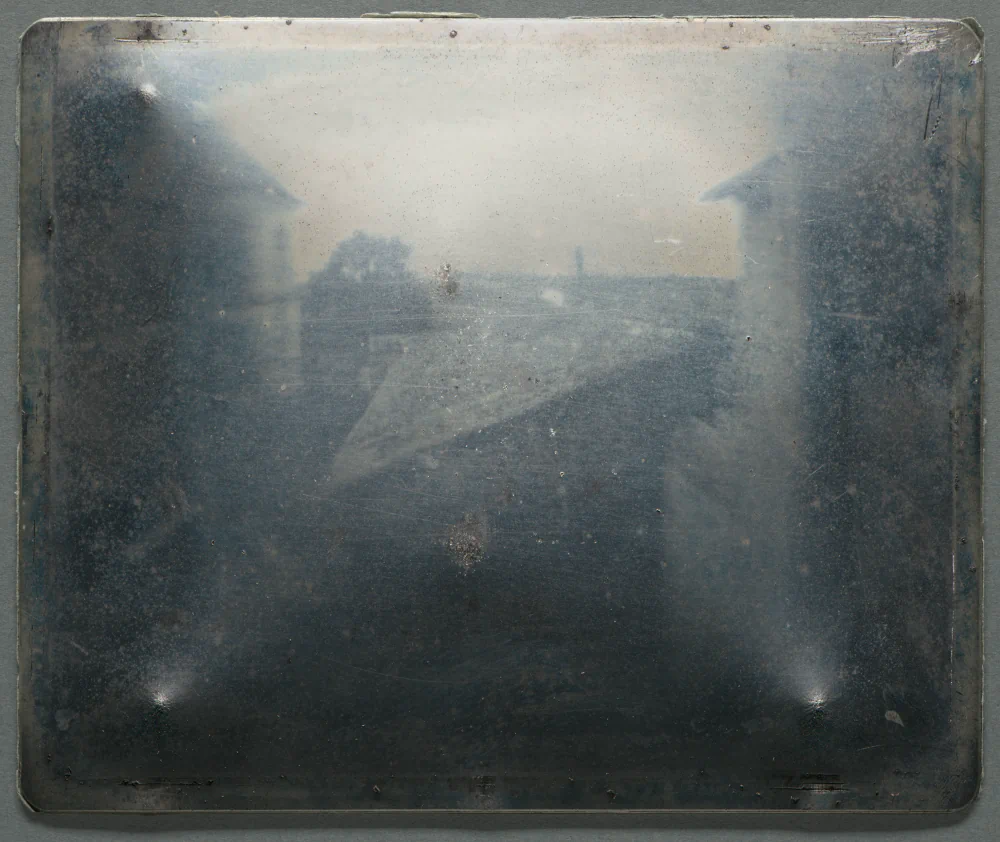
Because the heliographic process required extremely long exposure times, the plate had to remain inside the camera for many hours and possibly several days. As the sun moved across the sky during this period, light illuminated different parts of the buildings at different moments. The resulting image therefore contains a peculiar visual effect in which multiple sides of the same structures appear illuminated simultaneously.
Although the image may appear crude to modern viewers, its importance is immeasurable. It represents the earliest known photograph that has survived to the present day, a fragile artifact that marks the moment when light first inscribed a lasting representation of the visible world.
Today this photograph is preserved at the University of Texas at Austin, where it is regarded as one of the most significant objects in the history of visual culture.
Collaboration with Louis Daguerre
During the late 1820s Niépce established contact with Louis Daguerre, a Parisian artist and theatrical designer who had become fascinated by optical illusion and image projection. Daguerre operated a popular visual attraction known as the Diorama, in which painted scenes were illuminated in ways that created dramatic atmospheric effects. His interest in light and visual perception made him particularly receptive to Niépce’s experiments.
In 1829 the two men signed a formal partnership agreement in which they committed themselves to developing photographic processes together. Niépce contributed his heliographic techniques while Daguerre explored alternative chemical materials and methods for improving sensitivity and reducing exposure times.
Unfortunately Niépce did not live long enough to see the full impact of their collaboration. He died in 1833, leaving Daguerre to continue the research independently. Several years later Daguerre succeeded in refining a photographic method that dramatically improved image clarity and reduced exposure times to minutes rather than hours.
In 1839 the French government officially announced Daguerre’s invention of the daguerreotype, a process that produced highly detailed images on polished silver coated copper plates. The announcement quickly attracted international attention and is often regarded as the official birth of photography as a public medium.
Yet the scientific foundations that made this breakthrough possible had been laid by Niépce.
The rediscovery of Niépce’s contribution
For many decades the historical narrative surrounding photography emphasized Daguerre’s role while Niépce remained relatively obscure. The daguerreotype had been widely commercialized and became synonymous with early photography, overshadowing the earlier heliographic experiments.
However, historical research conducted during the twentieth century gradually restored Niépce’s reputation as a central figure in the invention of photography. Scholars recognized that without his original discovery of a light sensitive process capable of producing a stable image, the later developments of Daguerre and others would likely have taken a very different path.
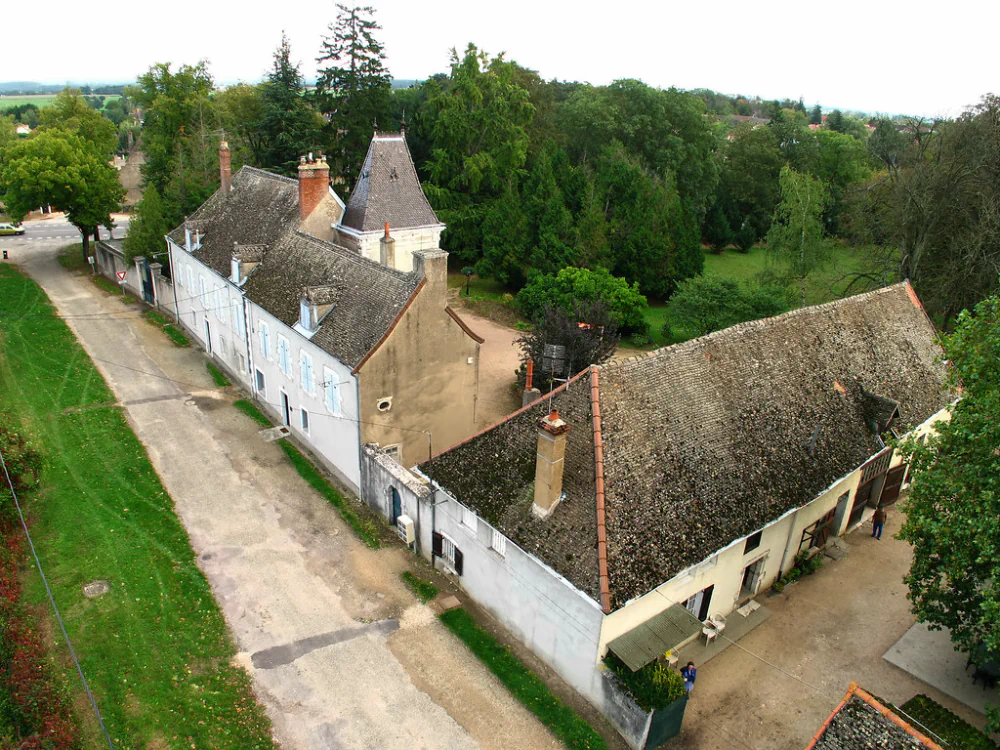
Today Niépce is widely acknowledged as one of the founders of photography. His former residence in Saint Loup de Varennes has been transformed into a museum dedicated to the origins of the medium, where visitors can explore the environment in which the first photograph was created and learn about the early technical experiments that made it possible.
The beginning of a visual revolution
The significance of Niépce’s achievement extends far beyond the technical novelty of a new imaging process. By demonstrating that light could permanently record the appearance of the world, he introduced a radically new relationship between reality and representation.
Before photography, images were interpretations of reality created through human skill. After photography, images could be traces of reality itself, generated by physical interaction between light and matter. This conceptual shift would eventually reshape journalism, science, art, memory, and historical documentation.
The modest rooftops captured in Niépce’s first photograph therefore mark the beginning of a visual revolution. From that moment onward, the world could be preserved through light, allowing scenes, people, and events to endure long after they had vanished from physical presence.
At the center of this transformation stands Nicéphore Niépce, the inventor who patiently experimented with chemistry, optics, and time until he succeeded in persuading light to write its own image upon the surface of the world.