
The world tells us nature will heal us. That the sunrise is redemptive.
That the vast landscape is waiting to reflect our longing back to us as meaning.
These are beautiful lies that keep us dependent on the mirror.
What happens when landscape refuses to mirror us back, when the external world remains indifferent, vast, unyielding, yet achingly beautiful? These works examine the psychological response to nature’s vastness as confrontation.
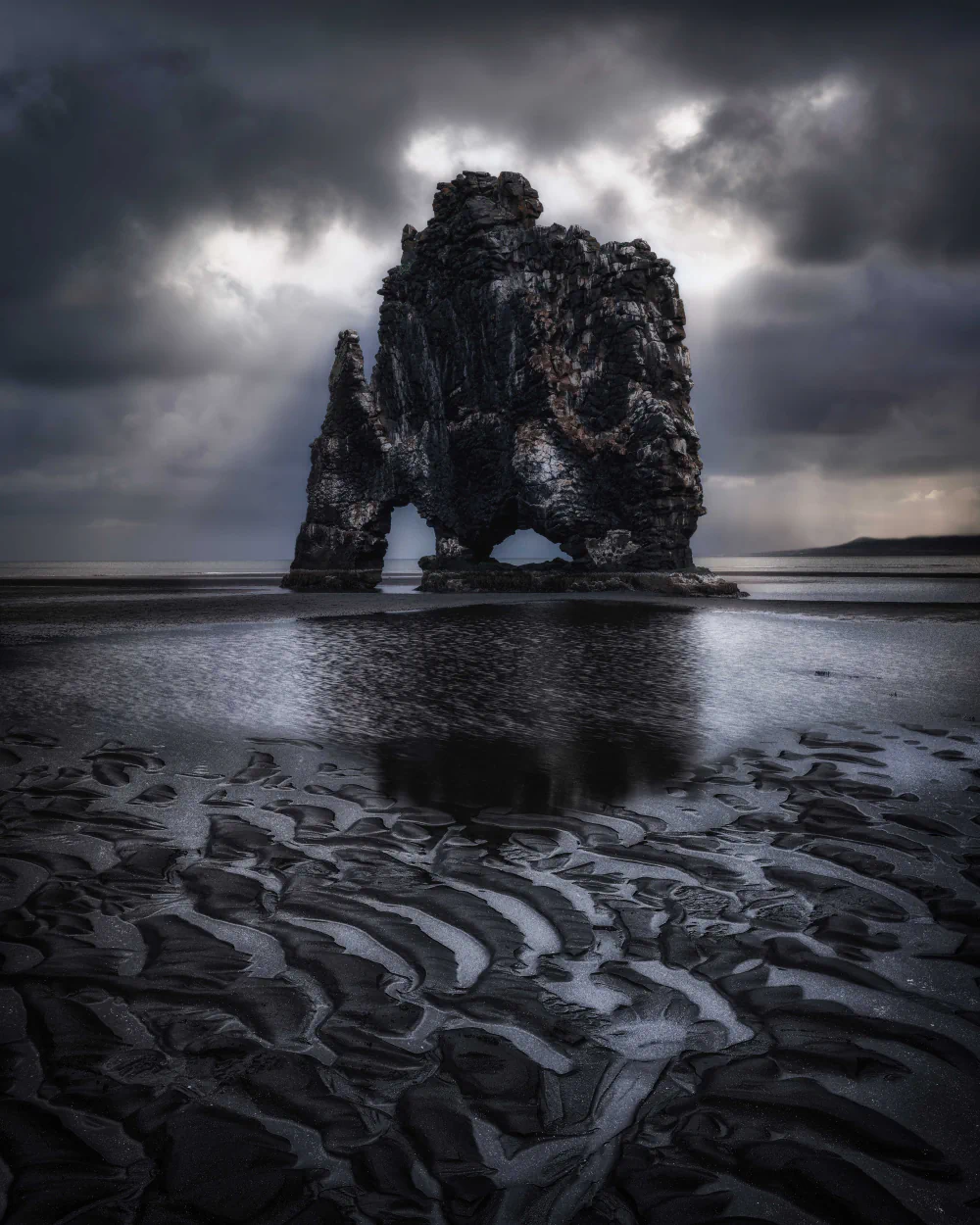
Off the northwest coast of Iceland, an ancient basalt stack rises from the tidal flat like a forgotten god, carved by time, unmoved by presence. No warmth, no welcome, only the echo of your gaze reflected by something ancient and impervious. In that silence, a haunting question: what stares back when nothing answers?
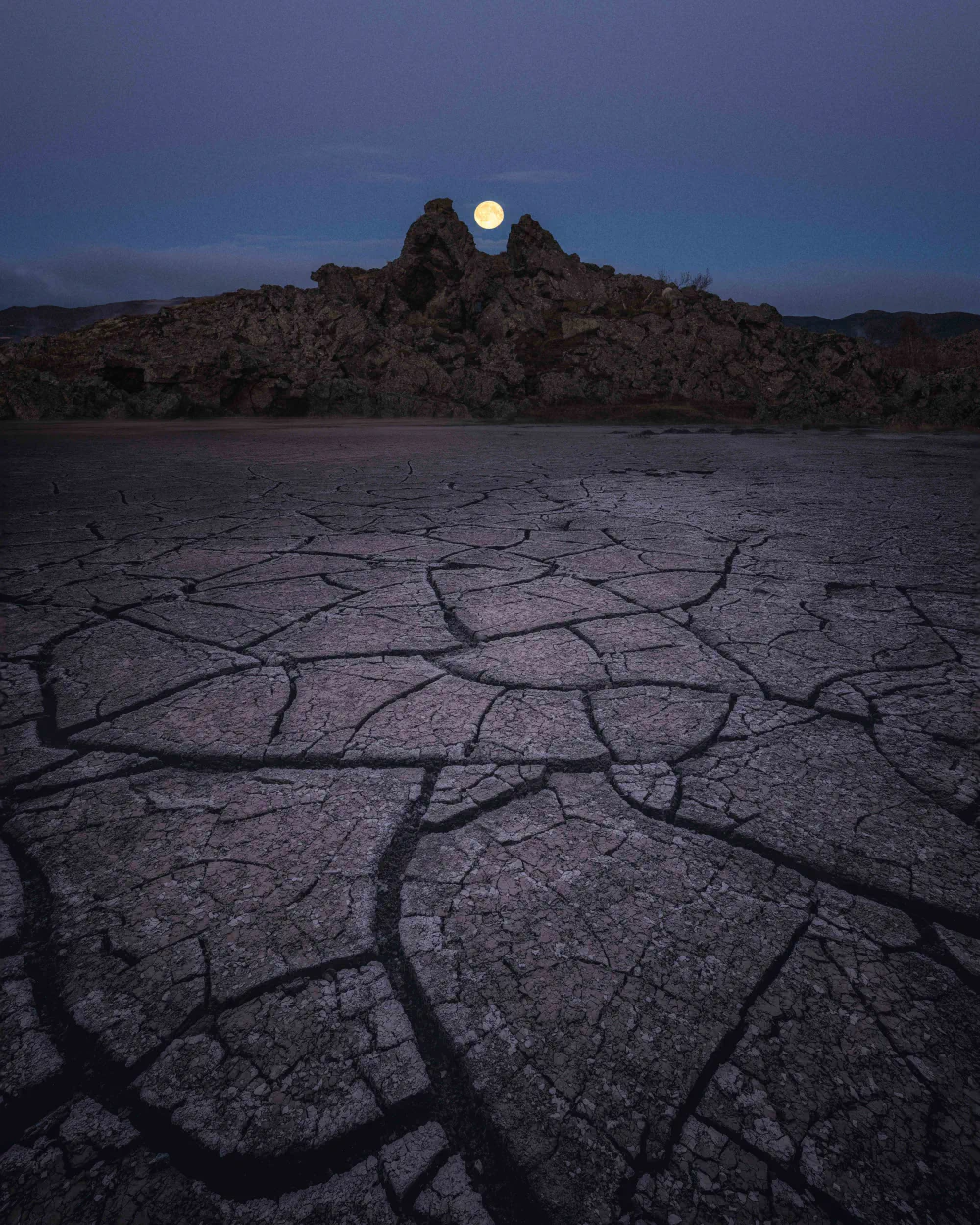
Cracked earth in front of a rock formation cradling the moon, an accident of geometry and light at a precise moment. No warmth enters the frame. The blue monochrome deliberately drains the scene of comfort. Rather than being in conversation with the viewer, this landscape is in the middle of its own existence. The silence here is not peaceful. It simply is.
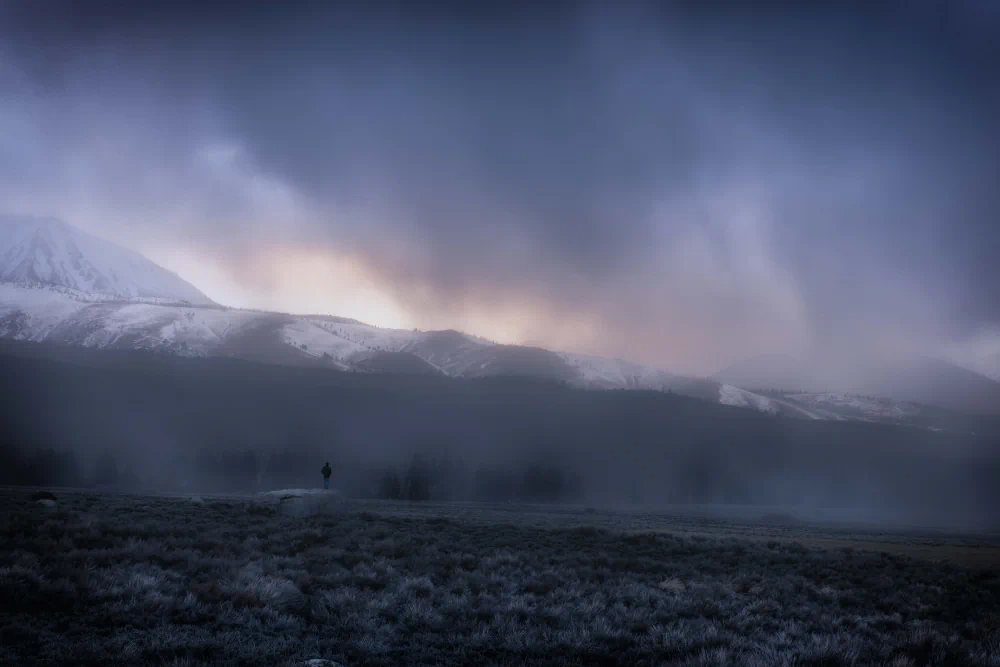
A figure stands at the edge of a mountain as fire moves across its ridge. The fog descends. The scale relationship is the argument: the figure is present, the mountain is not aware of it. In Hindu tradition, the ghat is the threshold between the living and what comes after, a place where the human is returned to the elemental. The mountain has been burning and cooling for longer than the concept of witness has existed. The figure watches. The mountain continues.
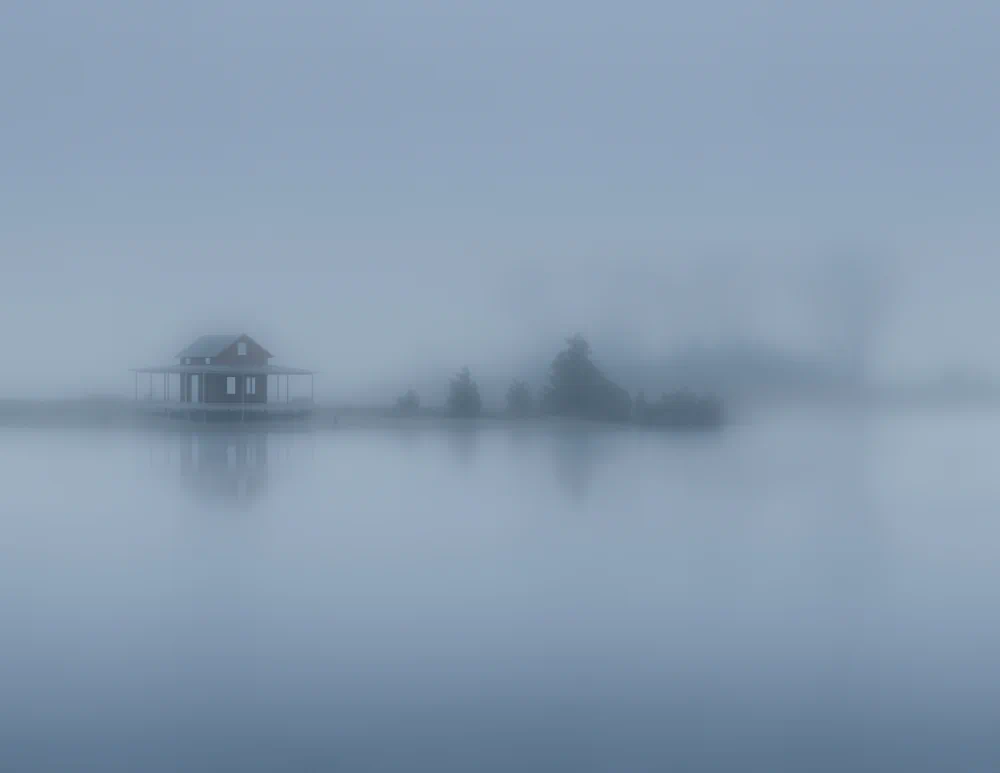
A boathouse floats in fog on a New England inlet, or appears to. The mist has consumed the waterline, the horizon, the distance between surface and sky. What remains is a structure and its reflection, both dissolving at the same rate into the same atmosphere. The boathouse was built for function, for shelter, for the human need to mark territory against indifferent water. The fog has no interest in that history. It moves through the frame at its own pace, neither obscuring nor revealing, but simply continuing a process that predates the structure and will outlast it. The reflection offers nothing the original does not withhold.
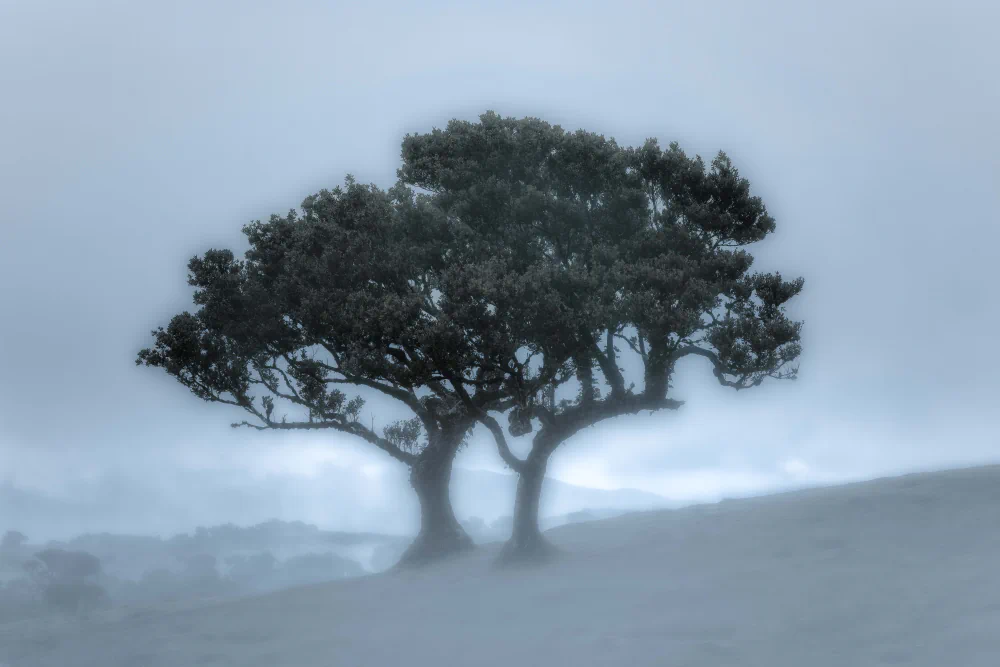
In the Laurisilva forest of Fanal, Madeira, two trees several centuries old stand entwined in fog that arrives most mornings and departs on its own schedule. The mist moves through their canopy without acknowledgment. It does not distinguish between wood and air, between ancient and new, between what has endured and what has not. But the trees have found each other. Their canopies have grown into a single architecture over centuries of indifferent weather. The world did not arrange this. The world does not notice it. Whatever covenant exists here was made between the trees themselves, two presences that have outlasted everything around them by growing toward each other in a landscape that offered nothing but continuation.
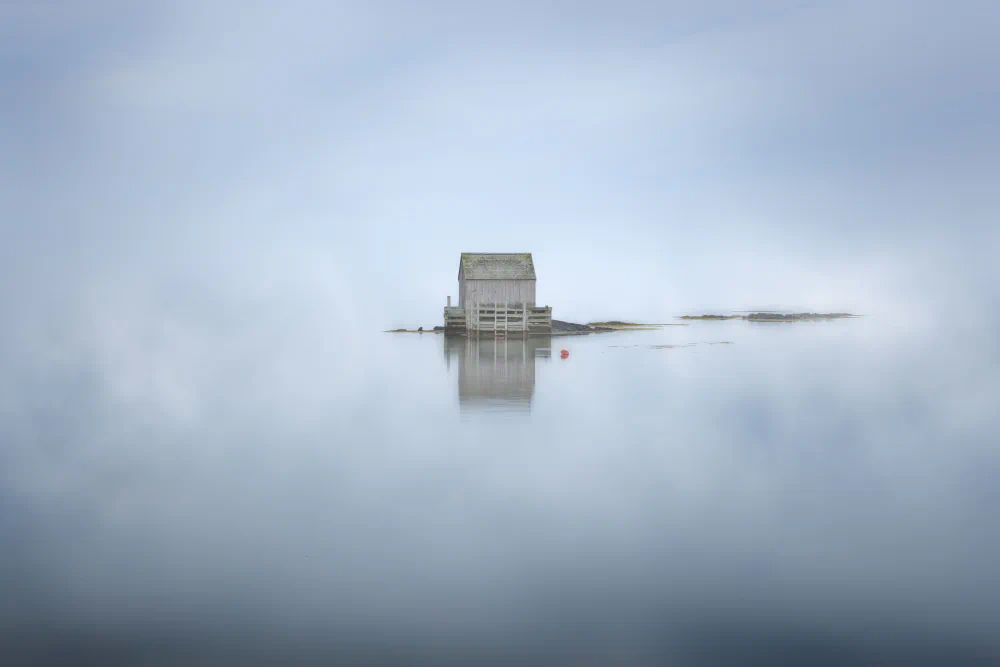
A fishing shack on a Nova Scotian islet, suspended between water and sky in conditions that have erased the boundary between them. The red buoy marks a position, a human insistence on being located, on mattering to the navigation of others. The water reflects the shack with the same flat equivalence with which it reflects everything else. The fog arrives from no particular direction. The shack has been here through seasons that did not notice it. The buoy signals. Nothing answers. This is not loneliness. Loneliness requires something to be lonely toward. This is simply the persistence of human marking in a landscape that has no use for it.
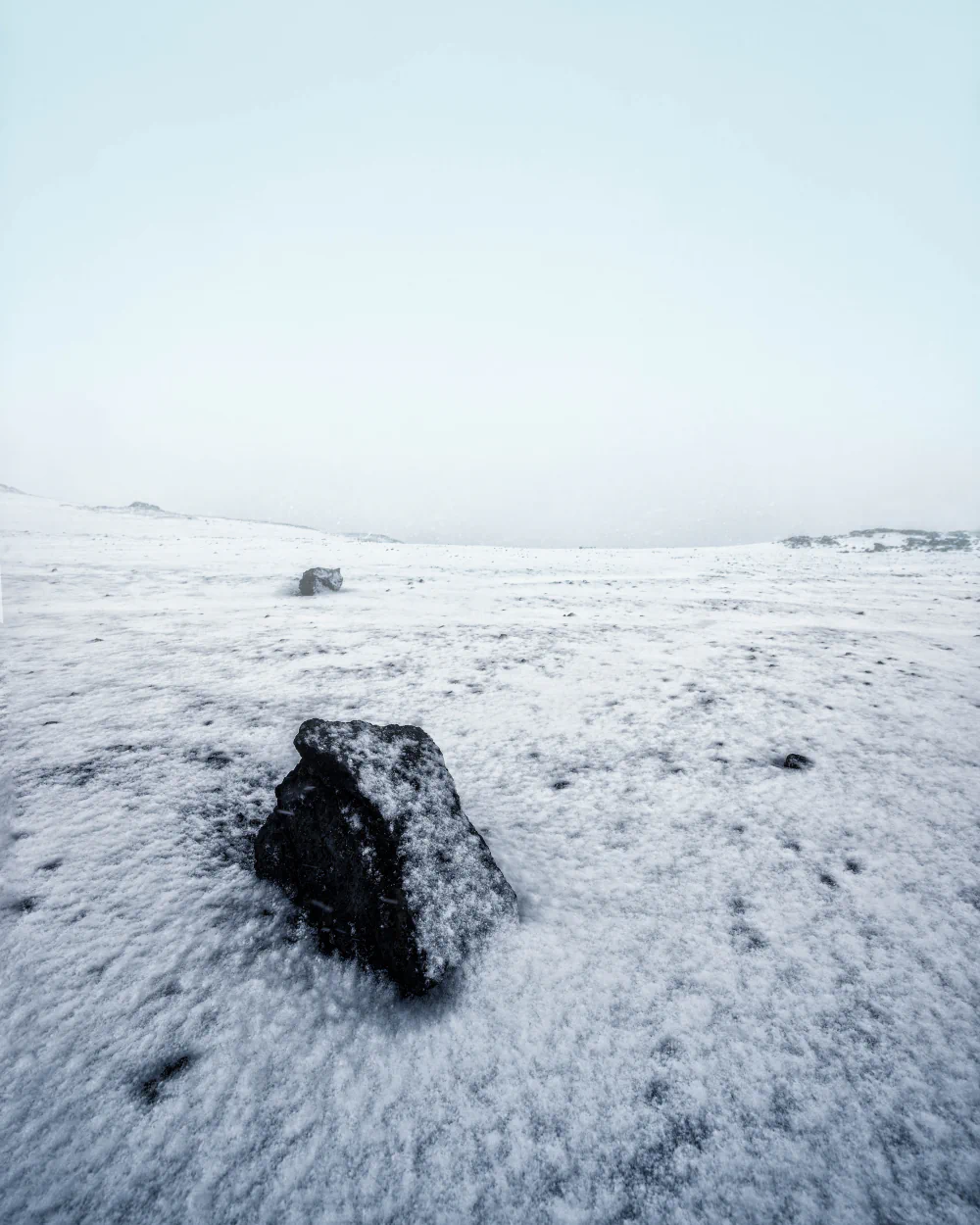
On the approach to Snæfellsjökull, the storm has reduced the world to white. Two boulders sit where a glacier left them, carried from somewhere else, deposited when the ice retreated, abandoned without ceremony. The force that placed them is gone. The whiteout continues around them with complete indifference to their presence. In geology, an erratic is a rock displaced from its origin by glacial movement, foreign matter in a landscape that has moved on without it. The storm does not know they are there, nor does it care.
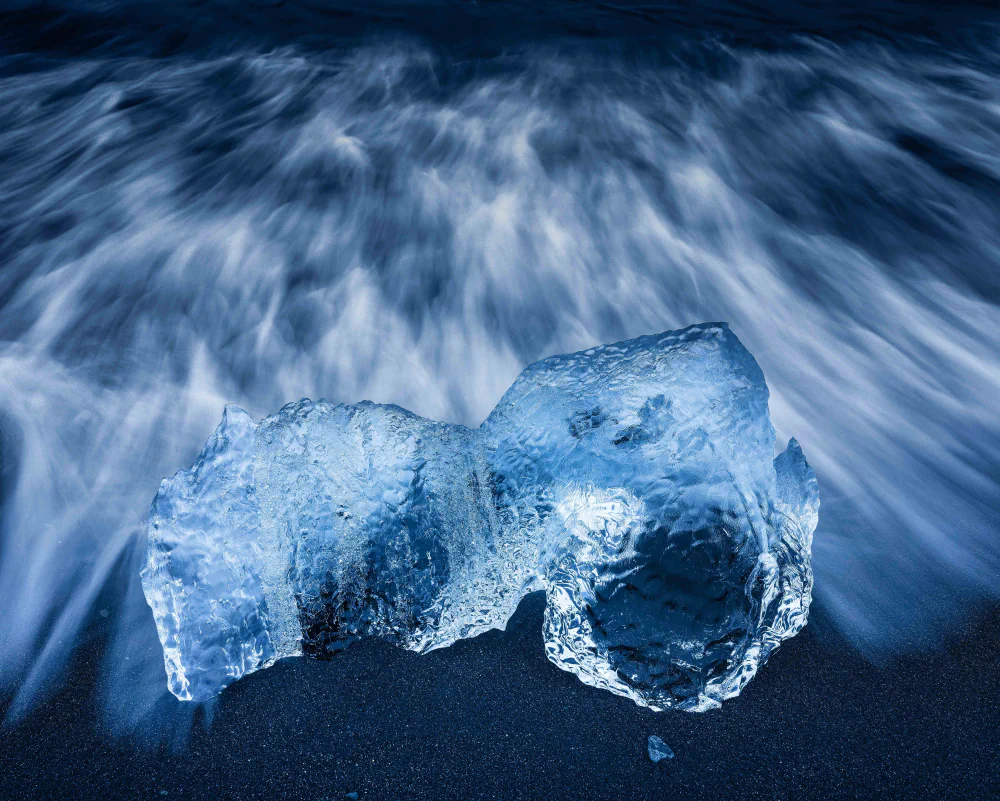
A fragment of glacial ice rests on black volcanic sand as the Atlantic moves through it. The ice formed over centuries in the Vatnajökull ice cap, compressed time made briefly solid, and has traveled here by forces indifferent to its biography. The ocean does not distinguish between what the ice was and what it is becoming. Water returning to water. The darkness from which the ocean arrives has no edge, no visible origin in the frame. The reclamation was already underway before the shutter opened. It will continue after.
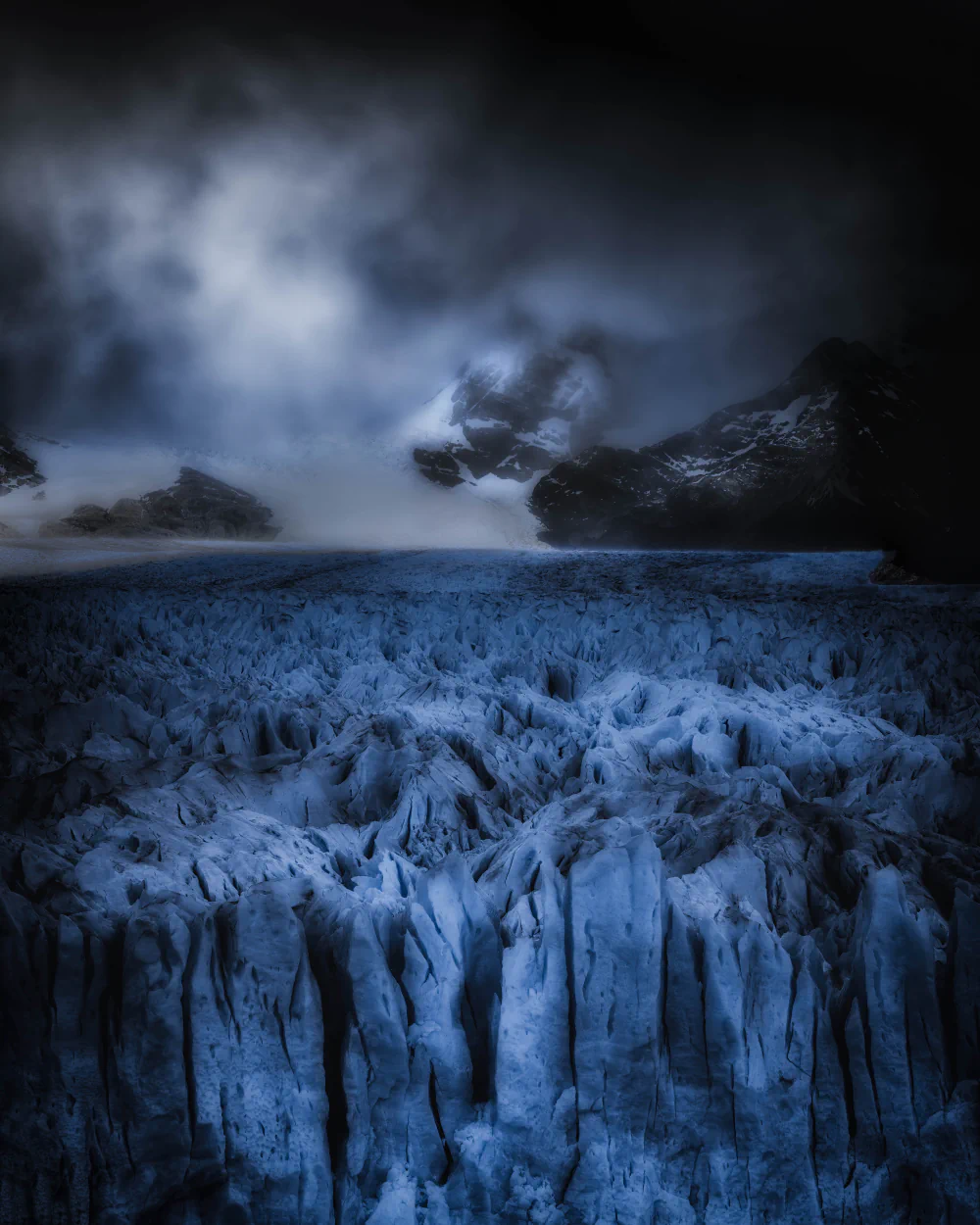
The southern face of Perito Moreno rises from the Argentine steppe in an architecture of compressed time, seracs formed over millennia, fracturing at the leading edge where the glacier meets the lake it is slowly filling. Above, a storm presses down from the Andes without acknowledgment of what lies beneath it. The glacier advances at roughly two meters per day. It retreats. It has been doing this since before the concept of witness existed. The storm has no opinion about the ice. The ice has no opinion about the storm. The frame holds both in permanent, indifferent relation.
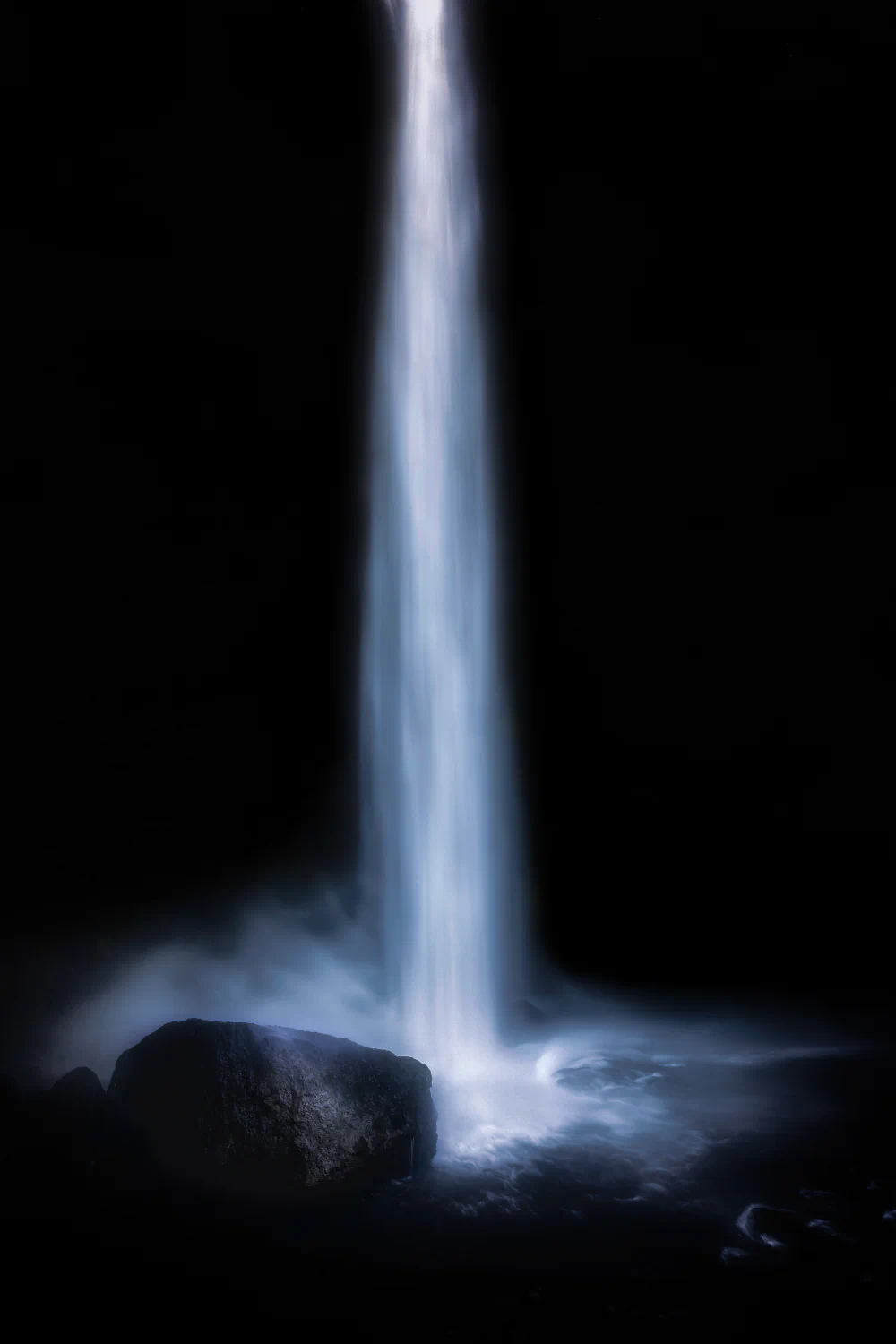
Behind the curtain of Kvernufoss, the water has been wearing away this rock for longer than language has existed to describe it. The darkness is not dramatic. It is simply the absence of light that the waterfall does not require. The rock does not resist. The water does not insist. This is erosion at the speed of indifference, a process so slow it resembles permanence, so permanent it makes impermanence visible. The waterfall will continue identically whether observed or not. The rock will become smaller. Eventually, it will not be there. The water will continue.
About KP Madhavan
KP Madhavan is a fine art photographer whose work examines the psychological confrontation between human consciousness and an indifferent universe. Working at the intersection of the cinematic and the sublime, his images render landscape as an emotional state, not as terrain to be observed, but as vastness to be survived. He calls this visual language Cinematic Solitude.
His work has been exhibited at the Benaki Museum in Athens, Galerie 24b in Paris, and Pleiades and SoHo Photo Galleries in Chelsea, New York, where he has held multiple solo exhibitions. He holds Gold and Silver Medals from the Prix de la Photographie Paris, Third Place at the International Photography Awards, and the Director’s Award from PhotoPlace Gallery. His work has previously been published in Dodho Magazine and Neun Magazine, and has been featured in the international press. [Official Website]