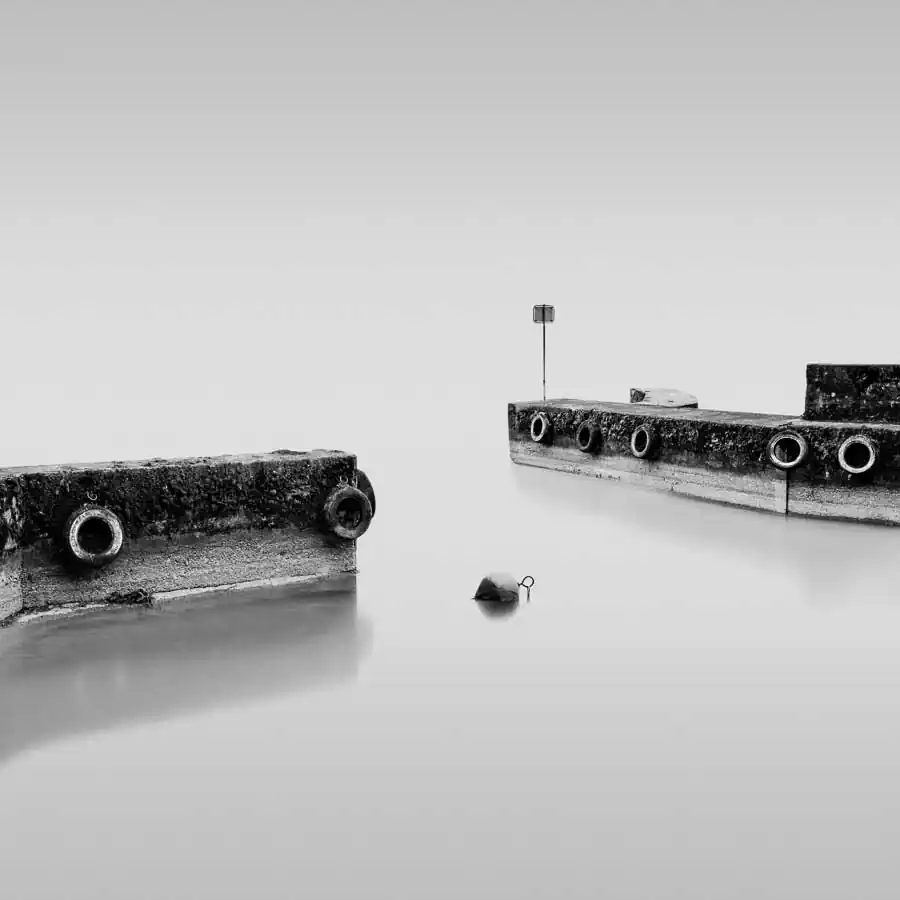

Long exposure photography occupies a paradoxical place within the history of the medium.
Although photography emerged in the nineteenth century through long exposures imposed by technical limitations, the cultural imagination of photography would later become inseparable from speed, immediacy and the decisive instant.
The twentieth century canonized the fraction of a second as the privileged site of meaning. From reportage to street photography, from sports to war documentation, the photograph became synonymous with the capture of a peak moment. Against this historical narrative, long exposure photography reintroduces duration not as accident but as deliberate aesthetic and philosophical position. It challenges the assumption that truth resides in fragmentation and proposes instead that reality unfolds through accumulation.
To understand long exposure is to recognize that time is not merely a neutral container in which events occur, but a material that shapes perception itself. When the shutter remains open for seconds, minutes or even hours, the image ceases to function as a frozen slice of reality. Instead, it becomes a condensation of movement. Water loses its turbulence and transforms into a smooth continuum. Clouds stretch into linear trajectories that reveal atmospheric currents invisible to the naked eye. Human figures dissolve into ghostly traces that suggest presence without solidity. Architecture, when photographed against moving surroundings, appears anchored, almost monumental, while the world around it becomes fluid. Long exposure therefore produces images that the human eye cannot directly perceive. It translates temporal experience into visual structure.
In this translation lies its conceptual force. The decisive moment privileges selection. It implies that meaning exists in a precise alignment of elements occurring at a singular instant. Long exposure rejects this hierarchy. It integrates rather than selects. It acknowledges that what appears stable is often the result of continuous transformation. In doing so, it alters the ontological claim of the photograph. Instead of asserting that “this happened,” the long exposure image suggests that “this persisted.” It does not document an event but renders visible a process.
This distinction carries psychological implications. The instant can feel urgent, dramatic, even aggressive. Duration, by contrast, invites contemplation. The extended shutter requires stillness, planning and patience from the photographer. It demands a relationship with environment that unfolds over time rather than through reflex. This slower engagement often produces images that evoke tranquility, abstraction or introspection. Yet long exposure is not inherently calm. It can equally intensify energy by revealing trajectories otherwise unseen. Urban traffic becomes luminous rivers threading through the city. Industrial landscapes acquire a spectral aura when surrounded by blurred movement. The technique does not prescribe mood; it transforms perception.
In contemporary practice, long exposure photography has expanded beyond its historical associations with seascapes and minimalist landscapes. It has entered performance, architecture, abstraction and conceptual work. The common thread is not subject matter but the manipulation of time as expressive device. Whether smoothing coastal waters into meditative expanses or dissolving dancers into luminous apparitions, long exposure converts motion into texture. It turns impermanence into form.
The persistence of long exposure in contemporary photography suggests that the desire for duration has not disappeared in the age of immediacy. On the contrary, it may have intensified. In a visual culture saturated with instantaneous images, the extended photograph offers resistance. It reminds us that experience is not composed solely of climactic moments. It unfolds continuously, often invisibly, beneath the surface of perception. Long exposure makes this continuity tangible. It restores time to the image not as background condition, but as central subject.
Time as Material
The Physical and Conceptual Weight of Duration
Long exposure photography treats time not as abstraction but as substance. In conventional photography, time is measured in fractions, often invisible in the final image. The shutter opens and closes so quickly that movement appears arrested. In long exposure, the duration of the open shutter becomes an active participant in the construction of the image. The photograph no longer represents a frozen configuration of elements; it becomes the visual residue of everything that occurred during the exposure interval. Time accumulates. It leaves traces. It imprints itself onto the sensor or film.
This accumulation produces a paradox. While the photograph becomes less faithful to any single instant, it becomes more faithful to duration. Consider the movement of water along a rocky coastline. To the eye, waves appear as discrete forms rising and collapsing. In a long exposure, those discrete forms merge into a continuous veil. The sea appears calm even when conditions were turbulent. The image therefore does not replicate appearance; it synthesizes it. It reveals the structural continuity underlying apparent chaos. What seemed fragmented becomes unified.
The same principle applies in urban environments. Pedestrians walking through a frame may disappear entirely if they move quickly relative to the exposure time. Vehicles become streaks of light tracing the geometry of streets. Architecture remains sharp because it persists; human presence blurs because it flows. In this way, long exposure distinguishes between the permanent and the transient. It assigns visual weight according to duration. What endures appears solid. What passes dissolves.
This redistribution of visual weight transforms the hierarchy within the image. Movement is no longer a disruption but a shaping force. In performance photography, dancers photographed through extended exposure cease to be defined by anatomical clarity. Their gestures elongate into arcs and halos of light. The body becomes gesture rather than object. Identity dissolves into rhythm. The resulting image does not describe choreography in literal terms; it conveys its temporal intensity.
Conceptually, this manipulation of time destabilizes the documentary claim of photography. If the medium has often been understood as evidence of a specific moment, long exposure complicates that notion. It presents a composite of moments layered together. It acknowledges that perception itself is continuous. Human vision integrates movement across fractions of time; long exposure makes that integration visible.
There is also an experiential dimension to this process. The act of waiting during a long exposure alters the photographer’s relationship to the scene. Instead of reacting to fleeting configurations, the photographer anticipates transformation. The exposure interval becomes a meditative duration. Environmental conditions such as wind, tide, traffic flow or human motion are not obstacles but collaborators. The final image depends on forces beyond the photographer’s control, yet shaped by intentional framing and timing. This tension between control and surrender defines much of the aesthetic depth in long exposure practice.
In treating time as material, long exposure expands photography beyond representation toward interpretation. It suggests that reality cannot be reduced to a single instant because existence itself unfolds in continuity. The camera, when allowed to remain open, records not what is fixed but what persists. Time becomes visible as texture, atmosphere and structure. In this visibility lies the distinctive power of long exposure photography: it makes duration tangible.
Landscape and the Dissolution of Form
Sea, Horizon and the Birth of Abstraction
Few genres have embraced long exposure as decisively as landscape photography, and particularly the seascape. The meeting point between water and land offers an ideal laboratory for duration because it contains within it two opposing temporalities: the apparent permanence of rock and the relentless movement of the sea. When photographed through extended exposure, this tension becomes visible in unexpected ways. The water, instead of crashing and fragmenting, smooths into a continuous surface. The rock, rather than appearing as inert mass, becomes sculptural anchor. The horizon stabilizes the frame while the elements within it dissolve.
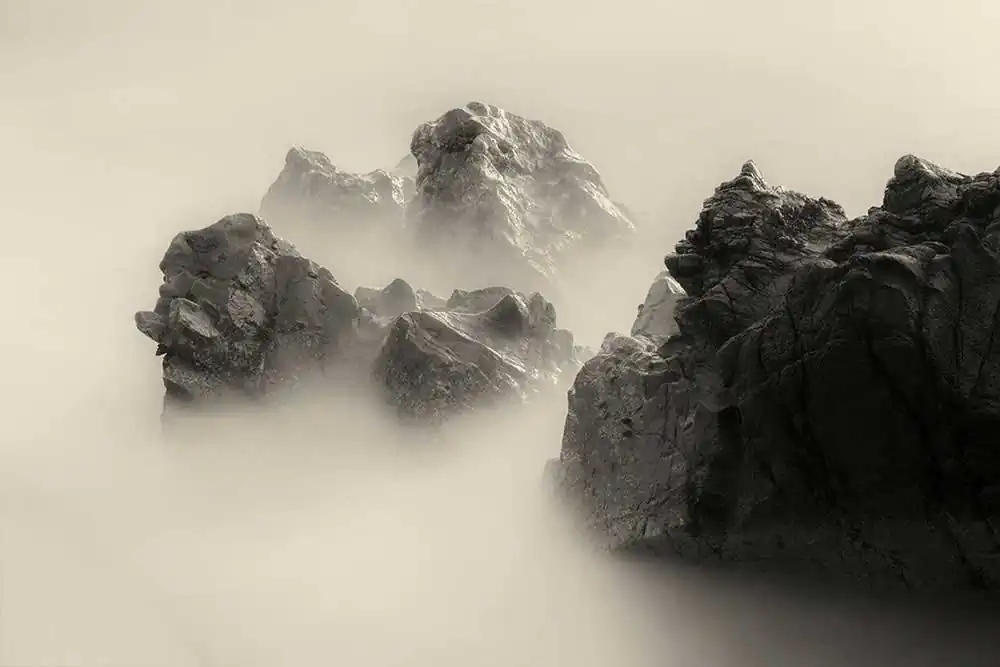
This transformation is not merely aesthetic. It reveals how perception is structured by time. To the naked eye, waves seem chaotic, fragmented into successive forms. The camera, when left open, refuses that fragmentation and integrates the motion into continuity. The sea ceases to be event and becomes atmosphere. The shoreline, shaped over centuries by erosion, appears both vulnerable and monumental. Long exposure thus aligns the photographic image with geological time rather than human time. It suggests that what we experience as instantaneous turbulence is part of a much larger temporal rhythm.
Contemporary photographers working with coastal environments frequently exploit this duality. The extended shutter becomes a way of quieting visual noise, of extracting form from disorder. Water transforms into a blank field against which minimal compositions emerge. Rocks float in white expanses. Piers and bridges extend into smooth horizons that appear almost metaphysical. In this context, long exposure approaches abstraction. The recognizable landscape begins to shed descriptive detail and assume formal qualities of line, tone and mass.
This movement toward abstraction is not accidental. Duration erases texture. It simplifies. It reduces the multiplicity of transient details into unified surfaces. The longer the exposure, the more radical the simplification. Clouds become streaks. Tides flatten. Even the sky, when exposed for extended periods, can assume a painterly continuity that resembles brushstroke rather than meteorology. The image becomes less about documentation of place and more about meditation on space.
The minimalist tendencies of contemporary long exposure seascapes reflect a broader desire for visual calm in a saturated culture. The smoothing of water and sky produces a contemplative atmosphere that invites stillness in the viewer. Yet this calm is not inherent to the environment; it is constructed through duration. The sea was not necessarily tranquil. It was transformed by time.
The horizon line plays a crucial role in this transformation. In many long exposure landscapes, it functions as structural axis dividing solidity from fluidity, permanence from motion. The upper half of the frame often retains atmospheric movement, while the lower half dissolves into a luminous plane. This division reinforces the philosophical undercurrent of long exposure: that stability and change coexist within the same temporal field.
However, not all long exposure landscapes pursue serenity. Some emphasize the tension between human intervention and natural continuity. Industrial structures, wind turbines, oil platforms or bridges inserted into extended exposures reveal another dimension of duration. The built environment stands rigid against smoothed water and streaked sky, highlighting the contrast between engineered permanence and natural flux. The camera thus becomes witness to competing temporal regimes.
In all these variations, long exposure landscape photography operates as a meditation on form emerging from movement. It reveals that what appears solid is defined by its persistence across time, while what appears fluid gains coherence through accumulation. The photograph does not freeze the landscape; it translates its temporal complexity into visual clarity.
Through duration, landscape becomes less descriptive and more elemental. Sea becomes surface. Rock becomes structure. Sky becomes gradient. The image approaches abstraction not by abandoning reality, but by integrating it over time. In this integration lies the quiet radicalism of long exposure: it redefines what it means to see a place.
The Human Body in Duration
Movement, Performance and the Dissolution of Identity
While landscape photography reveals the structural transformation of environment through duration, the application of long exposure to the human body introduces a different set of questions. The body is rarely still. It breathes, gestures, shifts. In instantaneous photography, these movements are arrested and clarified. Muscles are defined. Expressions are frozen. In long exposure, however, the body resists fixation. It elongates. It blurs. It fragments into luminous trails. The photograph becomes less about anatomy and more about trajectory.
This transformation has profound expressive potential. When dancers are photographed through extended exposure, their gestures accumulate into arcs and halos. The singular pose dissolves into movement itself. Rather than representing choreography as a sequence of discrete positions, long exposure renders its continuity visible. The dancer becomes both presence and absence, corporeal and spectral. The body ceases to be an object defined by outline and becomes an energy defined by motion.
This dissolution of clear boundaries destabilizes identity. In conventional portraiture, the face anchors recognition. In long exposure, facial features may blur beyond legibility. What remains is posture, direction, rhythm. The individual becomes gesture. This shift moves photography away from documentation of personal identity toward representation of embodied experience. It emphasizes becoming rather than being.
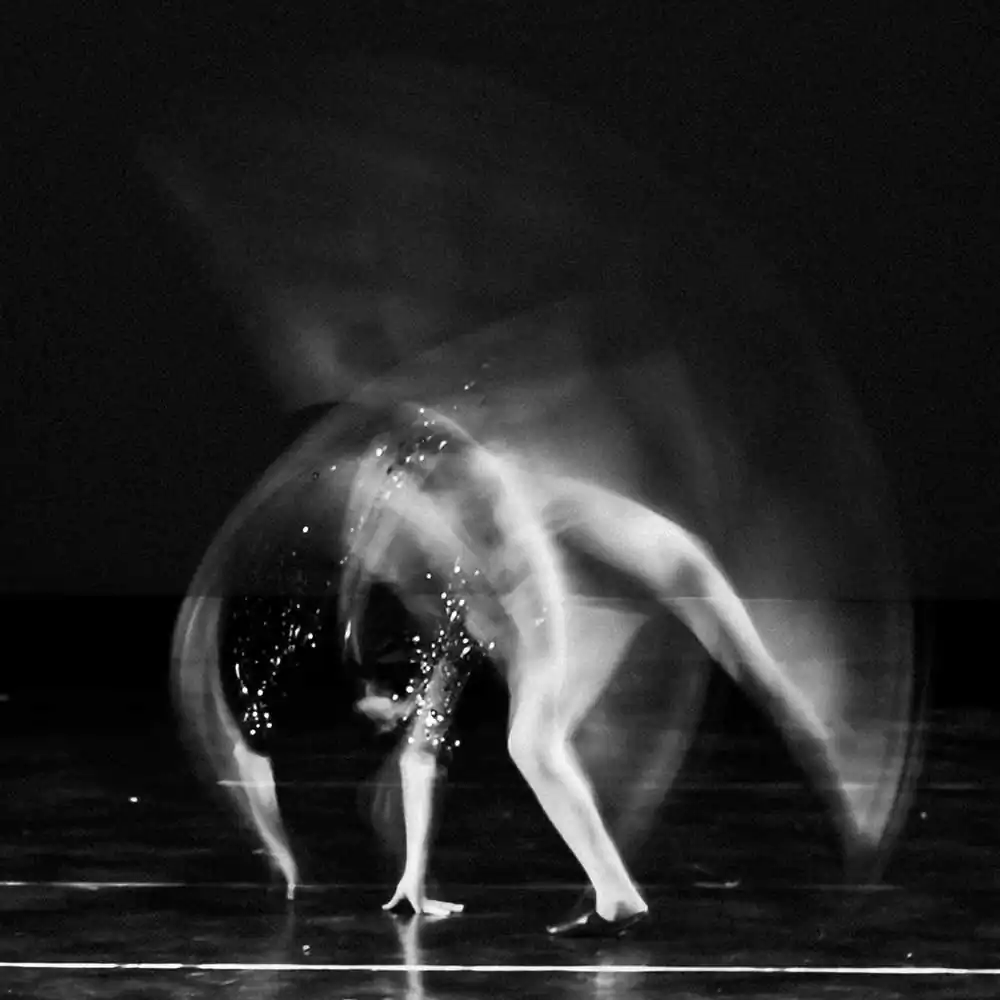
The ethereal quality often associated with long exposure performance photography arises from this interplay between visibility and disappearance. The extended shutter captures the trace of movement rather than its endpoint. As a result, the body appears partially transparent, as though suspended between dimensions. This aesthetic has frequently been described as ghost-like, yet it is less about haunting than about duration. The figure is not fading; it is unfolding.
Beyond dance, long exposure applied to everyday human movement introduces another dimension. Crowds photographed through extended shutter speeds produce images in which architecture remains solid while human figures dissolve into streaks or vanish entirely. The built environment appears stable, while humanity becomes transient flow. This inversion challenges the usual hierarchy in which people dominate the scene. It suggests that structures outlast movement, that space persists beyond its occupants.
At the same time, long exposure can amplify human presence when used selectively. By allowing only certain gestures to register clearly while others blur, the photographer can emphasize intention within flux. The technique requires precise anticipation. The duration must be calibrated to the speed of movement. Too short, and the effect disappears. Too long, and form dissolves entirely. This delicate balance underscores the intentional dimension of long exposure. It is not passive accumulation but controlled integration.
The psychological impact of viewing long exposure images of the human body differs from that of instantaneous photographs. The latter often generate immediacy, empathy, identification. The former evoke contemplation, distance, even introspection. The viewer is invited not to witness a moment but to experience a flow. The image suggests that identity itself is fluid, constructed across time rather than fixed in a singular instant.
In contemporary practice, long exposure performance photography frequently engages with themes of memory, vulnerability and transformation. The blurred figure becomes metaphor for impermanence. Movement recorded across seconds becomes symbol of passage. The camera does not trap the subject; it releases it into duration.
This liberation from fixation carries philosophical implications. If photography has historically been associated with the preservation of a moment against time, long exposure repositions it as collaboration with time. The subject is not extracted from temporal flow but embedded within it. The image acknowledges that existence is not static. It unfolds continuously.
In dissolving the body into light and movement, long exposure challenges photography’s claim to definitive representation. It affirms instead that reality is dynamic, layered and in constant transition. Through duration, the photograph becomes less about capturing who someone is and more about expressing how they move through time.