

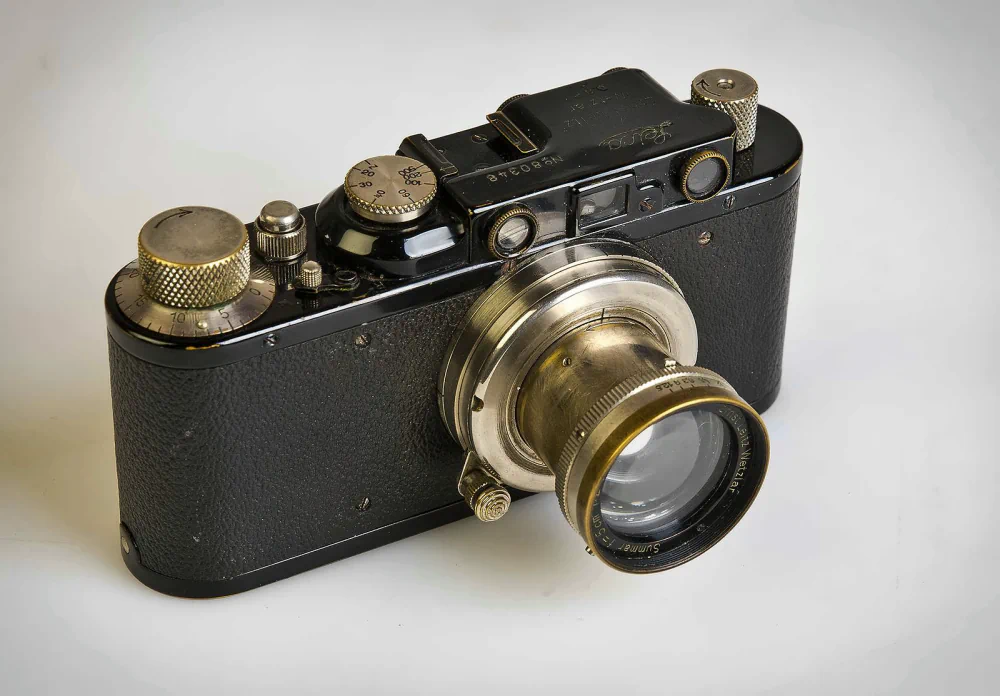
When the Leica II was introduced in 1932, it did not radically change the size, format, or philosophy established by the Leica I.
Instead, it introduced something far more decisive for the evolution of street photography: the coupled rangefinder. This was the moment when speed, accuracy, and discretion finally aligned in a single instrument.
For the first time, focusing and framing became part of the same continuous gesture. Earlier Leica users had to estimate focus or measure distance manually. With the Leica II, photographers could focus quickly through a dedicated rangefinder window, then compose and shoot without hesitation. The camera became faster not because of mechanical speed, but because it reduced cognitive interruption.
This seemingly modest improvement transformed the camera from a portable device into a responsive one.
Precision Without Breaking the Flow of the Street
Street photography depends on maintaining continuity with the environment. Every additional adjustment risks losing the moment. The Leica II’s coupled rangefinder allowed photographers to achieve accurate focus while remaining visually connected to the scene. There was no need to pause, measure, or recompose.
This design encouraged a new kind of confidence. Photographers could work closer to subjects, react faster, and rely less on pre-calculation. The camera did not demand attention; it supported instinct.
It was with cameras of this generation that photographers like Henri Cartier-Bresson began refining the working method that would later define modern street photography: moving lightly, observing constantly, and releasing the shutter at the precise intersection of form and life.
The Leica II did not create that philosophy, but it made it operational.
A Mechanical Design Built for Real Movement
Technically, the Leica II retained the compact body and 35 mm format that had already proven revolutionary. But the addition of the rangefinder turned the camera into a true tool for dynamic environments. It allowed photographers to work at wider apertures, closer distances, and faster decision-making speeds without sacrificing sharpness.
Its separate viewfinder and focusing window required practice, yet this dual-window system also reinforced awareness. The photographer had to remain engaged, switching attention deliberately between focus and composition. Over time, this interaction became instinctive, embedding the act of photographing into bodily rhythm.
The Leica II was not designed for automation. It was designed for mastery through repetition.
A Transitional Camera That Defined the Working Method
Historically, the Leica II occupies a crucial position. The Leica I introduced portability. The later M-series would refine usability. But the Leica II established the working method that connected those two eras. It proved that a small camera could also be precise enough for serious documentary work.
It is no coincidence that the visual language associated with twentieth-century reportage began to crystallize during this period. The Leica II allowed photographers to trust their equipment under real, unpredictable conditions. The camera no longer limited what could be attempted in public space. It quietly eliminated hesitation.
The Foundation for Everything That Followed
Without the Leica II, later milestones such as the Leica M3 would not have been possible. The essential idea of integrating focusing speed with observational freedom began here. The camera did not yet achieve the ergonomic perfection of later models, but it established the technological and conceptual bridge between early portability and mature street photography practice.
The Leica II demonstrated that innovation in photography is not always about adding complexity. Sometimes it is about removing barriers between perception and action. By making accurate focusing part of an uninterrupted gesture, it helped transform photography into something closer to reflex than procedure.
In the history of street photography, the Leica II stands as the moment when the camera stopped being merely carryable and became truly responsive to the pace of human life.