
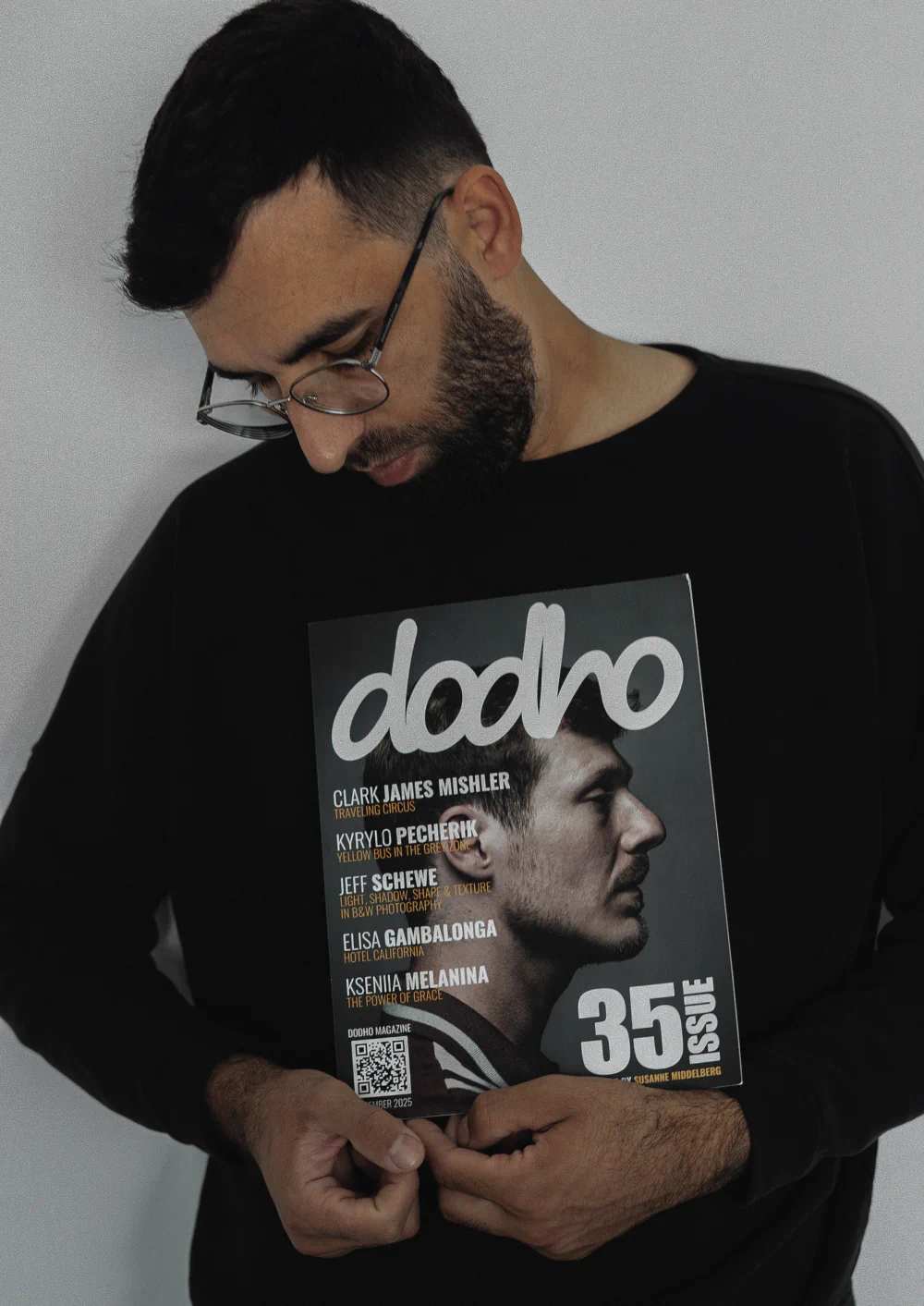
Kyrylo Pecherik is one of the featured authors of Issue 35 of Dodho Magazine.
Born in Odesa, Ukraine, he began photographing everyday life during his school years, later working as a photo correspondent for regional newsrooms across the country.
Since 2022, his work has continued to focus on documenting people and situations shaped by the war. Today, living between France and the United States, his photography remains rooted in a direct and unembellished approach. In this interview, we speak with Kyrylo Pecherik about process, presence, and the decisions that shape a project over time. [Issue #35]
When did you start using photography as an everyday tool to record what was around you? What led you to keep it as your main medium?
I began working with photography professionally in 2016, when I first held a camera in my hands. At that time, it was a Nikon D5100 — my first camera — provided by the editorial team of a magazine that accepted me after publishing several photographs of my city, originally shot on a phone.
I was drawn to photographing everything around me. I was attentive to details and felt a strong need to preserve them. My phone was filled with documentary images of my hometown — fragments of everyday life that felt important to me.
After completing my first shoot with a professional camera, I understood that this was my path. My desire to photograph more and more felt limitless. That first experience made something very clear to me: I was deeply drawn to the idea of stopping time within a single frame.
What images or photographers first sparked your interest in photography, even before you considered it a serious practice?
The first photographic series that truly stayed with me were the works of the French photographer Henri Cartier-Bresson. They left a strong impression and shaped how I began to understand photography.
I am also inspired by the work of the Danish photographer Jan Dago and the American photographer Inge Morath. There are many documentary photographers whose images I have saved and revisited over time — not to imitate them, but to better feel the essence conveyed through a single frame and to understand light within an image. Light, for me, is a crucial element — second only to meaning itself.
Among contemporary photographers, I am deeply inspired by the Ukrainian photographer Kostiantyn Liberov (libkos), a war documentarian whose work powerfully captures real life under the conditions of war.
Do you remember an early image or moment that made you feel you were beginning to find your own visual language?
To be honest, I am still searching for my visual language. I move back and forth between documentary photography and portraiture, and this tension remains part of my process.
Each year feels like a renewed search for myself. Perhaps that uncertainty is not a weakness, but an essential part of growth and development.
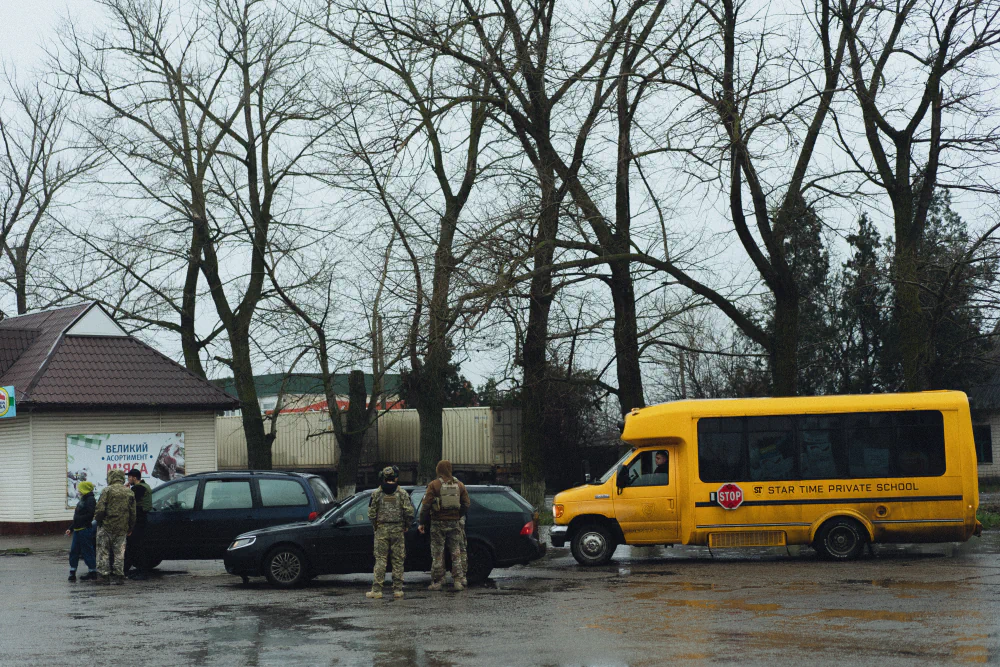
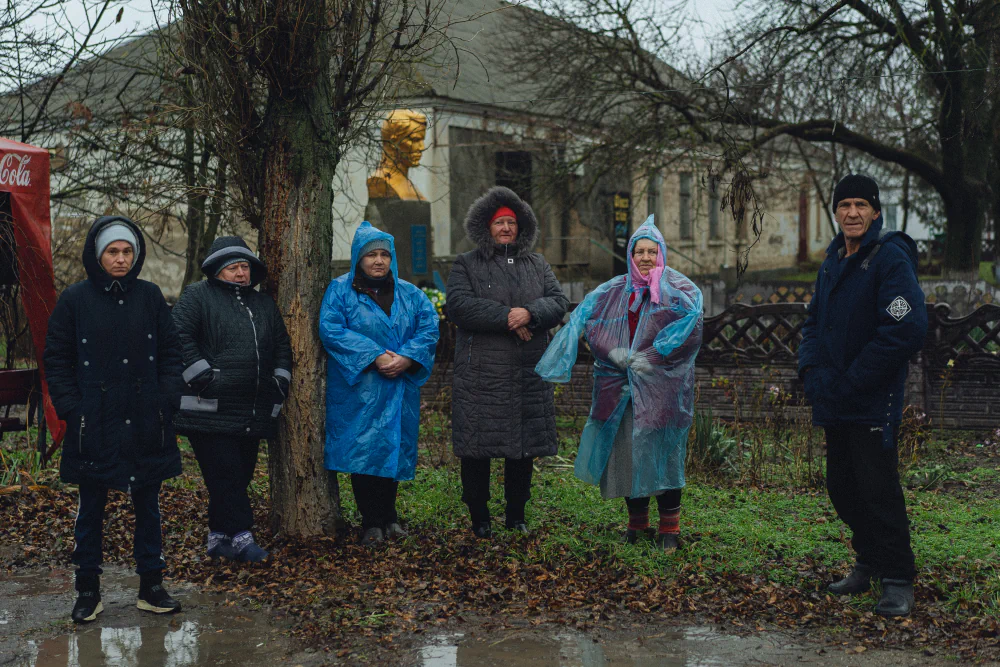
If you had to explain the project Yellow Bus in the Grey Zone to someone who has not seen it, how would you define it in a few words?
For me, documentary photography today is about presence and responsibility. It is not only about recording events, but about being attentive to reality as it unfolds, without trying to reshape or simplify it.
I return to documentary work because it allows me to stay connected to real life — to people, places, and moments that exist beyond aesthetic intention. It demands honesty, patience, and a willingness to look closely, even when what you see is uncomfortable or fragile.
Documentary photography remains important to me because it resists decoration. It does not ask for perfection, but for sincerity. Through this approach, I feel closer to understanding both the world around me and my own position within it.
What made you feel this project needed to be told over time rather than as a single, isolated record? While working on it, which decisions were more intuitive and which required greater distance and reflection?
The first series that truly affected me as a person was created in the first minutes after a missile strike hit a residential building. There were screams, crying, and confusion. Families waiting for news from rescuers. Rubble being cleared.
I did not want to photograph this, but my hand holding the camera rose instinctively. After that moment, I understood that my life is directly connected to photography — whether it is grief and suffering, or happiness and love.
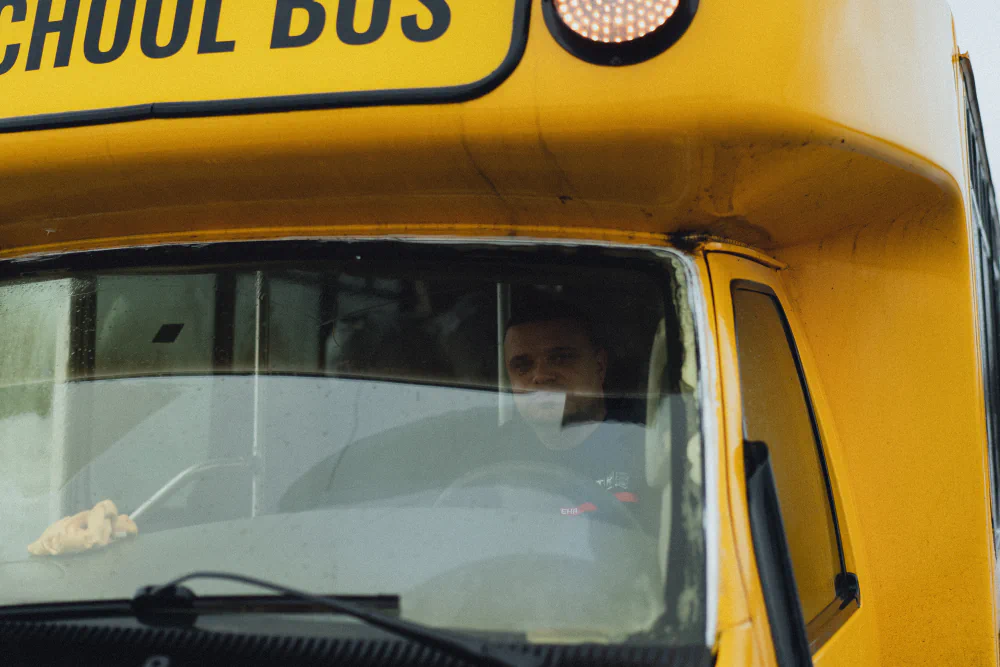
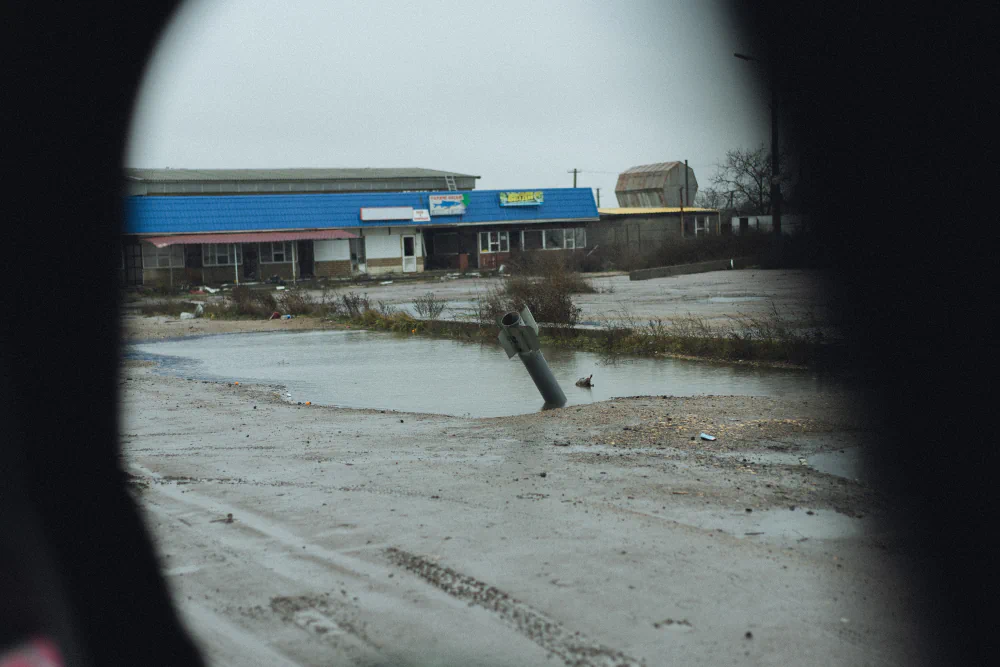
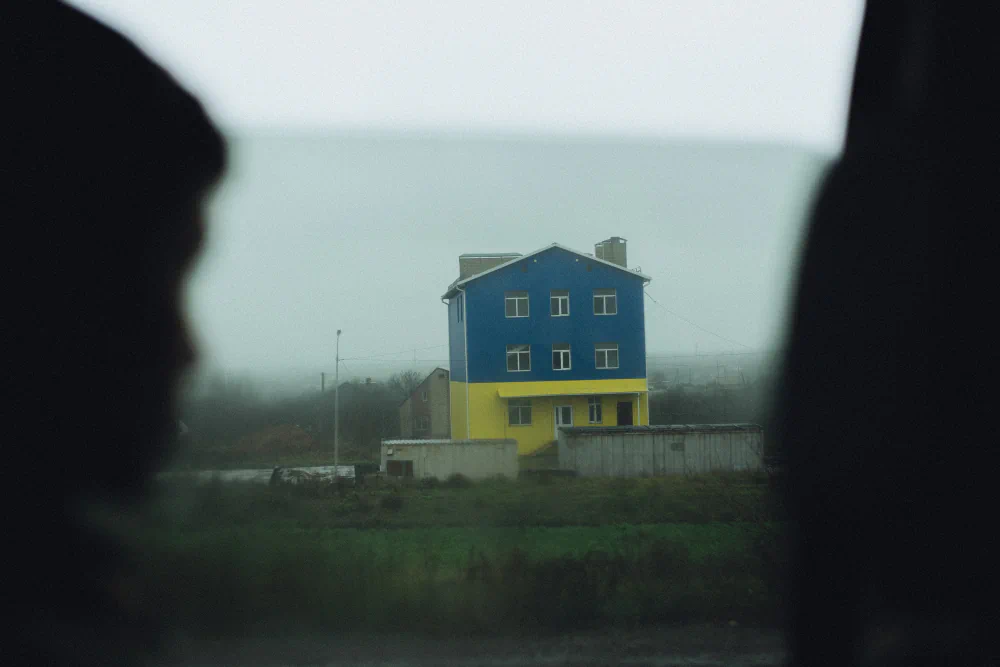
The second series that deeply influenced me was the one you published — Yellow Bus in the Grey Zone. To witness life where life seems absent comes at a great emotional cost.
What kind of presence do you try to maintain as a photographer within the situations you document? Which technical decisions do you need to have clear before starting, and which do you prefer to resolve during the process?
At the very beginning of my path as a photojournalist, emotionally difficult assignments had a strong impact on my state. When I came home, I wanted to withdraw into myself and avoid the question, “How was your day?” from my wife. My only desire was to mindlessly scroll through social media or watch a series, trying to disconnect.
But in the morning, I had to return to my desk — to edit the photographs, write the accompanying text, and send everything to the editor.
After about a year of work, a certain professional deformation began to take shape. Difficult assignments were no longer perceived as close to the heart. I understood that this was my job and that it should not have a strong impact on my mental health.
Over time, it became easier to suppress these emotions. A sense of professional distance emerged — as if an inner protective layer had formed between what was happening and myself. I learned to approach difficult assignments as part of the work, without allowing them to completely break me from within.
But on February 24, 2022, that distance disappeared. Everything that once felt structured and controlled collapsed. The emotions returned with the same intensity as at the very beginning, reminding me that there are things one cannot truly get used to — and perhaps should not.
Which part of the process did you find more demanding: the work in the field or the editing afterward?
The moment your work is printed is the moment photography begins to carry real weight. You realize that these images will remain — in books, magazines, archives, and personal albums — long after the moment itself has passed.
With that comes a deeper understanding of responsibility. These photographs are no longer created only for the present or for social media. They become part of a shared memory. One day, I know I will return to them myself and see that they are not simply images I once made, but fragments of real life preserved in time.
How do you manage your presence as a photographer when you are working within situations that are not unfamiliar to you?
I don’t think documentary photography today needs a clearly defined future. The world has become very fast, and images appear and disappear almost instantly, with only a few of them staying with us for any length of time.
Against this background, documentary photography is not about speed or reaction for me. It is more about the ability to pause and remain close to what is happening, just a little longer than is expected.
Perhaps its value today lies precisely in this — in attentiveness, in presence, and in the attempt to preserve not just an image, but a human sense of the moment. Even if such photographs become fewer, they remain necessary.
During the work, were there moments when you felt the project was giving something personal back to you? How did you know when it was time to close this project and move on to something else?
I want the viewer to feel curious about the image — to spend time with it, notice small details, and briefly step into the moment that was captured.
I’m not trying to explain anything or impose conclusions. What matters to me is that a sense of presence appears between the photograph and the viewer — a short pause. If an image creates that feeling, then it has done its work.
What would you like to continue exploring in the future, even if you do not yet have a clear form for it?
I simply wanted to preserve what was real.