
To speak of Josef Koudelka is to speak of a man who turned displacement into method and distance into a way of seeing.
Born in 1938 in Moravia, then Czechoslovakia, his life was shaped by two forces that defined him completely: history and movement. Trained as an aeronautical engineer, photographer by inner necessity, Koudelka did not arrive at the image through technical virtuosity but through urgency. He photographed as one breathes. Not to document what was visible, but to remain anchored in the world.
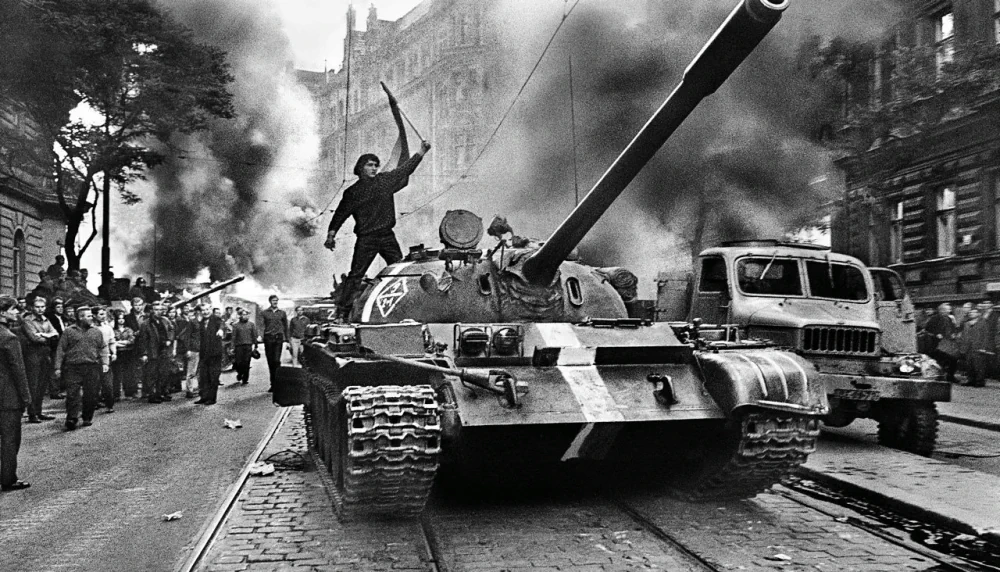
His name became forever linked to a specific historical event: the Soviet invasion of Prague in 1968. The images he made in the streets during the occupation did more than record political violence. They captured the disorientation of a betrayed nation. They were published anonymously under the initials P.P. for Prague Photographer in order to protect him. That decision was not merely caution. It marked the symbolic beginning of his life in exile. Soon after, he left his country and began the restless existence that would define his work.
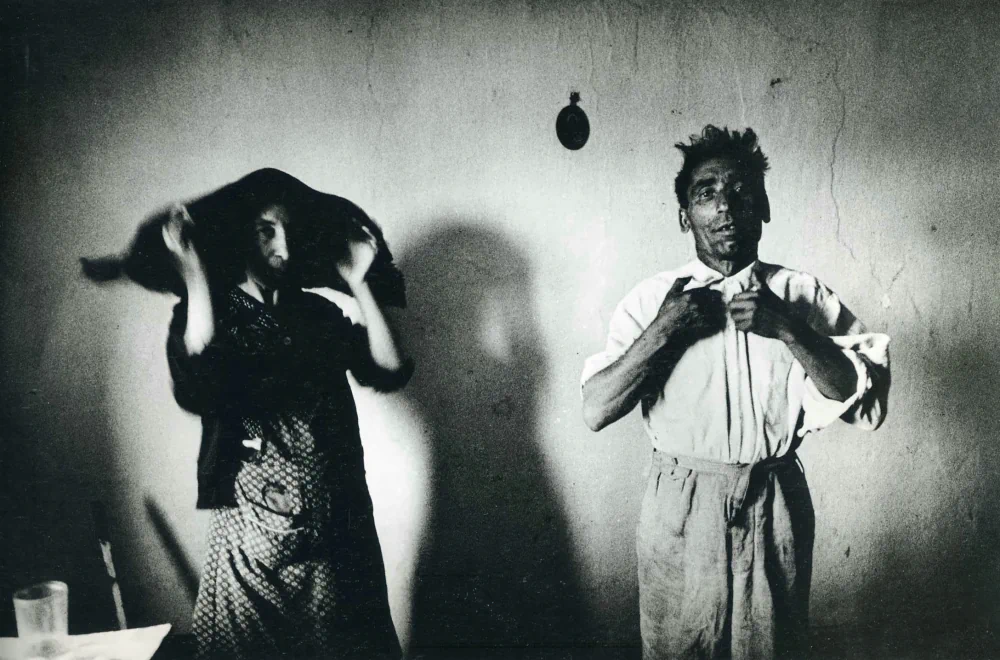
Koudelka did not photograph events. He photographed states of being. His images carry tension, waiting, gravity. Bodies occupy space with an almost theatrical intensity. His early work with Romani communities, gathered in the book Gypsies in 1975, already reveals a forceful aesthetic: tight framing, harsh contrasts, figures isolated within chaos. This is not neutral documentary practice. It is emotional, physical, almost visceral photography.
His gaze was never condescending or folkloric. In the Romani camps he did not search for exoticism but for dignity and fracture. The people he portrayed look directly into the camera without submission. They hold their ground inside the frame with a strength that unsettles. Koudelka moved among them like another nomad. There was no anthropological distance, only coexistence.
When he joined Magnum Photos in 1971, he did so already marked by exile. Paradoxically, that membership consolidated his independence. Unlike other Magnum photographers working on assignments or following news agendas, Koudelka chose his own rhythm. For years he lived almost without a fixed address, traveling across Europe with little more than a backpack and his camera.
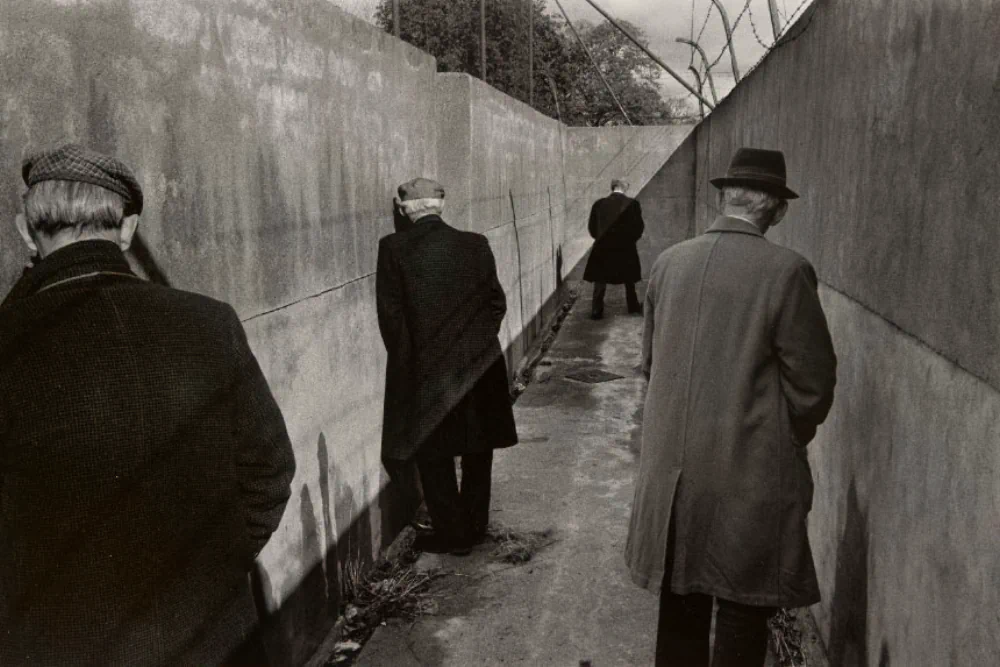
His later work shifts away from the human portrait toward landscape. But not any landscape. He avoids the sublime and the picturesque. His panoramic black and white photographs, made with large format cameras, depict wounded territories: walls, borders, industrial ruins, geopolitical scars. The landscape becomes memory. The territory becomes evidence of violence.
Koudelka is not a comfortable photographer. His images demand time. They are not designed for quick consumption. Composition is rigorous, almost architectural. Black and white is not nostalgia but structure. It strips the world of chromatic distraction and reveals its skeleton.
Exile is not a footnote in his biography. It is an aesthetic position. The photographer who does not belong sees differently. He observes without roots, yet with absolute intensity. That condition of always being in transit runs through his entire body of work.
Prague 1968: When History Enters the Frame
Anonymous Witness, Moral Tension, and the Birth of a Global Document
On August 21, 1968, Soviet tanks entered Prague to crush the reformist momentum of the Prague Spring. Koudelka was there. Not as a foreign correspondent. Not as an accredited reporter. As a citizen. That difference changes everything.
His photographs from those days lack the distance of the external observer. They were taken from inside fear. The most iconic image shows an outstretched arm holding a watch in the foreground while, in the background, an empty street is occupied by soldiers. Time suspended in front of invasion. One image that condenses an era.
Published internationally through Magnum and credited anonymously, these photographs became one of the great visual documents of the twentieth century. In 1969 they received the Robert Capa Gold Medal. Yet Koudelka could not publicly accept the award. His anonymity lasted until 1984.
Their significance lies not only in historical value but in visual language. There is no heroism. No spectacle. There is confusion, contained rage, absurdity. Tanks that appear lost in narrow streets. Unarmed citizens confronting machines of war. The frame does not seek drama. It seeks moral tension.
Those images forced him into exile and, at the same time, established his international reputation. But he never allowed himself to remain fixed as the photographer of 1968. His later work proves that he refused to be defined by a single moment. Movement was his true subject.
From Faces to Territory: The Epic of the Wounded Landscape
Panoramic Vision, Political Geography, and the Memory Inscribed in Land
During the 1980s and 1990s, Koudelka made a radical shift. He left behind the 35mm format and adopted panoramic cameras. The technical change signaled a conceptual transformation. Landscape became central. In projects such as Black Triangle, he documented environmental devastation along the borders of Germany, Poland, and the Czech Republic. These are not activist ecological images, yet they are deeply political. Smoking chimneys, destroyed forests, eroded soil. The panoramic frame amplifies emptiness.
Later, in Wall, he photographed the barrier built by Israel in the West Bank. He did not approach the conflict through direct confrontation but through its marks on the land. The wall appears as a horizontal scar dividing the terrain. Human figures disappear. The drama becomes geographic.
In these images humanity is barely visible, yet its presence is undeniable. Territory bears the imprint of political, economic, and military decisions. Koudelka does not accuse through slogans. He accuses through composition. His black and white is uncompromising. Contrast is extreme, almost violent. Texture dominates. Surfaces appear carved. There is something sculptural in the way he constructs space.
Style, Ethics, and Legacy
Radical Coherence, Formal Discipline, and the Persistence of a Solitary Vision
Koudelka has never chased trends. His body of work is coherent, almost stubbornly so. Always black and white. Always searching for formal intensity. His ethic is independence. He has refused assignments that would compromise his freedom. He has worked for years on projects without deadlines.
His influence is vast yet quiet. Many contemporary photographers have inherited his understanding of landscape as political memory. Others have learned from his ability to live among his subjects without intrusion.
He is neither a comfortable nor a media driven figure. He is, rather, radically faithful to himself. In his eighties he continues to work with the same discipline. He walks. He observes. He frames. There is no spectacle in his public persona. Only rigor. Josef Koudelka embodies a conception of photography that today feels almost heroic: the photographer as solitary witness, perpetual traveler, unsettling gaze. In an era of instantaneous imagery and accelerated consumption, his work demands slowness. That is precisely why it remains necessary.