
Eugène Atget did not photograph Paris as a modern city in transformation. He photographed it as if it were already disappearing.
His images do not announce change; they assume it. Long before the language of urban nostalgia became common, Atget worked with the quiet certainty that what he was seeing belonged to another time, even while it still existed.
Atget’s Paris is emptied of spectacle. Streets are often deserted, shop windows reflect without inviting, architecture stands without emphasis. The city appears suspended, stripped of urgency. This was not an aesthetic accident, but a position. Atget did not chase the present. He treated it as something already slipping away.
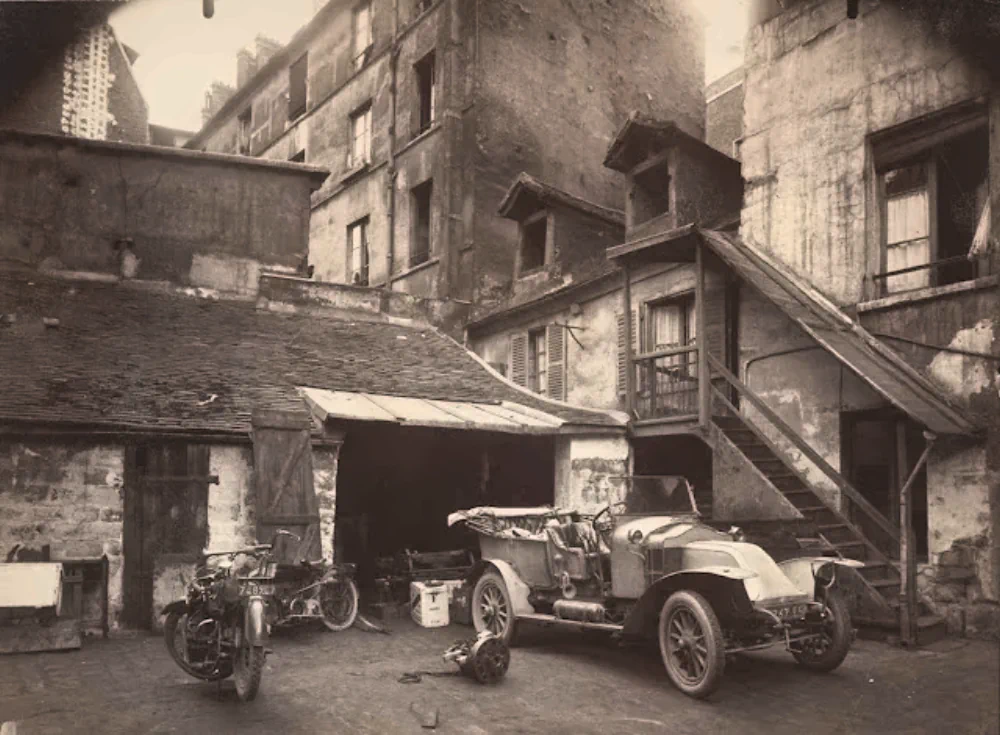
His photographs were made at a moment when Paris was undergoing rapid modernization. Haussmannization, industrial growth, and social change were reshaping the city. Yet Atget turned his camera toward courtyards, staircases, storefronts, trees, and facades that seemed resistant to progress. He did not document the future; he archived what was about to be lost.
What makes Atget’s work radical is not only what he photographed, but how he positioned time within the image. His photographs feel retrospective even when they are contemporary. The city is not shown as alive and evolving, but as a residue. Paris becomes a memory before becoming history. This temporal displacement gives his work its peculiar gravity. Atget photographs as if the present were already over. There is no celebration, no condemnation, no commentary. Only a steady act of attention directed at what remains unnoticed until it is gone.
Atget’s method reinforces this attitude. Using large-format cameras and long exposures, he worked slowly, deliberately. The city did not perform for the camera. Motion often dissolves, figures blur or vanish. What stays is structure, surface, trace. The human presence is secondary, sometimes almost erased.
In doing so, Atget reverses the usual hierarchy of urban photography. People do not define the city; spaces do. Architecture, signage, and trees carry memory. The city becomes an organism shaped by accumulation rather than event.
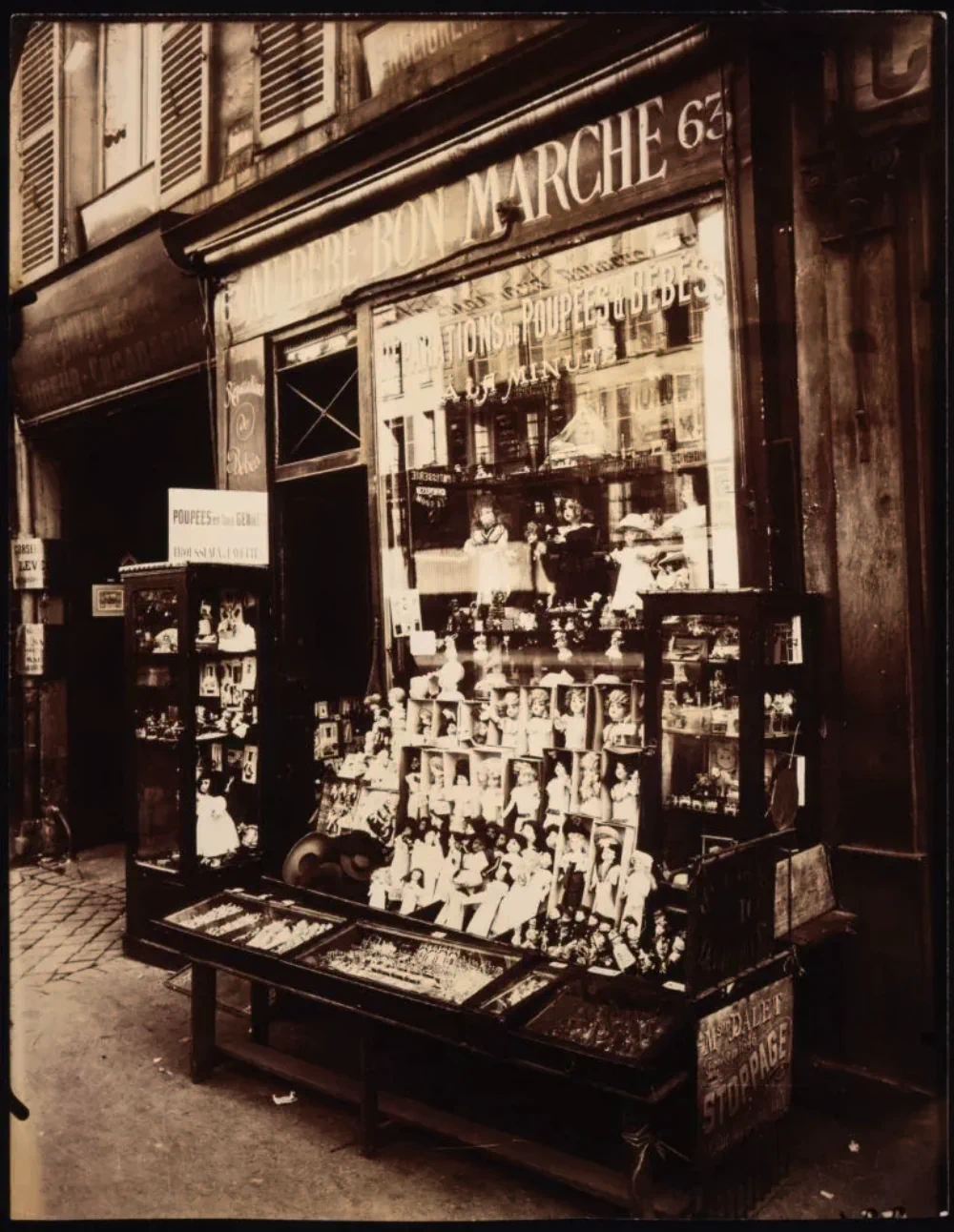
His work also resists narrative. There is no story unfolding, no climax, no decisive moment. Each image stands alone, yet together they form an inventory. Not a neutral catalog, but a charged one. The repetition of streets, windows, and corners creates a rhythm that feels archival, even obsessive.
This is why Atget was later embraced by Surrealists and modernists, despite his distance from their intentions. They recognized that his photographs detached the city from its immediate function and turned it into a psychological landscape. Paris becomes uncanny not because it is strange, but because it is too familiar and already receding.
Atget did not romanticize the past. He simply accepted its inevitability. His work suggests that cities are always photographed too late. That by the time the camera arrives, something has already changed. Photography, in his hands, becomes an act of belatedness.
To photograph a city as if it were already past is not to surrender to nostalgia. It is to acknowledge time as a force that shapes perception. Atget’s images do not ask us to mourn Paris. They ask us to see how every present contains its own disappearance.His legacy lies precisely there. Not in style, but in attitude. Atget teaches us that photography does not merely record what exists. It records what is about to vanish, even when we do not yet realize it.