
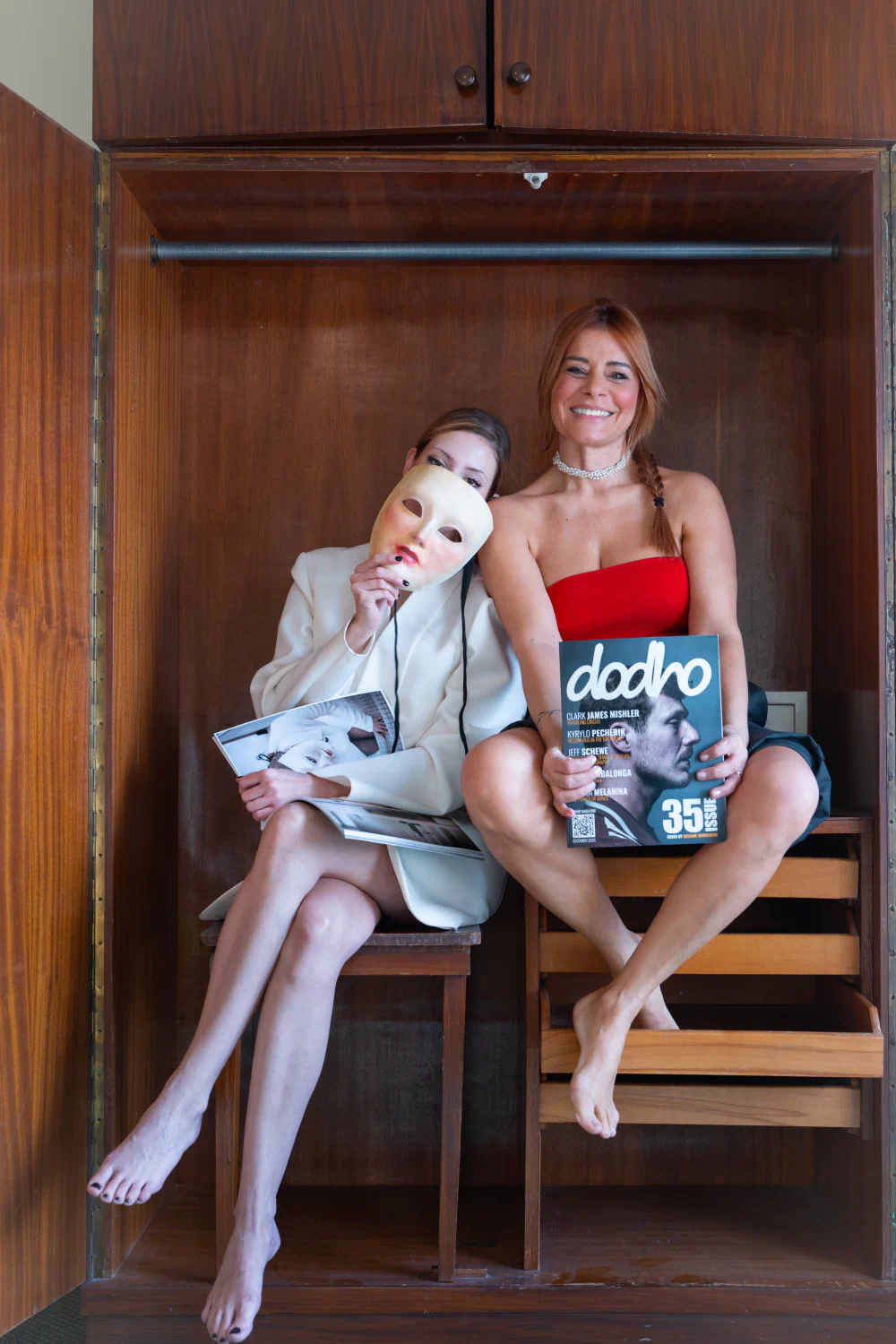
Elisa Gambalonga is one of the featured authors of Issue 35 of Dodho Magazine.
Her work unfolds in a fragile yet profound territory, where photography becomes a space for inner exploration, almost suspended between performative gesture, materiality, and emotion.
Guided by a sensitivity shaped by the body, space, and introspection, Gambalonga constructs images that move forward with delicacy but without concessions, exploring light and shadow, presence and absence. In this interview, we speak with her about her creative process, her personal search, and the place from which her images are born. [Official Website] [Issue #35]
How did your relationship with photography begin, and what hooked you at the start? What was happening in your life when you decided to take photography seriously?
My relationship with photography began long before I knew how to use a camera. I owned cameras without understanding them. I have always loved the object itself—the weight of it, the promise it held.
During the pandemic, time slowed down and life became quieter. In that suspended moment, I finally decided to study photography seriously, to understand how it worked. As I learned, something clicked: I realized this was something I could actually do.
My father is an artisan, and I grew up surrounded by the idea of making things with your hands, of building something from nothing. Photography revealed itself as the most direct and simple way for me to create. I could see results immediately, and that immediacy felt powerful, almost necessary.
What hooked me first was color and light—the way they move, the way they speak without words. I didn’t overthink it. I followed the sensations of that moment, trusting them. Photography became a place where feeling could turn into form, and where I could finally build something that felt like mine.
Which early influences shaped you (photography, cinema, painting, literature), and what did they give you?
I was shaped early on by a constant exposure to beauty, even before I could name it as an influence. I have always been drawn to interiors, design, and spatial arrangements—the quiet intelligence of how objects, colors, and proportions coexist. Working with clients who lived in beautiful homes trained my eyes over time; beauty became something familiar, something I learned to recognize instinctively.
Fashion also played a crucial role. I have worked—and still work—in that world, where aesthetics are never accidental and visual choices carry meaning.
All of these influences didn’t push me toward a specific style, but they educated my gaze. They taught me to notice, to respect form, and to trust my eyes—because they had already been living inside beauty for a long time.
Do you remember the exact moment when photography stopped being an interest and became a necessity? What triggered it? In the beginning, what attracted you more: telling stories, constructing images, or understanding yourself through the camera?
It began with self-portraits. When I turned the camera toward myself, something shifted. I discovered a painterly effect that immediately fascinated me, and from there I began to forget about technique. I allowed myself to experiment, especially with movement and blur, letting the image breathe and break its own rules.
I think part of me would have loved to paint. But I am instinctive, and I need to create quickly. Painting asks for longer, slower processes, while photography allowed me to arrive somewhere in seconds. When I realized I could achieve that same expressive depth using my own body, almost instantly, everything made sense. Through those self-portraits, I learned how to move, how to exist inside the frame.
I spent the first years shooting alone, and in that sense photography became a private space—a place that belonged only to me. Creating something on my own, with myself as both subject and tool, brought me closer to who I was. It wasn’t about telling stories at first; it was about constructing images that conveyed emotions.
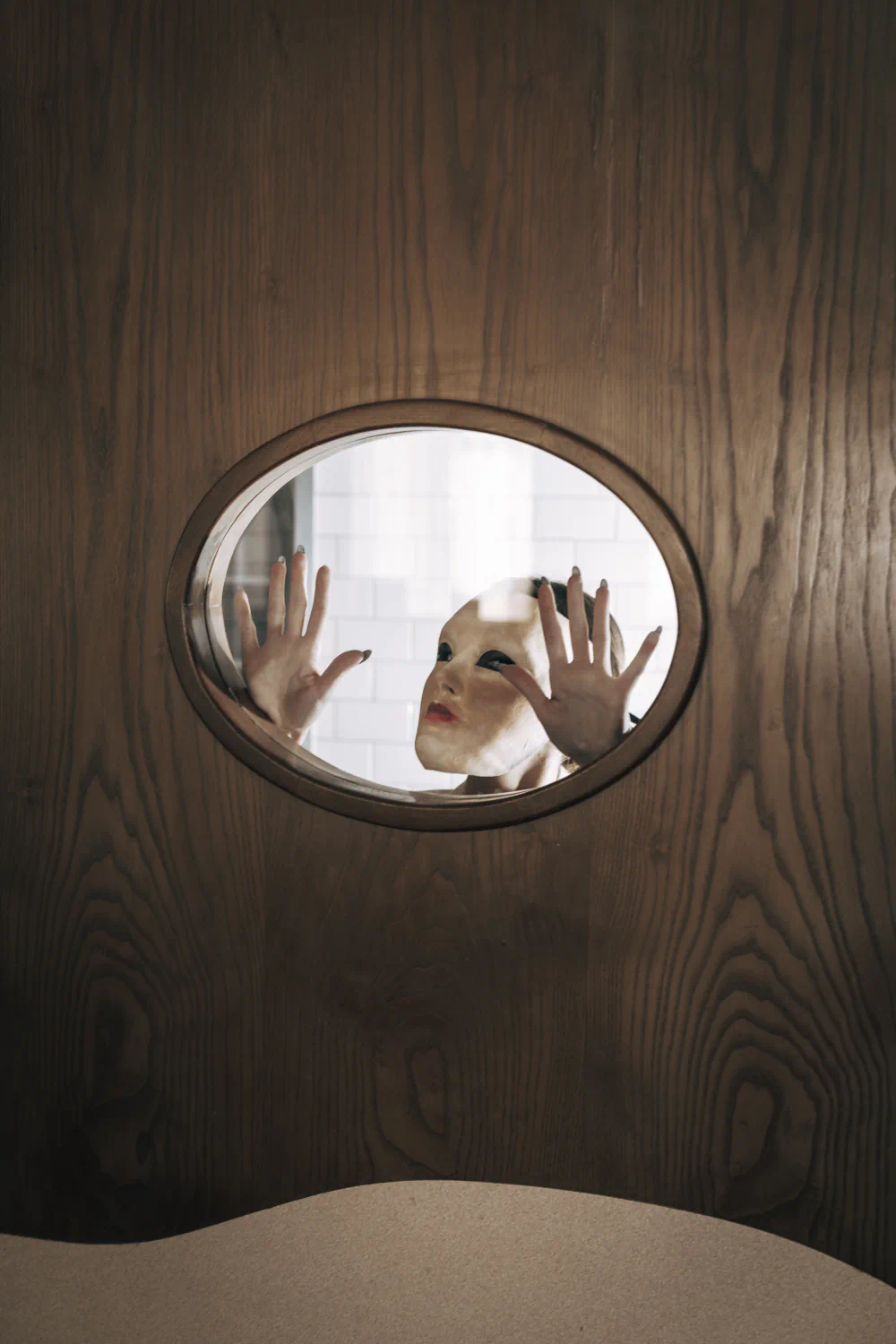
What pushed you to show your work for the first time (publishing, exhibiting, submitting to a magazine)? What fear lay behind that step?
I remember perfectly the first time I shared my work. I printed my very first photograph—single leaf—and placed it in my shop. The owner of a hotel saw it and wanted to buy it. Back at the hotel, he sent me the measurements of his corridor and said, “This is yours.” That simple act of printing and framing my work became the turning point.
As a self-taught photographer, and not in my twenties, stepping into that exposure—having my work displayed in a five-star hotel—brought more insecurity than fear. My face wasn’t in the images, yet in every way, it was me—both in front of and behind the camera. From that moment, I began printing and framing regularly, investing in this tangible aspect of my work, and allowing it to exist in the world beyond my own gaze.
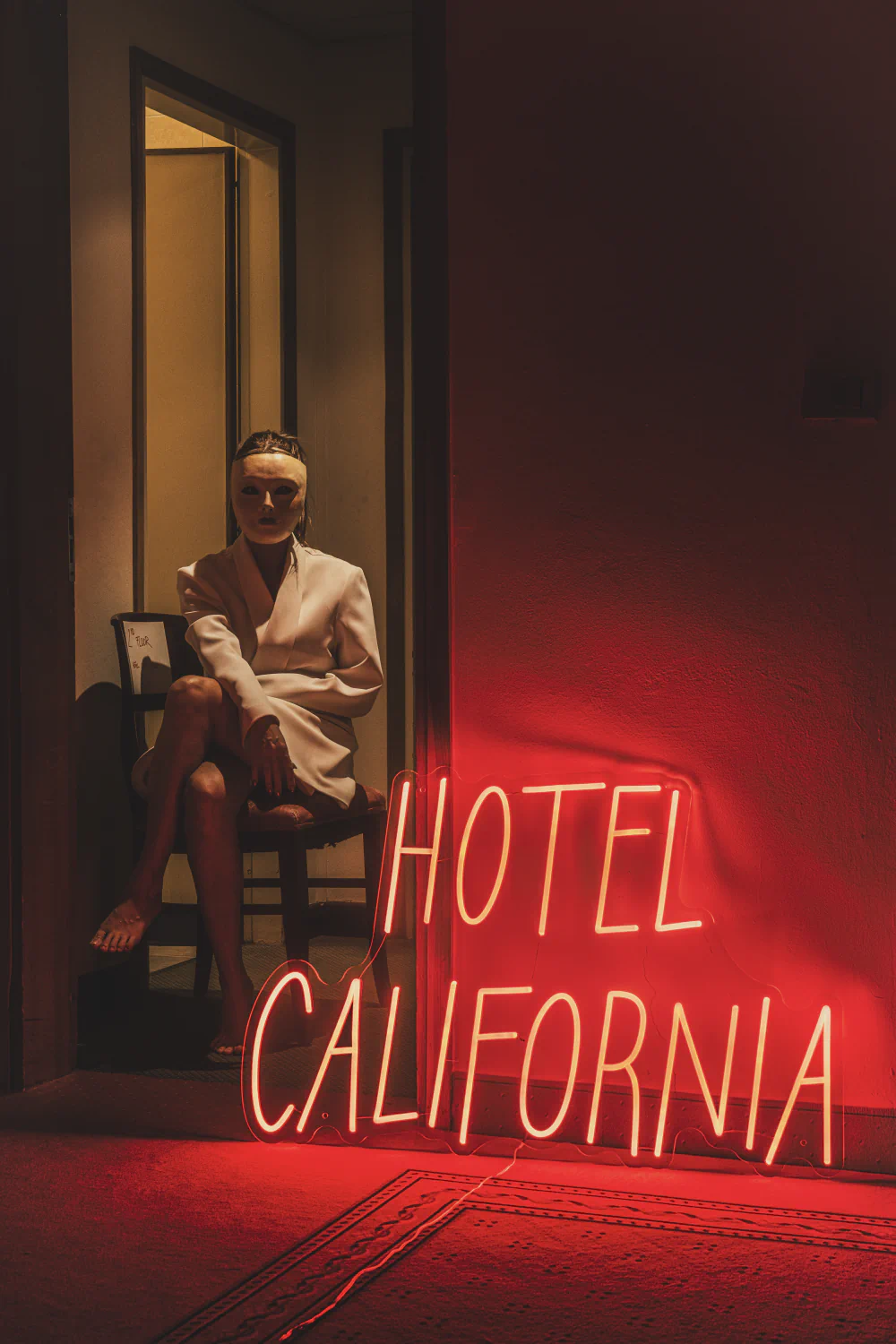
How did Hotel California come into being: intuition, personal urgency, or a natural evolution of your previous series? What appeared first: the place, the idea of the mask, or the conflict of identity?
After years of photographing only myself, I think I had reached a point where something inside me had run its course. I had spent a night sleeping within the walls of that hotel, and instinctively, I felt the need to photograph a door. I’ve always seen doors as silent witnesses to the passages of people, small markers of private journeys. I told the owner about my idea, and he handed me the keys, allowing me to explore (the hotel was no longer open to the public).
At the time, I was photographing nude part of body’s skin. Among the people involved in that project was Francesca. The moment I began photographing her, I felt something special between us. I asked her to come with me to Hotel California.
As soon as we entered a room, with the bed shifted and the nightstand askew, I thought, “It’s beautiful.” She said it out loud. I wondered: was it strange that two people could find beauty in something so out of place? From that instant, I knew we needed to explore further.
The moment I stepped into Hotel California (this is how I named it), despite the strangeness of the abandoned space—dark, quiet, eerie, to me, it felt like home.
Once I began shooting, I fell in love with the images. And then came the anxiety: I realized it wasn’t truly mine. Unlike the first location I photographed, this place belonged to someone else. Every time I typed the code to enter and mistyped it, there was a fleeting terror that it might never open again. I wanted to live there forever, yet feared losing it. Now, that anxiety has passed.
It isn’t mine—and yet, in a way, it is mine. I believe Francesca feels the same.
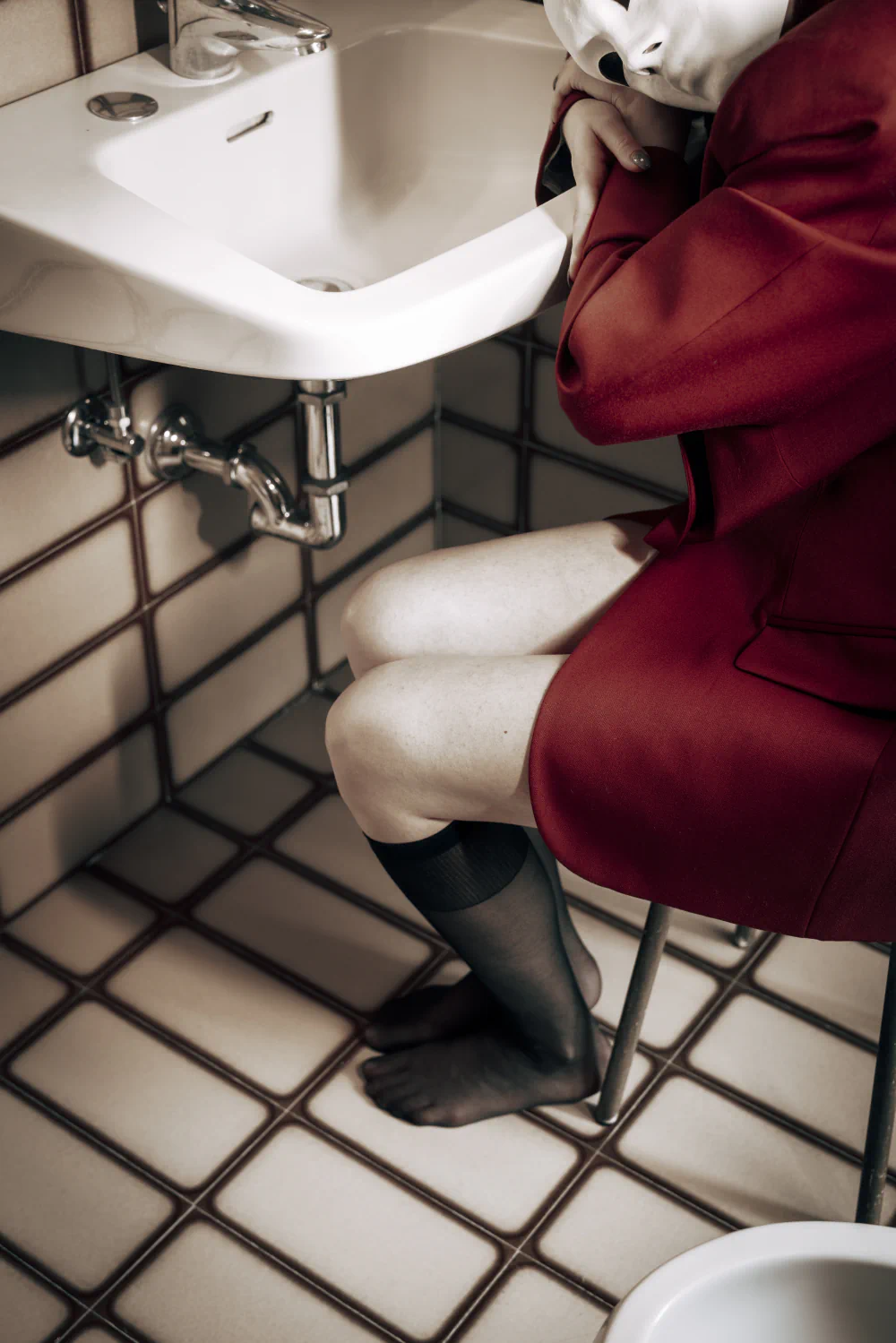
What element is essential for a photograph to be Hotel California?
The essential element for a Hotel California photograph is “being out of place.” There’s a subtle magic in it. Francesca and I experience the hotel through rituals: we walk down dark corridors with a flashlight, climb to the lower floor to fetch the masks—which, for now, never leave Hotel California—and we always ask the hotel for permission. Often, we find things slightly askew from how we left them, and that imperfection becomes part of the story.
For me, this sense of being out of place is about seeing and seeking beauty even where there is no perfection, no shine. Hotel California has taught me to find wonder in the unexpected, the irregular.
The Hotel California Four Seasons are not yet complete, and I’m not ready to give back the keys.
You say the project investigates identity. Which definition of identity did you want to challenge? Is this project more about escape or acceptance?
At first, we staged situations, creating a world of expression through Francesca, who became my alter ego. Hotel California is a refuge for both of us—a space that exists only for us, behind closed doors. In that sense, it is both escape and acceptance; one implies the other.
Through this process, we are exploring identity itself—not as something fixed, but as something fluid, performative, and shared. For Francesca entering Hotel California allows her to step away from daily life and express herself in every possible way. And yet, it is also acceptance—by embracing this space and what we create together, we accept a part of ourselves that exists fully in the images. Francesca is the mask, and the heart, of Hotel California.
Which part of the project is autobiographical, even if it is not a literal self-portrait? Did you work with a storyboard, or did you build the scenes in response to the place?
The project is entirely autobiographical. In some seasons, Francesca becomes the body through which the story moves; in others, it is me. There is no storyboard, no rigid plan. We follow the hotel itself—its rooms, its corridors, its silence—as it suggests each frame, each gesture.
Every scene grows organically, as if the space whispers to us, guiding our movements and our choices. The hotel becomes a mirror of our inner worlds, reflecting fragments of identity, memory, and emotion. Through this dialogue between ourselves and the place, the photographs capture not just presence, but a suspended moment of exploration—a search for who we are, who we can be, and the parts of ourselves we are learning to recognize.
Francesca is both alter ego and companion; in her, I see parts of myself that are distant, intimate, and essential. The project unfolds as a conversation, a shared autobiography written in light, shadow, and the silent geometry of the abandoned hotel.
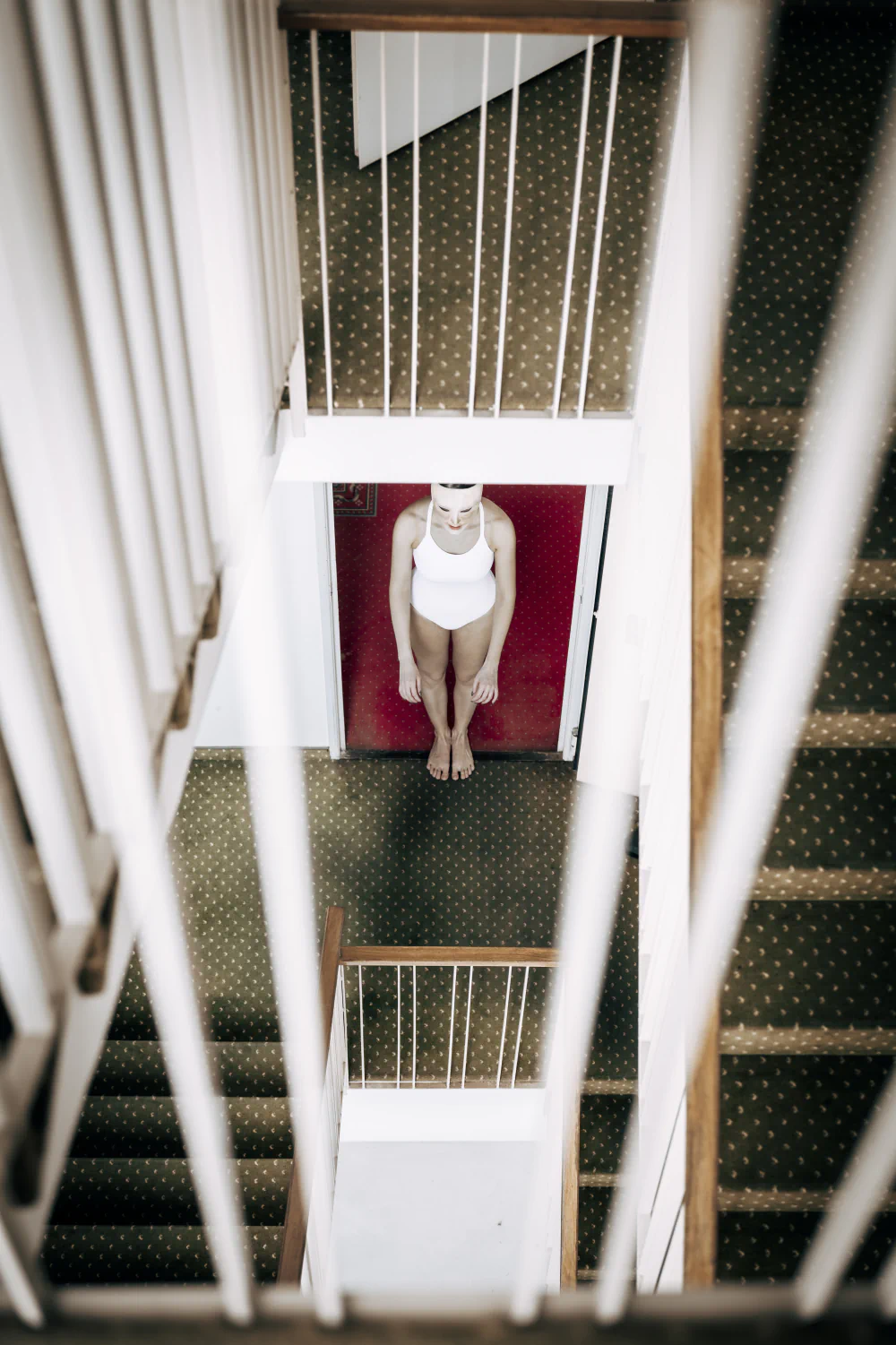
When did you decide that the face should disappear, and why? What did the mask allow you to do that a visible face did not?
I have never shown the face in my photography—this has always been my approach. I am photographing an emotion, a presence that could carry the faces of many forms of feminine energy, not just my own.
I see countless expressions within the mask; it is human, revealing the emotions that stir beneath the surface. Through the mask, I can make the personal universal. Over time, I noticed that others recognized themselves in it, and I followed that instinct.
The mask is me, and I am the one I photograph. It allows the intimate, the fragile, and the hidden to speak without words, to exist beyond a single identity, and to become a mirror for anyone who looks.
What would you like to explore that you have not yet pushed to its limits? What risk do you want to take in your next project? What theme do you feel is calling to you lately?
Hotel California is not finished. I am still exploring Season Three, and Season Four already lives in my mind. I don’t feel limits—I want to follow the project wherever it wants to take me, to push further into the landscapes of emotion, identity, and memory. The work itself calls me forward, and I trust the risk will be in surrendering to its unfolding, rather than trying to control it. Each new frame feels like stepping deeper into a world that exists between reality and dream, and I am eager to see where it leads.