

There are photographers who spend their entire lives chasing a single defining image, and there are others who produce a photograph so powerful that it quietly detaches from them and begins to live a life of its own.
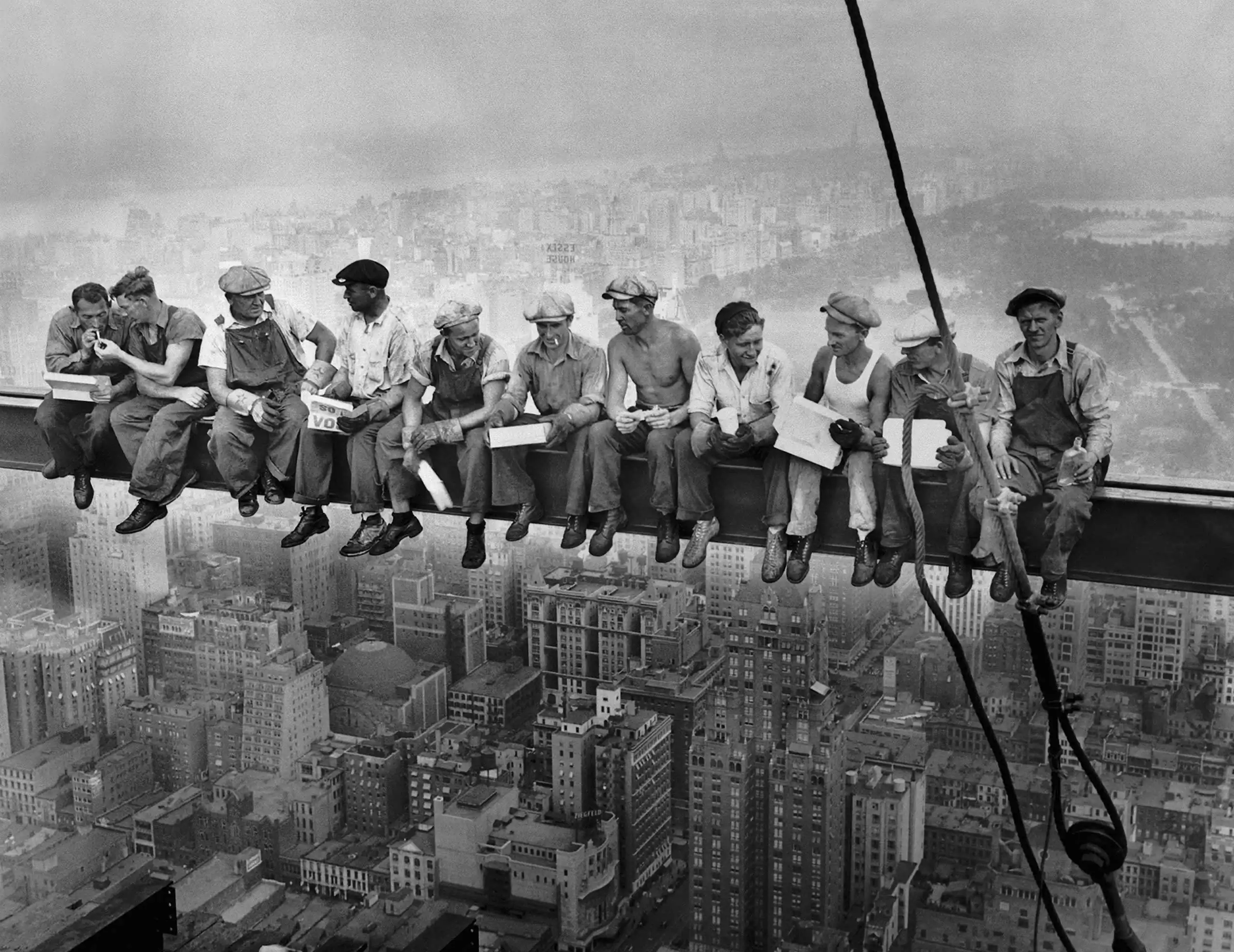
Charles Clyde Ebbets belongs, at least in the public imagination, to the second category. His name is now almost inseparable from Lunch atop a Skyscraper, the 1932 photograph of eleven steelworkers eating lunch on a beam high above Manhattan during the construction of 30 Rockefeller Plaza.
Yet for decades, the image circulated globally while the photographer himself remained largely invisible, an irony that says as much about the mechanisms of photographic history as it does about Ebbets’ own life.
To write about Ebbets is not merely to reconstruct a biography; it is to explore the tension between authorship and anonymity, between industrial assignment work and artistic legacy, between a working photographer’s career and the cultural afterlife of a single frame. His story unfolds less like that of a celebrated auteur and more like that of a professional image-maker absorbed by the very myth his work helped create.
A Life Before the Beam
Adventure, Commercial Photography, and the Making of a Working Image-Maker
Born in 1905 in Alabama, Charles Clyde Ebbets did not begin his career with the aura of an art photographer destined for museum retrospectives. His early life was shaped less by aesthetic theory than by opportunity, mobility, and the practical demands of earning a living with a camera. As a teenager, he showed an early fascination with photography, experimenting with equipment and absorbing the technical challenges of exposure and composition. By his twenties, he had already begun working professionally, navigating the shifting terrain of commercial and journalistic photography in the American South.
Florida became central to his early career. There, he photographed aviation, fishing expeditions, sporting events, and promotional material tied to tourism and development. His work reflected a photographer comfortable in dynamic environments, capable of positioning himself in precarious or logistically complex situations to secure compelling vantage points. Ebbets was not, at least initially, building a cohesive artistic portfolio; he was responding to assignments, adapting to clients, and mastering the technical discipline required to produce clear, marketable images under varied conditions.
This background is crucial for understanding the photograph that would later define him. Lunch atop a Skyscraper did not emerge from an isolated artistic epiphany; it was the product of a photographer accustomed to working within institutional frameworks, delivering images that served broader communicative purposes. Ebbets’ career was marked by pragmatism. He was a freelancer navigating an industry in which survival required flexibility rather than purity of vision.
The romantic narrative of the solitary artist rarely applies to photographers of his generation who operated within commercial ecosystems. Photography in the early twentieth century was deeply intertwined with advertising, journalism, corporate documentation, and promotional campaigns. Ebbets learned to function within these structures, developing an ability to translate physical risk and industrial ambition into visually persuasive imagery.
By the time he was hired to document the Rockefeller Center construction in 1932, he was already an experienced professional comfortable with heights, machinery, and orchestrated visual spectacle. The beam was not an accident in his trajectory; it was consistent with a career built on navigating environments where engineering, movement, and visual drama intersected.
1932 and Rockefeller Center
Assignment Work, Publicity Strategy, and the Question of Credit
When Ebbets was contracted to photograph the construction of Rockefeller Center, the United States was in the depths of the Great Depression. The project represented a bold architectural and financial commitment at a time when economic collapse dominated headlines. The developers required images that communicated resilience, progress, and stability, and photography became a central instrument in that strategy.
The photograph that would later be known as Lunch atop a Skyscraper was taken during a session designed to capture steelworkers on the girders of what would become 30 Rockefeller Plaza. Evidence suggests that the scene was staged as part of a coordinated publicity effort. Multiple photographers were present, including Thomas Kelley and William Leftwich, and the negatives were not individually credited upon publication. When the image appeared in the New York Herald Tribune on October 2, 1932, it carried no byline.
This absence of immediate attribution complicates the narrative of authorship. In the corporate environment of the early 1930s, photographs commissioned by developers were considered assets of the project rather than personal artistic statements. The identity of the photographer was secondary to the impact of the image. Ebbets, if indeed he was the principal photographer of the now-iconic frame, operated within this industrial logic.
For decades, his connection to the photograph remained obscure. Only in the early twenty-first century did renewed archival research and family advocacy bring his name into widespread association with the image. Documents confirming his employment during the relevant period strengthened the attribution, though historians continue to acknowledge the presence of other photographers on site.
This delayed recognition underscores a fundamental tension in photographic history. Authorship is often retroactively assigned once an image achieves cultural significance. During its initial circulation, however, Lunch atop a Skyscraper functioned as promotional material rather than as a signed artwork. The cultural machinery that later elevated it to icon status did not immediately elevate its maker.
Ebbets’ relationship to the image is therefore both central and paradoxical. He may have produced one of the most recognizable photographs in American history, yet for much of his life he did not inhabit the public role of its celebrated author.
After the Photograph
A Career Overshadowed and the Slow Construction of Legacy
Following his Rockefeller Center assignment, Ebbets continued working in photography, returning primarily to Florida, where he pursued commercial and documentary projects. His career encompassed fishing photography, environmental scenes, and regional assignments that reflected his ongoing adaptability. He was not absorbed into the New York art world, nor did he cultivate a persona built around the beam image.
Unlike photographers who consciously shape their legacies, Ebbets did not publicly frame Lunch atop a Skyscraper as a defining artistic statement. The image circulated widely, reproduced in newspapers, posters, and eventually in museum contexts, often detached from detailed biographical context. It became a symbol of American resilience, industrial courage, and urban modernity, while the photographer remained a relatively marginal figure in mainstream photographic historiography.
This imbalance between image and maker invites reflection. Photography, perhaps more than any other medium, has the capacity to eclipse its author. When a photograph becomes archetypal, it risks dissolving the identity of the person behind the camera. In Ebbets’ case, the photograph achieved mythic status while his broader body of work remained comparatively obscure.
Only decades later, as scholars and archivists revisited the origins of the image, did his name reenter the narrative with force. Family members sought recognition, producing payroll documents and testimonies that linked him directly to the Rockefeller Center assignment. The effort to secure proper attribution was not merely a matter of pride; it was an attempt to restore balance between cultural symbol and individual labor.
The irony is profound. The photograph depicts anonymous workers whose identities were largely forgotten, yet the photographer himself experienced a similar anonymity within the story of the image. Both subjects and author were subsumed by the myth.
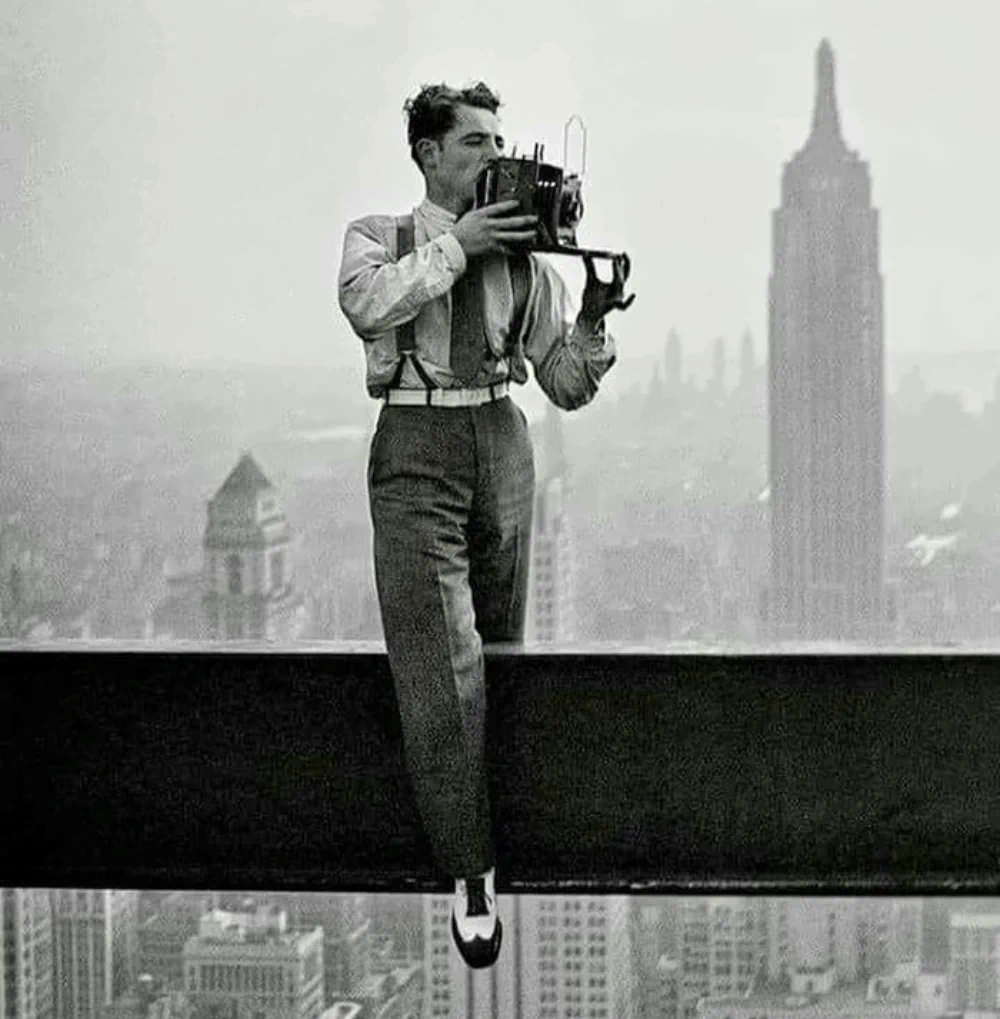
The Photographer and the Icon
Authorship, Memory, and the Fragility of Photographic Recognition
The life of Charles C. Ebbets raises larger questions about how photographic history is constructed. What determines which photographers are remembered and which fade into obscurity? How does the art world retroactively elevate certain figures while overlooking others whose work shaped visual culture in equally powerful ways?
Ebbets was not a manifesto-driven artist. He did not articulate a theory of photography, nor did he position himself within avant-garde movements. He was a professional navigating the commercial realities of his time. Yet through circumstance, skill, and historical timing, he may have produced one of the twentieth century’s defining images.
The tension between anonymity and authorship embedded in Lunch atop a Skyscraper reflects photography’s democratic paradox. The medium has the power to immortalize ordinary individuals, yet it can also render its makers invisible. In Ebbets’ case, the image transcended him, becoming part of collective memory long before his name was securely attached to it.
Today, when his authorship is cited, it carries both recognition and lingering uncertainty. The presence of other photographers at the scene ensures that a degree of ambiguity remains. That ambiguity does not weaken his legacy; it situates it within the collaborative and industrial nature of early twentieth-century photography.
Ebbets’ story is therefore not one of sudden fame but of gradual reclamation. His life illustrates how photographs can detach from their origins, circulate freely across generations, and only later be reconnected to their creators through archival persistence.
Beyond the Beam
Reconsidering Charles C. Ebbets Within Photographic History
To reduce Charles C. Ebbets solely to the photographer of Lunch atop a Skyscraper would be to repeat the same narrowing gesture that obscured him for decades. His broader career reveals a professional attuned to environment, movement, and spectacle, capable of translating physical risk into compelling visual form. His work in aviation and sports demonstrates a consistent fascination with human bodies interacting with dynamic spaces, a theme that culminated, perhaps inevitably, in the steel beam high above Manhattan.
Yet what ultimately defines his historical position is not stylistic innovation but the complex afterlife of a single image. Ebbets occupies a unique space in photographic history: simultaneously central and peripheral, credited yet contested, author and participant in a larger institutional production.
In an era when authorship is meticulously tracked and instantly attributed, his story serves as a reminder that photography’s history is not linear. Recognition can be delayed. Attribution can be uncertain. Images can outgrow their makers.
Charles C. Ebbets did not cultivate myth. He did not orchestrate the global trajectory of the beam photograph. He worked, as so many photographers did and continue to do, within assignments that required technical competence and compositional intelligence. That one of those assignments evolved into an icon of American modernity speaks to the unpredictable alchemy between context, image, and time.
In the end, perhaps the most fitting tribute to Ebbets is not to enshrine him as solitary genius, but to acknowledge him as a skilled practitioner whose work became inseparable from the collective imagination. Like the workers seated on the beam, he occupies a precarious position within history: balanced between anonymity and immortality, suspended between documented fact and enduring myth.