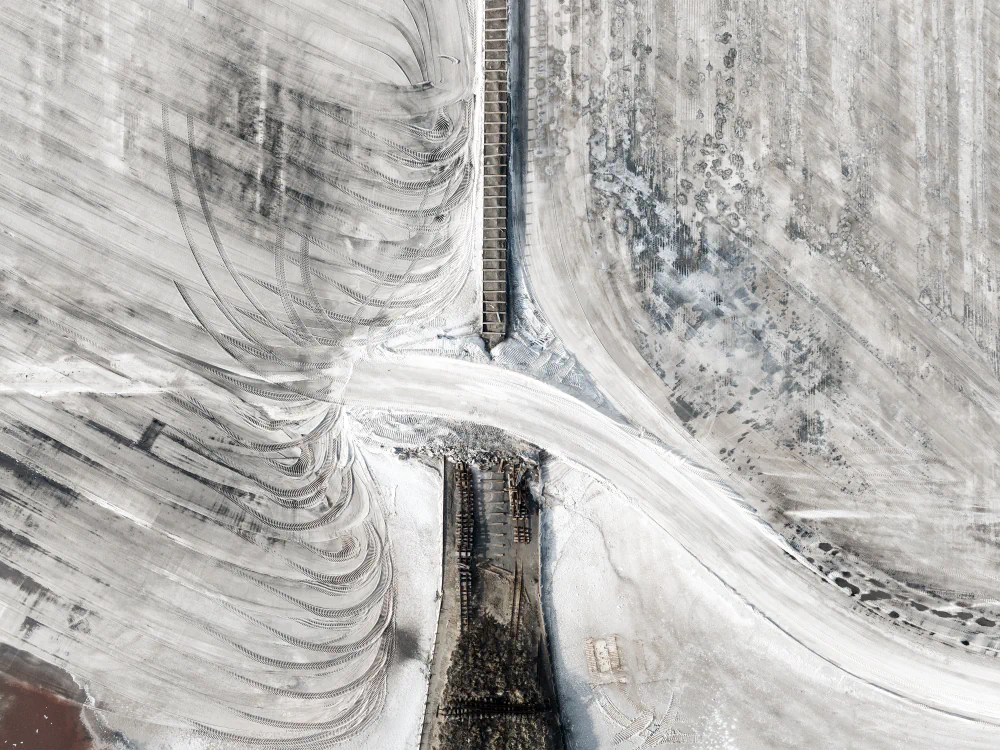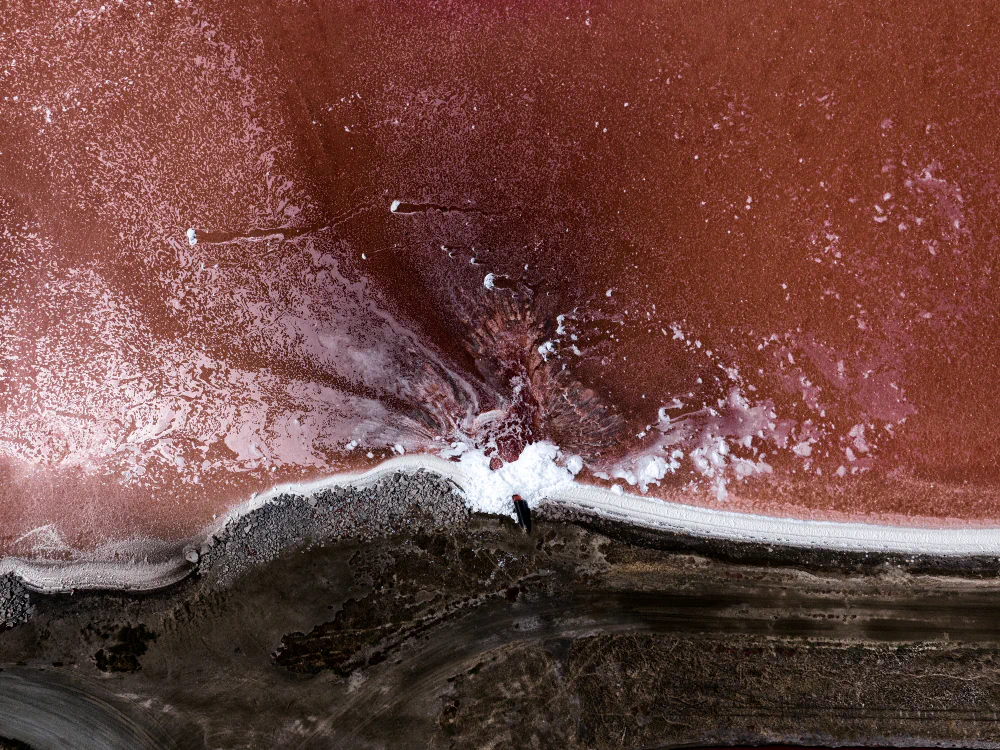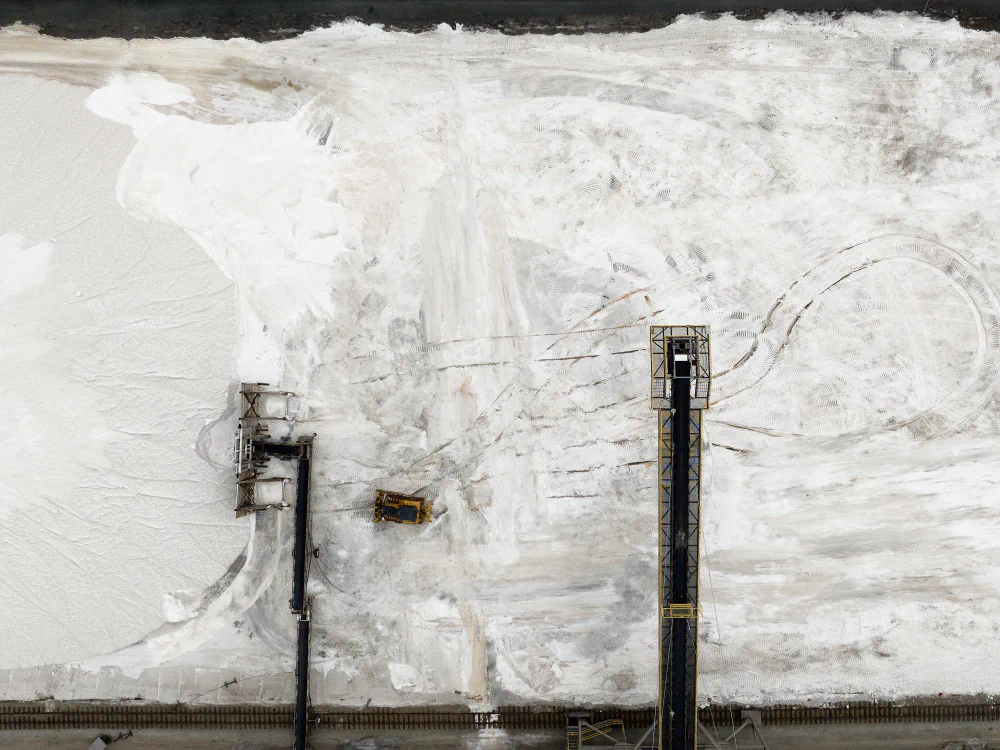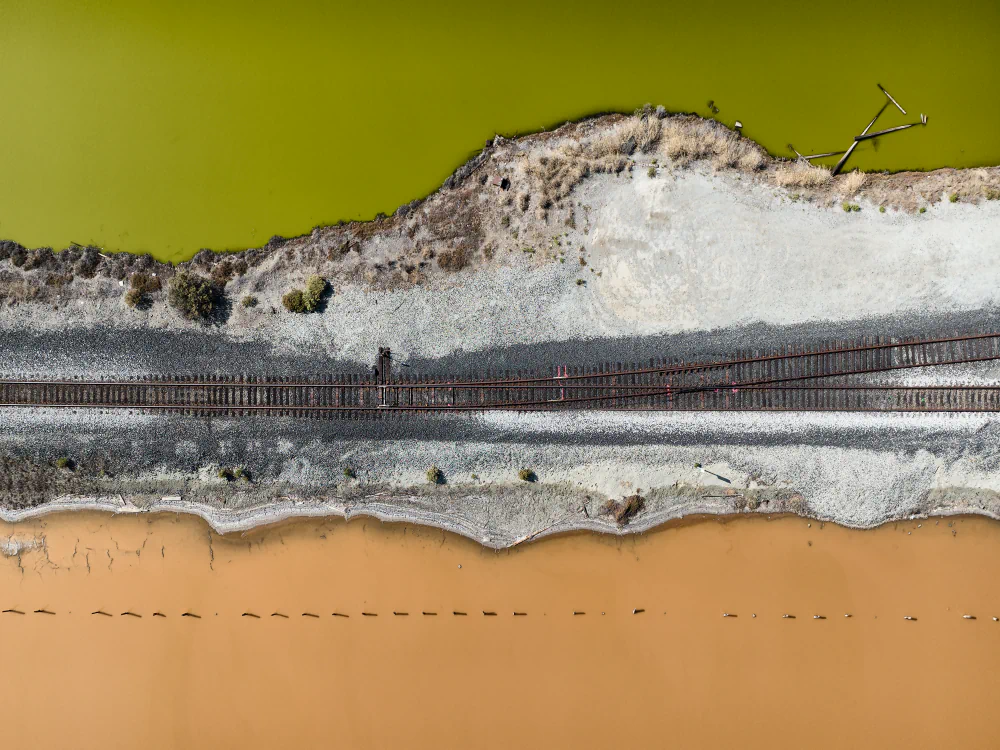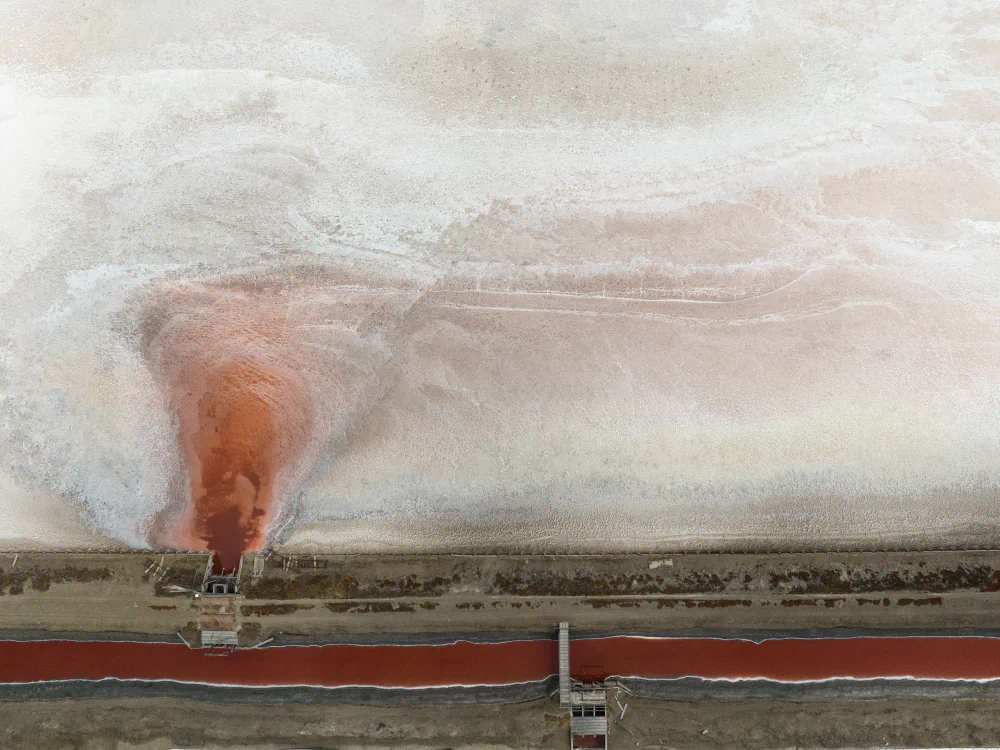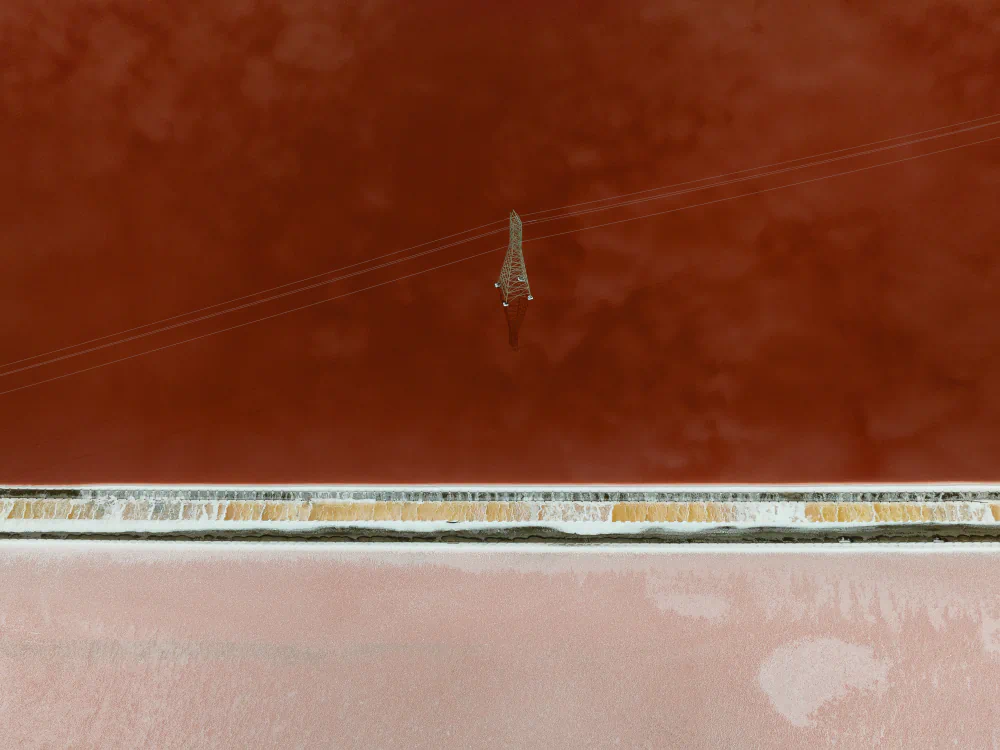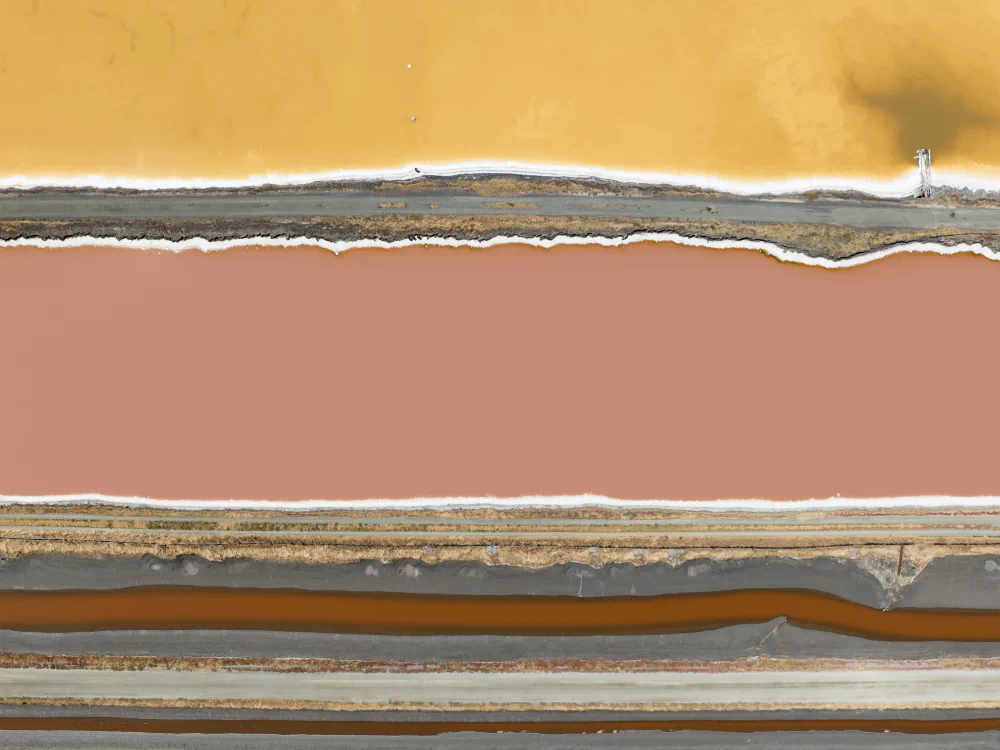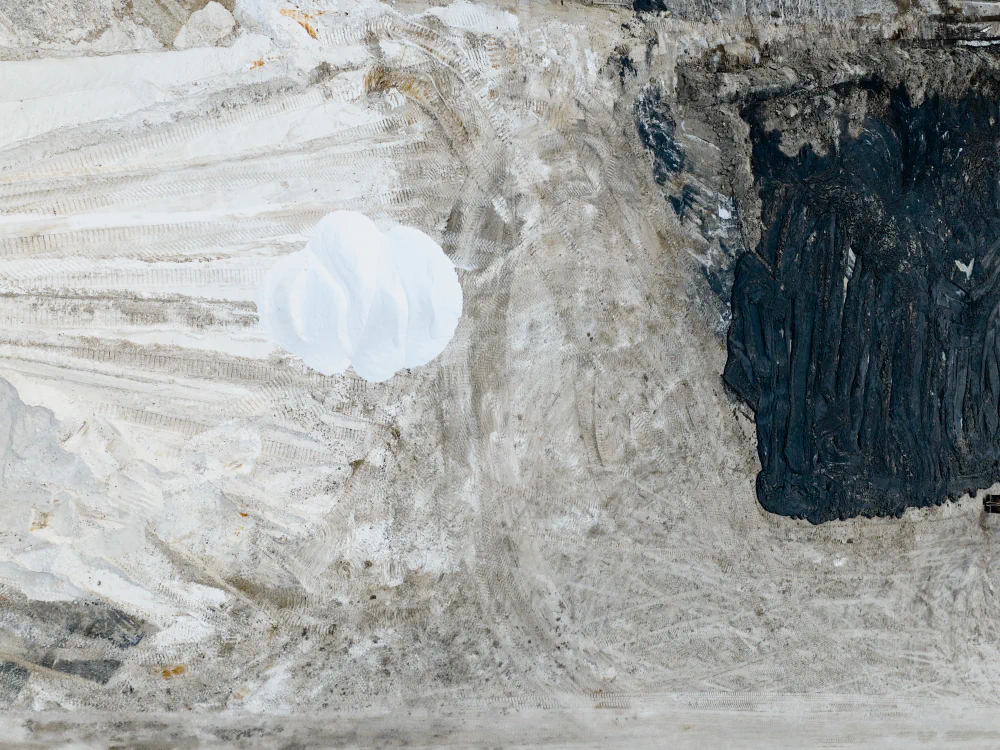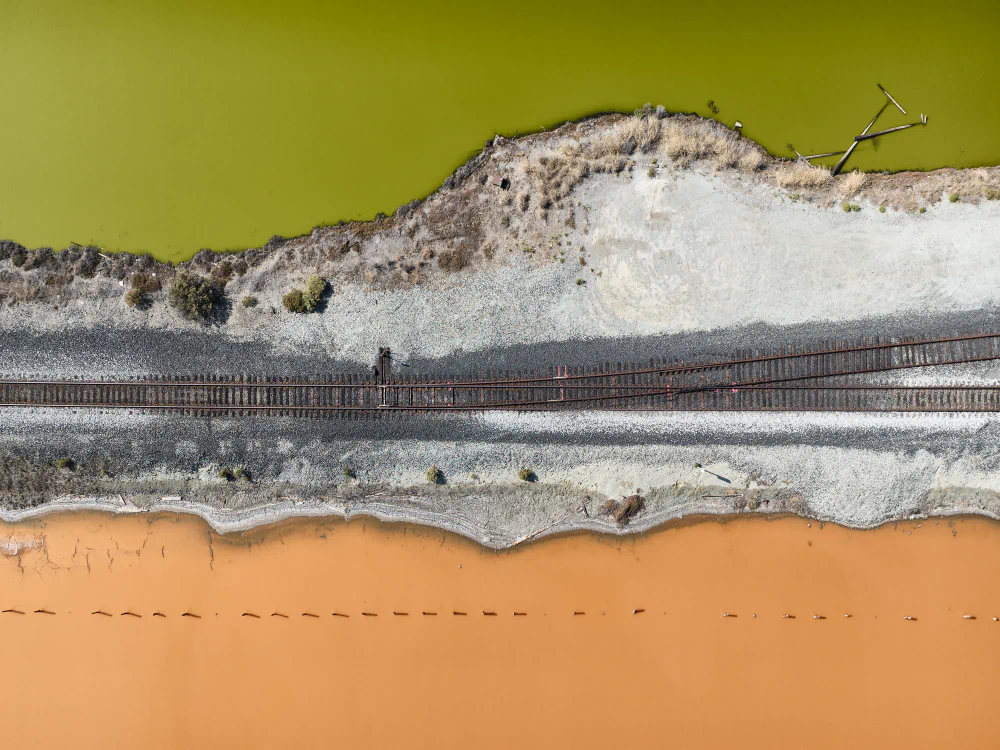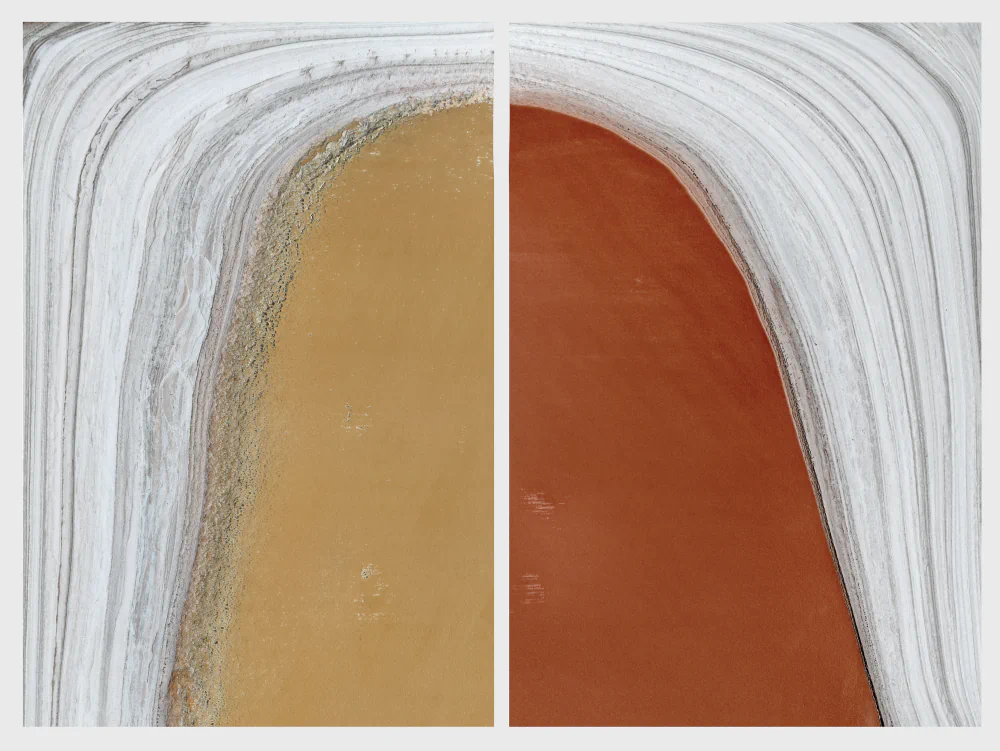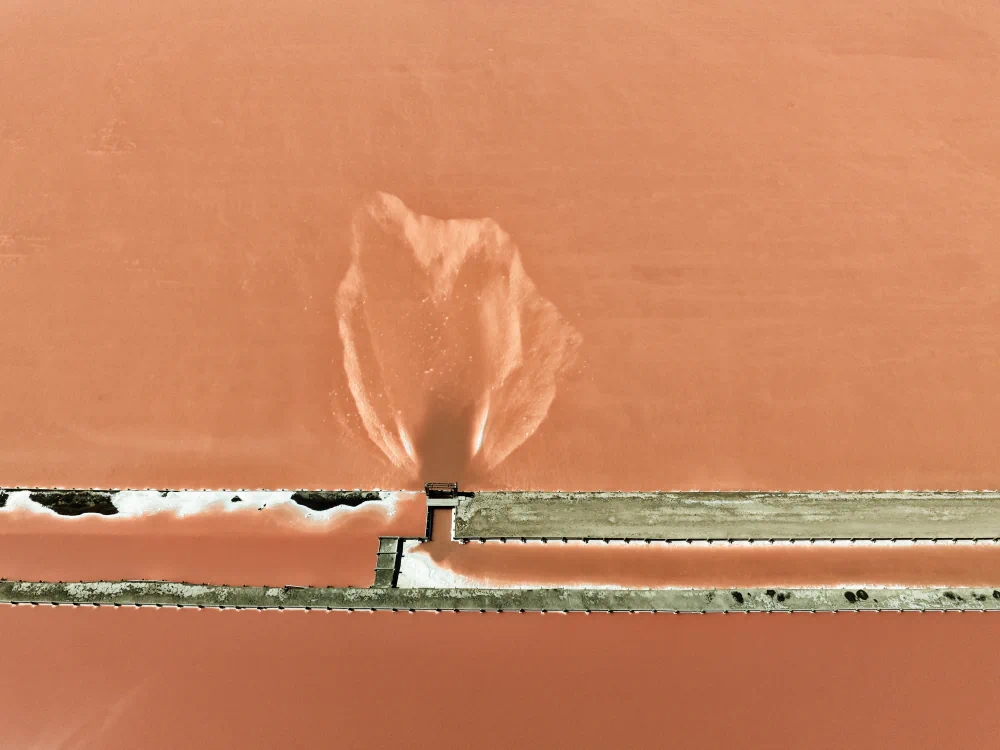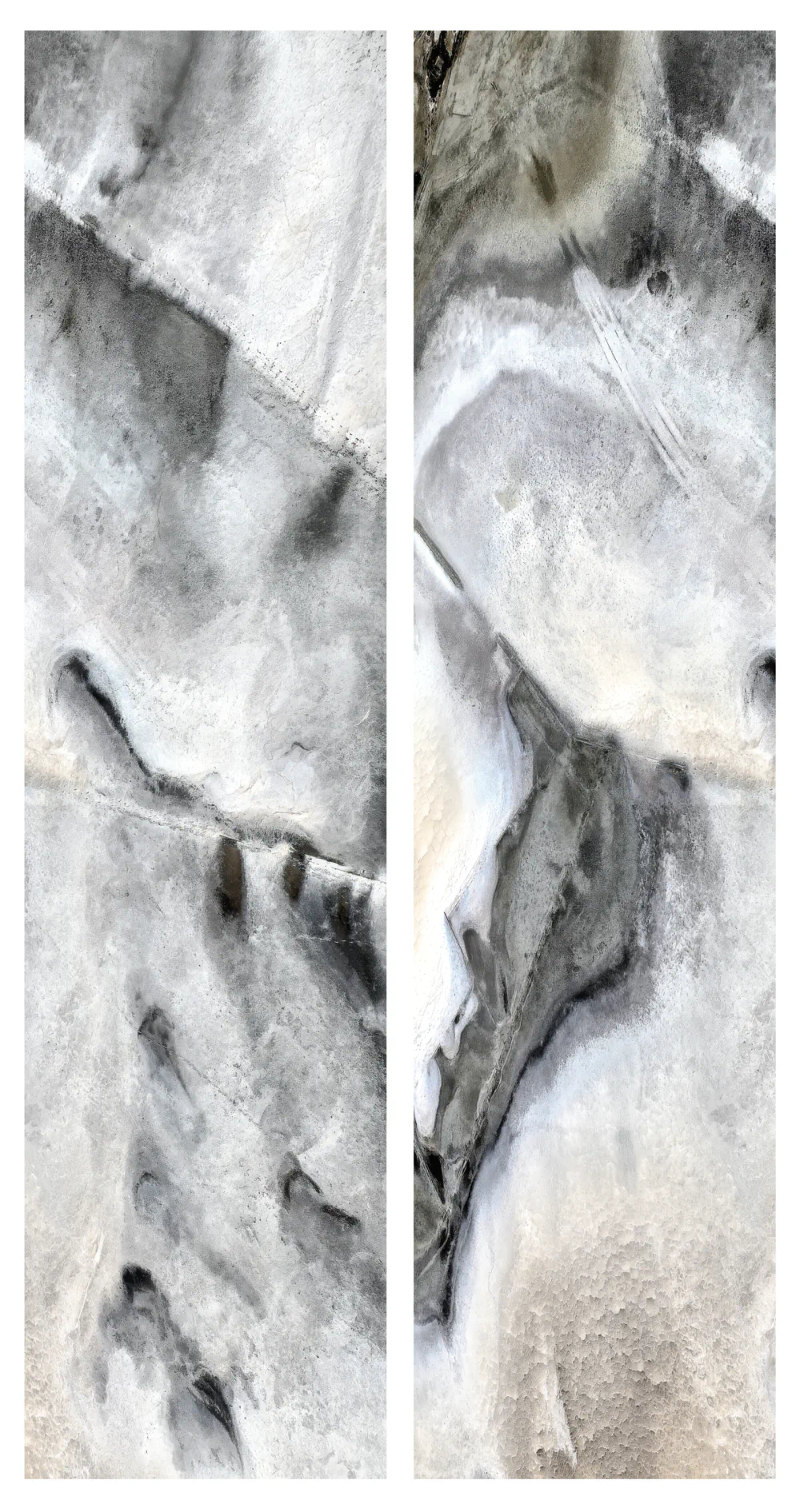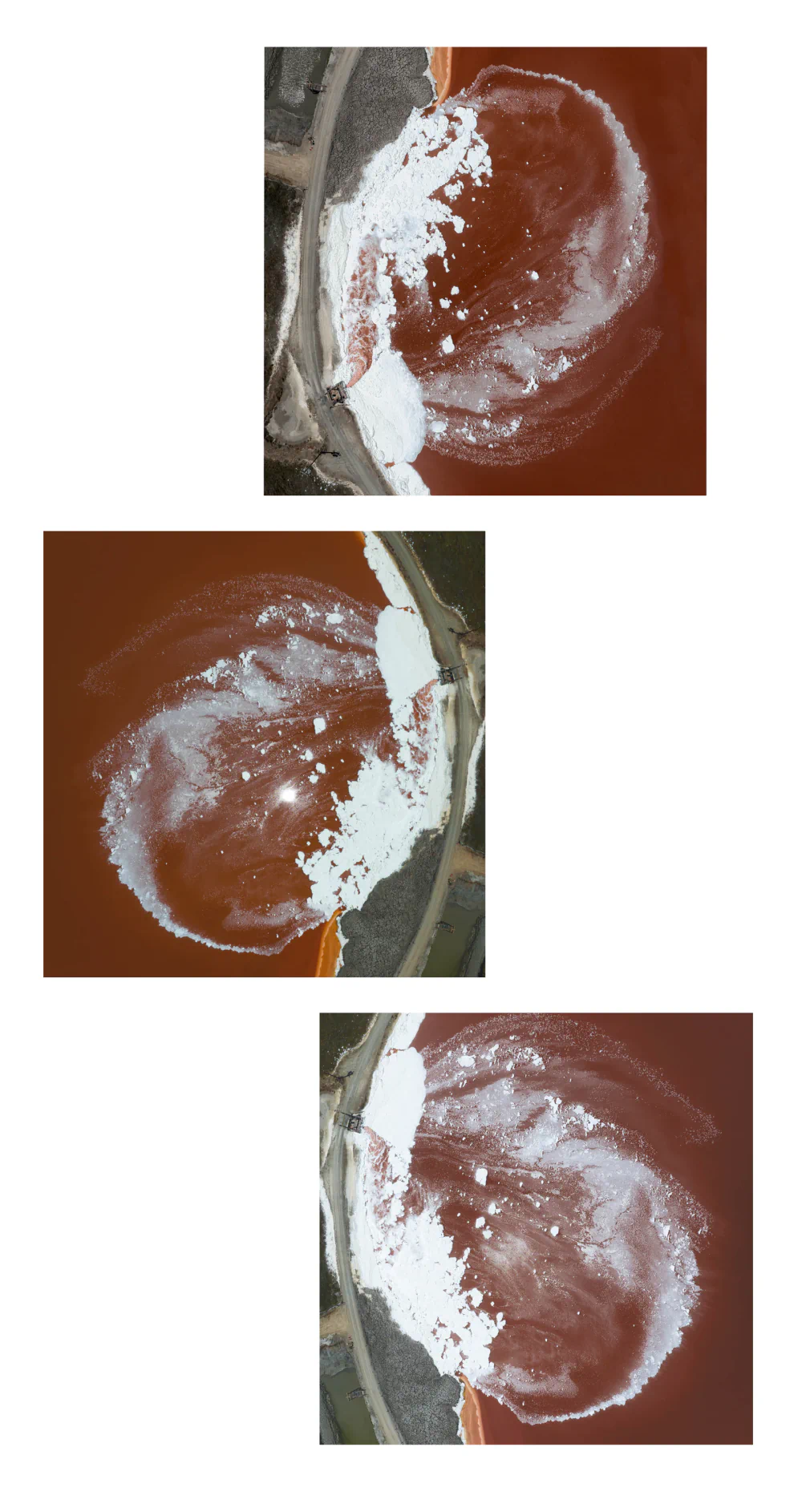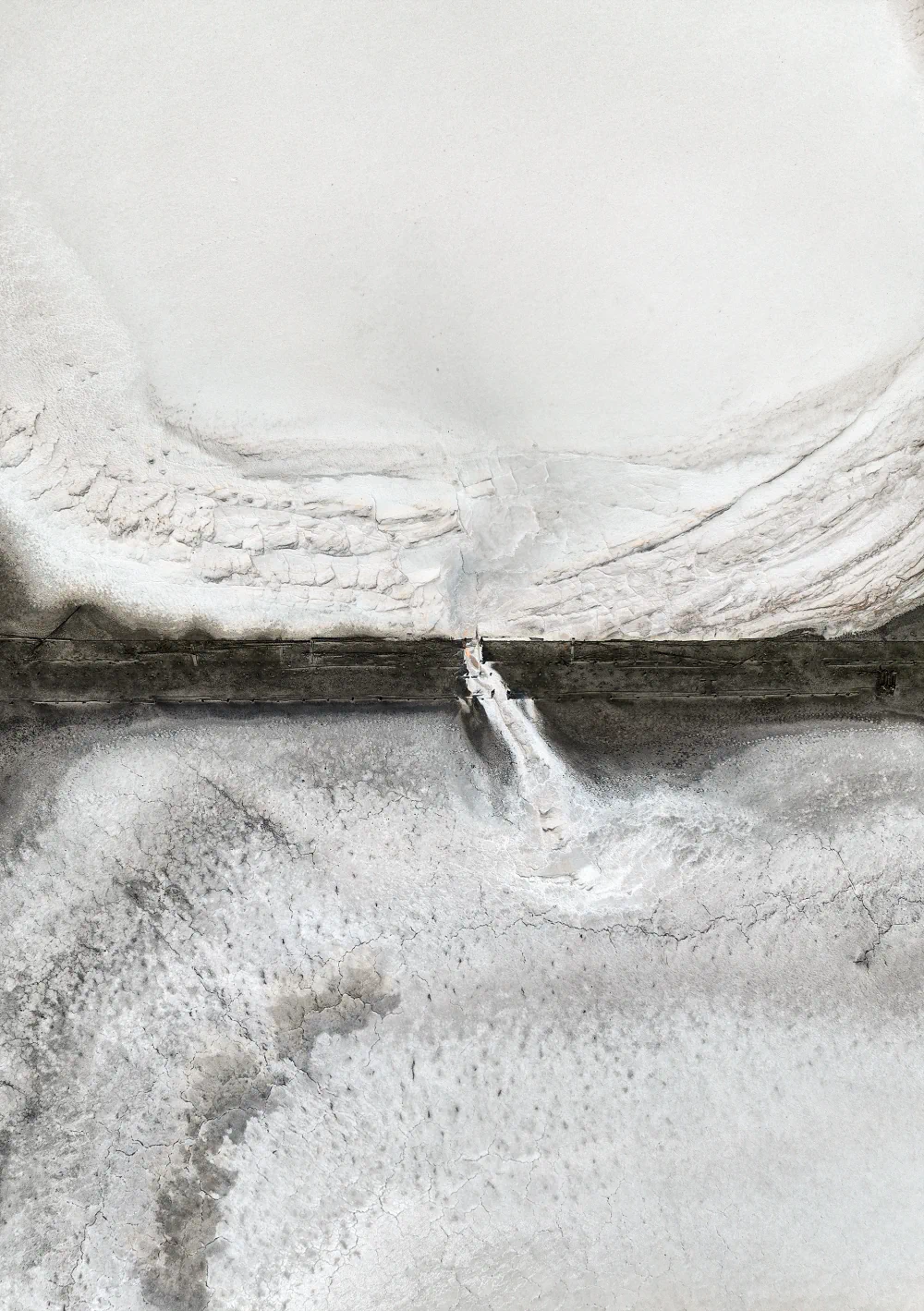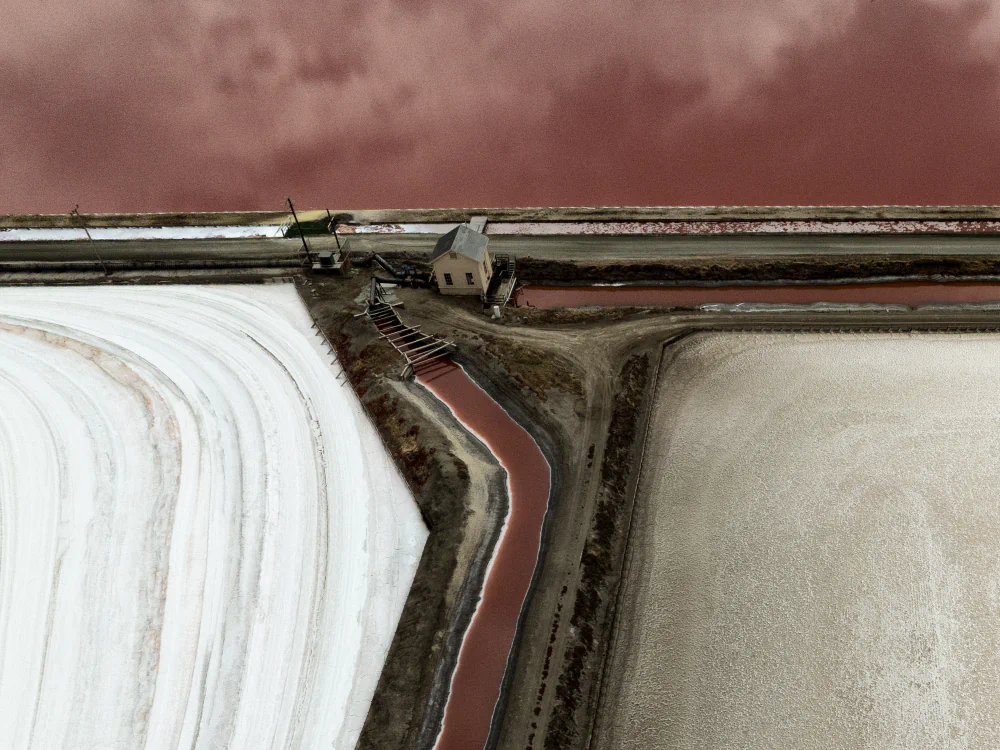

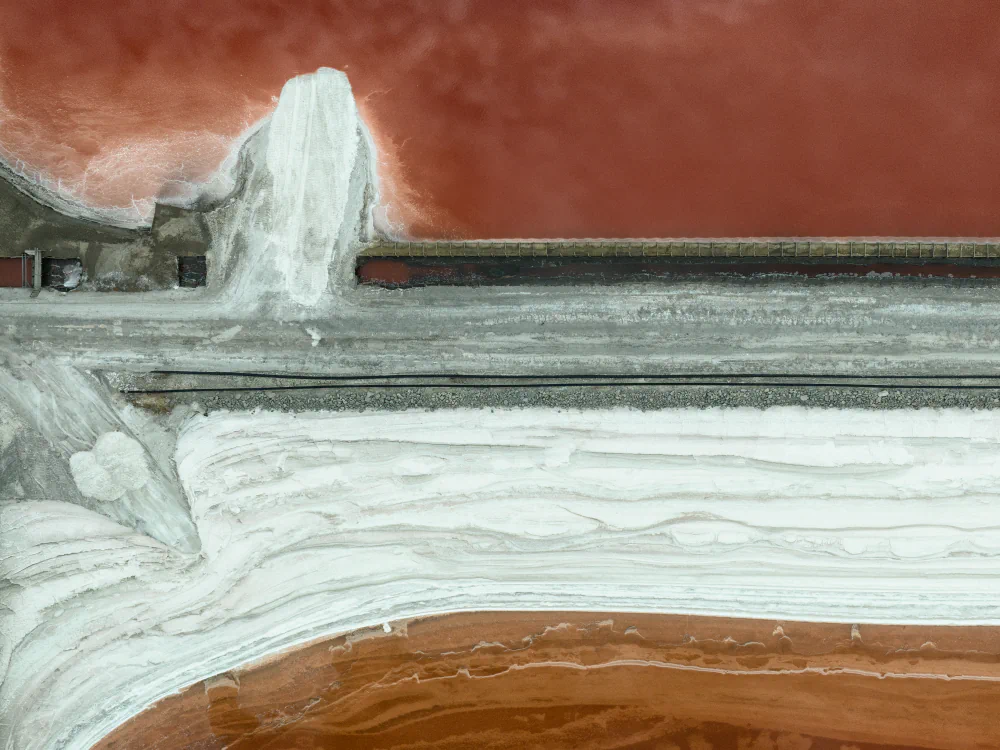
Visible from the artists’ home in the hills above Silicon Valley, the San Francisco Bay coastline reveals an otherworldly mosaic, a fractured geometry of vivid reds, oranges, and whites as far as the eye can see.
The scene, extending over 40,000 acres, is the unintended art of 150 years of industrial scale salt mining.
To extract hundreds of thousands of tons of salt each year for kitchens, dining tables, and icy roads, the Bay’s blue green water is channeled through a series of evaporation ponds, becoming redder as increasing saline levels allow only the most resilient microorganisms to survive. Among the ponds now lie signs of a fading, feeble salt industry: teetering wooden sluice gates that still channel increasingly saline water; rusting rail structures once used to move salt train cars from west to east; and heavy front loaders still pushing white saline mounds toward the horizon.
Bayscapes documents this surreal, almost alien landscape just as the tide turns. The community driven South Bay Salt Pond Restoration Project, one of the largest tidal wetland restoration projects, is actively transforming acres of salt evaporation ponds back into tidal marshlands, mudflats, and wetlands. In doing so, the intent is to boost biodiversity, provide flood protection against sea level rise, and restore native habitats. Indeed, images from recent years, when examined more carefully, capture not just yesterday’s industry but also flocks of small shorebirds hovering over the remnant foundations of a bridge, just one of the clues of ecological reclamation taking hold. As federal interest and support for environmental efforts remain under active threat, the artists intend that the raw, unaltered colorations and desolation in these images inspire continued, vigorous support for restoring what was lost and fostering a newly vibrant era for the San Francisco Bay, buttressing California’s pivot from industrial exploitation to environmental rejuvenation.
About Steve Goldband and Ellen Konar
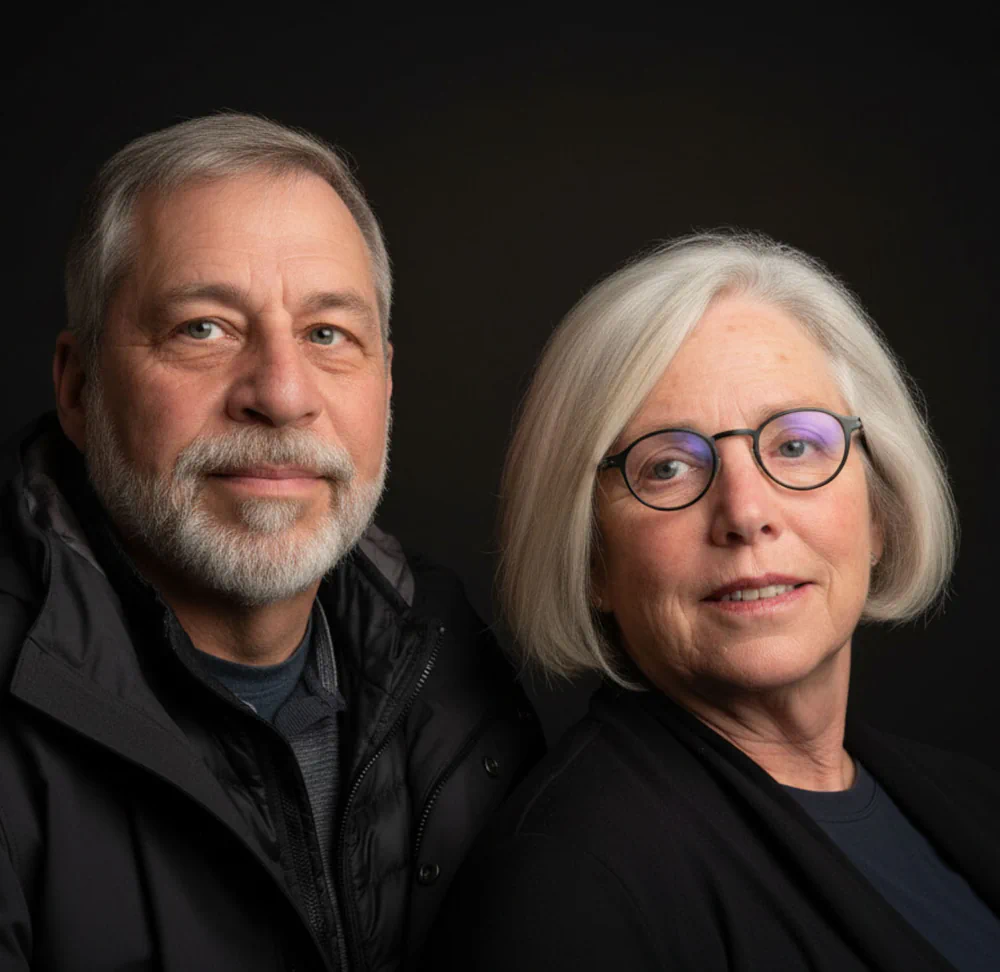
Steve Goldband and Ellen Konar are Bay Area photographic artists working in dynamic collaboration. Their co productions are often rooted in the landscape, evidencing Steve’s eye for geometry and light, elevated by Ellen’s interest in memory, meaning, and color. Both contribute to the full range of photographic endeavors, including image capture, processing, printing, and curating. Their commitment to surfacing and resolving their independent perspectives, a process rarely efficient and occasionally fraught, is the engine of their fifteen year photographic collaboration.
In their recent work, they often employ a camera mounted on drone technology. Hovering at roughly one hundred to three hundred feet, the drone serves as a mobile tripod, capturing scenes devoid of the grounding horizon line common to most landscape images. The mystery and translucency of these horizonless scenes are heightened by their embrace of the imperfection laden beauty of Japanese handcrafted papers and accentuated by their infusion of encaustic wax. Drawing on their backgrounds in psychology and technology, they emphasize the psychological tensions
between the natural world and the ambitions of human enterprise.
Ellen Konar and Steve Goldband’s photo based projects have appeared at galleries and museums such as the Center for Photographic Arts in Carmel, California; the Griffin Museum of Photography in Boston, Massachusetts; the Triton Museum of Art in Santa Clara, California; Soho Photo Gallery in Chelsea, New York; the Frederick Layton Gallery at MIAD in Milwaukee, Wisconsin; the Pacific Art League in Palo Alto, California; the Berkeley Art Center in Berkeley, California; Arc Gallery in San Francisco, California; Gray Loft Gallery in Oakland, California; the Awagami Museum in Tokushima, Japan; the Dohjidai Gallery of Art in Kyoto, Japan; and Gallery M in Yokohama, Japan. Their work has appeared in printed publications including LensWork Magazine, All About Photo, Seeing in Sixes, and Lenscratch Magazine. They have received awards from the Triton Museum of Art, the Center for Photographic Arts, LensCulture, and the Awagami Museum. In 2025, Ellen Konar and Steve Goldband were recognized as Photolucida’s 2025 Critical Mass Top 50. [Official Website]