
Antonella Cunsolo’s work operates within an uncomfortable yet necessary territory, where the image ceases to be surface and becomes a form of thought. Her practice, shaped by psychology and clinical experience, does not seek to represent reality as it is, but to give form to what usually remains hidden, fragmented, or difficult to articulate.
Throughout her trajectory, there is a clear shift toward an increasingly conceptual language, where photography becomes a space for symbolic construction. Her projects engage with complex issues such as identity, trauma, and the relationship with the body, always through a restrained, precise, almost surgical gaze.
In Issue 36 of Dodho Magazine, we presented her project “Borderline Ocean: What remains of Childhood Trauma”, a series that explores the lasting consequences of childhood trauma through images that move between aesthetic control and emotional instability. From this work, we spoke with her about her process, her approach, and the way photography can become a tool to understand what cannot be easily explained.

How did your relationship with photography begin, and at what point did you decide to take it seriously as a form of expression?
Photography entered my life at an early age thanks to my father, who passed on this passion to me. As a child, I was often his main subject, and I believe my relationship with images stems from there: even before photographing, I was observed, portrayed, and held within his gaze.
My father was a great aesthete and instilled in me a cult of beauty, an attention to light, harmony and color combinations, and the evocative power of images. But together with my mother, he taught me something more important: a profound sensitivity towards others, the ability to recognize and embrace human fragility without judging it. I believe my approach to photography today stems precisely from the encounter between these two dimensions: aesthetic research and the need to deeply understand and explain the human being.
I began to take photography seriously when it became for me a privileged and indispensable tool for expressing emotions, an indispensable space for inner and symbolic exploration, a language for giving form to what often remains invisible, emotionally complex, or difficult to express in words.
Today I can say that photography has healed many of my small wounds and still soothes the pain of the deeper ones, every day.
Without photography, I would feel incomplete, maimed.
You come from a background in psychology, psychotherapy, and phototherapy. At what moment did these disciplines fully merge into your photographic practice?
The fusion occurred gradually, but inevitably. For a long time, I viewed photography and psychology as two distinct, yet profoundly connected, languages. At a certain point, I realized that both were seeking the same thing: to make visible what normally remains hidden. Psychology taught me to observe, listen, and understand the complexity of the human being; photography gave me the ability to translate that complexity into images.
Today, my work is born and develops precisely from this encounter, to construct symbolic spaces in which emotions, memories, and conflicts can emerge visually.
Your work has evolved from landscape and urbex to portraiture and conceptual photography. What drove you toward this shift in visual language?
I believe it was a natural movement toward an increasingly interior exploration.
Landscape and urban exploration already represented, in some way, psychological states: on the one hand, awe and contemplation, on the other, decadence, abandoned and suspended places, traversed by time and absence.
Over time, however, I felt the need to draw closer to the human being and the emotional dimension. Portraiture and conceptual photography allowed me to construct less descriptive and more symbolic images, in which the body, objects, and space become elements of a psychic narrative. I am not interested in describing reality directly, but in evoking it in all its nuances.
Your current work carries a strong emotional charge. Would you say your photography emerges more from personal experience or from observing others?
It arises from both, but above all from the encounter between the two dimensions.
Personal sensitivity allows me to recognize certain fragilities and internal states; professional experience and listening to others allow me to move beyond a purely autobiographical perspective and transform those emotions into something shareable.
Many of my projects are born from real stories, from hours of listening and discussion, but they are never intended to be the portrait of a single individual. Rather, I seek to create archetypal images capable of speaking to a broader human condition, where the personal and the collective end up overlapping.
Creatively, how do you approach the beginning of a new project? Do you start with a clear idea, or with a more intuitive feeling?
Usually, everything stems from an emotional intuition rather than a rational idea.
There is almost always a mental image, a feeling, or a question that keeps returning and that I cannot let go of. From there, a highly layered research process begins: readings, pictorial references, psychological reflections, listening to real stories.
Only later does the project take on a more precise form. I never think of images as isolated photographs, but as fragments of a coherent symbolic universe, in which each element, light, body, space, and objects, contributes to constructing emotional and psychological meaning.
In Dodho Magazine, we presented your project “Borderline Ocean: What remains of Childhood Trauma” in Issue 36. How did this project originate, and what need was behind it?
“Borderline Ocean” was born from the need to give visual form to a suffering that is often invisible and difficult to describe.
It is a project born from listening to real stories, all sharing childhood traumas related to abandonment, neglect, and abuse. I was interested not so much in investigating the trauma itself, but rather what remains: its persistent traces in the construction of identity, in the conflicted relationship with one’s body, in the altered perception of reality and the surrounding world.
A past that does not fade away over time, but continues to live in the present, reactivating itself daily, influencing the way we feel, love, and exist, and casting its shadow on a fragile and inevitably compromised future.
The title evokes precisely this dimension: an unstable, profound, and constantly moving emotional ocean. The metaphor of the Ocean was created and described by psychiatrist and psychotherapist Luigi Cancrini in L’oceano borderline. Racconti di viaggio (2006, Raffaello Cortina Editore). The photographic work is inspired by this text.

The project explores childhood trauma as something that continues to shape adult life. What specifically were you trying to understand or reveal through this work?
I wanted to show how childhood trauma is not simply a painful memory confined to the past, but a structure that continues to organize the present.
I was interested in exploring how certain early experiences can fragment identity, alter the perception of oneself and others, and unsettle one’s relationship with reality and the body.
At the same time, however, I also wanted to explore attempts at psychic survival: defense mechanisms, symbolic constructions, gestures of self repair.
In this sense, the project speaks not only to the wound, but also to the constant tension between destruction and the possibility of reconstruction.
You chose a symbolic and conceptual language rather than a documentary approach. What does this allow you to express that a more direct form of photography would not?
Symbolic language allows me to work on a deeper, more universal level.
A documentary approach would have risked limiting the project to the biographical or journalistic dimension, whereas I wanted to represent internal states, not events.
Some psychological experiences, such as dissociation, emptiness, or fragmented identity, cannot be photographed directly. They must be evoked.
The conceptual construction creates a space suspended between reality and the mental dimension, where the viewer does not simply observe a scene, but is invited to inhabit it emotionally.
Furthermore, this approach allows me to protect the identity and vulnerability of the people whose stories inspired the work, transforming individual experiences into images with a broader collective and archetypal value.
The series evolves visually from a sense of apparent calm to more extreme psychological states. How did you structure this progression within the project?
The progression was constructed as a slow slide toward a loss of stability.
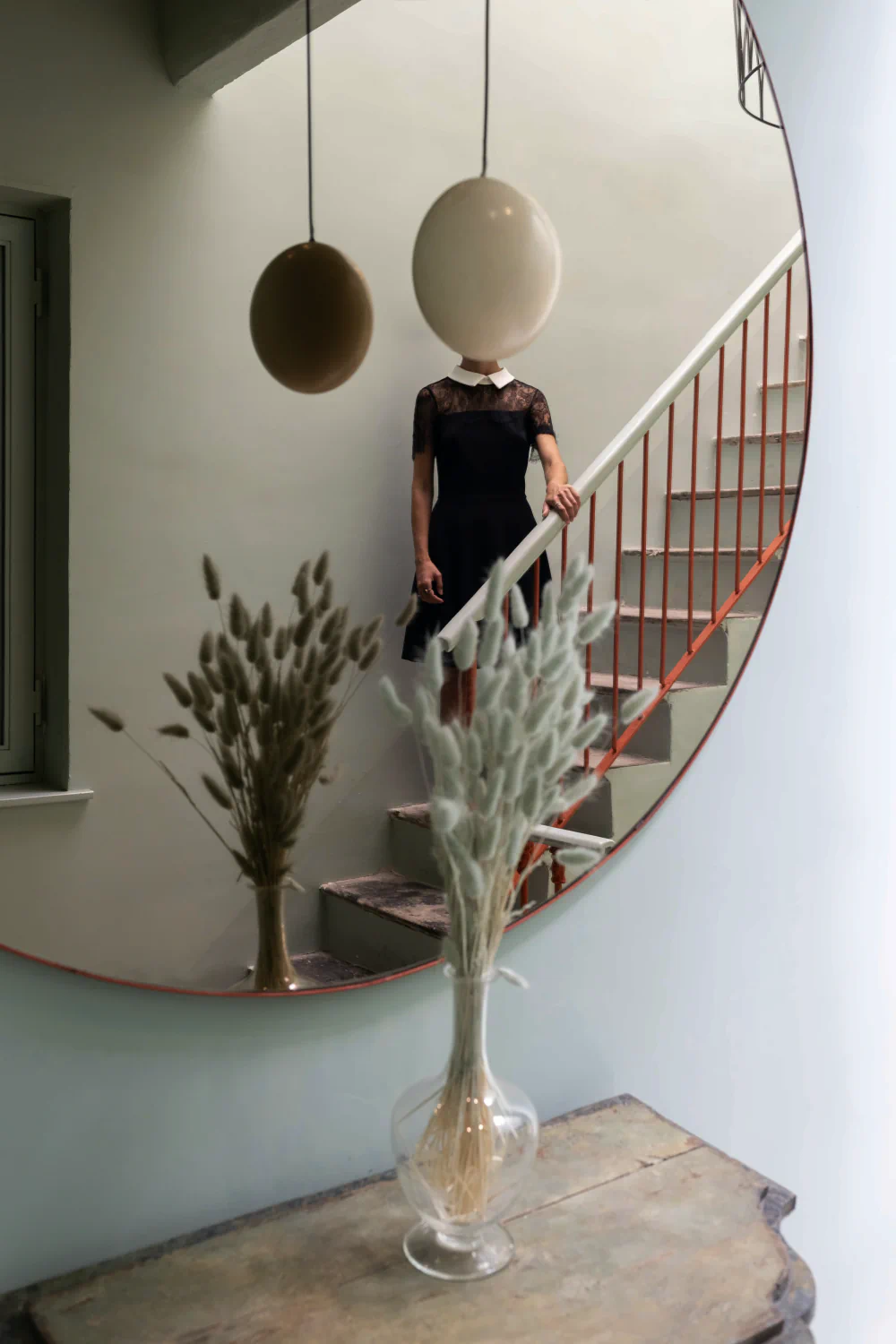
At the beginning, the images still maintain a more controlled composition: the spaces are more open, the light more balanced, even if already punctuated by fractures such as mirrors, reflections, and double images.
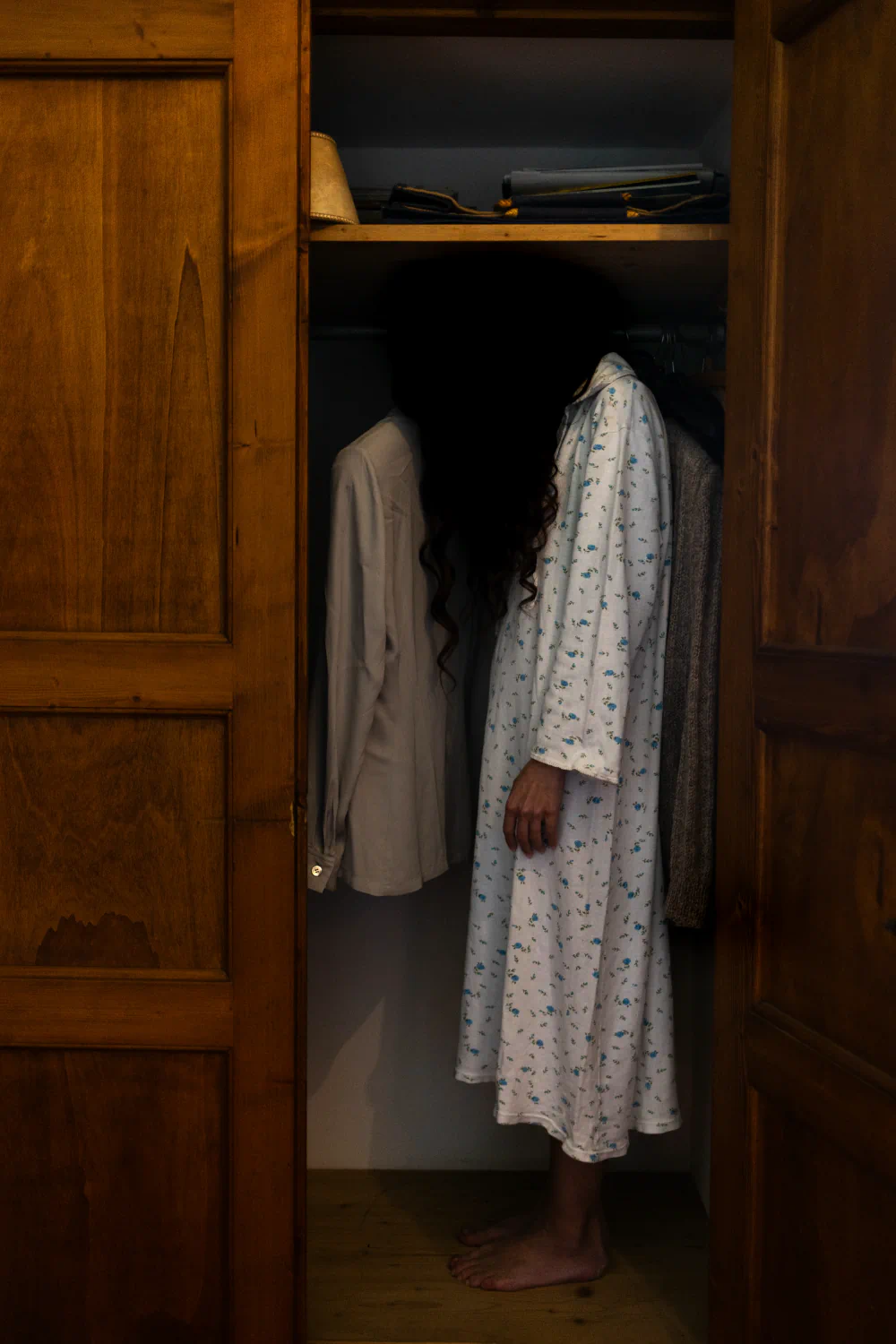
Gradually, however, the tension increases. The shadows become more closed, the contrasts more intense, the environments more claustrophobic.
The body also changes: from a relatively intact presence, it becomes increasingly fragmented, ambiguous, almost unrecognizable.
I was interested in the viewer perceiving this transformation not only on a narrative level, but above all on a sensorial and emotional level, as a progressive collapse of the psychic structure.
Elements such as mirrors, fragmented bodies, and the “Inner Mother” appear throughout the work. What role does symbolism play in the way you construct meaning?
For me, symbolism is not a decorative element, but the very core of the image’s construction.
Every object or gesture in the photographs functions as an extension of a psychic state.
Mirrors and reflections speak of unstable and fragmented identities. Partially hidden or disjointed bodies evoke dissociation and difficulty inhabiting oneself.
The “Inner Mother” introduces the theme of symbolic repair: the act of cradling a doll does not represent an idealized childhood, but rather the attempt to offer oneself the care that has been lacking.
I am interested in symbols remaining open, never fully explained, because it is precisely in that ambiguity that the image can continue to resonate with the viewer.
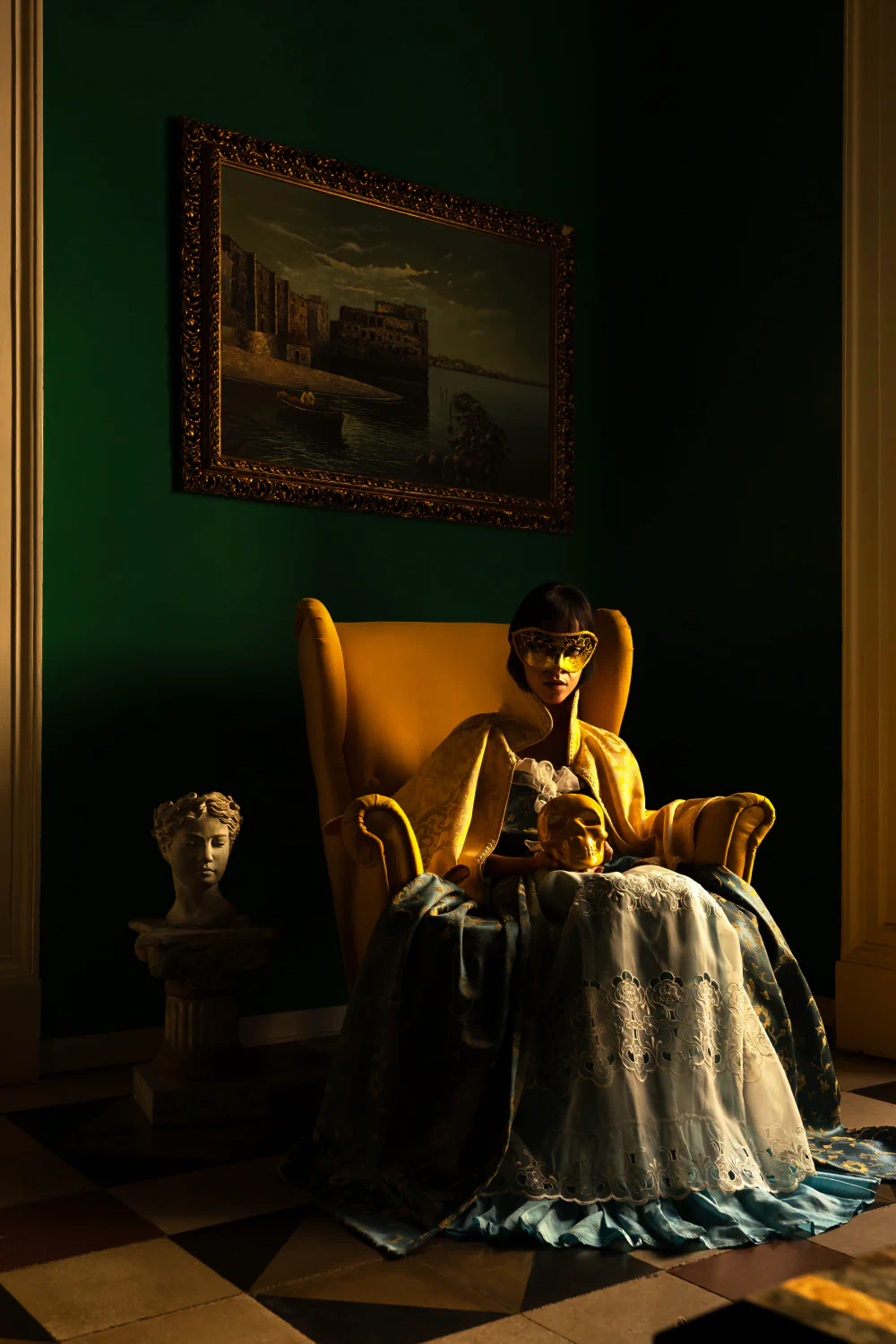
There is a constant tension between aesthetic control and emotional chaos. Does photography function for you as a way to give form to what feels internally unstable?
Yes, I believe photography also represents an attempt at containment.
Working on composition, light, and the construction of the image means creating a structure capable of accommodating something that, on an emotional level, tends toward dispersion or chaos.
I am interested precisely in this tension between formal rigor and psychological instability.
However, I do not think of aesthetics as a form of embellishment for pain. On the contrary, visual control serves to make it observable, to create a distance that allows engagement with highly complex content without being completely overwhelmed.
Beyond the personal dimension, the project also raises questions about collective responsibility. What do you hope the viewer takes away after experiencing these images?
First and foremost, I hope the viewer will perceive that trauma does not end with childhood and that certain wounds continue to profoundly impact adult life, even when they remain invisible.
I am interested in opening a space for reflection on psychological fragility without reducing it to a stigma or clinical label.
The project also aims to promote collective responsibility.
Is it enough to remove a child from a harmful environment if continuity of care and support is not guaranteed into adulthood?
Because those who grow up in fragmented environments remain fragile and often struggle to achieve full independence without constant support.
Many of these conditions are not even diagnosed.
I hope these images are not perceived simply as representations of pain, but as an invitation to look more deeply at what often remains hidden, ignored, or simplified.