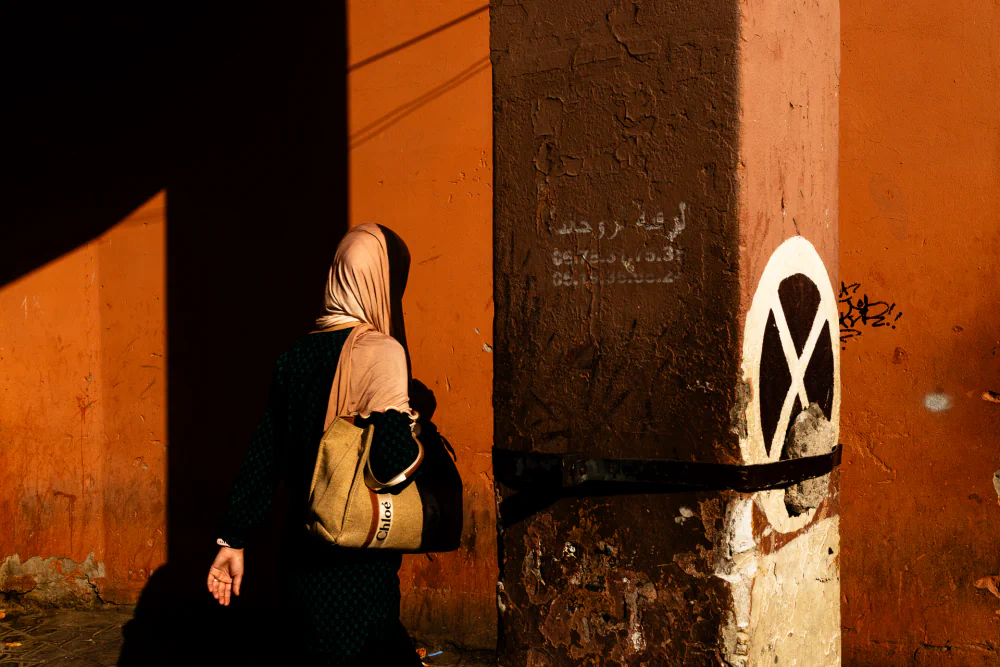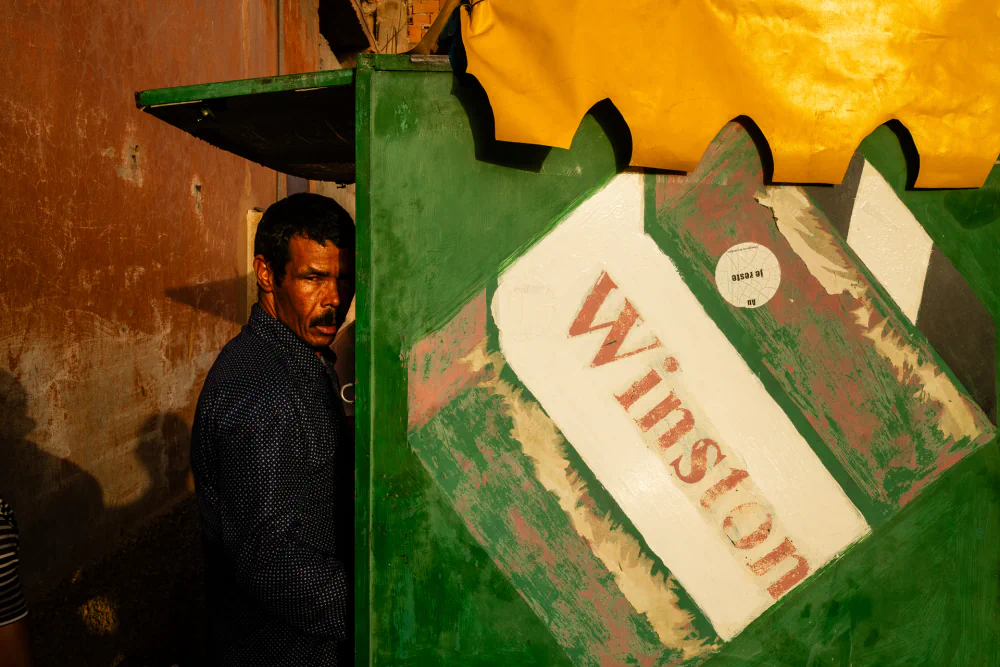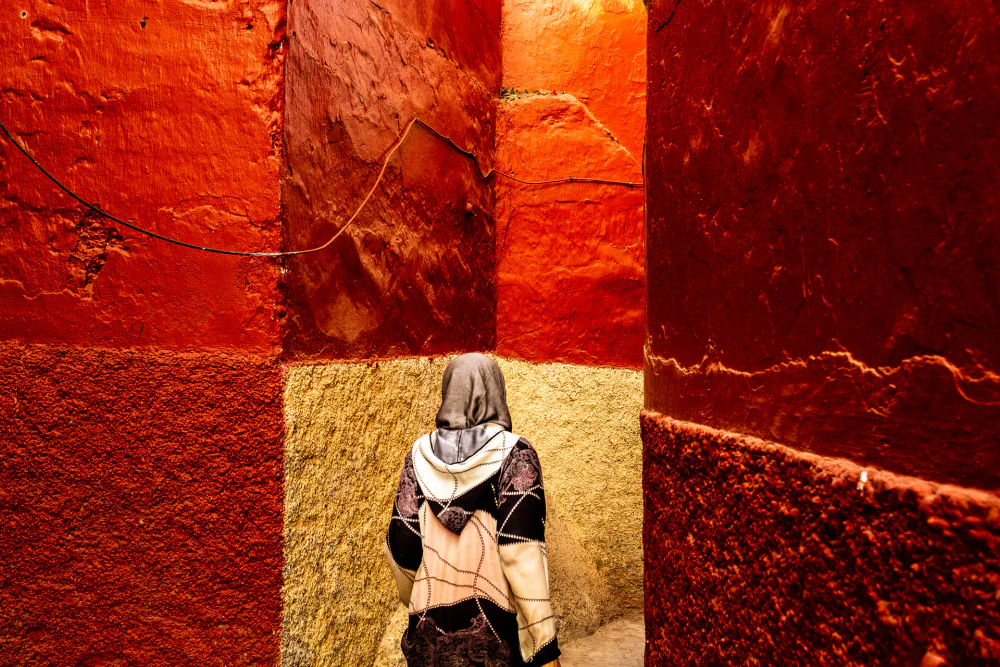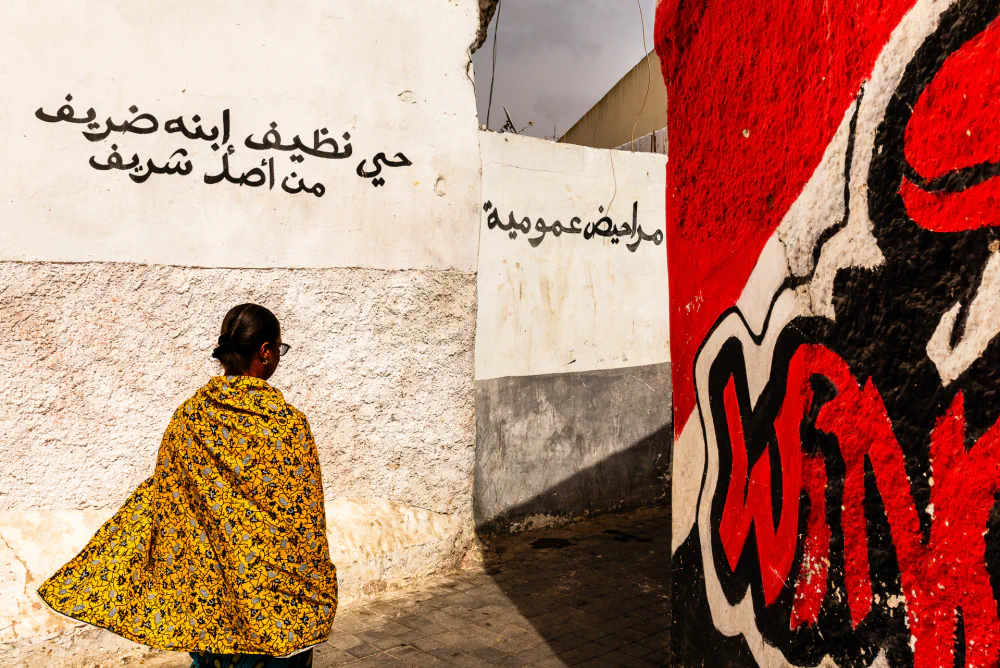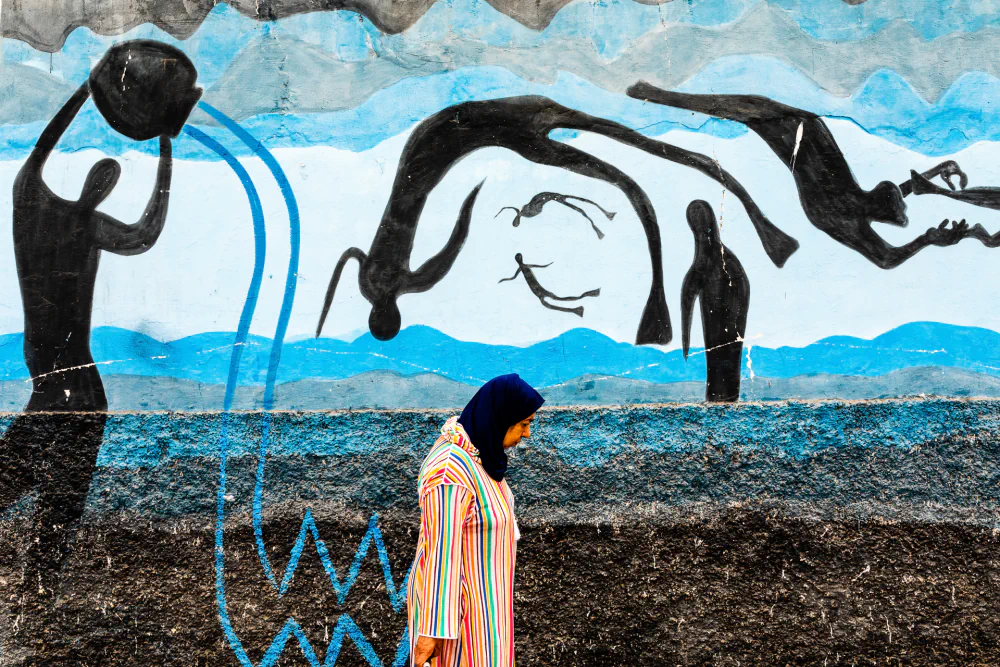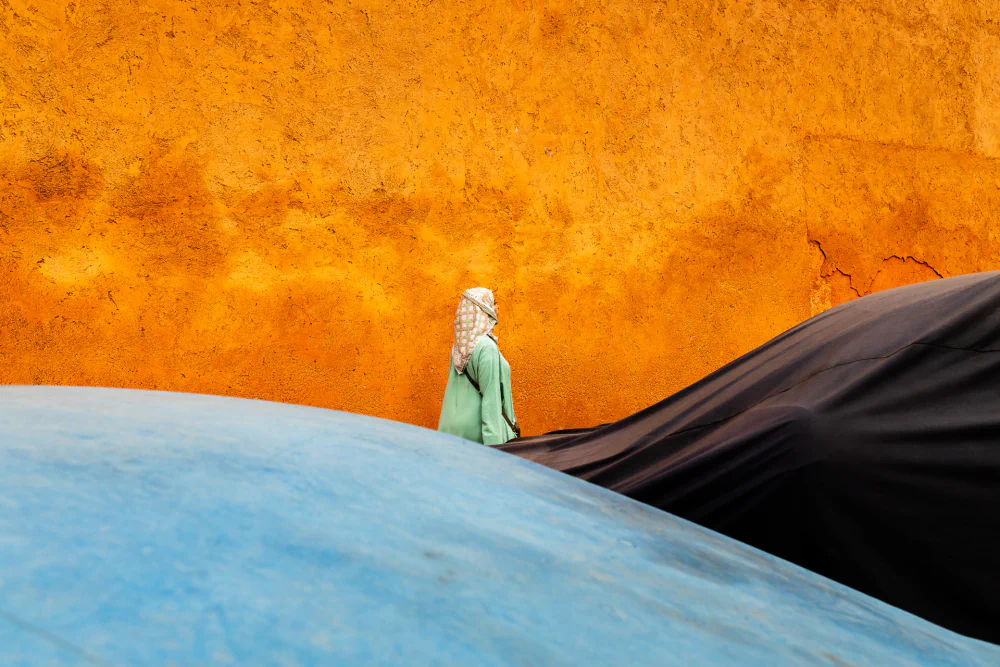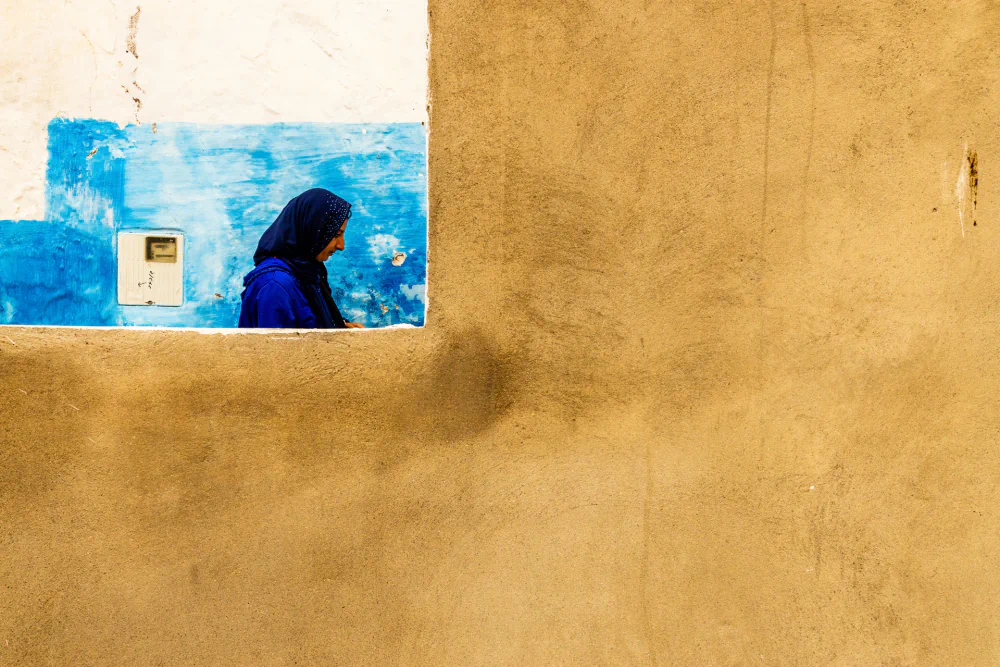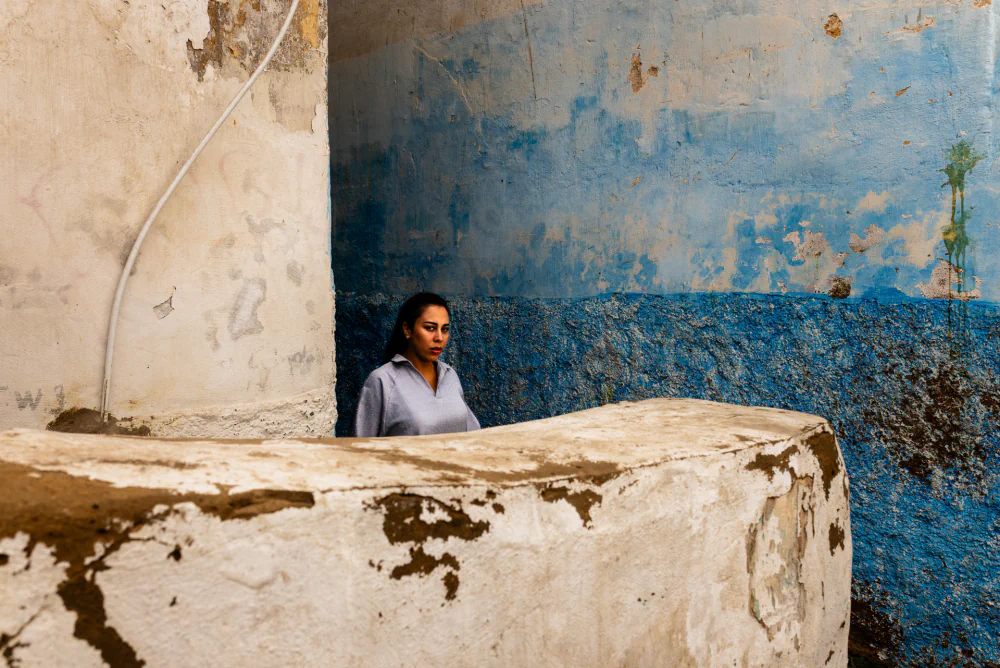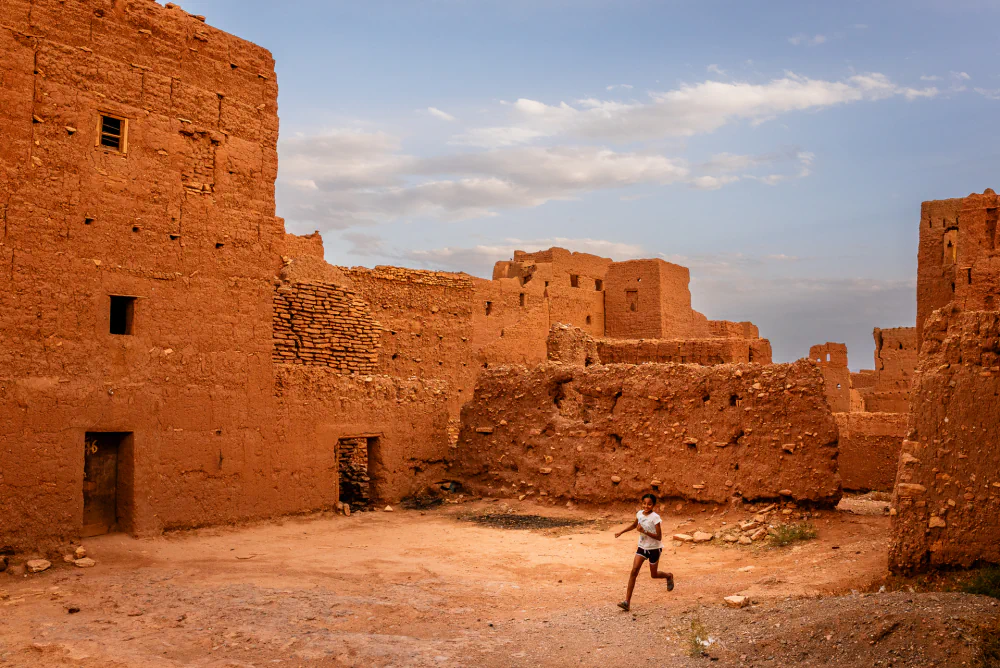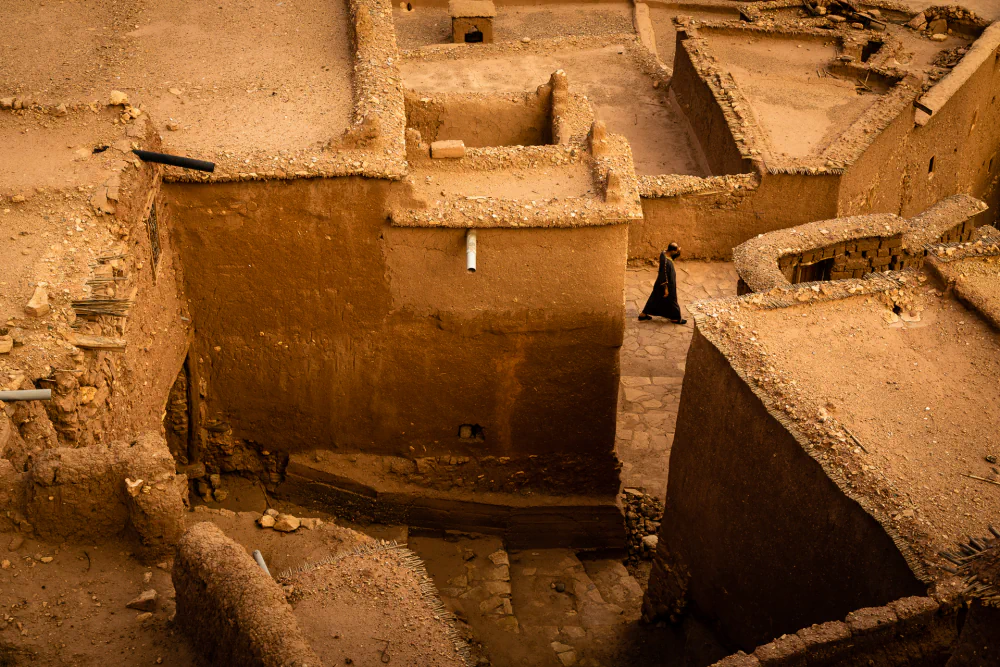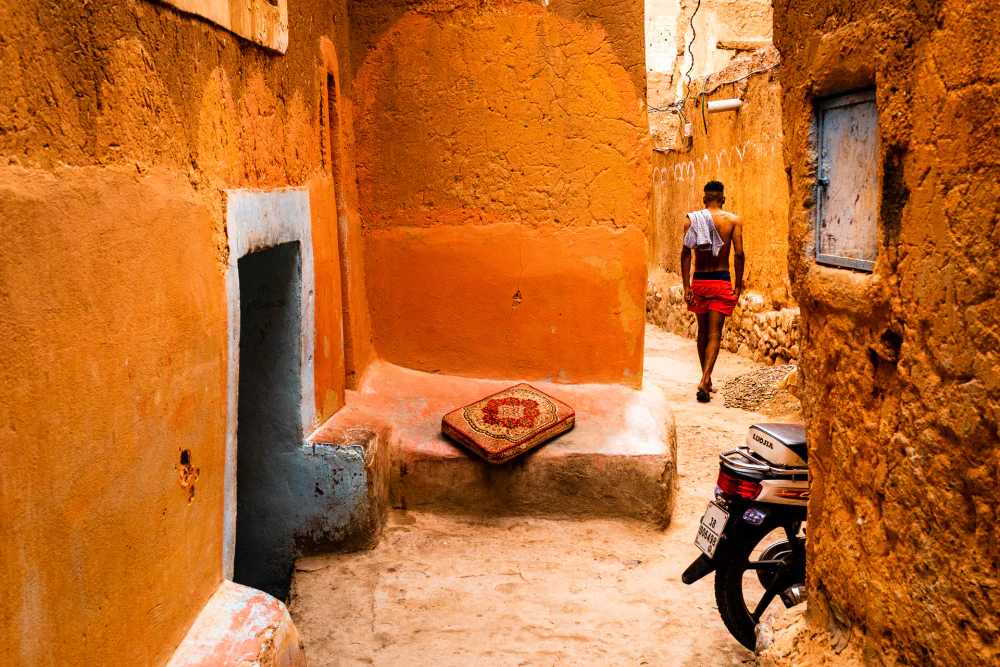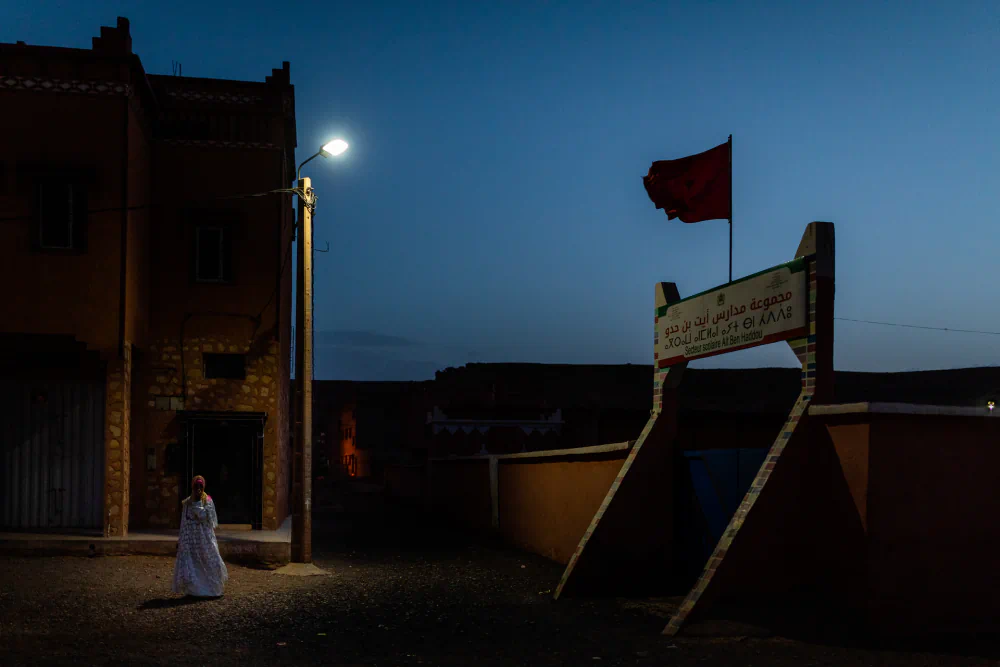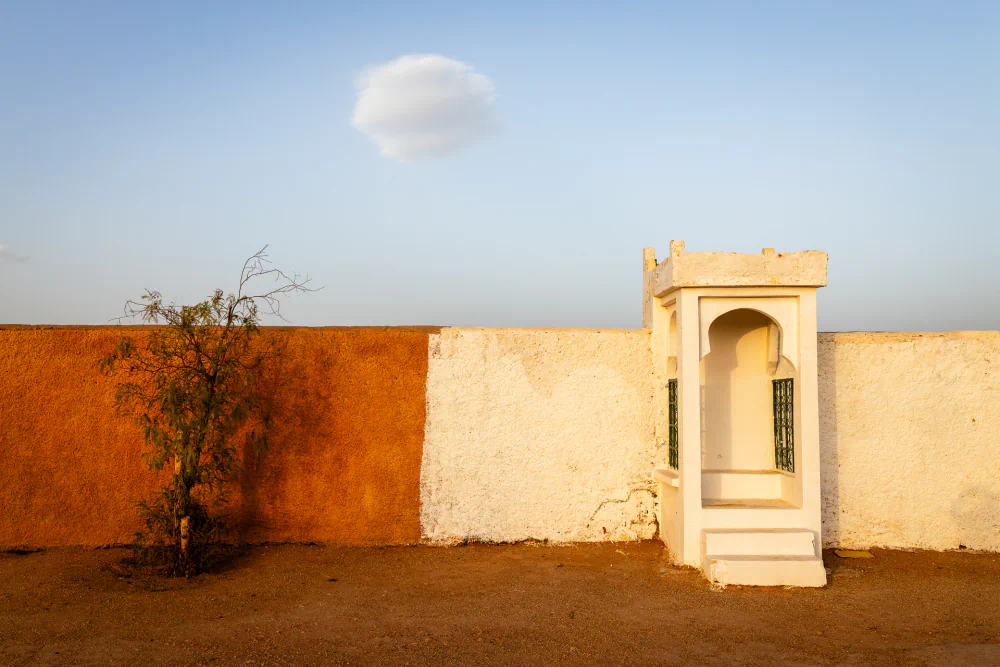


Morocco holds a rare and resistant beauty: a place where ancestral rituals and traditions weave the sacred with the profane, where time moves differently and atmospheres feel suspended, outside ordinary sequence.
Its colors are not decorative; they are elemental.
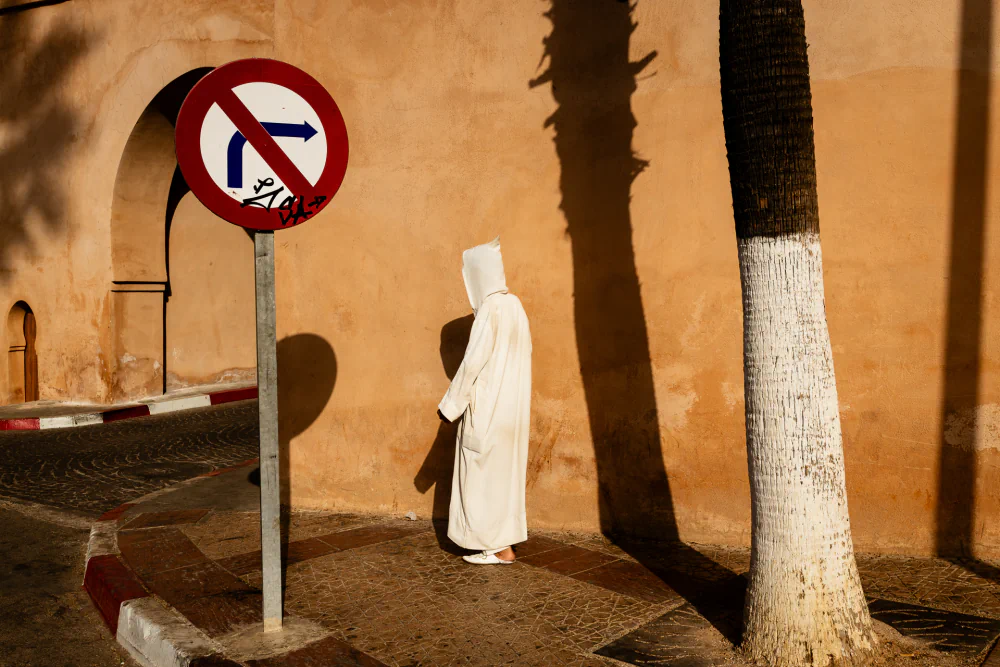
Sand and wind, sea and fire, the blinding sun: these forces do not merely shape the landscape; they shape the spirit of those who inhabit it. Above all, ochre yellow persists and dominates, deepening in intensity as it bathes forms in purity and reveals the preciousness of every detail.
Morocco today exists within a complex moment of transformation. Processes of modernization are visible and accelerating, yet something deeper holds. Traditional gestures persist within contemporary contexts; architecture adapts while retaining its symbolic core. It is this coexistence, not as picturesque contrast but as lived condition, that the work tries to inhabit.
The photographer returns to this country across multiple journeys, carrying the particular attention of someone who is neither fully outside nor fully inside what he observes. His position is that of a street colorist: he does not stage or intervene, but moves through space in a state of sustained readiness, waiting for the moment when forms, bodies, and light converge with a kind of inevitability. This practice requires patience and a willingness to remain present without imposing direction, to let the image come rather than go looking for it.
The compositions that result may appear constructed, but they are found. At every turn, scenes emerge as if drawn or painted, yet they are nothing more than the spontaneous arrangements of everyday life. Morocco cannot be narrated; it can only be witnessed, one unguarded moment at a time.
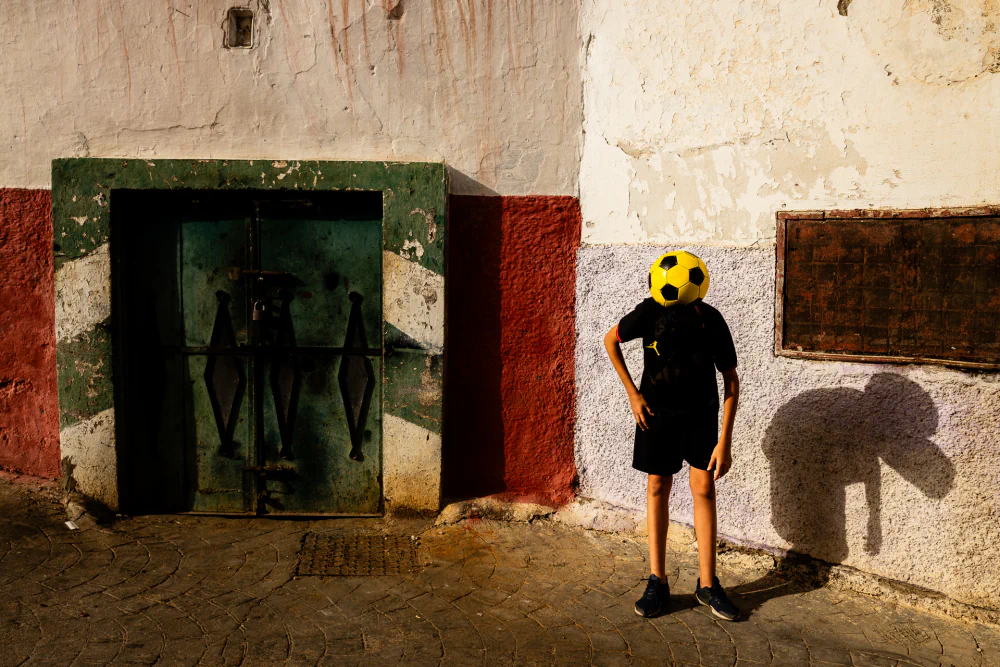
In Morocco, color is not something one sees; it is something one lives. Dense, radiant, and enveloping, it saturates surfaces and gestures alike. A white wall shifts toward blue or pink depending on the hour. Earth tones move from ochre to deep red to gray as the light changes. Within this constant transformation, color becomes a way of reading the world: of understanding how a place breathes, how it holds its people, and how it persists. For the photographer, it is the primary language through which Morocco reveals itself, not as background or atmosphere, but as structure; a force that organizes perception and carries meaning.
The idea of an atlas, here, is not geographic in a conventional sense. It is fragmentary, subjective, and deliberately incomplete; a constellation of impressions rather than a fixed narrative. Each image functions as a point of entry, suggesting connections rather than establishing them. There is no single story being told, no argument being made. What accumulates across these encounters is something closer to a state of attention: a record of remaining open to what unfolds, to what resists definition, and to the generosity of a people eager to share their world. The atlas grows with each return, and it will never be finished.
Morocco, Sentimental Atlas is also a deeply personal project. Morocco is the birthplace of the woman he loves, the land that holds her roots. This work is not only a tribute but also a search: an attempt to trace the shades that illuminated her childhood, to map the emotions that bind memory to place and past to present.
To photograph Morocco through this lens is to move between two kinds of knowledge: his, which is still being formed, and hers, which is carried in the body and needs no explanation. He is someone trying to understand a world that is second nature to her and still revelatory to him.
This is, in the end, a love letter to a country that keeps giving itself in color, in light, and in the blue hour that falls over its cities each evening, softening edges and stilling sound before the desert swallows the horizon whole.
About Nicola Fioravanti
Nicola Fioravanti, born in 1985, is an Italian photographer working between France, Morocco, and Italy. His practice investigates the expressive and emotional potential of color within contemporary urban environments, using photography as a way to observe how chromatic structures shape perception, rhythm, and spatial experience.
His work has been recognized with international awards, including the Sony World Photography Awards, the International Photography Awards, the 1839 Awards, and the ND Awards. It has also been presented in both solo and group exhibitions at institutions such as Somerset House in London, the Pinakothek der Moderne in Munich, the Centro Internazionale di Fotografia Letizia Battaglia in Palermo, the Palais de Tokyo and the Sorbonne in Paris, the Fnac galleries in Paris and Lyon, and Galerie Bab Rouah in Rabat.
His photographs have been featured in international publications and cultural platforms worldwide. He has also participated in major festivals and events, including the Getxophoto Festival in 2024 and 2025, and the Rencontres d’Arles in 2025, where he took part in a collective screening dedicated to Morocco as part of La Nuit de l’Année. In 2024, he received the Public Prize during a residency at the Festival Planches Contact in Deauville, under the artistic direction of Laura Serani.
Fioravanti’s work is characterized by a sustained inquiry into color as both structure and atmosphere, situating everyday urban spaces within a visual language that oscillates between documentation and abstraction. [Official Website]