

For much of the twentieth century documentary photography and street photography were built upon a belief that seemed almost unquestionable: reality should be represented in black and white.
This was not merely a technical decision. It was a cultural position. Black and white was associated with truth, with journalistic seriousness and with the aesthetic authority of modern photography. Color, by contrast, was often dismissed as something vulgar, commercial or amateur, more closely associated with advertising and popular imagery than with serious photographic practice.
Within that context the figure of Fred Herzog emerges as something quietly radical. Without seeking recognition or attempting to challenge the conventions of his time in any explicit way, Herzog began to construct one of the most fascinating visual chronicles of twentieth century urban life using precisely the element that photography seemed reluctant to accept: color.
Herzog was not working from the great cultural centers of photography. He was not part of the circles that defined the photographic discourse in New York or Paris. His territory was Vancouver, a port city undergoing rapid transformation in the decades following the Second World War. Walking through its streets with a Leica camera loaded with Kodachrome film, Herzog began recording everyday scenes that would eventually become one of the most extraordinary visual archives of urban life in the twentieth century.
At first glance what Herzog did appears simple. He photographed streets, storefronts, pedestrians, advertisements, workers, cars and corners that might otherwise have gone unnoticed. Yet beneath that apparent simplicity lay something far more significant. Herzog was developing a completely different way of looking at the modern city.
His photographs do not seek dramatic events or decisive moments in the classical sense popularized by Henri Cartier Bresson. Instead Herzog was drawn to the visual rhythm of everyday life. He observed how color shaped the experience of the urban environment, how painted signs, shop windows, neon lights and ordinary objects created a visual language unique to modern cities.
The Vancouver that appears in his photographs is a landscape in transition. Old neighborhoods coexist with new constructions. Small family businesses survive alongside the first signals of mass consumer culture. The city becomes a stage where countless small stories unfold simultaneously, and Herzog seems to understand that color is the only tool capable of capturing that complexity.
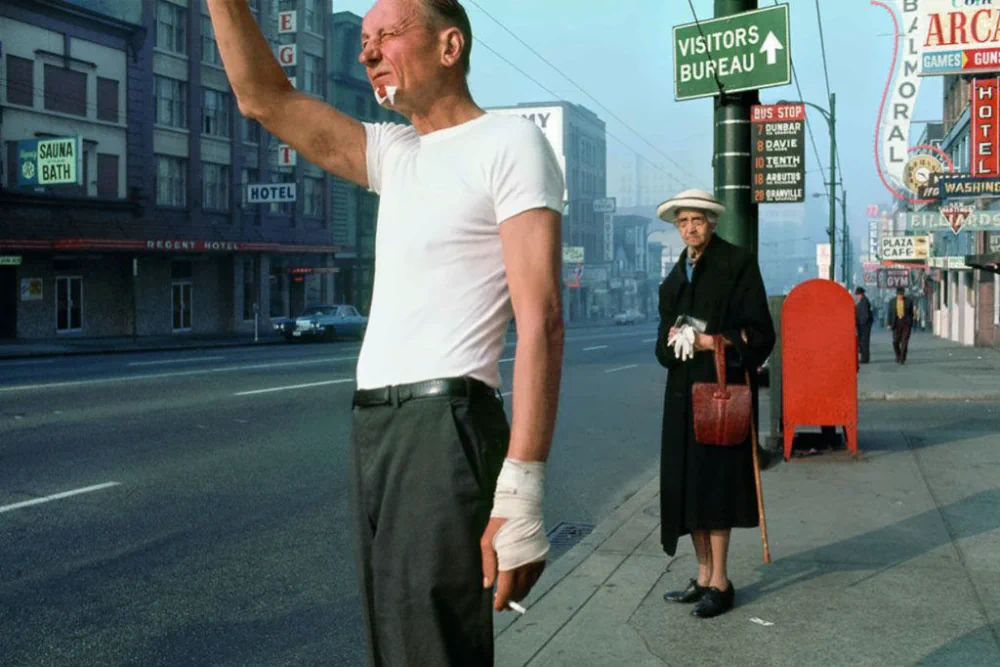
For decades, however, his work remained largely invisible. The technical limitations of the period made it extremely difficult to reproduce color photographs with the quality required by editorial publications or museum exhibitions. Kodachrome film produced extraordinary transparencies, but printing them accurately was another matter entirely.
As a result, while other photographers of his generation gained international recognition, Herzog’s archive continued to grow quietly in the background.
It was only in the late nineteen nineties and early two thousands that his work began to be rediscovered. Advances in digital reproduction technology finally allowed those decades old Kodachrome slides to reveal their full visual power. What emerged was something remarkable. What had long appeared to be a historical archive suddenly felt strikingly contemporary.
It became clear that Herzog had anticipated something photography itself would take decades to fully accept: color was not simply compatible with documentary photography. It had the power to transform it.
Vancouver as a visual laboratory
Everyday urban life as cultural document
To understand the importance of Fred Herzog’s work it is essential to look at the context in which his photographic vision developed.
Herzog arrived in Canada from Germany in nineteen fifty two. Like many European immigrants after the war he was searching for a new beginning. Vancouver, with its mixture of cultures, its active harbor and its rapid urban growth, offered an ideal setting in which to observe how modern life was taking shape in real time.
Unlike photographers who traveled in search of extraordinary events, Herzog found his material in the ordinary fabric of daily life. He walked through downtown streets, working class neighborhoods, commercial avenues filled with hand painted advertisements and industrial areas where human activity merged with the functional architecture of economic expansion.

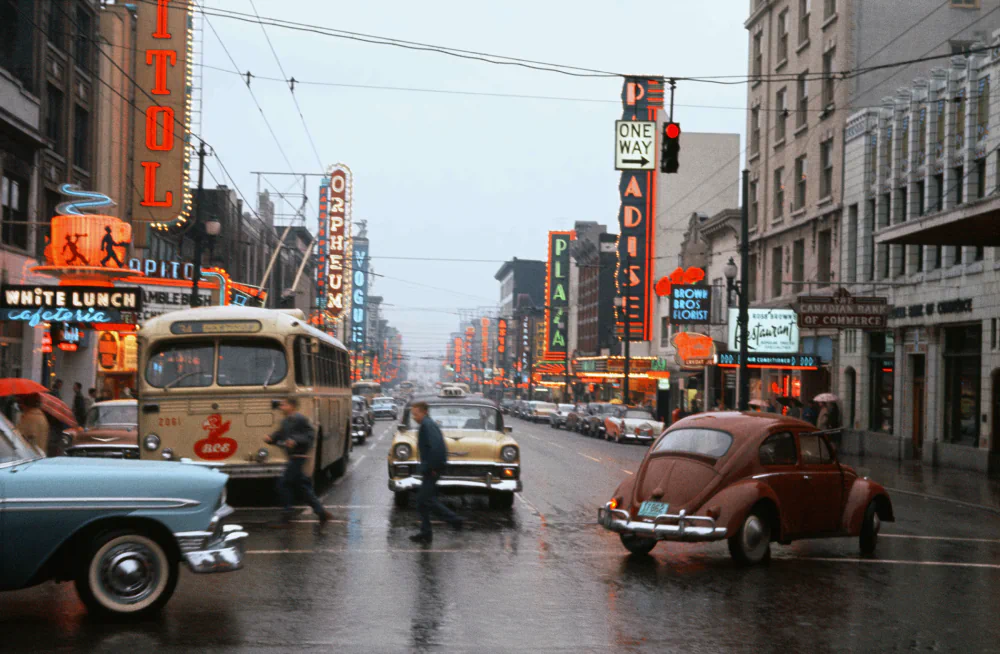
His photographs capture a very specific historical moment: the emergence of the contemporary city as we know it today. The streets Herzog photographed were filled with visual signals that defined twentieth century urban culture. Hand painted advertising signs, large typographic facades, brightly colored cars, crowded shop windows and a social life that unfolded almost entirely in public space.
All of these elements created a visual choreography that Herzog instinctively understood.
Many of his images appear to be structured through layers. In the foreground a person or everyday object anchors the scene. Behind it a building facade or advertisement introduces a dominant field of color. In the distance the architecture of the city completes the composition.
The result is a photograph that operates simultaneously as social document and aesthetic construction.
One of the most striking aspects of Herzog’s work is the absence of artificial drama. He does not manipulate situations or seek spectacular events. The intensity of his photographs emerges from the normality of the moments he records.
A woman waiting for a bus.
A man walking past a tire shop.
Children playing on a quiet sidewalk.
Scenes that appear insignificant at first glance yet, decades later, become fragments of urban memory.
Color plays a crucial role in this transformation.
The intense reds of advertising signs, the saturated greens of painted buildings or the bright yellows of certain cars are not simply decorative elements. They function as visual anchors that organize the reading of the image.
Herzog understood that the modern city could not be fully represented in black and white. Urban visual culture was fundamentally built around the impact of color.
Advertising, graphic design, commercial architecture and urban signage all relied on color to capture attention. To photograph that reality without color was, in a sense, to remove an essential part of its language.
For this reason Herzog’s work anticipates many of the concerns that photographers such as William Eggleston and Stephen Shore would later explore. Yet unlike them Herzog did not approach color through an explicit conceptual framework. His method was more intuitive, closer to sustained observation than to theoretical declaration.
The city was his studio.
The street was his laboratory.
And color was the instrument through which he decoded the visual landscape of the twentieth century.

The legacy of Fred Herzog
How his archive reshaped the history of color photography
Today when the revolution of color photography is discussed, names such as William Eggleston or Joel Meyerowitz often appear as essential references. Both played a crucial role in legitimizing color within the artistic discourse of photography.
Yet the work of Fred Herzog reveals that this transformation was more complex and that some of its most important figures remained largely unrecognized for decades. The rediscovery of Herzog’s archive significantly altered the way historians interpret the development of color photography. The Kodachrome transparencies he produced from the nineteen fifties onward revealed something extraordinary. The use of color within documentary photography existed long before the art world was ready to embrace it.
During the years Herzog was photographing Vancouver most documentary photographers still worked primarily in black and white. This was not merely a stylistic preference. Magazines, newspapers and galleries were structured around that visual tradition.
Color belonged elsewhere.
What Herzog did was insist on a simple but powerful intuition: contemporary reality was saturated with color and photography should reflect that fact.
That modest gesture carried enormous consequences.
When his work began to appear in international exhibitions in the early two thousands many critics and curators realized that Herzog’s archive was not simply a historical record. It was a body of work that had anticipated a fundamental aesthetic transformation.
His photographs do not only show what Vancouver looked like during the nineteen fifties and sixties. They reveal how urban visual culture itself began to organize around color.
In many ways Herzog was photographing the birth of a new urban aesthetic. Today his influence can be traced in numerous contemporary photographers who work within public space. The attention to color, typography, commercial architecture and the relationship between people and the visual language of the city has become a defining aspect of modern street photography.
Perhaps Herzog’s most important legacy lies elsewhere.
He demonstrated that photography does not require spectacular events in order to construct a powerful collective memory. Sometimes it is enough simply to observe what happens every day.
A street corner.
A storefront.
A brief exchange between strangers.
Over time such moments become cultural documents of immense value.
Decades after Herzog walked the streets of Vancouver with his Leica loaded with Kodachrome, his photographs continue to produce a strange and compelling sensation. Looking at them feels like opening a window onto a past that, although distant, remains deeply familiar.
The city has changed.
Painted advertisements have disappeared.
Cars and architecture are no longer the same.
Yet the essence of urban life remains unchanged: an endless succession of small moments which, when seen with the right eye, become history. Fred Herzog understood this before almost anyone else. And because of that intuition his archive no longer belongs only to the past of photography. It has become part of its future.