
To speak about Martin Parr is to speak about rupture. Not a theatrical or heroic rupture, but a quiet and corrosive one.
In the 1970s and 1980s, when British documentary photography still largely orbited around black and white humanism, shaped by postwar seriousness and classical social commitment, Parr turned the wheel in another direction. He embraced saturated color, frontal flash, uncomfortable proximity, and a gaze that did not ask for permission. That aesthetic decision was not merely formal. It was political.
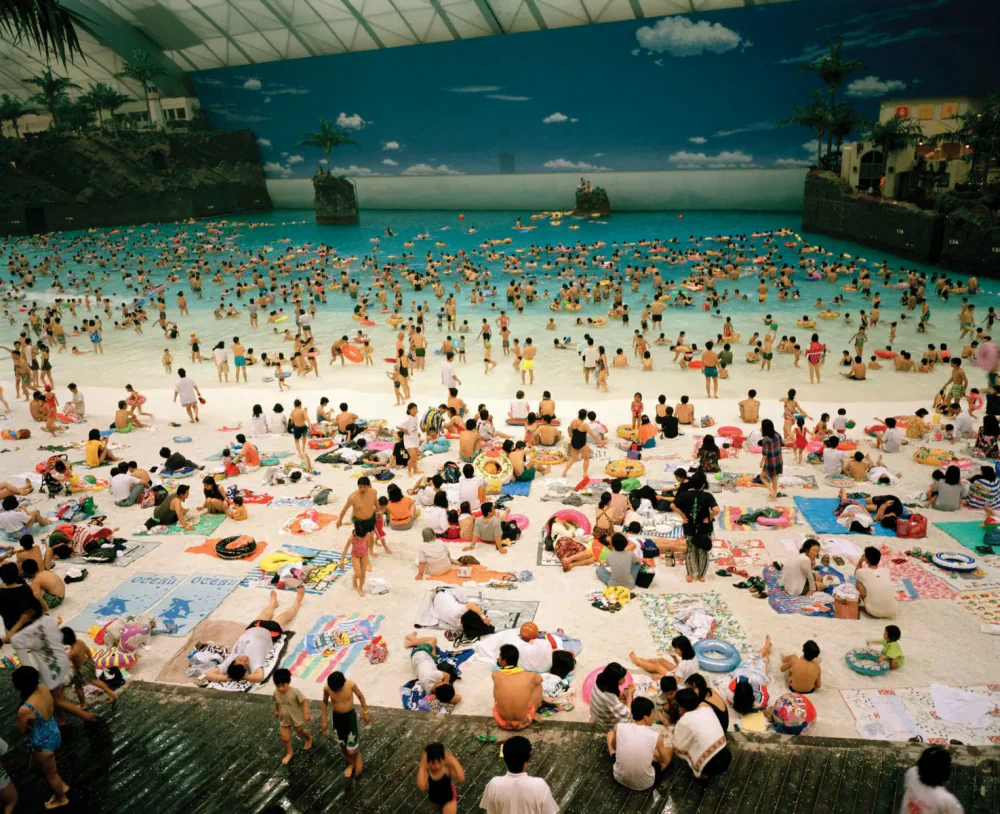
At a time when black and white was still associated with seriousness and documentary legitimacy, Parr understood that color could cut deeper than any explicit statement. He did not use color to beautify, but to expose. Sunburned skin, the electric blue of an artificial pool, the acidic yellow of an industrial drink, the plastic pink of a cheap souvenir all became signs of a visual culture dominated by consumption and standardization.
His series The Last Resort marked a turning point. Produced in New Brighton, a British seaside town in decline during the Thatcher era, the work did not seek sympathy. Nor did it offer overt denunciation. It showed. Families eating chips on dirty sand, sticky children under relentless sunlight, trash mingling with towels and inflatable toys. The framing is tight, the flash direct, the composition overloaded with information. There is no moral hierarchy within the image, but there is evidence: leisure itself is a symbolic battleground.
The backlash was fierce. He was accused of mocking the working class. Of cruelty. Of turning hardship into spectacle. Yet that discomfort was precisely the core of the project. Parr invented nothing. He photographed what was already there. The uneasy question was not why he showed those scenes, but why we found them offensive when confronted with them. Was the photographer the problem, or the mirror?
In this tension, his language took shape. Parr rejects the moralizing distance of classical documentary. He also refuses the refuge of abstract conceptualism. He moves close, fires the flash, and lets excess speak. His photography is not minimalist. It is dense with cultural information. Every inch of the frame contains signs: brands, packaging, industrial colors, repeated gestures.
Color in Parr is not decorative. It is diagnostic. To saturate is to reveal. To exaggerate is to describe with precision a reality that is already excessive. Consumer society does not need caricature. It is already a caricature of itself.
His admission to Magnum Photos in 1994 sparked further controversy. Some longstanding members believed his approach did not align with the agency’s humanist tradition. Yet that very tension expanded the definition of documentary practice. Parr demonstrated that social critique could take on visually uncomfortable, even seemingly frivolous forms.
What defines this early phase of his career is conceptual coherence. There is no gratuitous irony. There is cultural analysis through detail. Parr recognized that popular culture, mass tourism, industrial food, and compulsive consumption were not marginal subjects. They were the true landscape of contemporary life. And under his gaze, that landscape ceases to be banal and becomes symptomatic.
Tourism, Identity, and Globalization
The World as Theme Park and the Endless Repetition of the Same
If The Last Resort localized critique within a specific British context, his later work expands the field of observation to a global scale. Tourism becomes one of his central themes. Not romantic tourism, but mass tourism. Serial, repetitive, standardized tourism. Tourism as contemporary ritual.
Parr photographs tourists photographing. People viewing monuments through the screens of their devices. Crowds reproducing identical gestures in different corners of the planet. The Eiffel Tower, the pyramids, tropical beaches, shopping malls. The scenery shifts; the behavior remains the same.
Here, irony becomes more refined. Nothing needs to be underlined. The frontal composition and direct flash continue to function as instruments of dissection. The souvenir, the all inclusive resort bracelet, the perfectly plated restaurant dish, the buffet table: each object operates as a cultural indicator.
In Small World, Parr reveals how globalization homogenizes experience. The world becomes a catalog. Travel no longer means discovery but confirmation of a preexisting image. We travel to reproduce a postcard we already know.

What makes his approach compelling is that he does not position himself outside the system. He does not claim moral superiority. He is part of the global art circuit. He exhibits internationally, travels constantly, publishes extensively. That self awareness adds complexity to his critique. It is not accusatory. It is observational from within.
He also turns his lens toward wealth and exclusivity. In Luxury, he infiltrates art fairs, elite gatherings, private clubs, high end events. The result is not glamorous. It is excessive. Champagne, jewelry, carefully curated gestures, bodies tense under the weight of status. Under his lens, affluence is as performative as leisure on a public beach.
Whether photographing working class holidaymakers or global elites, Parr applies the same method. The coherence lies in the approach, not the subject.
His body of work ultimately functions as an anthropological archive of the late twentieth and early twenty first centuries. An archive where consumption is the central thread. From supermarkets to art fairs, from seaside resorts to luxury venues, all operate within the same visual logic.
Repetition is key. Parr understands that globalization standardizes not only products, but gestures, postures, desires. The camera records this repetition until it becomes undeniable.
There is no nostalgia in his gaze. No romantic longing. There is lucidity. The contemporary world is bright, colorful, filled with objects and stimuli. And precisely for that reason, it is unsettling.

Legacy, Influence, and Controversy
Cynicism or Precision? The Ongoing Debate Around His Vision
Martin Parr’s impact on contemporary photography is undeniable. His saturated color palette and direct flash have influenced generations of photographers who realized that advertising aesthetics could be repurposed as critical tools.
In an era shaped by Instagram and visual overexposure, his work feels almost prophetic. Chromatic excess, invasive proximity, fascination with the banal. All resonate with today’s image culture. Yet the difference is conceptual. Much contemporary imagery seeks seduction. Parr seeks revelation.
The debate over whether his gaze is cruel or simply honest remains unresolved. Some see cynicism. Others see one of the most precise chroniclers of consumer society. What is undeniable is that his work demands a position. It does not allow indifference.
His editorial production is vast. He has published dozens of books, amassed an extraordinary photobook collection, and helped solidify the photobook as a central format in contemporary photographic practice. For Parr, sequencing and editing construct meaning as decisively as any single image.
His work has been widely exhibited in major institutions worldwide, securing his place within the contemporary canon. Yet institutional recognition has not softened his language. It remains uncomfortable.
What once scandalized has now become reference. Saturation no longer shocks. Frontal flash is commonplace. Intense color is standard practice. But in Parr’s hands, these were not trends. They were strategic decisions.
Ultimately, his work poses a fundamental question. What do we expect from documentary photography? If we seek idealized empathy, his images may feel harsh. If we seek cultural analysis, they become indispensable.
Martin Parr offers no redemption, no epic narrative. He offers observation. And within that apparently light observation lies a profound critique of how we live, consume, and stage our own experiences.His legacy rests not only in his images, but in having expanded the boundaries of documentary practice. He proved that irony does not cancel commitment. That color does not diminish depth. That the banal is, in fact, the core of our culture. And above all, that photography does not have to comfort us. It can simply show us exactly as we are.