

The Leica M2 did not arrive with the fanfare of a technological breakthrough. Instead, it quietly adjusted the Leica system to match how photographers were actually working by the late 1950s.
While the M3 had been engineered around the 50 mm lens, many photographers were already gravitating toward wider focal lengths to engage more directly with the urban environment. The M2 acknowledged this shift and built it into the camera itself.
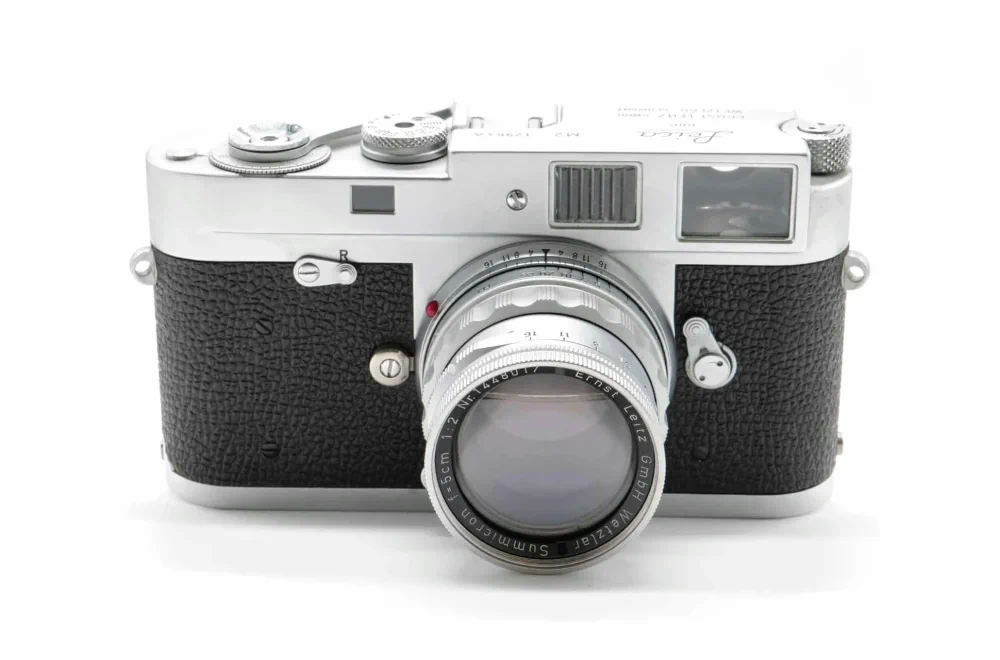
Its viewfinder introduced dedicated 35 mm framelines, making that focal length feel native rather than adapted. This mattered enormously. The 35 mm lens encouraged photographers to move closer, to include context, to let subjects interact with their surroundings rather than isolating them. The camera supported a more immersive way of photographing the street, where distance was replaced by participation.
In this sense, the M2 did not invent a new practice. It validated one that was already emerging.
Built for Use Rather Than Prestige
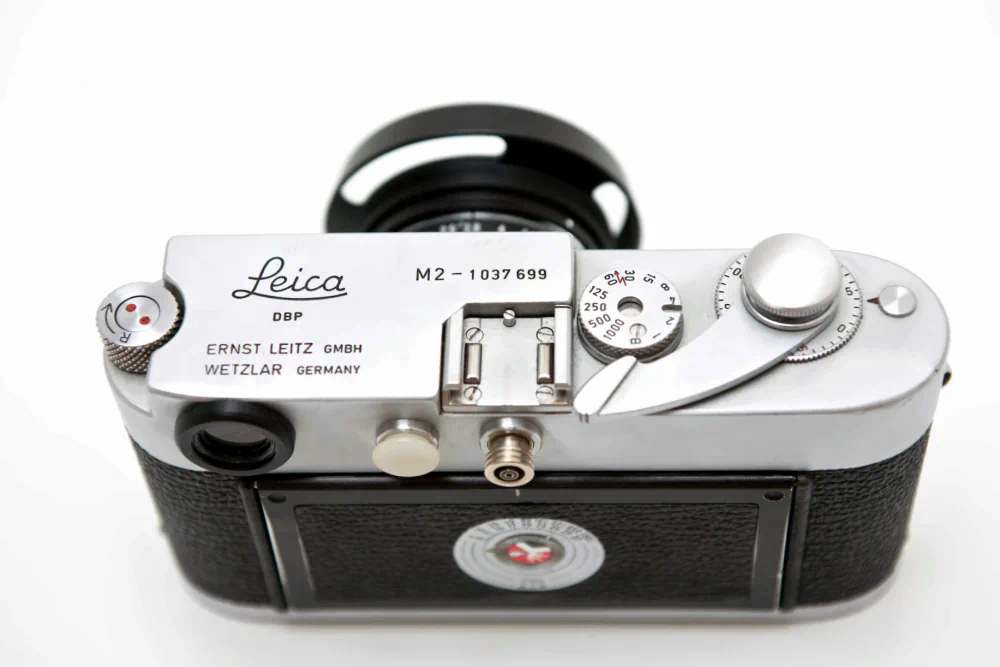
Compared to its predecessor, the M2 was deliberately simpler. Certain features considered nonessential were removed or reduced, resulting in a camera that felt more utilitarian than luxurious. This was a working tool, designed to withstand constant handling rather than occasional admiration.
The 0.72x magnification of the viewfinder offered a balanced perspective well suited to following movement across the frame. Photographers could see enough outside the framelines to anticipate action, while still maintaining accurate composition. Combined with Leica’s characteristically quiet shutter and smooth film advance, the camera allowed continuous shooting without disrupting the surrounding environment.
Photographers such as Joel Meyerowitz explored increasingly complex street scenes using the 35 mm field of view that cameras like the M2 made intuitive, helping move the genre toward layered compositions rather than isolated gestures.
A Camera That Matched a Changing Photographic Culture
The late 1950s and early 1960s marked a shift in documentary and street photography. The emphasis moved away from singular, perfectly timed moments toward a more fluid description of urban life. Images became denser, less hierarchical, more open to interpretation.
The Leica M2 aligned perfectly with this transition. Its ergonomics allowed fast handling, but without automation. Its design encouraged awareness rather than detachment. The photographer remained fully responsible for timing, framing, and distance, yet nothing in the camera slowed that engagement. Rather than shaping the photographer’s behavior, the M2 adapted itself to it.
An Understated but Lasting Influence
Although often overshadowed by the M3’s reputation and later models’ longevity, the Leica M2 played a crucial role in normalizing the 35 mm perspective that dominates street photography today. It represents a moment when Leica shifted from defining how photography should be done to listening to how it was already being practiced.
Its legacy is not dramatic innovation, but alignment between tool and method. The M2 demonstrated that small design decisions, such as which framelines a camera privileges, can influence how generations of photographers interpret public space. In the evolution of street photography, it stands as the camera that helped translate a changing visual culture into a practical, everyday instrument.