

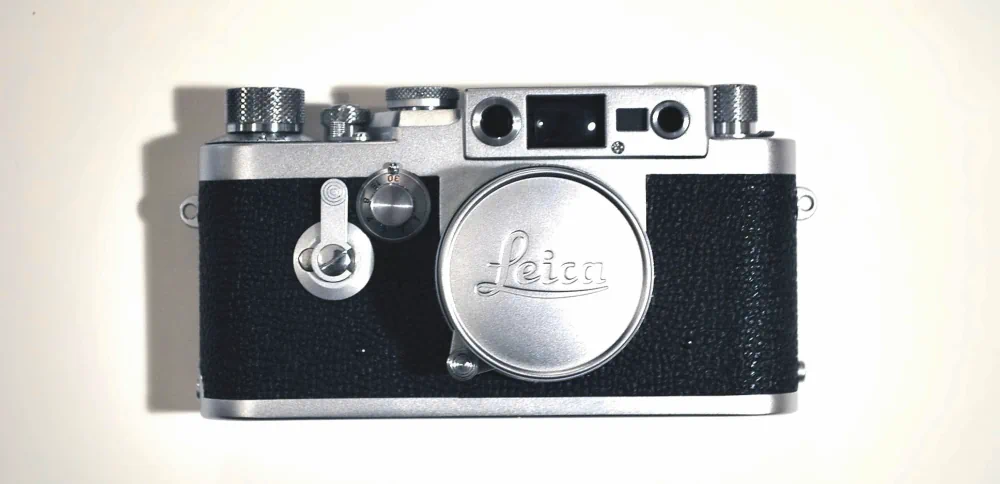
Introduced in 1957, the Leica IIIg marked the final and most refined chapter of Leica’s original screw-mount lineage.
At a time when the Leica M system had already begun redefining usability with the M3, the IIIg represented the culmination of three decades of incremental improvement to the Barnack-style camera. It was not a radical reinvention, but a technical consolidation of everything that had made early Leica cameras indispensable to photographers working in the street.
For practitioners of candid and documentary photography, the IIIg offered familiarity combined with subtle but meaningful enhancements. It retained the compact dimensions and mechanical precision that had made earlier models so effective in public environments, while introducing a larger, brighter viewfinder that finally allowed comfortable use of both 50 mm and 90 mm framelines. This improvement reduced one of the longstanding limitations of screw-mount Leicas and made the camera more adaptable to fast-moving situations.
The IIIg was, in essence, the last expression of a design philosophy rooted in miniaturization, mechanical reliability, and direct engagement with the world.
Refinement Rather Than Reinvention
Unlike the M3, which sought to simplify operation through integration, the Leica IIIg preserved the layered operational logic of earlier Barnack cameras: separate windows for viewing and focusing, a bottom-loading film system, and a body shaped by engineering necessity rather than ergonomic ambition. Yet for experienced users, these characteristics were not obstacles. They were part of a learned rhythm that encouraged attentiveness and deliberate control.
The camera’s extended viewfinder magnification and parallax-corrected framelines allowed photographers to work more confidently at varying distances, an advantage in dynamic urban environments where subjects approached unpredictably. Its shutter mechanism, descended from earlier Leica designs, remained exceptionally quiet, maintaining the discretion that had always been central to candid photography.
Photographers who continued to use screw-mount Leicas did so not out of resistance to change, but because these cameras offered a tactile immediacy and compactness that aligned perfectly with observational work.
A Camera Used During a Pivotal Moment in Documentary Photography
The late 1950s represented a transitional period in photographic history, when small-format cameras had fully proven their value for reportage and personal documentary. The Leica IIIg existed alongside newer M-series models and was used by photographers who valued continuity with earlier working methods. Among those associated with Leica screw-mount cameras of this generation was Robert Frank, whose approach to photographing American life relied on mobility, discretion, and the ability to work without drawing attention.
In this sense, the IIIg belongs to the same conceptual lineage that enabled deeply personal, observational bodies of work. It supported photographers who moved quickly, worked alone, and embraced unpredictability rather than staged clarity.
The End of the Barnack Line and the Beginning of a New Standard
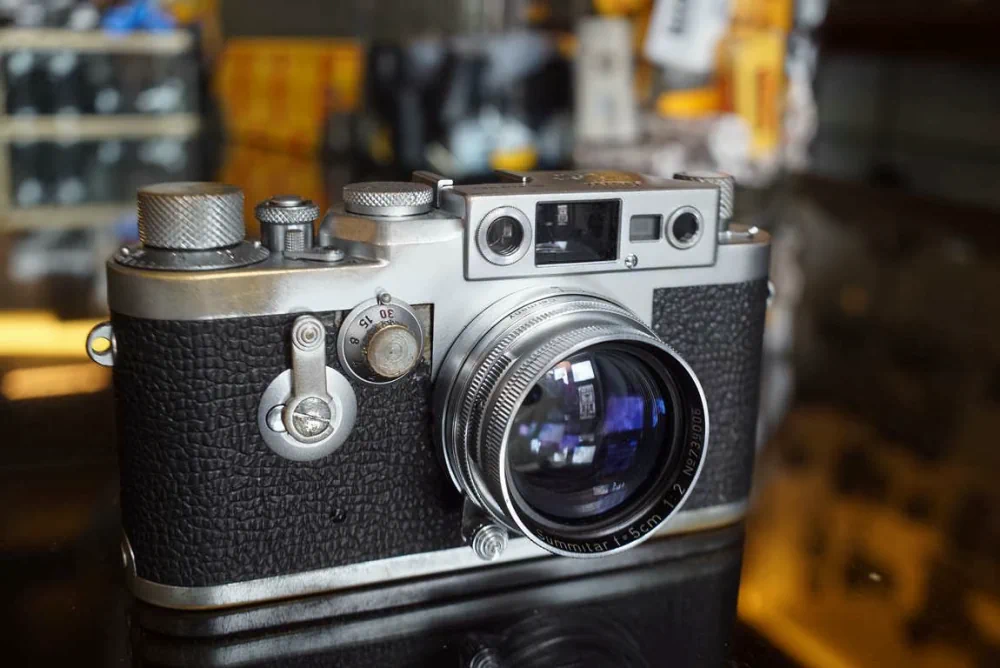
The Leica IIIg occupies a unique historical position. It was both an endpoint and a bridge. Technically, it represents the final and most advanced realization of the original Leica concept introduced in 1925. Historically, it existed at the very moment when the M system was redefining how rangefinder cameras would function for the rest of the century.
While the M-series ultimately became the dominant platform for street photography, the IIIg reminds us that innovation is rarely linear. The camera distilled decades of practical experience into a compact, durable form that remained entirely capable of meeting the demands of real-world observation. It did not seek to modernize photography. It perfected an earlier solution.
A Legacy of Mechanical Intimacy
Today, the Leica IIIg is often understood not simply as a collectible object, but as a testament to a phase in photographic history when engineering aimed to disappear behind the act of seeing. Its controls required engagement, its loading demanded familiarity, and its operation rewarded patience. These qualities fostered a close physical relationship between photographer and camera, reinforcing the idea that photographic awareness develops through repetition and touch.
As the final Barnack Leica, the IIIg stands as a reminder that the foundations of street photography were built not only on portability and speed, but also on mechanical clarity and trust. It represents the closing note of the first great chapter in small-camera history, just as a new one was beginning.