The importance of the Leica I lies not only in its reduced size, but in the new relationship it created between photographer and reality. For the first time, a camera offered sufficient quality, speed of operation, and discretion to be used continuously in public space.
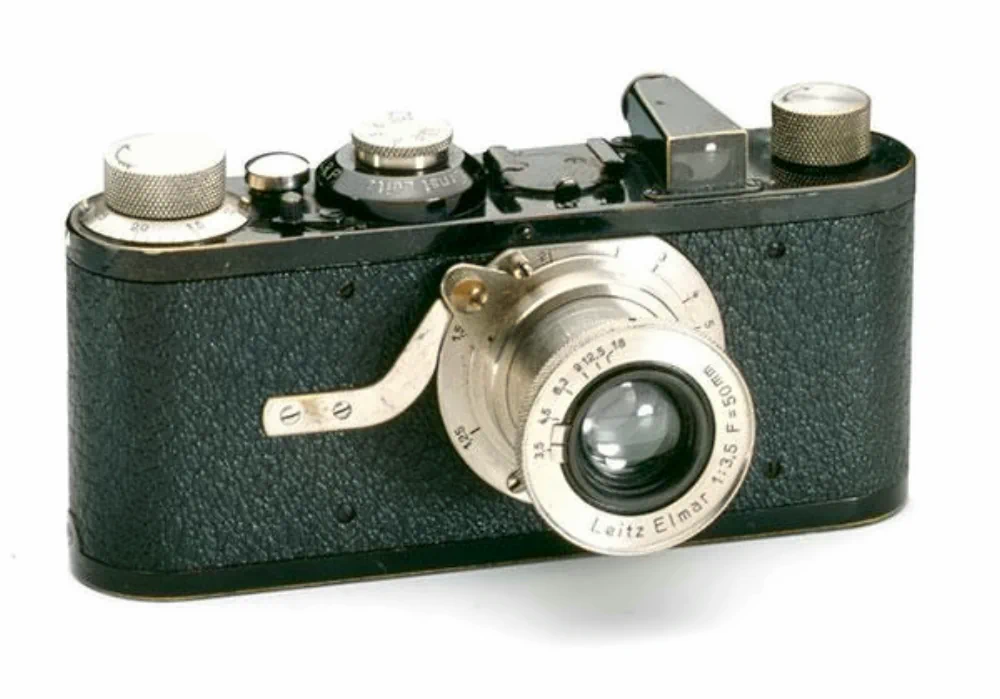
Its collapsible Elmar 50 mm f/3.5 lens reinforced this extreme portability. Closed, it made the camera nearly flat; extended, it delivered remarkable optical performance. A photographer could carry it in a coat pocket, bring it to the eye in seconds, and make an exposure without preparation.
That gesture, taking out the camera and photographing without ceremony, marks the true beginning of street photography. The Leica I did not impose distance. It encouraged immersion.
Speed as a New Way of Seeing
Before the Leica era, photography was largely about constructing an image. With the Leica I came the possibility of capturing one. Its relatively fast shutter, combined with the small-format film, allowed photographers to respond to changing situations rather than stage them. The camera no longer dictated the pace; life itself did.
This technical change altered photographic mentality. Attention shifted from preparation to recognition, from arranging to observing. The photographer’s task became identifying the meaningful moment rather than manufacturing it. Photography began to resemble perception.
The Birth of a Standard Still in Use Today
The Leica I was not merely a successful model. It introduced an entire system that would define twentieth century photography: 35 mm format, compact cameras, fast lenses, and a practice grounded in mobility. Many habits that now feel natural, carrying a camera at all times, working with a fixed focal length, photographing discreetly, can be traced directly to the limitations and advantages of this design.
Later Leica developments refined these ideas, but the essential philosophy was already present. The Leica I was conceived as a camera to be used constantly, not occasionally. It transformed photography into an activity embedded in everyday life.
More Than a Camera, a New Attitude Toward the World
The Leica I represents the moment photography ceased to be an exceptional act and became a continuous way of experiencing the world. It did not simply introduce a new format or industrial design. It reshaped how photographers moved, observed, and interacted with their surroundings. Its lightness, speed, and discretion allowed them to remain inside the flow of the city while recording it.
All subsequent street photography, from the mid twentieth century to the present, descends from that initial shift. The Leica I was not designed specifically for street photography because it did something more fundamental. It created the conditions that made street photography possible at all.