

When the Leica M3 was introduced in 1954, it was not marketed as a street photography camera.
It was presented as the most refined 35 mm camera ever built. Yet it quickly became one of the defining tools of the genre because it solved a fundamental problem: how to photograph life without interrupting it.
The M3 did not invent portability, nor did it introduce 35 mm photography. What it did was perfect the relationship between the photographer’s eye, hand, and timing. Every mechanical action was smooth, quiet, and immediate. Nothing distracted from the act of seeing.
For photographers working in public space, this translated into continuity. The camera did not demand attention. It allowed them to remain immersed in the flow of the street, observing rather than operating a machine. This quality made it a natural companion for figures such as Henri Cartier-Bresson, whose practice depended on anticipation and fluid movement rather than technical intervention.
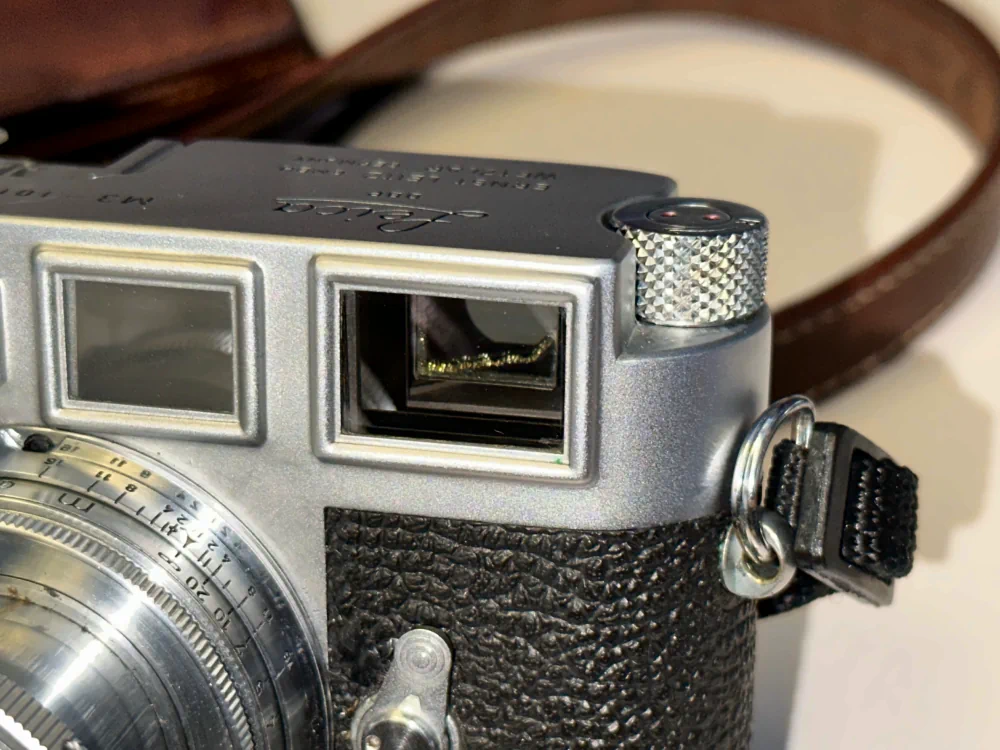
At the heart of the Leica M3 was its revolutionary combined viewfinder and rangefinder. Unlike SLR cameras, which show only what will be captured, the M3 allowed photographers to see beyond the frame lines. This seemingly small distinction transformed how images were constructed.
Photographers could watch subjects enter the frame before releasing the shutter. They could anticipate relationships, gestures, and alignments as they developed in real time. The act of photographing became predictive rather than reactive.
This was crucial for practitioners like Garry Winogrand and Lee Friedlander, who embraced complex, layered urban scenes. The M3 enabled them to work quickly while maintaining spatial awareness, something that bulkier reflex cameras often disrupted.
With its bright 0.91x magnification—optimized for the 50 mm lens—the viewfinder delivered a clarity that made focusing instinctive. After prolonged use, the camera seemed to disappear entirely, leaving only the act of looking.
A Mechanical Rhythm Aligned with Human Time
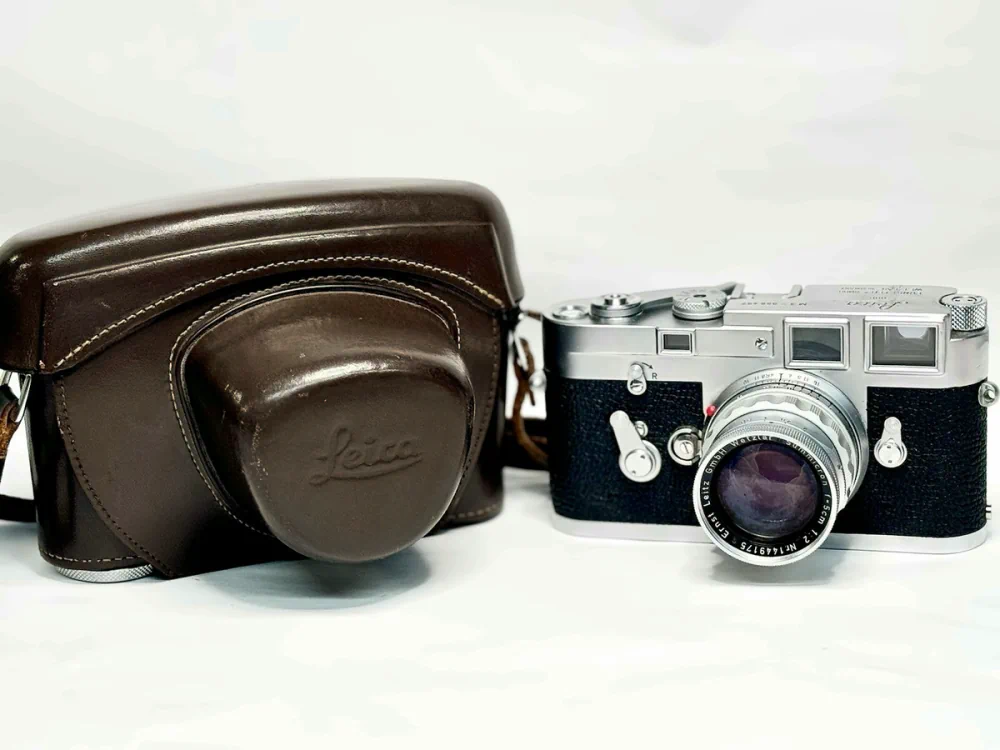
The Leica M3 belonged to a fully mechanical era, and that mechanical nature shaped the rhythm of photography itself. The soft cloth shutter produced minimal noise, allowing photographers to work unnoticed. The manual film advance created a cadence that mirrored observation: see, decide, act.
There was no automation to accelerate decision making, but there was also nothing to slow it down. The camera responded exactly as fast as the photographer’s hands. This synchronization between body and tool encouraged deliberate shooting rather than excess.
Photographers such as Josef Koudelka valued precisely this reliability and tactile immediacy. The M3 could endure difficult conditions and long assignments without drawing attention or failing mechanically. Its durability reinforced its role as a working instrument rather than a technological novelty.
A Cultural Model, Not Just a Camera
The Leica M3 ultimately became more than a piece of equipment. It established a philosophy that continues to shape street photography today: simplicity over complexity, discretion over spectacle, and awareness over automation.
Many modern digital cameras attempt to recreate these qualities through smaller bodies, manual controls, and fixed focal length designs. This recurring return to the principles embodied by the M3 suggests that it was not merely a successful product, but a particularly clear answer to a timeless question: how can a photographer remain present within the world while recording it?
Understanding the Leica M3 means understanding why street photography looks the way it does. It narrowed the distance between seeing and photographing to almost nothing, allowing generations of photographers to move through the city without breaking its rhythm.