Street Photography: A Complete History, Ethics and Cultural Analysis
Street photography explained: history, ethics, power, and the evolution of the urban gaze from modern cities to the digital era.
Feb 1, 2026
Street photography did not begin with the invention of the camera. It began much earlier, in the profound transformation of urban life that took place during the nineteenth century, when modern cities emerged as spaces of density, anonymity, and constant movement.
Before photography had the technical capacity to capture fleeting moments, there already existed a new way of looking at the world: a gaze shaped by the experience of walking through crowds, observing strangers, and confronting the spectacle of everyday life unfolding in public space.
The industrial revolution radically altered the structure of cities. The expansion of railways, factory labor, and rapid population growth transformed urban centers into environments of unprecedented scale and complexity. Paris, London, and later New York became laboratories of modernity, where individuals could move among thousands of people without being recognized. For the first time in history, anonymity became an everyday condition. The street ceased to be merely a place of transit and became a social stage where different classes, rhythms of life, and forms of behavior intersected.
Within this context emerged the figure of the flâneur, the urban observer described by Charles Baudelaire as someone who wanders without apparent purpose, attentive to the smallest details of the city. The flâneur was not an active participant in urban bustle but a silent witness who found in the crowd an inexhaustible source of visual and narrative stimuli. His gaze was curious, analytical, and, in a certain sense, detached. He observed fleeting gestures, chance encounters, and small scenes that held little importance in themselves but revealed the deeper pulse of modern life.
This way of observing the urban environment was fundamental to the later emergence of street photography. The flâneur introduced a new relationship between the individual and public space, one based on contemplation, attention to the ordinary, and interest in what usually passed unnoticed. His gaze did not seek extraordinary events but fragments of everyday life that, when observed carefully, acquired aesthetic and symbolic meaning.
In this new context, the street was transformed into an open theater. Every person walking through it became an involuntary actor in a collective choreography composed of intersecting trajectories, unfinished gestures, and encounters lasting only seconds. Modernity introduced an unprecedented visual experience: the sensation of being constantly surrounded by other people’s stories that appeared and disappeared rapidly. This dynamic produced a new awareness of the instant, a heightened perception of the ephemeral that would later become essential to the language of photography.
When photography emerged in the nineteenth century, its early technical limitations made it impossible to record this world in motion. Long exposure times prevented the capture of spontaneous scenes. Yet the idea that everyday street life could be a worthy subject of observation was already deeply embedded in the visual culture of modernity. The camera would inherit this way of seeing long before it could fully materialize it.
Thus, street photography did not arise simply as the result of technological advancement, but as the continuation of a much deeper cultural transformation: the birth of an urban gaze aware of the complexity of modern life and fascinated by its unpredictable nature. When the camera finally became fast and discreet enough, it merely translated into images an attitude that had been developing for decades. Street photography would ultimately become the visual crystallization of that modern experience: a way of recording how human beings inhabit the shared space of the city and how, within the crowd, each instant contains a story that disappears before it can be fully understood
Eugene Atget
The Camera Becomes Invisible: The Technological Revolution of the 20th Century
When mobility and discretion allowed photography to merge with the rhythm of the street.
The emergence of street photography as a recognizable practice did not depend solely on a cultural transformation, but also on a technological revolution that decisively altered the relationship between the photographer and the world. For much of the nineteenth century, the camera was a heavy, slow, and highly visible instrument, incapable of recording life in motion. Early urban images showed empty streets or motionless figures, not because cities lacked activity, but because long exposure times made it impossible to capture the real flow of everyday life. Photography, at that time, still belonged to the realm of the static, the posed, and the monumental.
Everything changed in the early decades of the twentieth century with the introduction of portable small-format cameras, particularly those using 35mm film. The arrival of the Leica in the 1920s was not merely a technical innovation, but a radical transformation in the very conception of photographic practice. For the first time, photographers could move freely, shoot quickly, and, above all, remain unnoticed. The camera ceased to be an object that imposed its presence and became an almost invisible extension of the body.
This new discretion profoundly altered the relationship between observer and observed. Photography was no longer an activity that required preparation and cooperation; it became spontaneous, almost instinctive. Photographers no longer needed to stop time to construct an image; they could insert themselves into the flow of reality and capture fragments of life as they unfolded before their eyes. The street, with its unpredictable rhythm, thus became an accessible territory for the camera.
This technical shift also had broader cultural implications. Photography became democratized, not only because more people could access a camera, but because the act of looking was no longer restricted to formal contexts. The ability to record the everyday gave visibility to aspects of urban life that had previously remained outside the field of visual representation. Seemingly insignificant scenes, fleeting gestures, and trivial situations began to acquire value as photographic material.
At the same time, this new mobility introduced an unprecedented ethical dimension. The capacity to photograph without being seen raised questions about the boundaries between observation and surveillance, between documentation and appropriation. The portable camera transformed the photographer into an ambiguous figure: a privileged witness capable of revealing invisible aspects of social life, but also an observer whose presence could be intrusive even when hidden.
Beyond these tensions, the technological revolution of the twentieth century ultimately allowed photography to align fully with the visual experience of modernity. The speed of the camera matched the velocity of urban life; its discretion mirrored the anonymity of the crowd; its ability to capture fleeting moments responded to a cultural sensitivity increasingly aware of the ephemeral. Street photography thus emerged not only as a technical possibility, but as the visual form most suited to representing a reality defined by mobility, uncertainty, and the simultaneity of experiences.
In this sense, the portable camera was not merely a new tool, but the device that made it possible to materialize an already existing way of seeing. It transformed the photographer into a mobile observer immersed in the very flow they sought to record, and turned the city into a space where every instant could become an image. Street photography, as it would develop throughout the twentieth century, would remain inseparable from this condition: a practice founded on speed, proximity, and the capacity to intervene visually within the everyday fabric of urban life.
Henri Cartier Bresson
The Myth of the Decisive Moment: Constructing a Canon
From modernist harmony to the fragmented realities that reshaped the visual narrative.
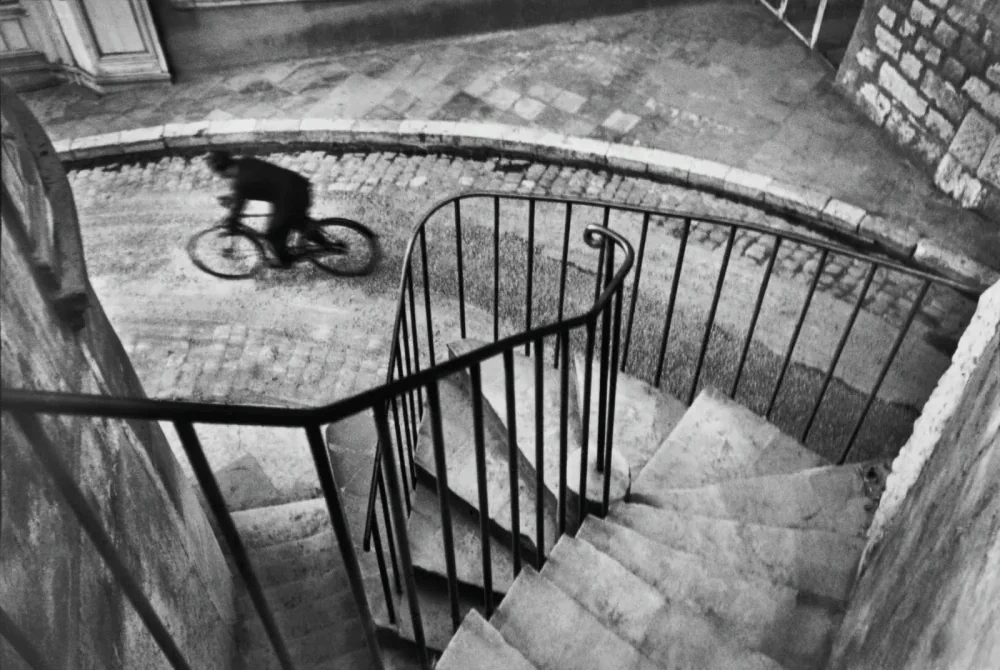
The history of street photography is often told through a small group of emblematic figures whose work came to define not only a style, but an entire way of understanding the medium. This narrative, consolidated during the mid-twentieth century, established what would become the dominant mythology of street photography: the idea that the camera could capture a perfect instant in which form, meaning, and emotion aligned with absolute precision. At the center of this mythology stands the concept of the “decisive moment,” popularized by Henri Cartier-Bresson, whose images exemplified a belief in photography as an art of timing, intuition, and compositional harmony.
Cartier-Bresson’s work embodied a modernist ideal rooted in clarity, balance, and the search for visual order within the apparent chaos of urban life. His photographs suggested that reality, despite its unpredictability, could be distilled into moments of formal perfection if the photographer possessed sufficient sensitivity and discipline. This vision profoundly shaped the institutional and cultural perception of street photography, influencing generations of practitioners and establishing a canon that privileged elegance, geometry, and narrative closure.
Yet this canonical narrative was never uncontested. As street photography evolved, other photographers challenged the notion that reality could be reduced to singular moments of harmony. Robert Frank’s groundbreaking book The Americans, published in 1958, marked a decisive rupture with the modernist ideal. Rather than presenting neatly composed scenes, Frank’s images were often raw, ambiguous, and emotionally charged. They revealed a fractured social landscape marked by inequality, alienation, and tension. His work suggested that the street was not a space of visual equilibrium, but a site of contradictions that resisted aesthetic resolution.
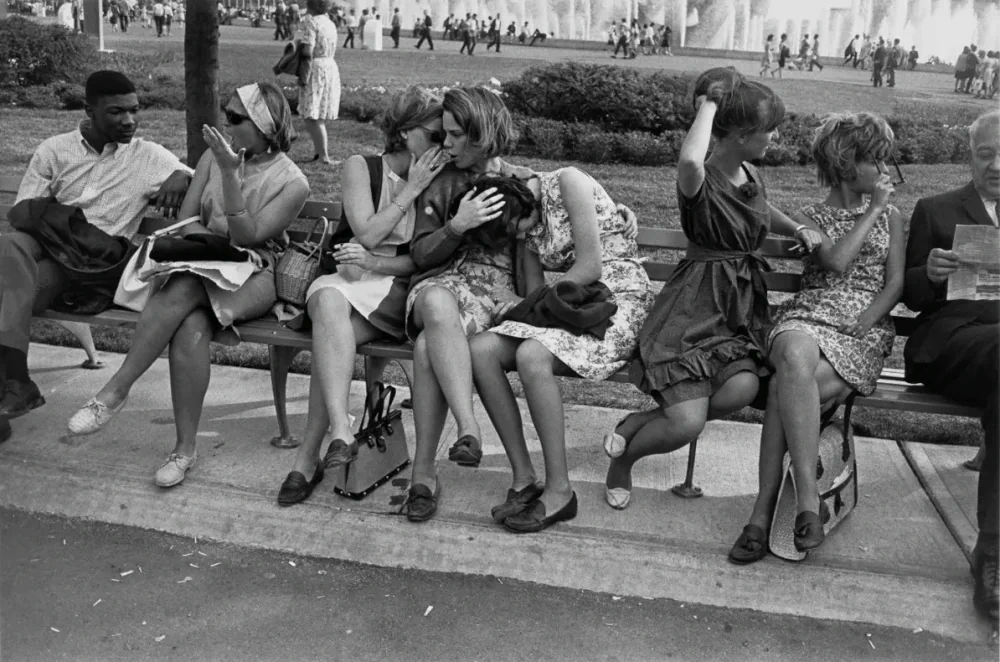
In the following decades, Garry Winogrand pushed this challenge even further. His photographs abandoned the search for compositional perfection in favor of a restless engagement with the unpredictability of urban life. Winogrand famously claimed that he photographed to understand how things looked when photographed, emphasizing process over outcome. His images frequently appeared disordered, tilted, or unresolved, reflecting a world that no longer conformed to the modernist aspiration for coherence. In his hands, the street became a space of visual instability where meaning remained open and uncertain.
The posthumous discovery of Vivian Maier’s vast archive added yet another dimension to this evolving narrative. Unlike many of her contemporaries, Maier worked outside institutional frameworks, producing thousands of images without seeking public recognition. Her photographs combined acute observational sensitivity with an intensely personal perspective, revealing an urban world marked by subtle psychological tensions. Maier’s work demonstrated that street photography could be both deeply subjective and profoundly attentive to the social environment, complicating the idea of a unified photographic canon.
Taken together, these developments reveal that the myth of the decisive moment was never a universal truth, but rather a historical construct shaped by specific cultural conditions and institutional preferences. While the modernist narrative emphasized control, precision, and formal clarity, later practitioners exposed the limitations of this framework by embracing ambiguity, fragmentation, and emotional complexity. Street photography thus emerged not as a monolithic genre governed by a single aesthetic principle, but as a dynamic field defined by ongoing debates about the nature of reality, representation, and visual meaning.
Today, the legacy of the decisive moment continues to influence how street photography is perceived, yet it coexists with a much broader range of approaches that question its assumptions. Contemporary practitioners often reject the idea that a single image can encapsulate the essence of a situation, favoring instead sequences, open-ended narratives, and strategies that foreground uncertainty. In this expanded context, the decisive moment appears less as a definitive model than as one chapter in a longer, more complex history of how photographers have attempted to engage with the ever-changing reality of the street.
Street Photography and Power: Who Has the Right to Look?
Examining the social hierarchies embedded in the act of observing strangers.
Street photography has often been described as an act of observation, a practice rooted in attentiveness to the everyday rhythms of public life. Yet this seemingly neutral description obscures a fundamental dimension of the medium: the relationship between looking and power. To photograph in the street is not simply to record what happens in a shared space; it is also to exercise a form of visual authority. The photographer decides where to point the camera, when to release the shutter, and which fragments of reality are worthy of preservation. This act of selection is never entirely innocent. It reflects social positions, cultural assumptions, and historical hierarchies that shape both who is seen and how they are represented.
From its earliest manifestations, street photography has been intertwined with the asymmetries of modern urban life. Cities are spaces where social differences become visible through clothing, behavior, architecture, and patterns of movement. Photographers navigating these environments inevitably encounter disparities of class, race, and gender. The ability to move freely with a camera is itself conditioned by social privilege. Historically, many of the canonical figures of street photography were individuals who could circulate within urban spaces without attracting suspicion or facing systemic barriers. Their capacity to observe others without being scrutinized in return was not universal, but contingent upon their social positioning.
This asymmetry becomes particularly evident when considering how marginalized communities have often been depicted within the tradition of street photography. Images of poverty, labor, or social vulnerability have long been central to the visual language of the street. While such photographs can serve to document injustice and raise awareness, they also risk reinforcing unequal power dynamics between photographer and subject. The camera can transform individuals into objects of aesthetic interest, reducing complex lives to symbolic representations that serve external narratives. The tension between documentation and appropriation remains one of the most persistent ethical dilemmas within the field.
The relationship between street photography and colonial visual practices further complicates this dynamic. Throughout the nineteenth and twentieth centuries, photography played a central role in constructing visual knowledge about colonized populations. Although street photography as a genre developed primarily in urban contexts, its methods often echoed broader patterns of visual extraction in which the act of looking was associated with control, classification, and authority. Contemporary critics have increasingly emphasized the need to interrogate these historical legacies, questioning whose perspectives have dominated photographic narratives and whose experiences have been marginalized or excluded.
In recent decades, photographers and scholars have sought to challenge these power structures by rethinking the ethics of representation. Some practitioners adopt collaborative approaches that involve dialogue with subjects, while others focus on photographing communities to which they themselves belong, thereby shifting the balance between observer and observed. These strategies reflect a growing awareness that the act of photographing is never purely objective, but always embedded within social relationships that shape the meaning of the resulting image.
The expansion of global perspectives has also contributed to a more complex understanding of power within street photography. As practitioners from diverse cultural contexts engage with the medium, they bring distinct sensibilities to questions of visibility, privacy, and public space. In some societies, the act of photographing strangers carries different ethical implications than in others, highlighting the cultural specificity of norms surrounding observation and consent. This plurality of perspectives challenges the assumption that street photography operates according to universal principles, revealing instead a field marked by ongoing negotiation between artistic freedom and social responsibility.
Ultimately, the question of who has the right to look cannot be resolved through simple rules. It is inseparable from broader issues of inequality, access, and historical context. Street photography remains a practice defined by its capacity to reveal aspects of urban life that might otherwise remain unseen, yet this capacity is inseparable from the power dynamics inherent in the act of seeing itself. To engage responsibly with the medium requires acknowledging that every photograph is not only a record of what happened in front of the camera, but also a reflection of the complex relationships that made that image possible.
Garry Winogrand
Ethics in the Open Space: Between Witness and Intrusion
Navigating the fragile boundary between documentation and personal dignity.
Few areas of photography inhabit such a persistent moral tension as street photography. Its defining condition, the ability to photograph strangers in public without prior consent, places the practice in a continuous negotiation between two opposing imperatives: the desire to bear witness to social reality and the obligation to respect the dignity and autonomy of those who appear within the frame. Unlike portraiture, documentary projects based on collaboration, or staged photographic work, street photography operates within an ethical terrain where decisions are made in fractions of a second and often without the possibility of dialogue.
Legally, in many parts of the world, photographing individuals in public spaces is permitted. The law tends to recognize that public environments are areas where expectations of privacy are limited. Yet legality does not resolve the deeper ethical questions that surround the act of photographing. The distinction between what is allowed and what is appropriate remains central to ongoing debates within the field. A photograph may comply with legal standards while still raising profound concerns about representation, consent, and the potential consequences of its circulation.
At the core of this ethical dilemma lies the asymmetry between photographer and subject. The photographer controls the moment of capture, the context in which the image will be presented, and the narratives that may later be attached to it. The subject, by contrast, often has little awareness of being photographed and no influence over how the image will be interpreted or distributed. This imbalance becomes particularly significant when images depict individuals in moments of vulnerability, distress, or social marginalization. In such situations, the act of photographing can be perceived not as documentation, but as intrusion or even exploitation.
Street photographers have historically responded to this tension in different ways. Some adopt a strict personal code of conduct, choosing not to photograph situations that could cause harm or humiliation to their subjects. Others emphasize the importance of intention, arguing that the ethical value of a photograph depends on whether it seeks to reveal social realities with empathy and respect, rather than to sensationalize or objectify. Still others question whether ethical guidelines can ever be universal, suggesting that each photographic encounter is shaped by specific contextual factors that defy simple categorization.
The rise of digital technologies and global image circulation has intensified these ethical challenges. In earlier eras, the distribution of photographs was relatively limited, often confined to exhibitions, books, or specialized publications. Today, images can spread instantaneously across social media platforms, reaching audiences far beyond their original context. This shift has altered the stakes of street photography, as subjects who may have once remained anonymous within a local environment can now be exposed to a global public. The potential for misinterpretation, online harassment, or unintended consequences has increased significantly, making ethical considerations more urgent than ever.
Some contemporary photographers have responded to these changes by rethinking their approach to public space. Rather than relying solely on candid observation, they may engage in conversations with subjects after photographing them, seek retrospective consent, or incorporate collaborative elements into their practice. Others choose to focus on broader urban environments, using distance, abstraction, or visual fragmentation to avoid identifying individuals directly. These strategies reflect an evolving understanding of the ethical responsibilities that accompany the act of photographing in a world where visibility has become both pervasive and potentially harmful.
Ultimately, the ethical complexity of street photography cannot be resolved through rigid rules or universal prescriptions. It remains a practice defined by situational judgment, personal values, and cultural context. The photographer must navigate a delicate balance between the impulse to record the visible world and the awareness that every image involves real human lives. This tension, rather than diminishing the significance of street photography, is precisely what gives the medium its enduring relevance. It forces practitioners to confront not only what they see, but also the consequences of how and why they choose to show it.
The End of Innocence: Street Photography in the Age of Surveillance
How constant visibility has transformed both behavior and photographic practice.
The conditions that once made street photography possible have undergone a profound transformation in the early twenty-first century. For much of its history, the practice relied on a specific balance between visibility and invisibility. Photographers could move through public spaces with relative discretion, and the act of observing strangers often occurred within a context where cameras were rare and largely associated with intentional, deliberate uses. The street was a space where life unfolded without the constant awareness of being recorded. This condition, which underpinned the aesthetic and ethical foundations of street photography, has largely disappeared.
The proliferation of digital technologies has fundamentally altered the visual ecology of contemporary cities. Smartphones, surveillance cameras, and networked recording systems have created an environment in which the act of being photographed is no longer exceptional, but routine. Public space has become saturated with devices capable of capturing and transmitting images in real time. As a result, the asymmetry that once defined the relationship between photographer and subject has shifted. Individuals now move through urban environments with an acute awareness that they may be visible at any moment, not only to photographers, but to an invisible web of institutional and personal observation.
This transformation has changed the behavior of those who inhabit the street. In earlier periods, candid photography depended on a certain degree of social unselfconsciousness. People were often unaware of the presence of cameras and therefore acted without regard for how they might appear in images. Today, the omnipresence of recording devices has introduced a performative dimension to public life. Individuals frequently adjust their behavior in anticipation of being seen, curating gestures, expressions, and interactions in ways that reflect broader cultural dynamics shaped by social media and digital self-representation.
For street photographers, this shift poses a fundamental challenge. The traditional premise of capturing unguarded moments has become increasingly difficult in an environment where self-awareness permeates public behavior. The street is no longer a space of visual innocence, but one characterized by mutual observation. The photographer is no longer the sole figure engaged in looking; they are themselves subject to being looked at, recorded, and interpreted. This reciprocity complicates the notion of the photographer as an invisible witness and introduces a new level of reflexivity into the practice.
At the same time, the expansion of surveillance technologies has raised broader questions about the relationship between street photography and institutional forms of visual control. Surveillance systems operated by governments and private corporations collect vast quantities of visual data, often without public transparency. While street photographers traditionally operate within an artistic framework, their activities now coexist with structures of observation that serve entirely different purposes. This proximity has led some critics to question whether the aesthetics of candid photography can be disentangled from the broader culture of monitoring that defines contemporary urban life.
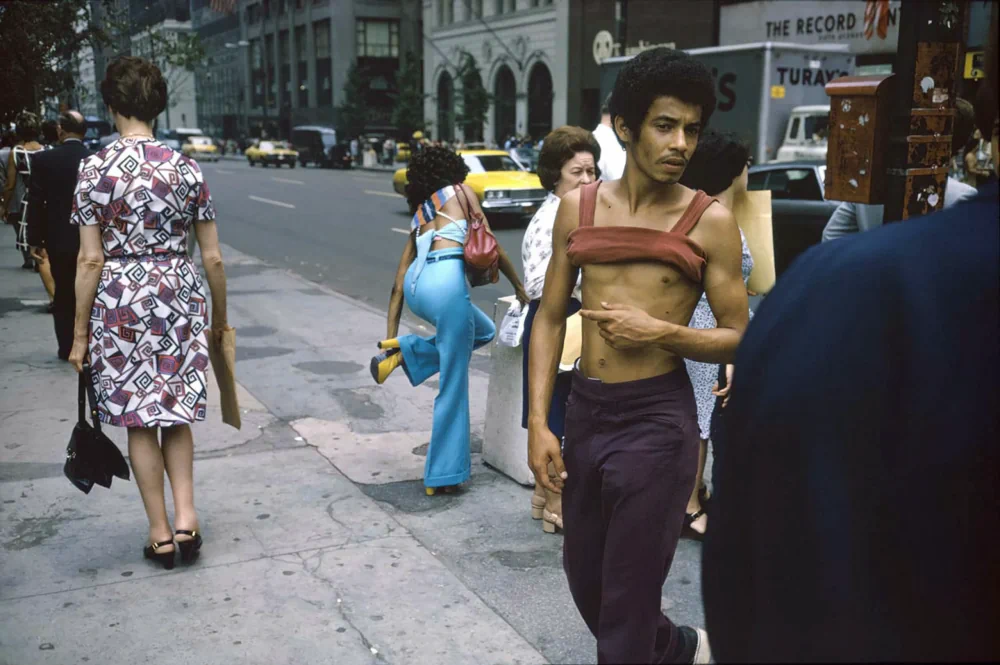
In response to these conditions, many contemporary street photographers have adapted their strategies. Some emphasize conceptual approaches that foreground the very presence of surveillance, incorporating themes of visibility, anonymity, and data culture into their work. Others turn toward abstraction, using reflections, shadows, or fragmented compositions to convey the experience of a visually saturated environment without focusing on identifiable individuals. These approaches reflect an awareness that the act of photographing in public space now carries different implications than it did in previous eras.
Despite these challenges, street photography has not lost its relevance. Rather, it has evolved in response to a transformed visual landscape. The contemporary street is no longer simply a site of spontaneous encounters, but a complex network of mediated interactions shaped by technology, power, and self-consciousness. In this context, the role of the street photographer has shifted from that of an invisible observer to that of a participant within a broader system of visual exchange. The practice now involves not only capturing what is visible, but also reflecting on the conditions that determine how visibility itself is produced, controlled, and experienced in the modern city.
Joel Meyerowitz
A Global Language: Decentering the Western Canon
The emergence of diverse perspectives reshaping the meaning of the street.
For much of the twentieth century, the history of street photography was narrated through a largely Western lens. Canonical figures were predominantly associated with cities such as Paris, New York, or Chicago, and the visual language of the genre was often interpreted through cultural frameworks rooted in European modernism and American postwar experience. This concentration of attention created the impression that street photography was intrinsically linked to a specific set of urban environments and aesthetic traditions. Yet the practice itself has always possessed a far broader geographical and cultural scope than this narrative suggested.
As photography expanded globally, practitioners from diverse regions began to engage with the street as a site of visual exploration, bringing with them distinct historical contexts and cultural sensibilities. In cities across Asia, Africa, Latin America, and the Middle East, photographers approached public space in ways that both intersected with and diverged from Western precedents. The rhythms of urban life, the organization of social interactions, and the visual codes embedded in everyday environments varied significantly from one region to another, generating alternative forms of street photography that challenged the universality of the established canon.
These global perspectives revealed that the street itself is not a neutral or uniform space. It is shaped by local histories, social hierarchies, and cultural norms that influence how individuals occupy and perceive public environments. In some contexts, public space functions as an extension of communal life, characterized by close interpersonal interactions and fluid boundaries between private and collective spheres. In others, it may be structured by more rigid divisions of class, gender, or authority. These differences inevitably affect both the experience of being photographed and the ethical considerations surrounding photographic practice.
The expansion of global street photography has also contributed to a diversification of visual aesthetics. While early canonical work often emphasized formal composition, geometric order, and the search for singular moments of visual clarity, many contemporary practitioners explore more fragmented or layered approaches. Their images may foreground complexity, ambiguity, and multiplicity rather than resolution. Urban environments are depicted not as coherent stages for isolated events, but as dense networks of overlapping social realities that resist simplified interpretation.
Equally significant has been the emergence of photographers who challenge the traditional power dynamics associated with the act of looking. Practitioners working within their own communities frequently adopt perspectives shaped by lived experience rather than external observation. Their images may reflect intimate familiarity with local environments, offering nuanced portrayals that differ markedly from earlier documentary traditions rooted in outsider viewpoints. This shift has expanded the ethical and conceptual possibilities of street photography, demonstrating that the relationship between photographer and subject can be grounded in shared social context rather than distance.
The circulation of images through digital platforms has further accelerated this process of decentering. Photographers from previously underrepresented regions now have the capacity to share their work globally, contributing to a more pluralistic understanding of the genre. This expanded visibility has disrupted older hierarchies that once determined which images entered institutional collections or historical narratives. The canon of street photography is no longer a fixed body of work defined by a limited set of geographic and cultural references, but an evolving constellation of practices shaped by global exchange.
In this broader context, street photography can no longer be understood as a singular visual tradition. It has become a global language articulated through diverse dialects, each shaped by local conditions and cultural histories. The street remains a shared space of human interaction, yet its meanings are continually redefined by those who inhabit and photograph it. This multiplicity does not weaken the coherence of the genre; rather, it enriches it, revealing the capacity of street photography to adapt to a wide range of social realities while maintaining its fundamental commitment to observing the dynamics of life in public space.
Why Street Photography Still Matters Today
The enduring relevance of recording everyday human interaction in public space.
In an era defined by an unprecedented abundance of images, it might seem that street photography has lost the distinctiveness that once set it apart. Billions of photographs are produced daily, many of them taken in public spaces and shared instantly across digital networks. The act of capturing urban life is no longer rare, and the visual documentation of everyday scenes has become a routine component of contemporary communication. Yet this apparent saturation does not diminish the relevance of street photography. On the contrary, it underscores the unique role the practice continues to play in helping societies understand how human beings inhabit shared environments.
At its core, street photography remains one of the most direct ways of recording the subtle dynamics of social interaction. Unlike institutional forms of visual documentation, which often focus on significant events or formal narratives, street photography attends to the microhistories that unfold continuously within public space. These images reveal how individuals navigate proximity and distance, how they negotiate visibility and anonymity, and how they express identity through gesture, movement, and spatial positioning. In doing so, they provide insights into the everyday structures that shape collective life but rarely appear in official records.
The contemporary relevance of street photography is also linked to its capacity to resist the increasingly curated nature of visual culture. Much of today’s image production is oriented toward self-presentation, branding, and controlled representation. Social media platforms encourage users to construct idealized versions of their lives, producing images that conform to aesthetic and narrative expectations. Street photography operates in a fundamentally different register. Its value lies precisely in its openness to unpredictability, its attention to unplanned encounters, and its willingness to engage with moments that resist conventional standards of beauty or coherence.
This capacity to reveal unfiltered aspects of public life gives street photography a distinct documentary function. While it does not typically aim to provide comprehensive accounts of social conditions, it captures fragments that, taken collectively, form a visual archive of how societies evolve over time. Changes in clothing, architecture, urban infrastructure, and patterns of behavior become visible through these images, offering future viewers a nuanced record of everyday experience. In this sense, street photography contributes to a broader cultural memory that extends beyond formal historical narratives.
Moreover, the practice retains a critical dimension in relation to contemporary forms of power and visibility. As public spaces become increasingly regulated by surveillance technologies and commercial interests, street photography provides an alternative mode of visual engagement that foregrounds human presence rather than institutional oversight. It invites viewers to consider how individuals occupy and transform urban environments, emphasizing the agency embedded within ordinary actions. By focusing on the lived experience of public space, street photography counters abstract representations that reduce cities to data flows or architectural spectacle.
The enduring significance of street photography also lies in its capacity to foster a form of attentiveness that is increasingly rare in fast-paced visual cultures. To engage with the street through photography requires patience, observation, and sensitivity to subtle interactions that might otherwise remain unnoticed. This practice encourages both photographers and viewers to recognize the complexity embedded within seemingly mundane situations. It transforms everyday life into a site of aesthetic and intellectual inquiry, reminding us that meaning often resides in moments that appear insignificant at first glance.
Ultimately, street photography continues to matter because it addresses a fundamental aspect of human existence: the experience of sharing space with others. Cities remain places where strangers encounter one another without prior connection, where individual trajectories intersect unpredictably, and where collective life unfolds through countless small interactions. By recording these encounters, street photography preserves a visual trace of how societies function at their most immediate level. In doing so, it affirms the enduring importance of looking carefully at the world around us, even in an age when images are produced and consumed at unprecedented speed.
The Future of Street Photography: Between Presence, Memory and Uncertainty
Adapting a historic practice to a technologically mediated urban world.
As street photography moves further into the twenty-first century, its future is shaped by a paradox. Never before have human lives been so thoroughly documented in public space, yet never has the act of observing those lives been so conceptually complex. The conditions that once defined the genre, anonymity, spontaneity, and the relative invisibility of the photographer, now coexist with a visual environment saturated by constant recording, algorithmic interpretation, and self-conscious performance. In this transformed landscape, street photography can no longer rely on the assumptions that guided its earlier history. It must continually renegotiate its purpose and its methods.
One of the most significant challenges facing the practice today is the changing nature of public space itself. Contemporary cities are increasingly shaped by privatization, surveillance infrastructures, and digital mediation. Spaces that appear open are often governed by invisible systems of control, while interactions that once occurred physically are now filtered through virtual networks. This shift alters not only what can be photographed, but also what it means to inhabit the street as a shared social environment. The photographer is no longer simply documenting human presence within space, but also engaging with the technological conditions that structure visibility itself.
At the same time, street photography retains a unique capacity to record aspects of life that remain resistant to abstraction. While data systems can map movement patterns and quantify urban behaviors, they cannot fully capture the subtleties of human expression, the emotional resonance of fleeting encounters, or the complex social negotiations embedded within everyday gestures. Street photography continues to provide a form of visual knowledge grounded in lived experience rather than statistical representation. Its images offer a counterpoint to the increasingly abstract ways in which contemporary societies understand urban life.
The future of the genre is also likely to be shaped by an expanded diversity of voices and perspectives. As access to photographic tools becomes nearly universal, practitioners from varied cultural, social, and geographic backgrounds contribute to an ever-growing plurality of approaches. This diversification challenges earlier hierarchies that once defined whose images were recognized as part of the historical narrative. Street photography is no longer centered on a limited set of global cities or aesthetic conventions; it is a distributed practice reflecting multiple ways of experiencing and interpreting public space.
Technological developments will undoubtedly continue to influence the medium. Advances in artificial intelligence, automated image recognition, and immersive visual technologies are already transforming how images are produced, categorized, and consumed. These innovations raise new questions about authorship, authenticity, and the role of human intention in photographic practice. In a context where machines can generate or analyze images at unprecedented scales, the value of street photography may increasingly lie in its capacity to preserve a distinctly human form of attention: one rooted in perception, empathy, and the subjective interpretation of lived reality.
Yet despite these evolving conditions, the fundamental impulse that gave rise to street photography remains unchanged. It is the impulse to look closely at how people move through shared environments, to observe the small interactions that shape collective life, and to recognize meaning within moments that might otherwise pass unnoticed. This impulse is not tied to specific technologies or historical periods; it reflects a deeper human curiosity about the social world and our place within it.
Street photography will likely continue to transform in response to shifting cultural and technological landscapes. Its aesthetic strategies may evolve, its ethical frameworks may be redefined, and its modes of dissemination may expand. But its core function will endure: to create visual records of how individuals coexist within the ever-changing theater of public life. In an age marked by both visual excess and increasing abstraction, this function remains essential. Street photography persists not because it offers definitive answers about the world, but because it preserves the complexity, ambiguity, and immediacy of human presence within it.
The Street as a Mirror of the Human Condition
Understanding photography as a reflection of how we coexist in shared spaces.
Throughout its history, street photography has been shaped by a continuous interplay between technological possibility, cultural transformation, and ethical reflection. It emerged from the experience of modern urban life, developed through the evolution of portable photographic tools, and expanded across diverse social and geographic contexts. At every stage, it has reflected broader shifts in how societies understand visibility, power, and the relationship between individuals and the spaces they inhabit. To examine the trajectory of street photography is therefore to trace a parallel history of modernity itself, seen through the lens of everyday human interaction.
What distinguishes street photography from other forms of visual practice is not merely its subject matter, but its unique position at the intersection of observation and participation. The photographer is never entirely detached from the environment being recorded. Moving through the same spaces as the subjects, sharing the same conditions of visibility and vulnerability, the street photographer occupies a role that is simultaneously embedded and reflective. This dual position allows the medium to capture moments of collective life with an immediacy that few other visual forms can achieve.
At the same time, the act of photographing in public space inevitably raises questions that extend beyond aesthetics. Each image reflects choices about what to reveal, what to omit, and how to interpret the complexities of human presence. These choices are shaped by social context, personal perspective, and the evolving ethical frameworks that govern visual representation. Street photography thus functions not only as a record of visible reality, but also as a site of ongoing negotiation between artistic freedom and social responsibility.
The persistence of the genre across changing historical conditions suggests that its significance lies in its capacity to address fundamental aspects of human experience. Cities continue to be spaces where individuals encounter one another without prior connection, where identities are expressed through movement and interaction, and where the boundaries between private and public life remain fluid. Street photography captures these dynamics at a granular level, revealing patterns of behavior that often remain invisible within broader social narratives.
In an age characterized by both unprecedented visual saturation and increasing abstraction, this capacity to focus on immediate, embodied experience acquires particular importance. While contemporary technologies enable the continuous production and circulation of images, they also risk detaching visual representation from the realities of lived human interaction. Street photography counteracts this tendency by grounding its images in specific moments, places, and encounters. It reminds viewers that behind every urban landscape are individuals whose presence shapes the collective texture of social life.
Ultimately, street photography endures because it engages with one of the most fundamental questions of modern existence: how human beings share space with others they do not know. It reveals the subtle negotiations that occur within the public sphere, the fleeting connections that define urban life, and the tensions between individuality and collective presence. In doing so, it transforms ordinary moments into visual reflections of the broader human condition.
The street, as both physical environment and symbolic space, continues to function as a mirror of societal change. As long as cities remain central to human life, and as long as individuals move through them in unpredictable patterns of interaction, street photography will retain its relevance. It will persist not merely as a photographic genre, but as an enduring practice of attentive looking, one that seeks to understand how the complexities of human coexistence unfold in the shared spaces of everyday life.
Bibliographic References and Theoretical Context
Intellectual frameworks that shaped the cultural and critical understanding of the medium.
Any comprehensive understanding of street photography must acknowledge the intellectual and cultural frameworks that have shaped its interpretation over time. While the practice is often associated with spontaneous observation and visual intuition, its development has been closely intertwined with broader philosophical reflections on modernity, urban experience, and the politics of representation. The theoretical context surrounding street photography extends beyond the medium itself, drawing on insights from literature, sociology, cultural theory, and visual studies.
One of the earliest conceptual foundations for understanding the visual experience of urban life can be found in the writings of Charles Baudelaire, particularly his reflections on modernity and the figure of the flâneur. Baudelaire’s portrayal of the urban observer established a framework for thinking about the act of looking as a defining feature of modern existence. His work emphasized the fleeting, transitory nature of contemporary life and the importance of attentiveness to the ordinary. These ideas would later resonate strongly with the ethos of street photography, which similarly focuses on ephemeral moments within the flow of everyday activity.
In the twentieth century, Walter Benjamin provided one of the most influential theoretical interpretations of photography’s relationship to modern urban experience. In essays such as The Work of Art in the Age of Mechanical Reproduction and his writings on Parisian arcades, Benjamin explored how technological reproduction transformed both artistic perception and social consciousness. His analysis of photography emphasized its capacity to reveal aspects of reality that remain inaccessible to direct human perception, a concept that has been central to many interpretations of street photography as a medium capable of uncovering hidden dimensions of social life.
Sociological perspectives have also contributed significantly to the theoretical context of street photography. The work of scholars such as Erving Goffman, who examined the performance of social behavior in public spaces, provides valuable insight into the interactions captured by street photographers. Goffman’s analysis of everyday encounters highlights the structured nature of seemingly spontaneous actions, offering a framework for understanding how gestures, spatial positioning, and visual cues operate within the social choreography of urban environments.
In more recent decades, critical visual studies have introduced important reflections on power, representation, and the ethics of looking. Scholars such as Susan Sontag and John Berger examined the ways in which photographic images shape cultural narratives and influence perceptions of reality. Their work raised essential questions about the responsibilities of photographers and the potential consequences of visual representation, particularly when images depict marginalized or vulnerable subjects. These debates remain central to contemporary discussions of street photography’s ethical dimensions.
The global expansion of photographic practice has further enriched the theoretical landscape. Postcolonial and decolonial perspectives have challenged earlier narratives that framed street photography primarily within Western cultural contexts. These approaches emphasize the importance of recognizing diverse visual traditions and interrogating historical power structures embedded in photographic representation. By situating street photography within broader global dynamics, contemporary scholarship highlights the multiplicity of ways in which public space can be observed and interpreted.
Taken together, these intellectual influences demonstrate that street photography is not merely a technical or aesthetic practice, but a medium deeply embedded within complex cultural and theoretical frameworks. Its development reflects ongoing dialogues about modernity, social interaction, and the ethical implications of visual observation. Understanding these contexts allows for a more nuanced appreciation of the genre, revealing it as a form of visual inquiry that extends beyond the surface of images to engage with fundamental questions about how human beings perceive and represent one another within shared environments.
Street Photography as Visual Knowledge: Between Art, Document and Interpretation
A practice that reveals reality while simultaneously constructing meaning.
Street photography occupies a distinctive position within the broader landscape of visual culture because it resists simple classification. It is neither purely documentary nor entirely artistic, neither fully objective nor wholly subjective. Instead, it operates within an intermediate space where observation, interpretation, and aesthetic construction converge. This hybrid condition has allowed street photography to function simultaneously as a form of visual evidence and as a mode of personal expression, creating a body of work that reflects both social realities and individual perspectives.
Unlike traditional documentary photography, which often seeks to provide structured accounts of specific events or social conditions, street photography is typically oriented toward fragments rather than narratives. Its images do not aim to explain contexts comprehensively; instead, they isolate moments that suggest broader patterns of human behavior without resolving them into definitive meanings. This openness invites viewers to engage actively with the image, constructing interpretations based on their own experiences and cultural frameworks. In this sense, street photography produces a form of knowledge that is not analytical or systematic, but intuitive and relational.
The epistemological significance of street photography lies precisely in this capacity to reveal aspects of social life that remain inaccessible to formal modes of representation. Statistical data can describe demographic trends, urban planning can map spatial structures, and sociological research can analyze patterns of interaction. Yet none of these methods can capture the subtle textures of lived experience: the fleeting gestures that convey emotional states, the spontaneous alignments of bodies within space, or the micro-negotiations that occur between strangers in public environments. Street photography translates these intangible dynamics into visual form, offering insights that complement other forms of knowledge.
At the same time, the interpretive dimension of street photography complicates its status as a record of reality. Every photograph is shaped by the photographer’s choices regarding framing, timing, and perspective. These decisions inevitably influence how subjects are perceived and how the meaning of the image is constructed. The camera does not simply mirror the world; it reorganizes it, isolating certain elements while excluding others. As a result, street photographs must be understood not as transparent documents, but as mediated representations that reflect both the external environment and the photographer’s subjective engagement with it.
This dual character has positioned street photography within ongoing debates about the relationship between art and truth. Some critics emphasize its documentary value, viewing it as an essential visual archive of urban life. Others highlight its aesthetic dimensions, interpreting it primarily as a creative practice shaped by formal considerations and individual vision. In reality, these perspectives are not mutually exclusive. The strength of street photography lies precisely in its ability to operate across these boundaries, combining observational fidelity with interpretive depth.
The interpretive openness of street photography also allows it to adapt to diverse cultural contexts. Because its images often avoid explicit narrative frameworks, they can resonate across different social and historical environments. A photograph of strangers interacting within a public space may evoke distinct meanings depending on the viewer’s cultural background, yet it remains anchored in a shared human experience: the negotiation of coexistence within collective environments. This universality contributes to the enduring relevance of street photography as a medium capable of communicating across cultural and linguistic divides.
Ultimately, street photography functions as a form of visual knowledge that complements rather than replaces other modes of understanding social reality. It does not provide definitive explanations, but it reveals patterns, tensions, and possibilities that might otherwise remain unnoticed. By translating the complexities of everyday life into images, street photography invites viewers to reflect on the ways in which human presence is expressed, interpreted, and negotiated within the shared spaces of the modern world.
We use cookies on our website to give you the most relevant experience by remembering your preferences and repeat visits. By clicking “Accept”, you consent to the use of ALL the cookies.
This website uses cookies to improve your experience while you navigate through the website. Out of these, the cookies that are categorized as necessary are stored on your browser as they are essential for the working of basic functionalities of the website. We also use third-party cookies that help us analyze and understand how you use this website. These cookies will be stored in your browser only with your consent. You also have the option to opt-out of these cookies. But opting out of some of these cookies may affect your browsing experience.
Necessary cookies are absolutely essential for the website to function properly. This category only includes cookies that ensures basic functionalities and security features of the website. These cookies do not store any personal information.
Any cookies that may not be particularly necessary for the website to function and is used specifically to collect user personal data via analytics, ads, other embedded contents are termed as non-necessary cookies. It is mandatory to procure user consent prior to running these cookies on your website.