PhotoBrussels Festival 2026: When photography stops being a showcase and becomes an ecosystem.
For years, many photography festivals have fallen into a predictable logic: big names, iconic images, easily digestible narratives. In its tenth edition, PhotoBrussels Festival proposes something different. Not an event concentrated in a single venue, but a distributed photographic ecosystem, expanded across the city and sustained by a diverse network of galleries, independent spaces, museums, and cultural institutions.
From January 22 to February 22, 2026, Brussels becomes a living photographic territory, with 52 exhibitions and more than one hundred artists, many of them deeply connected to the Belgian context while maintaining an international outlook. This is not just about showing work, but about activating a scene, making visible a way of understanding photography as a cultural, political, and material practice.
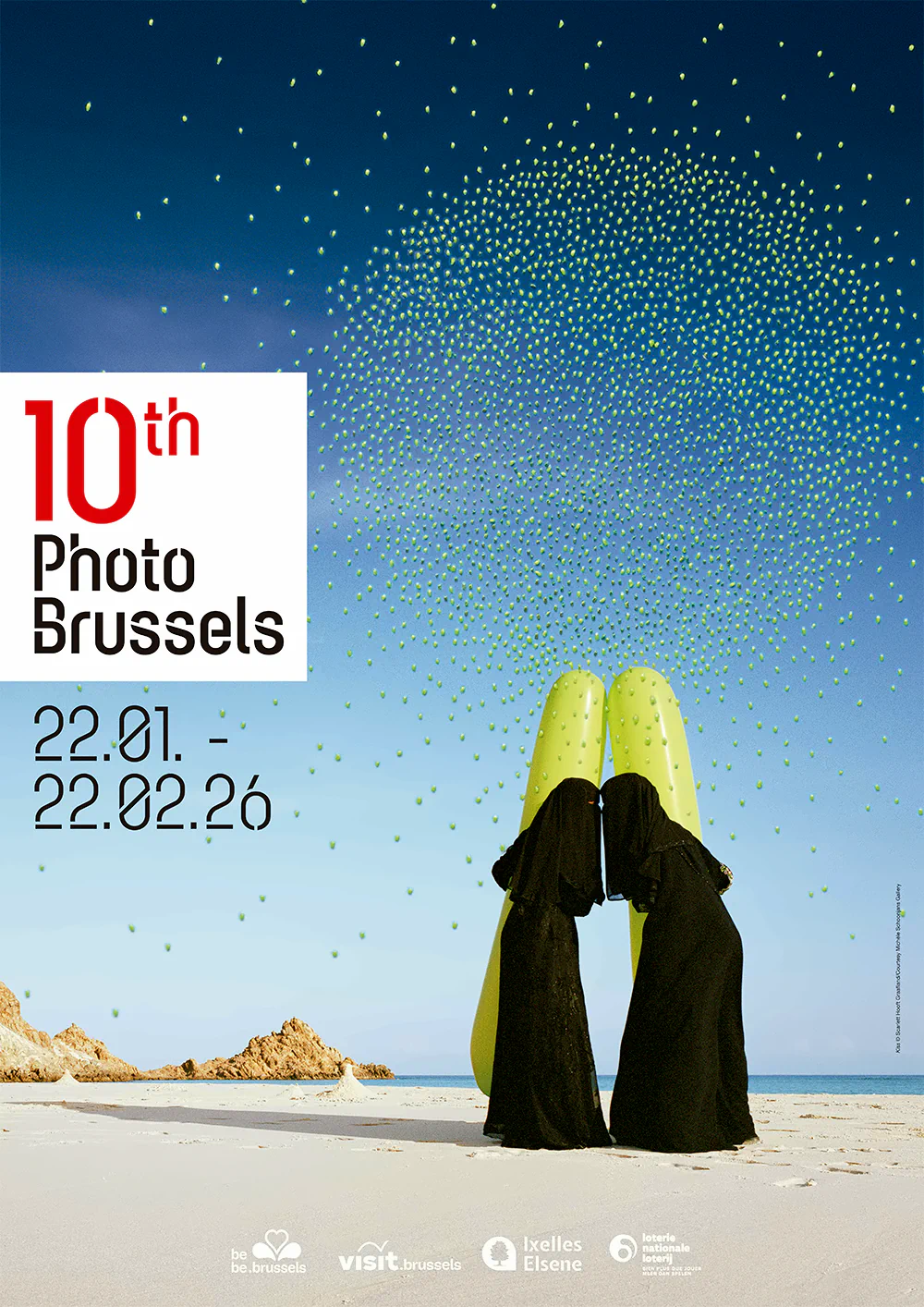
Ten years are not a celebration, they are a position
The anniversary does not function here as nostalgia or as a self-satisfied retrospective. On the contrary, the festival’s discourse insists on something increasingly rare: photography as a plural, uncomfortable language, engaged with its time. The exhibitions address issues that define our present—identity, memory, labor, ecology, migration, post-truth—through approaches ranging from documentary to staged imagery, from archive to fiction, from analog processes to hybridizations with artificial intelligence.
There is no dominant aesthetic and no single narrative. And that is precisely what matters. Against the visual homogenization imposed by platforms and the market, PhotoBrussels commits to a diversity of ways of seeing, even when those ways contradict one another.
The city as a curatorial device
One of the festival’s most compelling gestures is its relationship with the city. The exhibitions are not isolated within an “art circuit,” but dispersed across neighborhoods, small galleries, hybrid spaces, and non-conventional venues. The visitor does not consume images; they move through them, travel, connect contexts.
This model demands a different kind of attention. Photography ceases to be an autonomous object hanging on a white wall and begins to engage in dialogue with space, with movement, with the urban experience. In this sense, PhotoBrussels does not simply present contemporary photography; it experiments with a contemporary way of seeing it.
Living photography, not canonized
Perhaps the most significant aspect of this edition is its implicit rejection of a closed canon. There is no intention to establish authority or repeat consecrated formulas. Instead, there is a clear emphasis on process, experimentation, the fragility of images, and their ability to generate questions rather than answers.
Ten years after its founding, PhotoBrussels Festival does not present itself as a fixed institution, but as an evolving organism, attentive to changes in the medium and to the tensions of the present. And at a moment when photography risks becoming pure visual flow, this stance is not neutral: it is a declaration of principles.