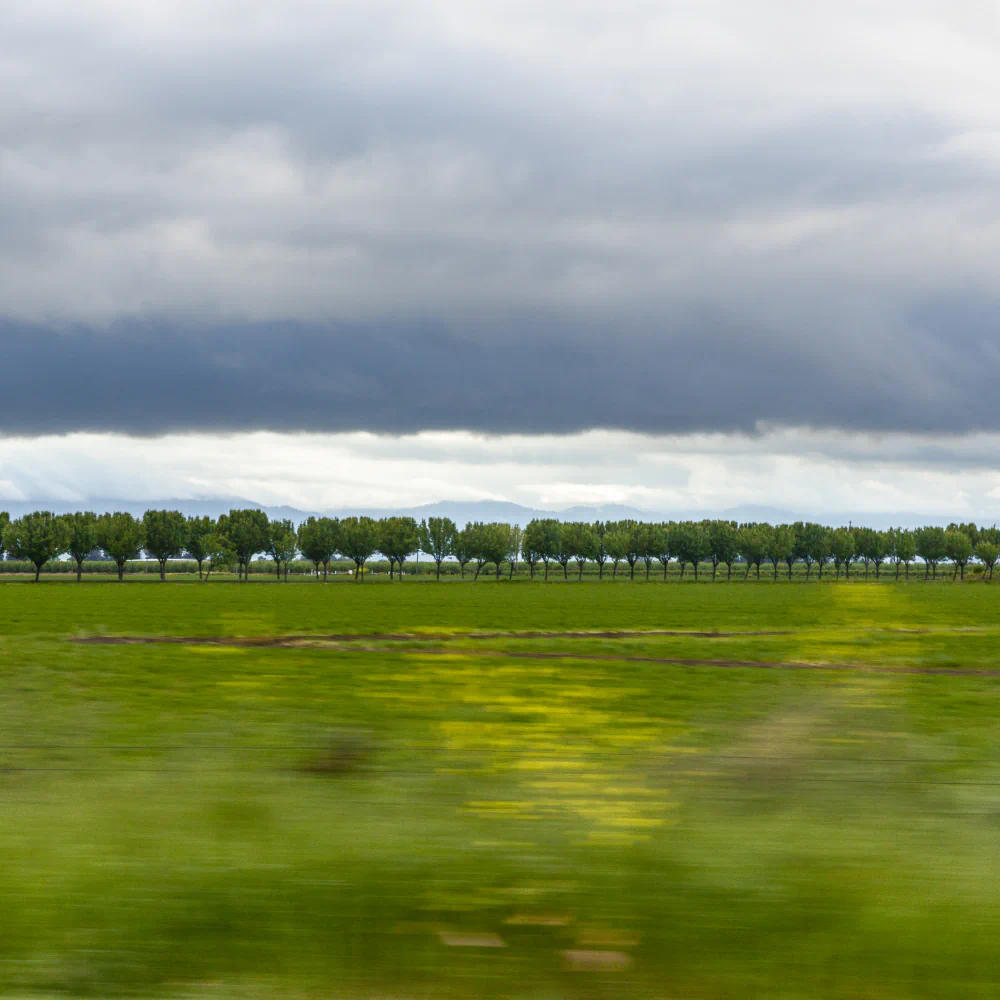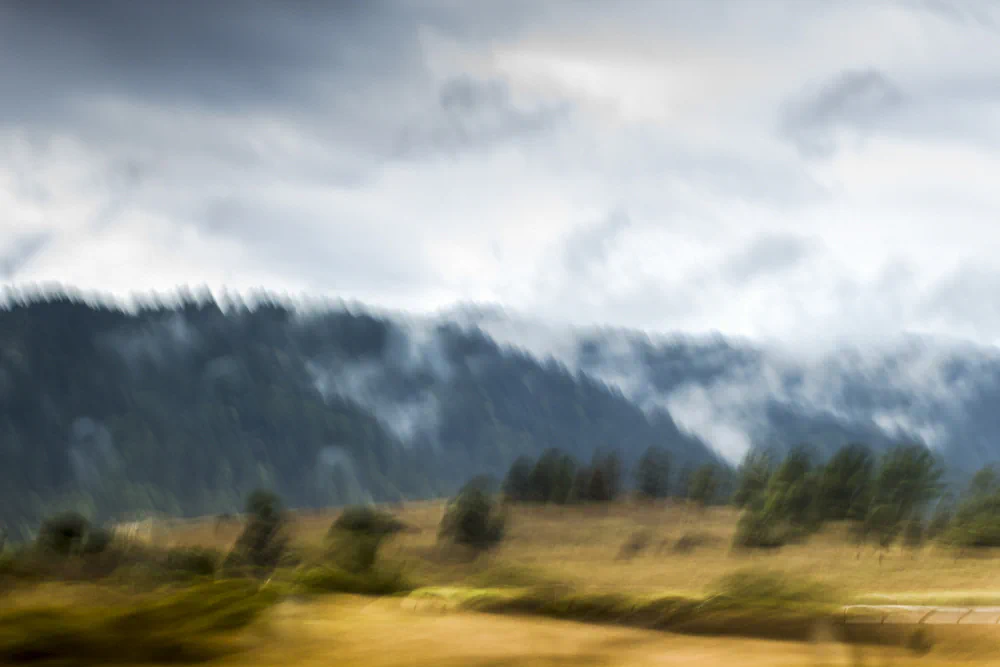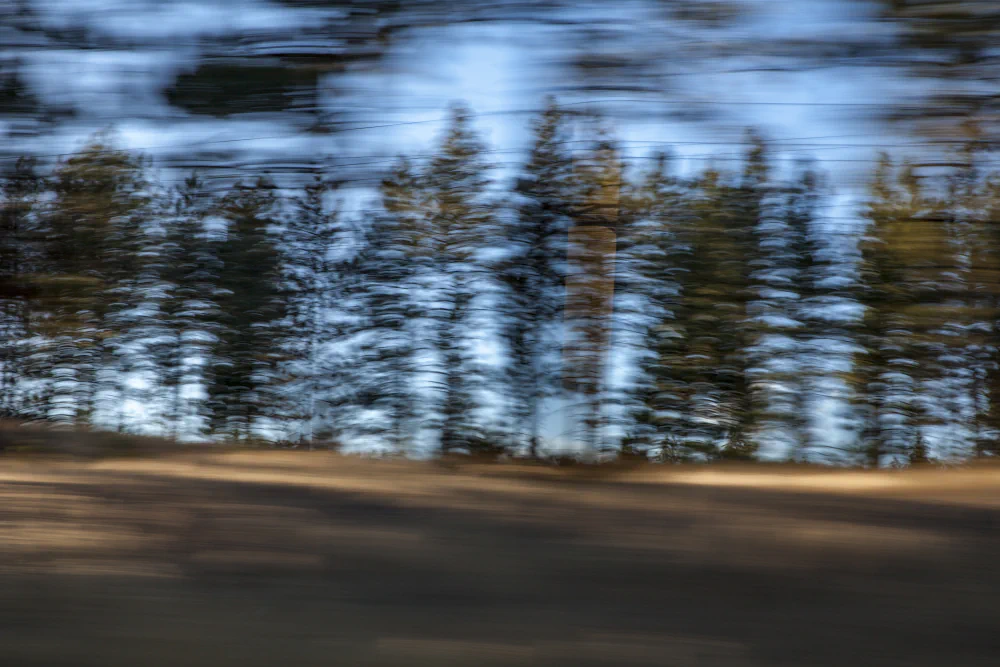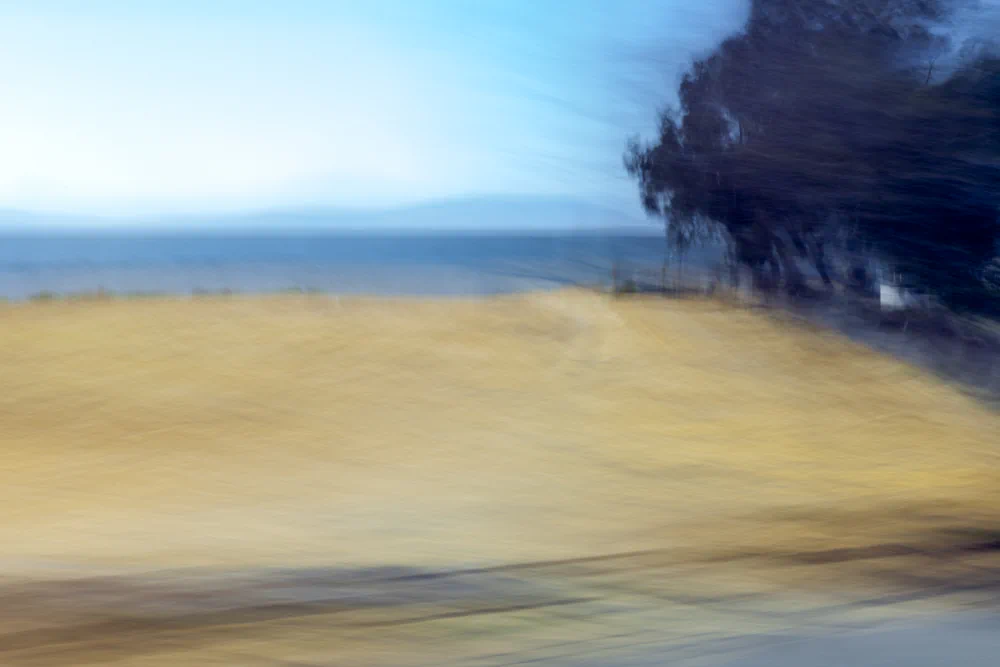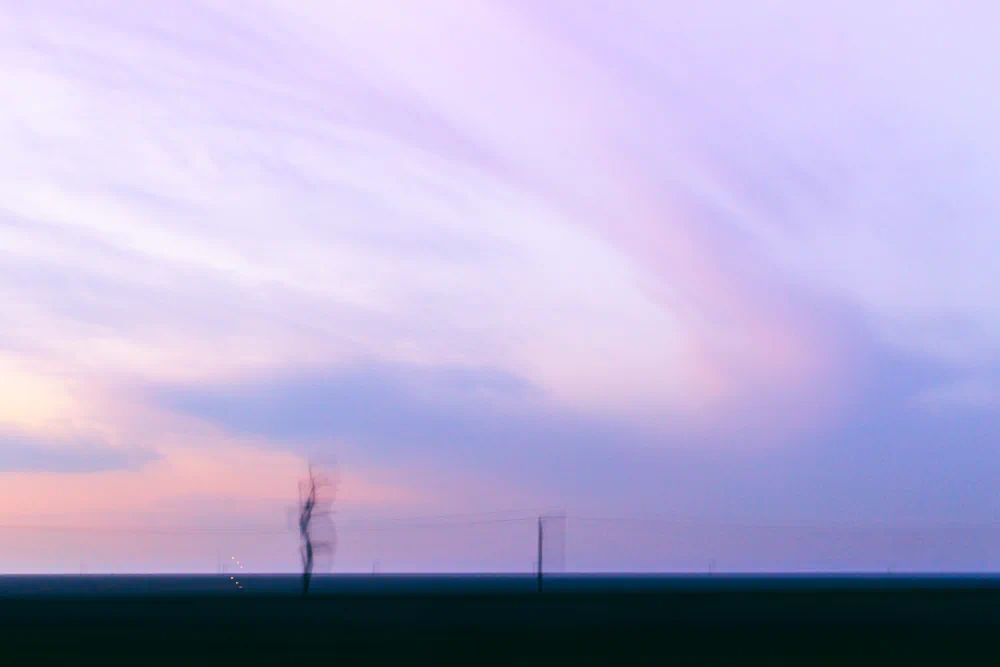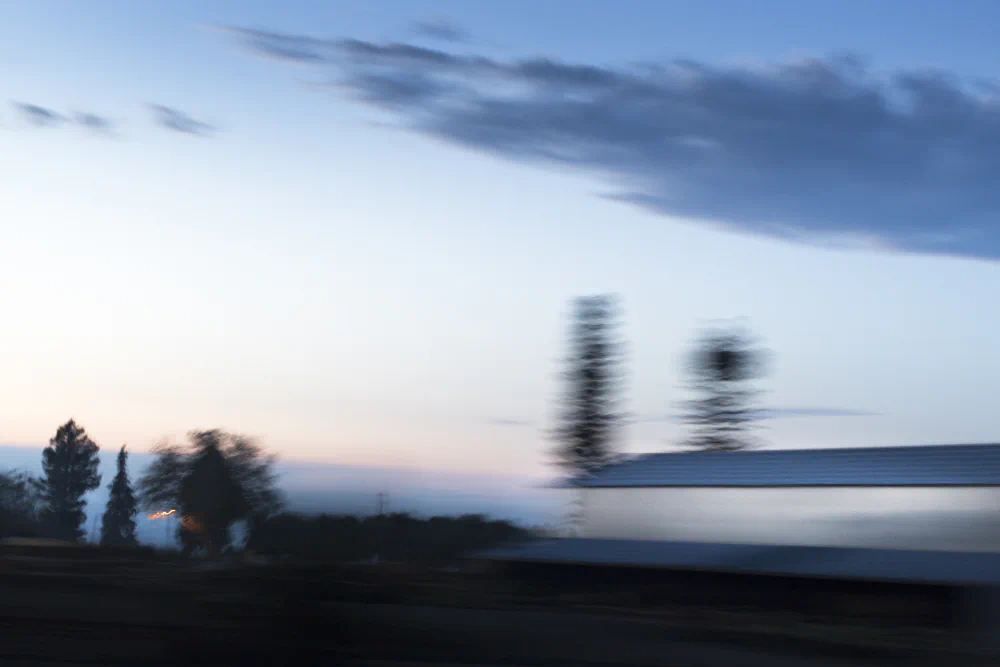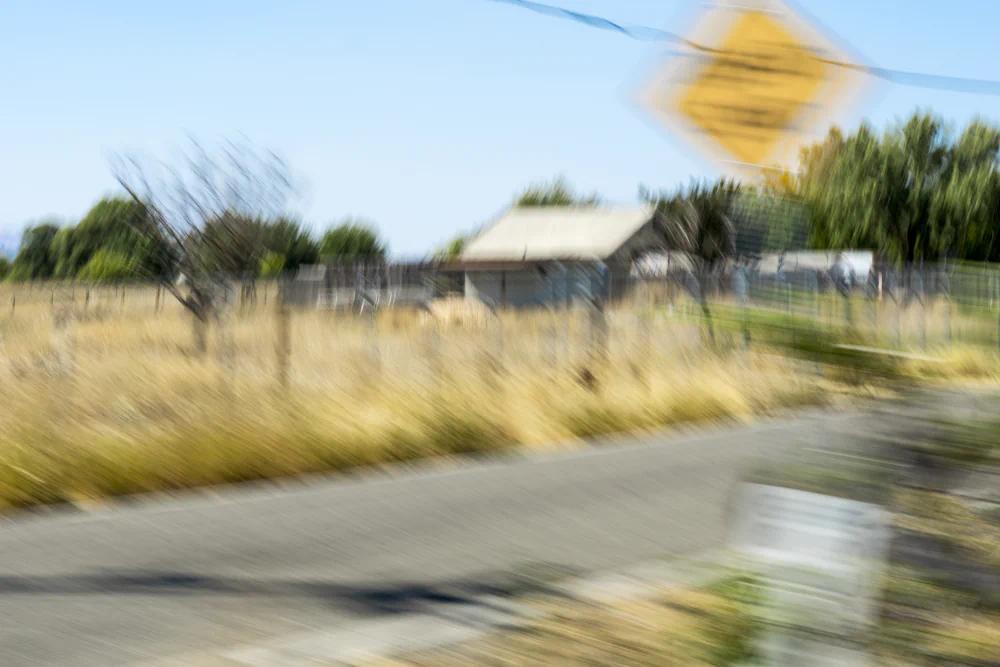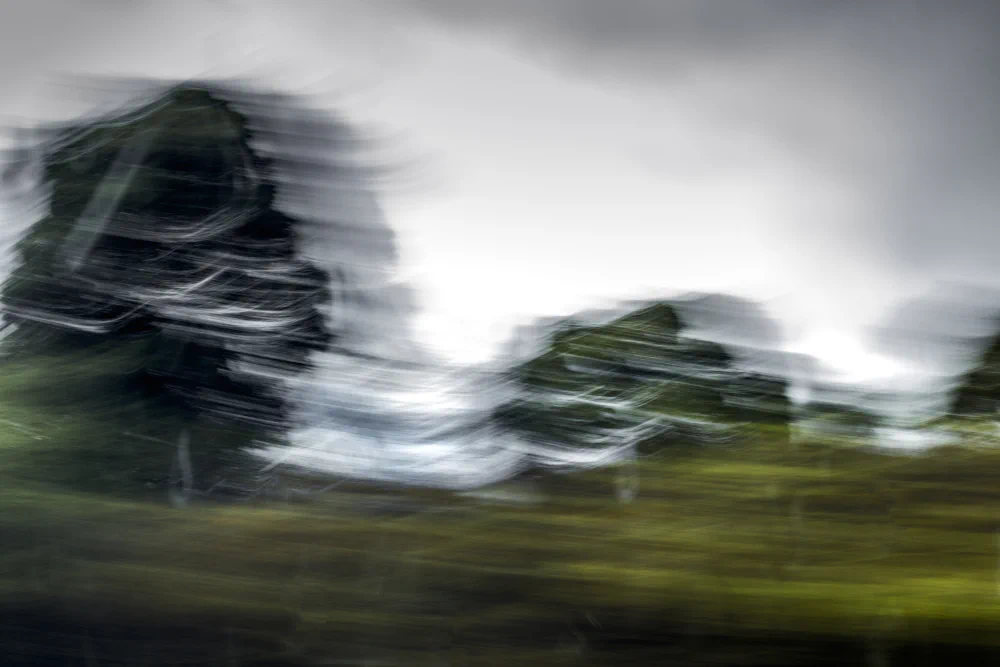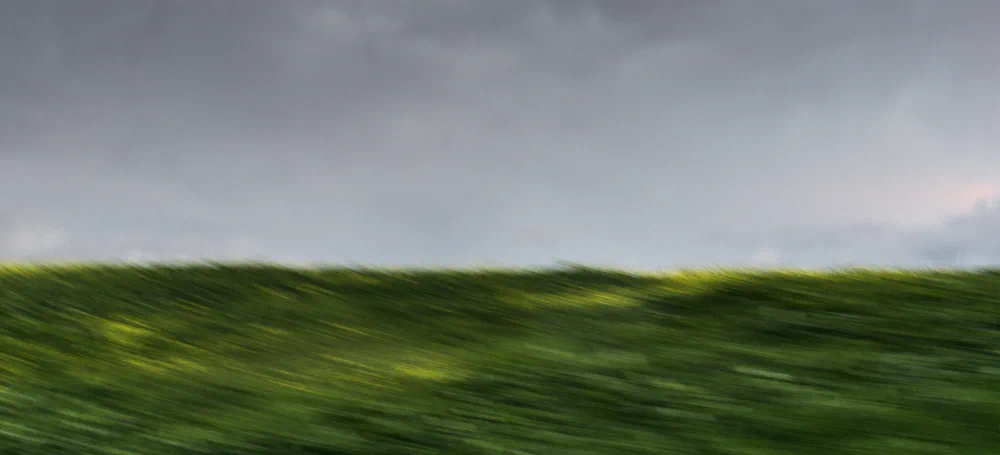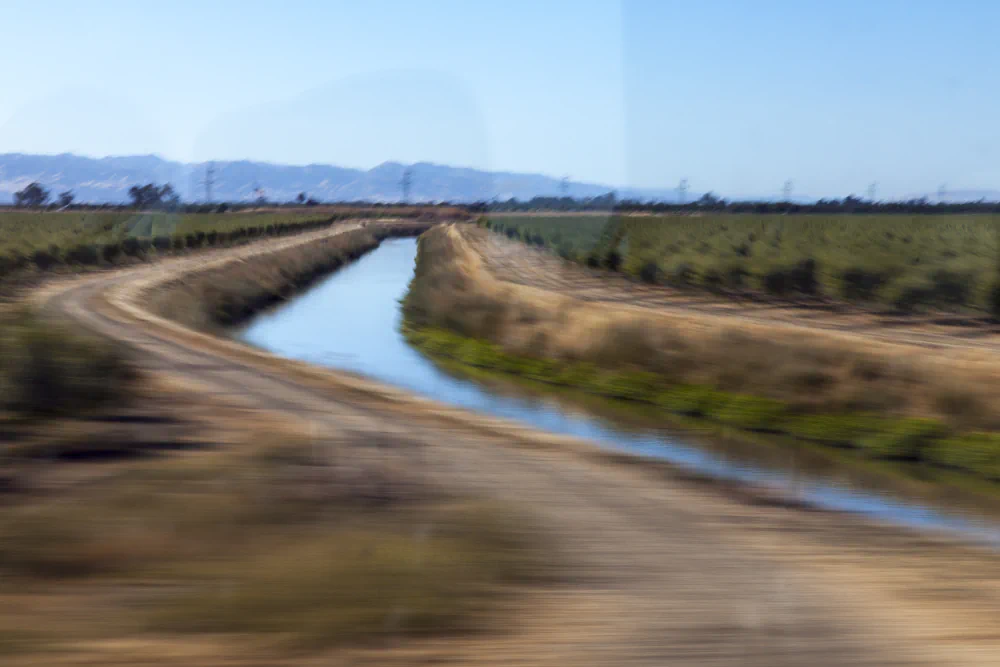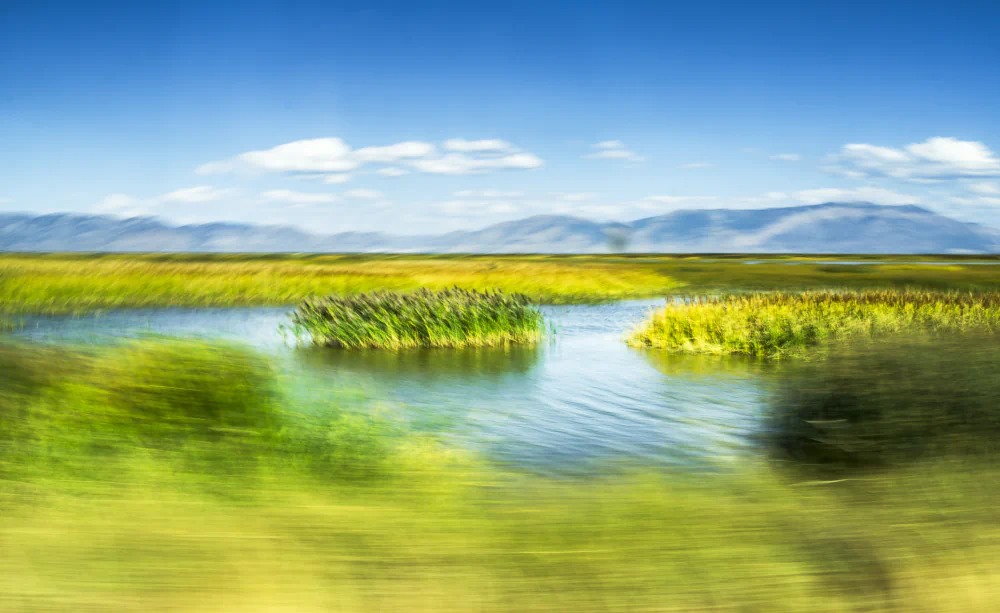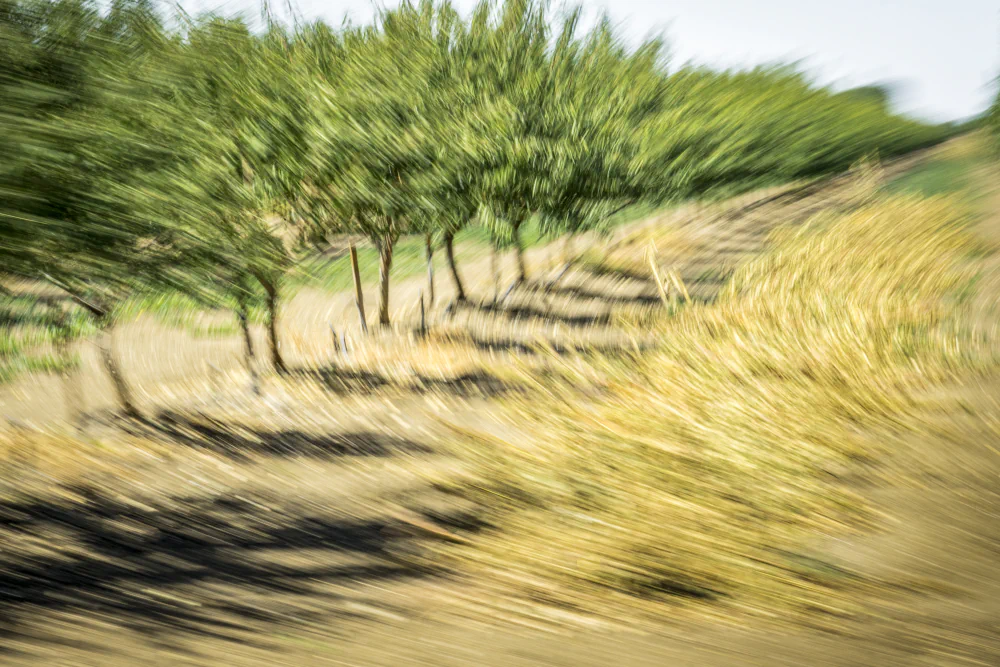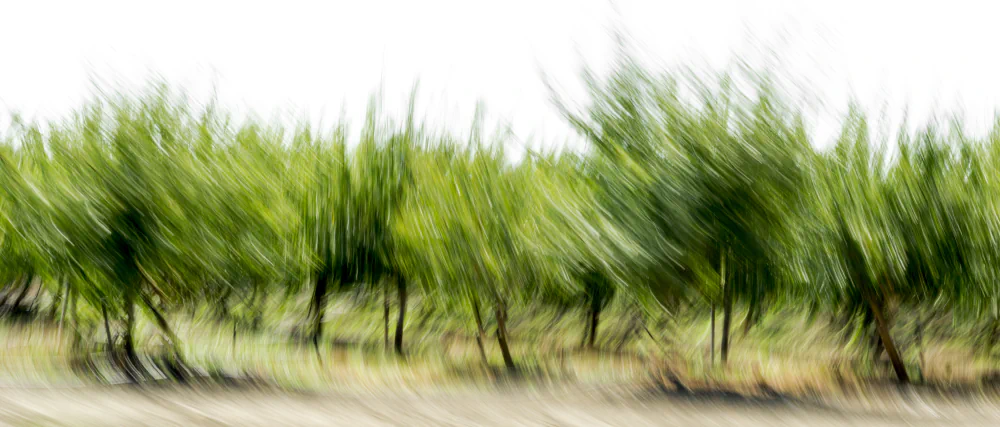

Using Intentional Camera Movement (ICM)—a photographic approach that combines a slow shutter speed with deliberate camera motion—65 MPH is a body of work created while traveling as a passenger through California’s San Joaquin Valley.
Made from within a moving vehicle, these images prioritize sensation over description, allowing light, color, and form to blur and reassemble.
Rather than documenting the landscape with precision, the photographs respond intuitively to speed, rhythm, and atmosphere, mirroring the way memory itself operates: fluid, partial, and emotionally charged.
The artist grew up in the San Joaquin Valley, and returning to these roads decades later reawakened memories that were both vivid and elusive. The valley is often defined by its flatness and utility, yet it has always felt expansive and deeply formative to her. Its long horizons, agricultural cycles, shifting light, and changing climate shaped her earliest understanding of place. Traveling through it again, mile after mile, she became less interested in what the land looks like now than in how it feels—and how it once felt to a child.
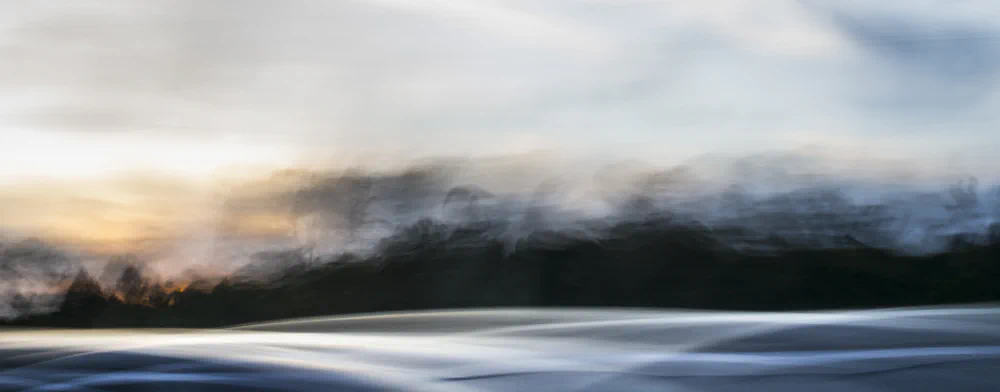
At eight years old, she spent countless hours riding in the back seat of her father’s 1950s station wagon. Barely tall enough to see clearly out the window, the world rushed past at a thrilling pace. Sixty-five miles per hour felt closer to one hundred. The landscape was not something to be analyzed; it was something to be absorbed. Fields, sky, orchards, and roadside structures merged into a magnificent, colorful blur. That early experience left a lasting imprint—less a series of images than a sensory memory of motion, anticipation, and wonder.
65 MPH is an attempt to return to that way of seeing. By relinquishing sharp focus and traditional compositional control, the artist allows the camera to perform an act of remembering rather than recording. ICM becomes a physical gesture that parallels the body’s experience of travel and the mind’s experience of recollection. The resulting images hover between representation and abstraction. Hints of horizon lines, farmland, and sky emerge, but never fully settle into place. This instability is intentional, reflecting the way memory resists clarity and permanence.
The decision to work as a passenger is central to the project. As a child, she had no control over direction or destination—only the act of looking. Revisiting that position now underscores a sense of surrender: to speed, to time, and to the passage of the landscape itself. The camera responds to the unpredictable elements of travel—the vibration of the road, shifting light, fleeting moments that cannot be repeated. In this way, the process mirrors childhood itself: always in motion, observant but unanchored.
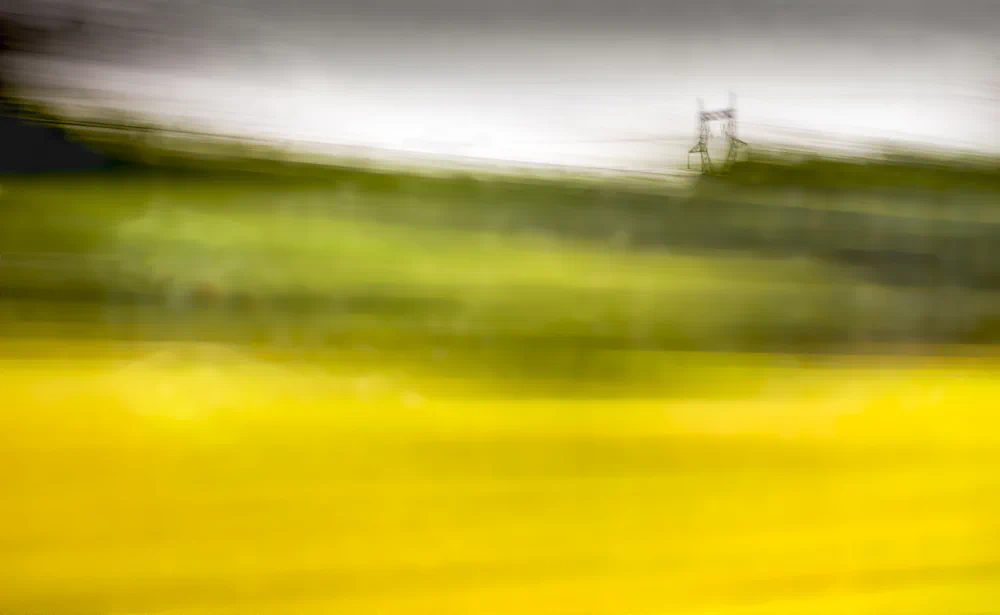
The San Joaquin Valley is a region shaped by labor, migration, and constant transformation. Climate change, drought, and development continue to alter its physical and cultural landscape. In 65 MPH, these changes are not documented literally but absorbed into the work’s atmospheric quality. The images acknowledge impermanence, suggesting that the valley of her childhood now exists largely as an internal landscape—filtered through time, distance, and memory.
While rooted in a specific geography, 65 MPH is not intended as a singular autobiographical narrative. The ambiguity created through motion and abstraction leaves space for viewers to bring their own experiences of travel, memory, and transition into the work. The photographs function as thresholds—neither fully descriptive nor entirely abstract—inviting personal associations with speed, place, and the quiet introspection that occurs while looking out a car window, moving through time as much as through landscape.
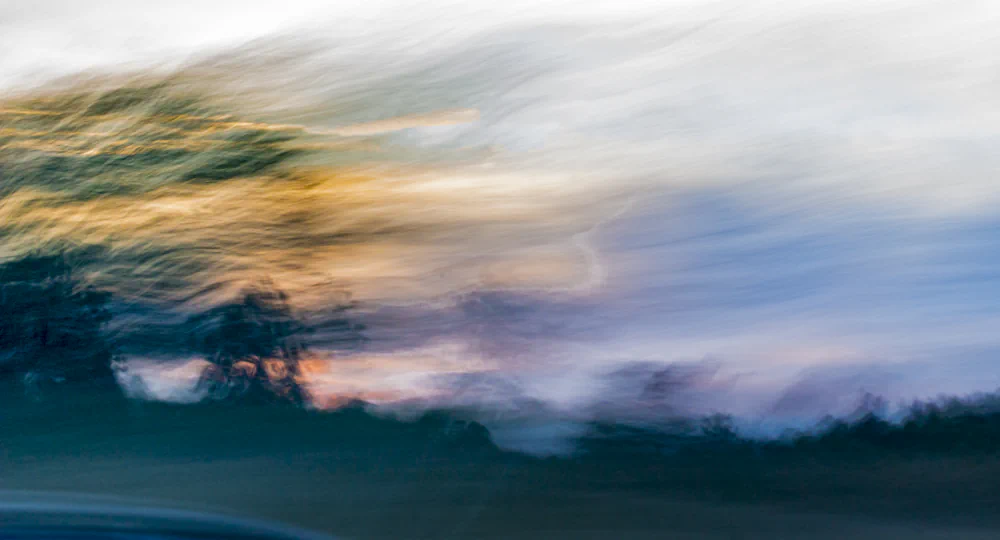
Ultimately, the series is about speed—not only physical velocity, but the way time accelerates, childhood recedes, and places evolve. By embracing blur, motion, and uncertainty, 65 MPH invites viewers to slow down and consider how landscapes live within us long after we have passed through them. What remains is not a map, but a sensation: light flickering through a window, the hum of the road, and a world rushing by.
About Marsha Guggenheim
MARSHA GUGGENHEIM is a San Francisco–based fine art photographer. Her work is driven by a passion for storytelling, exploring in-camera techniques to create images that reimagine the past and inspire the present.
She has been recognized for award-winning series including 65 MPH, Without a Map, Facing Forward, With This Ring, as well as a number of additional works that explore unexpected moments through street photography and portraiture.
Represented by Corden Potts Gallery, Guggenheim is a Critical Mass finalist and is included in numerous private collections both nationally and internationally. She has exhibited her work in over fifty exhibitions. Recent exhibitions include a solo show at the Griffin Museum of Photography (Massachusetts), an exhibition at the Harvey Milk Photography Center (San Francisco), a winning Storytelling Series at Photonostrum (Barcelona), and participation as an exhibitor in the de Young Museum’s Open 2023 (San Francisco).
Her work has been featured in numerous publications, including The Washington Post, Black & White Magazine, All About Photo Magazine, Fraction Magazine, F-Stop Photography Magazine, Art Doc Magazine, The San Francisco Chronicle, and Lenscratch. [Official Website]